
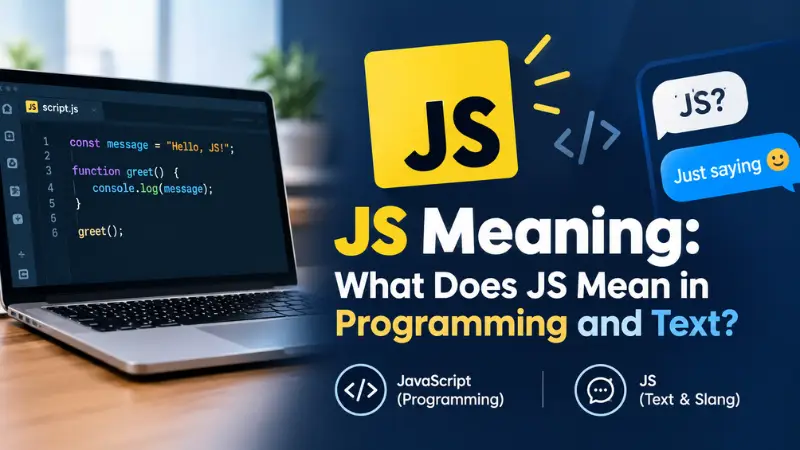
JS usually means “JavaScript,” a programming language used to make websites and web applications interactive. It works alongside HTML and CSS to create everything from buttons and menus to animations, online forms, games, and complex web applications.
For example, when you click a button on a website and something happens without the entire page reloading, JavaScript may be responsible for that behavior.
However, “JS” can have other meanings depending on the context. In texting, social media, business, or personal names, it may refer to something completely different.
What Does JS Mean?
The most common JS meaning in technology is JavaScript.
JavaScript is a high-level programming language that allows developers to add logic and interactive features to websites and applications.
| Term | Meaning |
|---|---|
| JS | JavaScript |
| HTML | HyperText Markup Language |
| CSS | Cascading Style Sheets |
| JavaScript | Programming language used to add behavior and interactivity |
A simple way to remember the three core web technologies is:
- HTML → Structures the webpage
- CSS → Controls appearance and layout
- JavaScript (JS) → Adds behavior and interactivity
What Is JavaScript?
JavaScript is a programming language commonly used to create interactive web experiences.
A webpage can use JavaScript to respond to actions such as:
- Clicking a button
- Submitting a form
- Typing into a search box
- Opening a menu
- Changing page content
- Displaying notifications
- Validating information
- Loading new content
- Creating browser-based games
JavaScript is also used beyond traditional webpages. Developers can use it to build server-side applications, mobile applications, desktop software, and other types of applications.
What Is JS Used For?
JavaScript has a wide range of uses in modern software development.
1. Interactive Websites
One of the most common uses of JS is adding interaction to websites.
For example, JavaScript can make a navigation menu open when a visitor clicks a menu icon.
2. Web Applications
JavaScript is widely used to create web applications such as dashboards, productivity tools, online stores, and social platforms.
Modern JavaScript frameworks and libraries can help developers build complex interfaces that update dynamically.
3. Form Validation
JS can check information entered into a form before it is submitted.
For example, it can detect whether an email field appears to contain a valid email address and display an appropriate message.
4. Animations and Dynamic Content
JavaScript can change elements on a webpage while the visitor is using it.
For example, a script could change text after a user clicks a button:
document.getElementById("message").textContent = "Hello!";5. Server-Side Development
JavaScript isn’t limited to browsers.
With environments such as Node.js, developers can use JavaScript to create server-side applications and APIs.
6. Mobile and Desktop Applications
JavaScript-based technologies can also be used to create applications for mobile devices and desktop computers.
A Simple JavaScript Example
Here’s a basic example of JavaScript:
let name = "Alex";
console.log("Hello, " + name);
This code stores the name Alex in a variable and then prints a greeting to the console.
Another simple example:
function greet() {
  alert("Hello!");
}
When the greet() function runs, the browser displays a message saying “Hello!”
These examples are small, but the same language can be used to create much more sophisticated applications.
How Does JavaScript Work?
When JavaScript is used in a webpage, a JavaScript engine interprets and executes the code.
Modern web browsers contain JavaScript engines that allow scripts to run directly in the browser.
The basic process looks like this:
User action → JavaScript runs → Page responds
For example:
Click button → JavaScript detects click → Text changes
This ability to respond to user actions is one reason JavaScript is so important to modern web development.
JavaScript vs. HTML vs. CSS
If you’re new to web development, it can be difficult to understand the difference between these technologies.
| Technology | Main purpose | Example |
|---|---|---|
| HTML | Structure | Headings, paragraphs, images |
| CSS | Presentation | Colors, spacing, fonts |
| JavaScript | Behavior | Clicks, calculations, dynamic updates |
Think of a webpage as a house:
- HTML is the structure.
- CSS is the design and decoration.
- JavaScript provides interactive behavior.
All three can work together to create a complete website.
Is JS the Same as Java?
No. JavaScript and Java are different programming languages.
Despite their similar names, they have different histories, designs, and typical uses.
JavaScript is heavily associated with web development and is commonly used in browsers and JavaScript runtimes.
Java is a separate programming language used for many types of software, including enterprise applications and Android development historically.
So:
JS = JavaScript, not Java.
What Does JS Mean in Texting?
Although JS most commonly means JavaScript in technology, its meaning can change in text messages and online conversations.
Depending on context, “JS” may be used as an abbreviation for different phrases. For example, some people use it as shorthand for “just saying.”
The intended meaning depends on the surrounding conversation.
For example:
“I’m not trying to be rude, JS.”
In this context, JS could mean “just saying.”
Therefore, if you see “JS” in a text message rather than a programming discussion, don’t automatically assume it means JavaScript.
Other Meanings of JS
“JS” is a short abbreviation, so it can represent different things in different contexts.
| Context | Possible JS meaning |
|---|---|
| Programming | JavaScript |
| Texting | Just saying |
| Names/initials | Initials such as J.S. |
| Organizations | An abbreviation or acronym |
| Business | Company, product, or internal abbreviation |
Context is essential when determining what JS means.
Why Is JavaScript So Popular?
JavaScript became an important part of web development because it enables websites to respond to users and update content dynamically.
Today, developers can use JavaScript across different parts of an application, including:
- Front-end development
- Back-end development
- APIs
- Web applications
- Mobile applications
- Desktop applications
- Browser extensions
- Interactive experiences
Its large ecosystem also includes numerous frameworks, libraries, tools, and developer resources.
Common JS Terms You May See
If you’re learning about JavaScript, you’ll probably encounter several related terms.
JavaScript Framework
A framework provides tools and structures that help developers build applications.
JavaScript Library
A library is reusable code that developers can incorporate into their projects to perform particular tasks.
Node.js
Node.js is a JavaScript runtime that allows JavaScript code to run outside a traditional web browser.
JavaScript Function
A function is a reusable block of code designed to perform a particular task.
JavaScript Variable
A variable stores a value that a program can use and, depending on how it is declared, potentially change.
FAQs
JS usually stands for JavaScript, a programming language commonly used for websites and applications.
In programming, JS means JavaScript. It is commonly used to add functionality and interactivity to websites and applications.
In texting, JS can have different meanings depending on context. One possible meaning is “just saying.”
Yes. JS is a widely used abbreviation for JavaScript.
No. JavaScript and Java are separate programming languages with different designs and common uses.
JavaScript is used for interactive websites, web applications, server-side development, APIs, and other software applications.
The difficulty depends on your programming experience and what you want to build. Beginners can start with basic concepts such as variables, functions, conditions, and events before moving to more advanced topics.
Websites use JavaScript to add interactive and dynamic behavior, such as responding to clicks, processing input, updating content, and communicating with servers.
Final Thoughts on JS Meaning
The most common JS meaning is JavaScript, especially when you’re reading about websites, coding, software, or web development. JavaScript allows developers to create interactive experiences and is used across many areas of modern software development.
If you encounter “JS” outside a programming context, check the surrounding conversation because it can have other meanings, including abbreviations used in texting.
Want to learn more about JavaScript? Start with the basics—variables, functions, conditions, arrays, and events—then practice by building small interactive webpages.
SEO Metadata
Meta title:
JS Meaning: What Does JS Mean in Programming?
Meta description:
JS usually means JavaScript, a programming language used for interactive websites and apps. Learn JS meaning, uses, examples, and more.
URL slug:/js-meaning/


