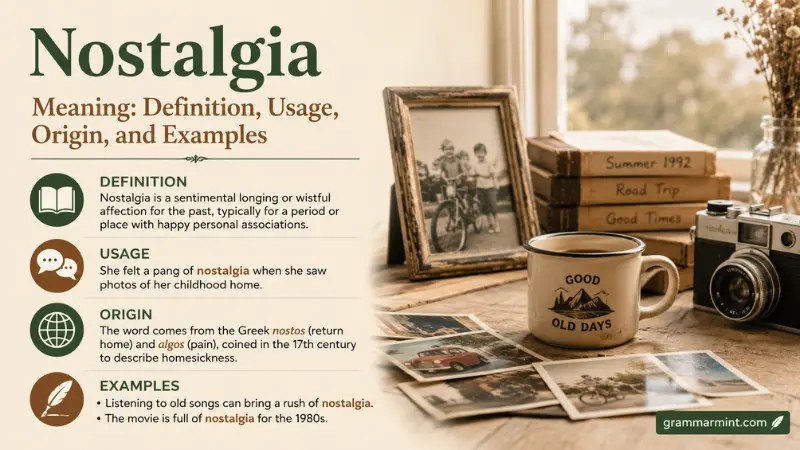
An old song can suddenly remind you of school, friends, or a family vacation. A photograph may bring back feelings you thought were gone.
That emotional connection to the past is often called nostalgia. It usually combines happy memories with a sense of longing.
You may see the word in conversations, books, movies, reviews, and social media posts. People also use it when discussing music, fashion, and childhood memories.
Understanding the word helps you describe a very specific emotional experience. It is stronger than simply remembering something from your past.
This guide explains the meaning, pronunciation, grammar, origin, and everyday use of nostalgia. You will also see clear examples and related words.
Quick Answer
Nostalgia meaning: a warm but slightly sad longing for a valued part of the past. It often involves people, places, experiences, or periods you miss.
TL;DR
• Nostalgia is a feeling connected with the past.
• It often feels both pleasant and slightly sad.
• Nostalgia is normally used as a noun.
• Music, smells, photos, and places can trigger it.
• Nostalgic is the related adjective.
What Does Nostalgia Mean in Plain English?
Nostalgia means missing or warmly remembering something from the past. That memory usually has strong personal or emotional value.
For example, you might remember summers at your grandparents’ house. You feel happy about the memory but sad it has passed.
That mixed feeling is nostalgia. It is often described as bittersweet because positive and negative feelings can appear together.
Nostalgia is not simply remembering an event. The word normally suggests affection, longing, or emotional attachment to that memory.
You can feel nostalgia for:
• childhood
• school or college days
• old friendships
• a former home
• family traditions
• older music or movies
• past vacations
• earlier stages of life
Pronunciation and Part of Speech
Nostalgia is a noun. Dictionaries generally treat its emotional sense as an uncountable noun.
A simple American pronunciation is:
nah-STAL-juh
The main stress falls on STAL. Cambridge gives the U.S. pronunciation as /nɑːˈstæl.dʒə/.
You normally say:
• I felt nostalgia.
• She felt nostalgia for her childhood.
• The song filled me with nostalgia.
You usually do not say “I am nostalgia.” Use nostalgic when describing a person’s feeling.
How Nostalgia Is Used in Everyday English
Nostalgia often appears after verbs such as feel, evoke, bring, or trigger. It also commonly appears with the preposition for.
For example:
• I feel nostalgia for my college years.
• That commercial evokes nostalgia for the 1990s.
• The old photographs brought a wave of nostalgia.
• Her childhood home filled her with nostalgia.
The phrase nostalgia for tells readers what someone misses. It is one of the clearest everyday patterns.
You may also hear phrases like a sense of nostalgia or a wave of nostalgia. These describe the strength or arrival of the feeling.
Is Nostalgia Happy or Sad?
Nostalgia can contain both happiness and sadness. That emotional mixture is one of the word’s main features.
The happy part comes from remembering something meaningful. The sad part comes from knowing that time has passed.
Researchers often describe nostalgia as a mixed or bittersweet emotion. Positive feelings are common, but longing and loss can also appear.
For example, hearing your graduation song may make you smile. It may also make you miss your old friends.
So, nostalgia does not mean pure sadness. It also does not mean simple happiness.
What Can Trigger Nostalgia?
Many ordinary experiences can bring old memories back. A trigger often has a personal connection with an earlier period.
Common triggers include:
• old songs
• family photographs
• familiar smells
• childhood foods
• former neighborhoods
• television shows
• old games
• school reunions
• family traditions
Music is especially associated with nostalgic memories. Research has examined how familiar music can evoke autobiographical memories and mixed emotions.
A smell can also bring back a specific place or moment. However, the same smell may mean nothing to another person.
That is because nostalgia is often personal. Your experiences shape what feels nostalgic to you.
Examples of Nostalgia in Sentences
These examples show how the word works in natural English.
• The old family videos filled Mia with nostalgia.
• I feel nostalgia whenever I visit my hometown.
• That song brings back strong feelings of nostalgia.
• He spoke with nostalgia about his college days.
• The diner creates nostalgia for classic American road trips.
• Looking through the yearbook gave us a wave of nostalgia.
• Her grandmother’s recipe always triggers childhood nostalgia.
• The movie appeals to viewers through nostalgia for the 1980s.
Modern examples commonly use nostalgia for, filled with nostalgia, and a wave of nostalgia.
A common mistake is using nostalgia when an adjective is needed.
Incorrect: I feel very nostalgia today.
Correct: I feel very nostalgic today.
Correct: I feel a lot of nostalgia today.
Origin and History of Nostalgia
The word has a much more medical history than its modern meaning suggests. Johannes Hofer coined the term in 1688.
He used it for severe homesickness. The condition was associated with people separated from their homes and familiar surroundings.
The term was formed from Greek elements connected with returning home and pain. Its earliest meaning was therefore much narrower.
Over time, the meaning changed. Nostalgia came to describe emotional longing for earlier times more generally.
Today, you do not need to miss your physical home. You can feel nostalgia for childhood, music, relationships, or another life period.
Nostalgia, Nostalgic, and Related Words
Nostalgia and nostalgic belong to the same word family. However, they have different grammatical jobs.
| Context | Best Choice | Why |
|---|---|---|
| Name the feeling | nostalgia | It is a noun |
| Describe a person | nostalgic | It is an adjective |
| Describe an action | nostalgically | It is an adverb |
| Talk about remembering | reminiscence | Focuses more on remembering |
Examples make the difference clearer.
• Nostalgia: The photograph gave me nostalgia for childhood.
• Nostalgic: The photograph made me nostalgic.
• Nostalgically: She spoke nostalgically about summer vacations.
Dictionary entries identify nostalgic as an adjective describing someone experiencing or showing nostalgia.
Reminiscence is related but not identical. You can remember the past without strongly wishing for it again.
Synonyms, Antonyms, and Common Mistakes
Several words overlap with nostalgia, but few match it perfectly. The best choice depends on the exact context.
Close alternatives include:
• longing — a strong desire for something absent
• yearning — a deep emotional desire
• reminiscence — remembering or discussing the past
• homesickness — longing specifically for home
• wistfulness — gentle sadness mixed with longing
• sentimentality — strong tender or emotional feeling
Thesaurus sources connect nostalgia with ideas such as longing, remembrance, and homesickness. These words are not interchangeable in every sentence.
There is no perfect single-word antonym for nostalgia in every context. Contentment with the present can express the opposite idea.
Common Mistake: Nostalgia vs. Nostalgic
Use nostalgia when naming the emotion.
Correct: That song gives me nostalgia.
Use nostalgic when describing someone or something.
Correct: That song makes me nostalgic.
Common Mistake: Nostalgia Does Not Mean Any Memory
A normal memory does not automatically involve nostalgia. Nostalgia usually adds longing, affection, or emotional attachment.
Correct: I remember my first apartment.
More specific: I feel nostalgic when I remember my first apartment.
Mini Quiz
Choose the best answer.
1. Which sentence uses nostalgia correctly?
A. I am very nostalgia today.
B. I feel nostalgia for my school days.
C. She nostalgia about childhood.
2. What part of speech is nostalgia?
A. Noun
B. Verb
C. Adjective
3. Which word describes a person feeling nostalgia?
A. Nostalgically
B. Nostalgic
C. Nostalgia
4. Which situation best shows nostalgia?
A. Forgetting where you placed your keys
B. Missing childhood summers after seeing an old photograph
C. Planning tomorrow’s grocery shopping
Answer Key
- B
- A
- B
- B
FAQs
What is nostalgia in simple words?
Nostalgia is a warm longing for something from your past. It often combines happy memories with a little sadness.
Is nostalgia happy or sad?
It can be both. Nostalgia often feels pleasant because the memory matters, but loss can add sadness.
What is an example of nostalgia?
Imagine hearing a song you loved during high school. You smile, remember your friends, and wish you could revisit that period.
That feeling is nostalgia. Old homes, photographs, foods, and movies can create similar reactions.
Is nostalgia positive or negative?
Nostalgia is usually described as a mixed emotional experience. It can bring warmth and connection while also creating longing.
Its effect depends on the person and situation. Constantly idealizing the past can feel different from enjoying an occasional memory.
What causes nostalgia?
Nostalgia often begins when something connects you with a meaningful past experience. Music, conversations, smells, photographs, and familiar places are common triggers.
Can nostalgia be bad?
Nostalgia itself is not automatically harmful. However, dwelling heavily on an idealized past can sometimes make the present feel worse.
Balanced reflection is different from constantly wishing current life could disappear.
What does nostalgia mean in psychology?
Psychology generally treats nostalgia as an emotional experience involving longing and memories of the past. It often includes personally meaningful people, events, and relationships.
Conclusion
The nostalgia meaning centers on emotional longing for a meaningful part of the past. It often combines warmth, happiness, loss, and affection.
Use nostalgia for the feeling and nostalgic for someone experiencing it. Notice how each word works when describing your own memories.