
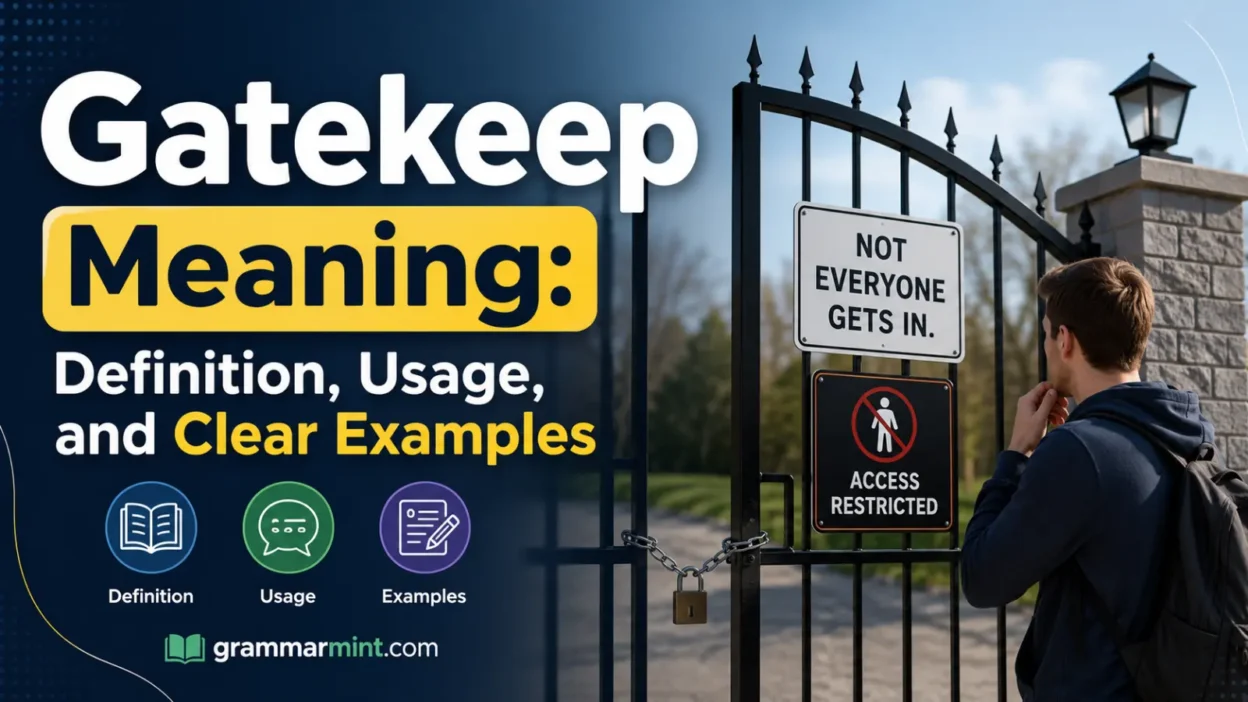
You may see gatekeep in TikTok comments, fandom debates, workplace discussions, or news articles. The word describes controlling who can access information, opportunities, resources, or a group. Online, it often means hiding a useful source or deciding who counts as a “real” fan.
Understanding the term matters because its tone changes with context. A friend may use it jokingly about a restaurant. A worker may use it seriously about unfair access to a job. In media studies, gatekeeping can simply describe how information gets selected.
This guide explains the gatekeep meaning in plain English. It covers pronunciation, grammar, slang use, and common examples. You will also learn when the word sounds fair, critical, or exaggerated. By the end, you can recognize gatekeeping and use the term naturally.
Quick Answer
Gatekeep meaning: To gatekeep means to control or restrict access to something valuable. That “something” may be information, power, opportunities, resources, or membership in a group.
TL;DR
• Gatekeep is mainly a verb.
• It means controlling access or inclusion.
• Online, it often means withholding useful details.
• The tone is usually critical.
• Some gatekeeping can protect safety or privacy.
• The past tense is gatekept.
What Does Gatekeep Mean?
To gatekeep means to decide who gets access and who does not. The access may involve information, opportunities, communities, or valuable resources.
The word uses the image of guarding a gate. A gatekeeper lets certain people pass while stopping others. Modern use applies that idea to social and professional situations.
For example, a manager may control access to an important meeting. A fan may decide that newer listeners are not “real” fans. Both actions can be called gatekeeping.
Simple definition: Gatekeep means to control, limit, or block access.
Gatekeep Meaning in Slang and Social Media
In online slang, gatekeep often means refusing to share useful information. It can also mean excluding people from a hobby, fandom, identity, or trend.
Someone may comment, “Don’t gatekeep,” after seeing a great outfit. The person wants the brand name or shopping link. The phrase means, “Please share the information.”
Gatekeeping also appears in fandom debates. A person may claim that only longtime followers count as true fans. That person is setting an unfair entry rule.
Common online examples include:
• Hiding the name of a restaurant
• Refusing to name a beauty product
• Keeping a helpful website secret
• Calling casual fans “fake” fans
• Excluding beginners from a hobby
Online use is usually informal. It often carries a negative or teasing tone.
Pronunciation and Part of Speech
Gatekeep is pronounced GAYT-keep. The stress falls on the first part.
The word is mainly a verb. Dictionaries record both transitive and intransitive uses.
Verb forms:
• Base form: gatekeep
• Third-person form: gatekeeps
• Past tense: gatekept
• Past participle: gatekept
• Present participle: gatekeeping
Transitive use takes an object:
• The group gatekeeps useful information.
Intransitive use does not require a direct object:
• Some longtime fans gatekeep.
Gatekeeping is also used as a noun. It names the act or process of controlling access.
• Gatekeeping can make beginners feel unwelcome.
Gatekeeper is a noun for the person or system controlling access.
• The editor acts as a gatekeeper.
How Gatekeep Works Across Different Contexts
The basic meaning stays similar across settings. However, the purpose and tone can change.
| Context | Best Interpretation | Why |
|---|---|---|
| Social media | Withholding a source or detail | Someone refuses to share useful information |
| Fandoms | Policing who counts as a true fan | Membership depends on unfair personal rules |
| Workplaces | Controlling access to opportunities | A person limits contacts, meetings, or knowledge |
| Media | Selecting information for an audience | Editors decide what reaches the public |
| Safety | Restricting access for protection | Rules may prevent harm or misuse |
In social media, the word often describes personal behavior. In media or healthcare, it may describe an established process.
The word does not always prove that an action is unfair. Context shows whether the restriction is necessary or excessive.
How to Use Gatekeep Correctly
Use gatekeep when someone controls access, information, or group membership. The verb often takes a direct object.
Everyday examples:
• “Why are you gatekeeping that coffee shop?”
• “She gatekept the name of her hairstylist.”
• “They gatekeep important training opportunities.”
• “Older members should not gatekeep the hobby.”
• “The assistant gatekeeps access to the executive.”
You can also use gatekeeping as a noun:
• “That rule feels like unnecessary gatekeeping.”
• “Gatekeeping keeps new players out of the community.”
“Don’t gatekeep” is common online. It asks someone to share a source, product, place, or method.
• “That jacket looks great. Don’t gatekeep the brand.”
Use the term carefully in formal writing. Explain what access is being controlled and by whom.
When Gatekeeping Is Harmful or Reasonable
Gatekeeping is harmful when it protects status through unfair exclusion. It may block beginners, hide opportunities, or maintain unequal power.
Examples of harmful gatekeeping include:
• Rejecting new fans without a fair reason
• Hiding job information from selected coworkers
• Creating changing rules for group membership
• Blocking qualified people from useful contacts
• Treating personal taste as an official standard
However, not every access limit is harmful. Some restrictions protect privacy, safety, quality, or confidential information.
A moderator may remove dangerous posts. A company may protect customer records. A private person may keep personal details confidential.
These actions involve access control. Yet speakers may avoid gatekeeping because the word often suggests unfairness.
Related Forms and Common Confusions
Gatekeep, gatekeeping, and gatekeeper share one central idea. Each word has a different grammatical role.
• Gatekeep: the action
• Gatekeeping: the action or process
• Gatekeeper: the person or system controlling access
Gatekeeping is not the same as privacy. Privacy means protecting personal information or personal space. Gatekeeping often involves controlling other people’s access.
It is also different from censorship. Censorship suppresses content or expression. Gatekeeping selects who or what may pass through a controlled point.
Gatekeeping is not gaslighting. Gaslighting involves manipulating someone’s trust in their memory or judgment. Gatekeeping involves access, inclusion, or information.
Synonyms and Antonyms
No single synonym fits every use of gatekeep. The best choice depends on the context.
Close synonyms include:
• Restrict: limit access or use
• Control: decide how something is accessed
• Block: prevent entry or progress
• Exclude: keep someone out
• Withhold: refuse to provide information
• Filter: select what passes through
• Regulate: control through rules
Possible opposites also depend on context:
• Share
• Include
• Welcome
• Open
• Allow access
• Make available
“Share” works for hidden information. “Include” works for groups. “Open access” fits resources or opportunities.
Common Mistakes With Gatekeep
A frequent mistake is using gatekeep for any disagreement. Disagreeing with someone does not automatically control their access.
Too broad: “He disliked my favorite movie, so he gatekept me.”
Better: “He said only expert viewers could discuss the movie.”
Another mistake is confusing privacy with gatekeeping.
Privacy: “She kept her home address private.”
Gatekeeping: “She refused to share a public application link with certain coworkers.”
Writers may also use the wrong past tense.
Wrong: gatekeeped
Correct: gatekept
Avoid vague statements in formal writing.
Vague: “The company gatekeeps.”
Clear: “The company gatekeeps access to leadership meetings.”
Mini Quiz
1. What does gatekeep usually mean?
A. To open every resource
B. To control or restrict access
C. To forget information
2. Which sentence uses gatekeep correctly?
A. “She gatekept the event details from new members.”
B. “She gatekeeped very quickly.”
C. “She gatekeep happy.”
3. What is the past tense of gatekeep?
A. Gatekeeped
B. Gatekept
C. Gatekeeping
4. What does “don’t gatekeep” usually request online?
A. Share the source or detail
B. Delete the post
C. Change the topic
Answer key: 1-B, 2-A, 3-B, 4-A.
FAQs
What does gatekeep mean in simple words?
Gatekeep means to control who can access something. It may involve information, resources, opportunities, or membership in a group.
What does gatekeeping mean in slang?
In slang, gatekeeping often means hiding useful information or excluding others. People commonly use it for products, places, fandoms, and online communities.
What does “don’t gatekeep” mean?
“Don’t gatekeep” means “please share the information.” The speaker may want a product name, location, link, source, or method.
Is gatekeep a real word?
Yes. Major dictionaries list gatekeep as a verb. Its common forms include gatekeeps, gatekept, and gatekeeping.
What is an example of gatekeeping?
A fan says only people who know every album are true supporters. That person is creating a personal rule to exclude newer fans.
Is gatekeeping always bad?
No. Access limits may protect safety, privacy, or confidential records. However, gatekeeping often has a negative tone in everyday conversation.
Why do people gatekeep?
People may want status, control, privacy, or exclusivity. Others may believe they are protecting quality, safety, or a valued community.
Conclusion
The gatekeep meaning centers on controlling access, information, or inclusion. Context shows whether that control is harmful, reasonable, or playful.
Look for what is being restricted and who makes the rule. That approach will help you use gatekeep accurately.