Few English grammar topics cause more confusion than lay and lie. The two verbs look simple, but their forms can be surprisingly difficult to remember. The biggest problem is that the past tense of lie is lay, which is also the present tense of lay.
This confusion often appears in phrases such as “lie down” and “lay down.” You may hear both expressions in everyday conversation, but they do not mean exactly the same thing.
The good news is that the basic rule is simple: lay takes an object, while lie does not.
In this guide, you’ll learn the difference between lay and lie, their correct tense forms, common mistakes, and easy ways to remember which verb to use.
Quick Answer
Use lay when you mean to put or place something somewhere. It requires a direct object.
Use lie when you mean to recline, rest, or be in a horizontal position. It does not take a direct object.
For example:
- Please lay the book on the desk.
- I need to lie down for a while.
The easiest question to ask is:
Are you placing something somewhere?
If yes, use lay.
Are you or something else resting or reclining?
If yes, use lie.
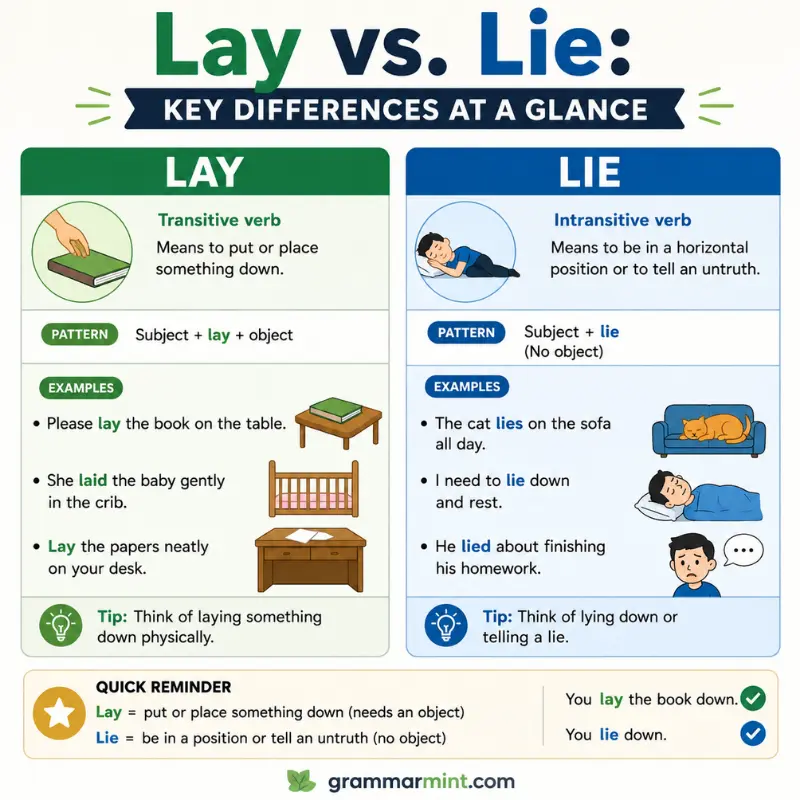
Lay vs. Lie: Key Differences at a Glance
| Verb | Meaning | Needs an Object? | Present | Past | Past Participle |
|---|---|---|---|---|---|
| Lay | Put or place something | Yes | lay | laid | laid |
| Lie | Recline or rest | No | lie | lay | lain |
A quick memory trick is:
Lay = place something.
Lie = rest yourself.
For example:
- I lay the phone on the table.
- I lie on the couch.
What Does “Lay” Mean?
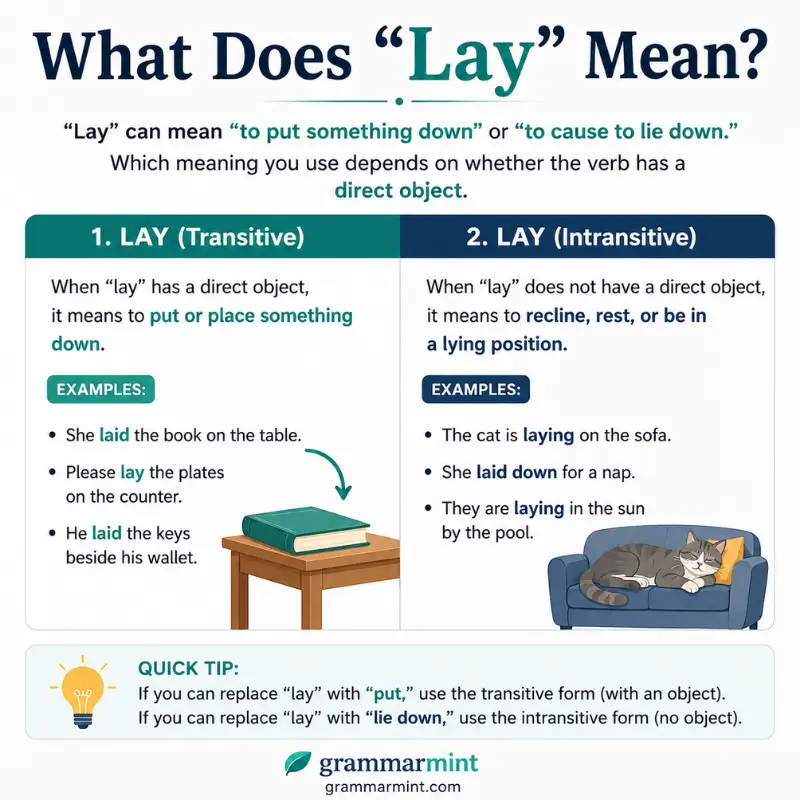
Lay means to put, place, or set something somewhere. Because something is being placed, lay requires a direct object.
Examples:
- Please lay the book on the table.
- She laid her phone beside the laptop.
- He lays the keys on the counter every morning.
- We laid the documents on the desk.
- The teacher asked me to lay the papers in a neat pile.
Notice that each sentence answers the question “Lay what?”
- Lay the book.
- Laid her phone.
- Lay the papers.
That is a useful test for identifying lay.
What Does “Lie” Mean?
Lie means to recline, rest, or remain in a horizontal position. It does not require a direct object.
Examples:
- I need to lie down.
- She likes to lie on the sofa.
- The dog is lying under the table.
- He lay on the beach all afternoon.
- The baby has lain in the crib for hours.
Here, no object is being placed anywhere. The subject is simply resting or remaining in a position.
Lay and Lie Tense Forms
This is where the confusion becomes much easier to understand.
Lay
The verb lay has these forms:
- Present: lay
- Past: laid
- Past participle: laid
- -ing form: laying
Examples:
- I lay the book on the table every morning.
- Yesterday, I laid the book on the table.
- I have laid the book on the table.
- I am laying the book on the table now.
Lie
The verb lie has these forms:
- Present: lie
- Past: lay
- Past participle: lain
- -ing form: lying
Examples:
- I lie on the couch after work.
- Yesterday, I lay on the couch.
- I have lain on the couch for an hour.
- I am lying on the couch now.
The important point is that lay is the past tense of lie.
That is why these sentences can look confusing:
- Present: I lie down.
- Past: I lay down.
Both are correct, but they refer to different times.
Why Is “Lay” the Past Tense of “Lie”?
The confusion exists because these two verbs developed from different Old English roots, but their forms eventually became similar.
The biggest source of trouble is the past tense:
lie → lay → lain
Meanwhile:
lay → laid → laid
So lay has two grammatical roles:
- It is the present-tense verb meaning “to put or place.”
- It is the past tense of lie, meaning “to recline or rest.”
This overlap is why even experienced writers sometimes pause before choosing the correct form.
Lie Down or Lay Down?
The phrase “lie down” is correct when you mean to recline or rest.
For example:
- I’m tired, so I’m going to lie down.
- Please lie down and get some rest.
- The dog likes to lie down in the shade.
However, “lay down” is correct when you are placing something somewhere.
For example:
- Please lay down the book.
- She laid down her phone.
- He laid the baby down carefully.
There is an important distinction here:
- I need to lie down. → I am going to rest.
- I need to lay the baby down. → I am placing the baby in a position.
Is “I Lay Down” Correct?
Yes, “I lay down” is correct when you are talking about the past.
For example:
Yesterday, I lay down for an hour.
Here, lay is the past tense of lie.
But if you are talking about the present or future, use lie:
- I lie down after lunch.
- I’m going to lie down for a few minutes.
- Please let me lie down.
So remember:
Present: I lie down.
Past: I lay down.
Perfect: I have lain down.
Laying vs. Lying: What’s the Difference?
The -ing forms create another common spelling problem.
Use laying when something is being placed somewhere.
- She is laying the clothes on the bed.
- I am laying the papers on the desk.
- He was laying the baby in the crib.
Use lying when someone or something is resting or reclining.
- She is lying on the bed.
- I am lying on the couch.
- The dog was lying in the sun.
A simple rule is:
Laying = placing something.
Lying = resting or reclining.
Common Mistakes With Lay and Lie
Here are some mistakes you may see in everyday writing.
Mistake: I’m laying on the couch.
Correct: I’m lying on the couch.
You are resting, not placing something.
Mistake: He laid on the sofa yesterday.
Correct: He lay on the sofa yesterday.
Because lay is the past tense of lie, the correct sentence is “He lay on the sofa.”
Mistake: I’m going to lay down for a nap.
Correct: I’m going to lie down for a nap.
You are resting, so use lie.
Mistake: The cat has laid there all day.
Correct: The cat has lain there all day.
The past participle of lie is lain.
Mistake: Please lie the book on the table.
Correct: Please lay the book on the table.
The book is being placed somewhere, so lay is required.
Mistake: She is laying on the beach.
Correct: She is lying on the beach.
She is resting rather than placing something.
Lay or Lie in Everyday Sentences
The best way to understand these verbs is to see them in context.
At home:
- I’m going to lie down for a few minutes.
- Please lay the blanket on the bed.
At work:
- Please lay the documents on my desk.
- The files were lying on the table.
With children:
- Please lay the baby in the crib.
- The child is lying on the floor.
With pets:
- The dog is lying in the sun.
- She laid the dog’s blanket near the door.
Lay vs. Lie in Formal and Casual English
The traditional distinction between lay and lie remains important in formal writing.
In casual conversation, however, you may hear people use lay where standard grammar calls for lie, especially in expressions such as “I’m going to lay down.”
This usage is common enough that it rarely causes confusion in casual speech. However, if you are writing a school assignment, professional email, article, report, or other formal text, it is better to follow the standard distinction.
When in doubt, you can also choose a simpler alternative:
- I’m going to lie down.
- I’m going to rest.
Both communicate the same basic idea.
An Easy Trick to Remember Lay vs. Lie
Try this simple test:
If you can ask “Lay what?” → use lay
- Lay the book.
- Lay the keys.
- Lay the papers.
There is an object receiving the action.
If there is no object → use lie
- Lie down.
- Lie on the couch.
- Lie in bed.
- Lie on the beach.
A second memory trick can make it even easier:
Lay = place.
Lie = rest.
A Simple Tense Chart
Keep this chart handy when you are unsure:
| Meaning | Present | Past | Past Participle | -ing Form |
| Put or place | lay | laid | laid | laying |
| Recline or rest | lie | lay | lain | lying |
The most confusing line is the second one:
lie → lay → lain → lying
The most important thing to remember is that “lay” can be both a present-tense verb and the past tense of “lie.”
British vs. American English
The basic distinction between lay and lie is the same in both British and American English.
Both varieties generally follow these standard forms:
- lay → laid → laid
- lie → lay → lain
The main difference you may notice is in everyday speech. Some speakers, particularly in casual American English, use lay more broadly in phrases such as “I’m going to lay down.”
Even so, the traditional grammatical distinction remains useful and is expected in careful formal writing.
Lay vs. Lie Comparison Table
| Context | Correct Choice | Example |
| Putting a book on a table | Lay | Lay the book on the table. |
| Resting on a couch | Lie | I want to lie on the couch. |
| Past tense of resting | Lay | Yesterday, I lay on the couch. |
| Putting something somewhere in the past | Laid | I laid the book on the table. |
| Past participle of lie | Lain | She has lain there for an hour. |
| Placing something now | Laying | He is laying the papers down. |
| Resting now | Lying | He is lying on the bed. |
When Should You Use “Laid”?
Use laid as the past tense or past participle of lay when something is being placed.
Examples:
- I laid the keys on the counter.
- She laid the baby in the crib.
- We have laid the documents on the desk.
- He laid the blanket on the floor.
Remember:
Lay → laid → laid
Never use “layed” as the standard past form of lay.
When Should You Use “Lain”?
Use lain as the past participle of lie.
It normally appears with helping verbs such as has, have, or had.
Examples:
- She has lain in bed all morning.
- The dog has lain under the table.
- He had lain on the beach for hours.
- The book had lain untouched for years.
Remember:
Lie → lay → lain
Although lain may sound formal or old-fashioned in everyday conversation, it is the standard past participle.
FAQs
What is the difference between lay and lie?
Lay means to put or place something somewhere and requires an object. Lie means to recline or rest and does not take a direct object.
Should I say “lie down” or “lay down”?
Use “lie down” when you mean to recline or rest.
For example:
I’m tired, so I’m going to lie down.
Use lay when you are placing something:
Please lay the book down.
Is the past tense of “lie” “lay”?
Yes. The past tense of lie is lay.
- Present: lie
- Past: lay
- Past participle: lain
Is “I lay down” grammatically correct?
Yes, when you are talking about the past.
Yesterday, I lay down for a nap.
For the present, use:
I lie down for a nap.
Does “lay” always need an object?
In its standard use meaning “to put or place,” yes. The object is the thing being placed.
For example:
Lay the phone on the table.
What is the difference between laying and lying?
Laying is the -ing form of lay and means placing something.
Lying is the -ing form of lie and means resting or reclining.
- She is laying the clothes on the bed.
- She is lying on the bed.
Is “layed” a word?
Layed is not the standard past tense of lay. The correct form is laid.
Lay → laid → laid
Mini Quiz: Lay or Lie?
Choose the correct form in each sentence.
- I need to ___ down for a few minutes.
- She ___ the keys on the counter.
- Yesterday, I ___ on the beach all afternoon.
- The baby has ___ there for hours.
- Please ___ the book on the table.
- The dog is ___ in the sunlight.
- He ___ the papers on my desk yesterday.
- I am ___ on the sofa right now.
Answer Key
- lie
- laid
- lay
- lain
- lay
- lying
- laid
- lying
FAQs
The confusion between lay and lie mainly comes from their overlapping forms.
The easiest rule is:
Lay = put or place something.
Lie = rest or recline.
Remember their forms:
Lay → laid → laid → laying
Lie → lay → lain → lying
When you are unsure, ask yourself whether an object is being placed.
If you can answer “lay what?”, use lay.
If nothing is being placed and someone or something is simply resting, use lie.
Once you remember this basic difference, phrases such as “lie down,” “lay the book down,” “laid the keys,” and “lying on the couch” become much easier to use correctly.