
If you’ve ever read a lease agreement, you’ve probably seen the words lessor and lessee. At first glance, they look almost identical, which is exactly why so many people confuse them.
These terms appear in apartment leases, car leases, office rentals, equipment leases, and business contracts. You may also see them in accounting documents, financial reports, and legal paperwork.
Mixing them up can create serious misunderstandings. In a contract, switching one word can change who grants the right to use the property and who receives that right. It can also affect who pays rent, who receives payment, and what responsibilities each party has.
The good news is that the difference is simple once you understand the relationship between the two words.
This guide explains lessor vs. lessee in plain American English. You’ll learn what each word means, where the terms come from, when to use them, common mistakes to avoid, and easy ways to remember the difference.
Quick Answer
The lessor is the person, business, or organization that grants the lease. The lessee is the person, business, or organization that receives the right to use the property under the lease.
In a typical rental situation:
- The lessor provides or grants the lease.
- The lessee receives the lease.
- The lessee usually pays rent or lease payments to the lessor.
In everyday language, the lessor is often called the landlord, while the lessee is often called the tenant.
Easy Memory Trick
Think about the endings:
- LessOR = the party that gives or grants the lease.
- LessEE = the party that receives the lease.
A useful pattern in English is that -or often identifies the person performing an action, while -ee often identifies the person receiving the action.
For example:
- employer → gives employment
- employee → receives employment
- grantor → gives a grant
- grantee → receives a grant
The same basic relationship applies to lessor and lessee.
Key Differences at a Glance
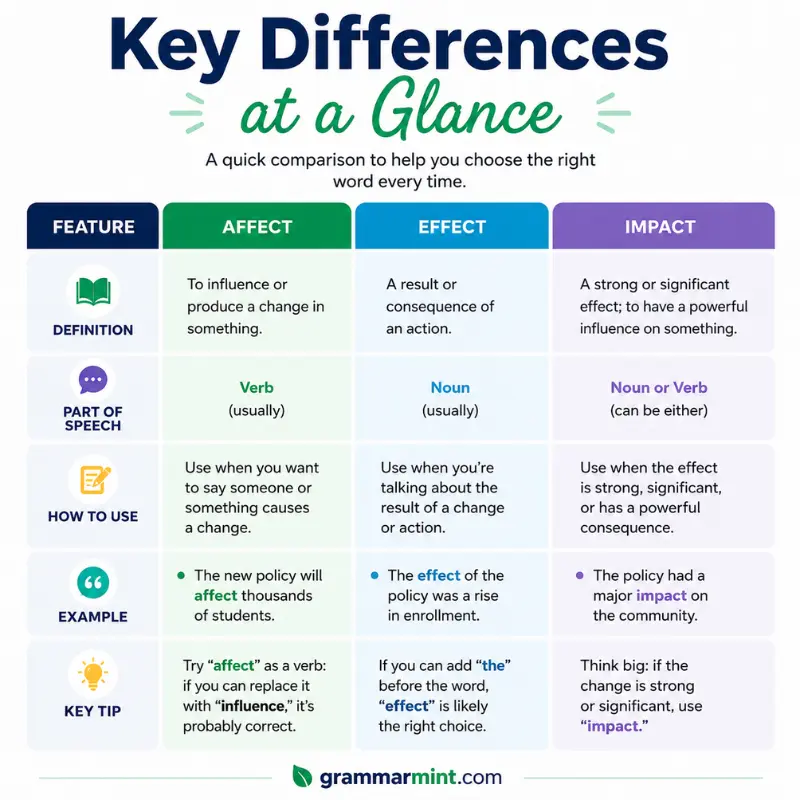
| Feature | Lessor | Lessee |
|---|---|---|
| Main role | Grants the lease | Receives the lease |
| Typical position | Owner or authorized leasing party | Renter or user |
| Payment direction | Usually receives rent | Usually pays rent |
| Everyday term | Landlord | Tenant |
| Role in contract | Gives the right to use property | Gets the right to use property |
| Example | Apartment owner | Apartment renter |
The most important thing to remember is this: the terms describe opposite sides of the same lease agreement.
You generally cannot understand one role without the other. A lease has a party granting rights and a party receiving those rights.
What Is a Lessor?
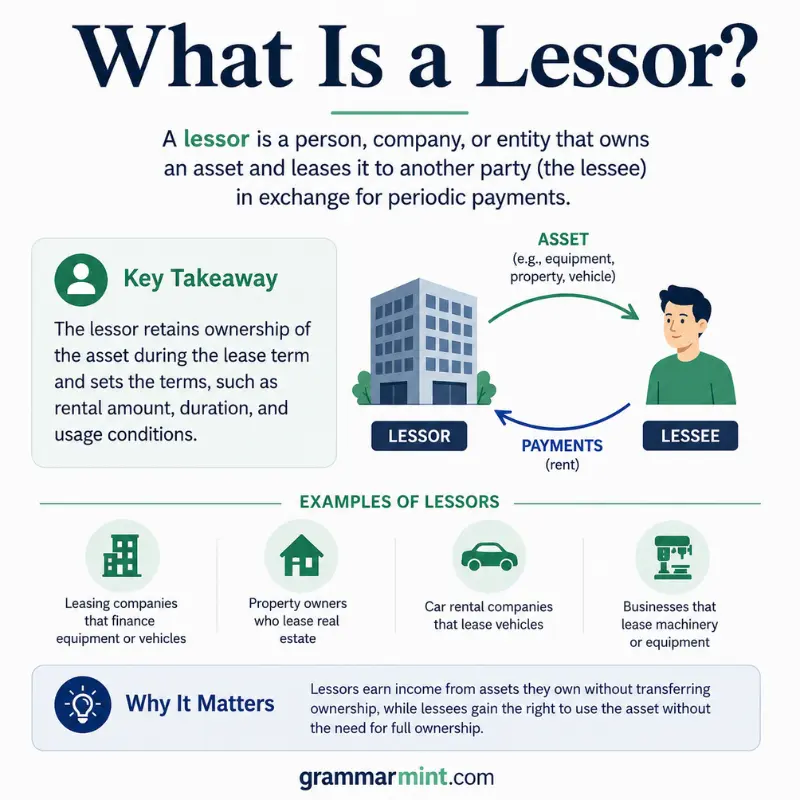
A lessor is the party that grants another party the right to use property or an asset for a specific period under a lease agreement.
In many situations, the lessor owns the property. For example, if someone owns an apartment and rents it to another person, the owner may be the lessor.
However, the lessor does not always have to be the individual who personally owns the property. In some cases, an authorized company, agent, or organization may act as the leasing party.
Examples of a Lessor
A lessor could be:
- An apartment owner renting out a unit
- A commercial landlord leasing office space
- A car leasing company
- An equipment company leasing machinery
- A business leasing specialized equipment to another business
- An authorized property management company acting on behalf of an owner
Example Sentence
The lessor agreed to renew the lease for another year.
In this sentence, the lessor is the party granting the lease.
Another Example
The lessor must provide the property according to the terms of the lease agreement.
Again, the word refers to the party on the leasing or granting side of the agreement.
What Is a Lessee?
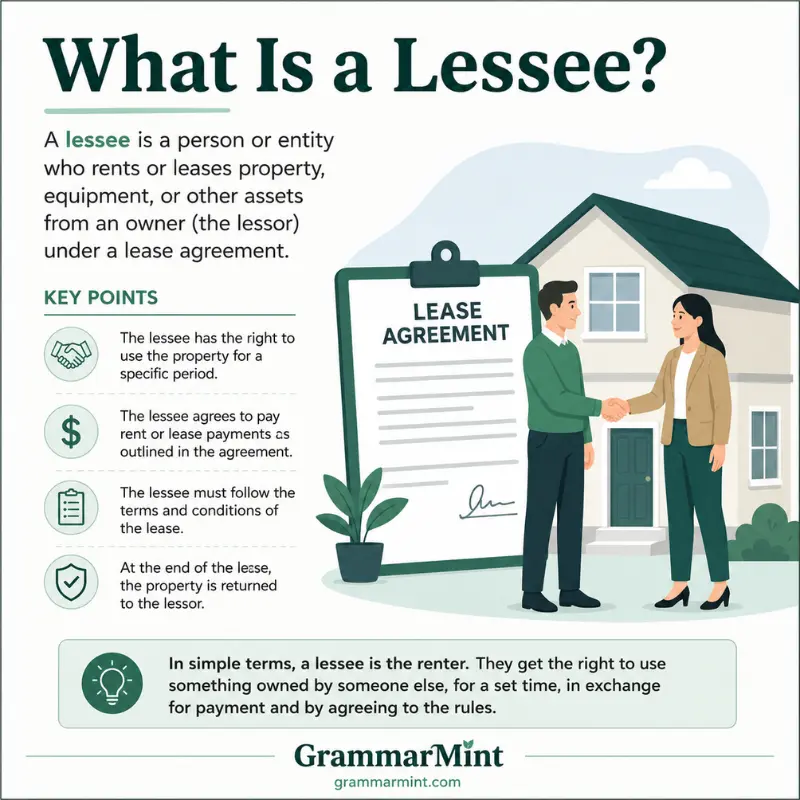
A lessee is the party that receives the right to use property or an asset under a lease agreement.
In a typical apartment rental, the lessee is the tenant. The tenant does not necessarily own the property. Instead, the tenant has the legal right to use or occupy it according to the terms of the lease.
Examples of a Lessee
A lessee could be:
- A person renting an apartment
- A family renting a house
- A company renting office space
- A driver leasing a vehicle
- A business leasing equipment
- An organization leasing a building for its operations
Example Sentence
The lessee must pay rent on the first day of each month.
Here, the lessee is the party using the property and making the required lease payment.
Another Example
The lessee requested permission to make changes to the office space.
The lessee is the party receiving the right to use the office under the lease.
How the Two Roles Work Together
The easiest way to understand the difference is to look at a simple example.
Imagine that Sarah owns an apartment. She rents the apartment to Daniel for one year.
In this agreement:
- Sarah is the lessor because she grants Daniel the lease.
- Daniel is the lessee because he receives the right to use the apartment.
- Daniel pays rent according to the lease terms.
- Sarah and Daniel both have rights and responsibilities under the agreement.
You can think of the relationship like this:
Lessor → grants the lease → Lessee
And usually:
Lessee → pays lease payments → Lessor
This simple direction helps prevent confusion.
Lessor vs. Lessee in an Apartment Lease
In a residential lease, the terms often match the familiar words landlord and tenant.
| Legal Term | Everyday Term |
| Lessor | Landlord |
| Lessee | Tenant |
For example, a lease might say:
“The Lessor agrees to lease the premises to the Lessee for a term of twelve months.”
In plain English, this means:
“The landlord agrees to rent the property to the tenant for twelve months.”
Both versions describe the same basic relationship. The first is more formal and legal, while the second is easier for most people to understand in everyday conversation.
Lessor vs. Lessee in a Car Lease
These terms are not limited to real estate.
Suppose a car company leases a vehicle to a customer.
- The company granting the lease is the lessor.
- The customer receiving the right to use the vehicle is the lessee.
For example:
The lessee must return the vehicle at the end of the lease term.
The person driving and leasing the vehicle is the lessee.
This is important because many people mistakenly associate lessor and lessee only with houses and apartments. In reality, a lease can involve many types of property and assets.
Lessor vs. Lessee in Commercial Leases
Businesses also use these terms regularly.
For example, imagine that a company rents an office in a commercial building.
- The building owner or authorized leasing party is the lessor.
- The company renting and using the office is the lessee.
A commercial lease may include detailed responsibilities involving:
- Rent payments
- Security deposits
- Maintenance
- Insurance
- Repairs
- Property modifications
- Lease renewals
- Early termination
- Use restrictions
Because these agreements can be complex, formal terms such as lessor and lessee are common.
Once the contract defines each party, the agreement can repeatedly use the shorter legal terms instead of constantly writing the full names of the parties.
Origin of Lessor and Lessee
Both words are connected to the verb lease.
The words describe the two sides of the leasing relationship:
- The lessor is associated with granting or leasing property.
- The lessee is associated with receiving the leased property or right of use.
The endings also help explain why the words look so similar.
The ending -or often appears in words for a person who performs an action. The ending -ee often appears in words for a person who receives an action.
Compare:
- grantor / grantee
- employer / employee
- assignor / assignee
- lessor / lessee
This pattern is not a perfect rule for every English word, but it is a useful way to remember the difference.
The similar spelling is therefore not accidental. The words share the same basic legal relationship and describe the two connected parties.
British vs. American English
There is no major difference between American English and British English when it comes to the meanings of lessor and lessee.
Both terms are used in formal legal and financial contexts.
In everyday conversation, however, people are more likely to use simpler words.
In everyday speech:
- Lessor → landlord
- Lessee → tenant
For example, someone is much more likely to say:
“My landlord raised the rent.”
than:
“My lessor increased the lease payment.”
The legal term is correct, but it sounds more formal.
Similarly, people usually say:
“I’m a tenant.”
rather than:
“I’m the lessee.”
The word lessee is especially common when discussing the actual contract or legal rights under the lease.
Which One Should You Use?
Your choice depends mainly on context and audience.
Use “lessor” and “lessee” in formal writing
These terms are appropriate in:
- Lease agreements
- Legal documents
- Commercial contracts
- Financial reports
- Accounting documents
- Business correspondence requiring technical precision
Example:
The Lessor shall provide written notice before entering the premises, except as otherwise permitted by the lease.
This sounds formal and contractual.
Use “landlord” and “tenant” in everyday writing
These words are usually better for:
- General articles
- Conversations
- Text messages
- Beginner-friendly guides
- Informal emails
- Social media
Example:
The landlord must give the tenant proper notice.
This is easier for a general audience to understand.
Consider Your Readers
Legal accuracy is important, but clarity also matters.
If you are writing for lawyers, accountants, real estate professionals, or businesses, lessor and lessee may be the best choices.
If you are writing for beginners, you can introduce both terms and then explain them in plain language.
For example:
The lessor (usually the landlord) grants the lease, while the lessee (usually the tenant) receives the right to use the property.
This gives readers both the technical and everyday vocabulary.
Common Mistakes and Quick Fixes
Mistake 1: Calling the tenant the lessor
Incorrect: The tenant is the lessor.
Fix: The tenant is generally the lessee. The lessor grants the lease.
Mistake 2: Calling the landlord the lessee
Incorrect: The landlord is the lessee.
Fix: The landlord is generally the lessor because the landlord grants the lease.
Mistake 3: Thinking both words mean tenant
Fix: They describe opposite roles. The lessor grants the lease, while the lessee receives it.
Mistake 4: Choosing the word based only on spelling
Because lessor and lessee look almost identical, writers sometimes guess.
Fix: Do not rely on appearance. Ask: Who grants the right to use the property? Who receives it?
Mistake 5: Swapping the terms in a contract
This can create major confusion because contracts may assign duties and rights to “the Lessor” or “the Lessee.”
Fix: Before finalizing a document, identify each party clearly and check every use of the terms.
Mistake 6: Thinking the lessor must personally own the property
The lessor is typically the party granting the lease, but the exact legal relationship can depend on the agreement and applicable law.
Fix: Focus on the party’s contractual role rather than assuming that every lessor is an individual property owner.
Mistake 7: Misspelling “lessee”
Incorrect: lesse
Correct: lessee
The word ends with -ee.
Mistake 8: Using formal terms when simpler language is better
A general audience may find “lessor” and “lessee” confusing.
Fix: Use landlord and tenant when legal precision is not necessary.
Mistake 9: Assuming a lease always involves real estate
Cars, equipment, machinery, and other assets can also be leased.
Fix: Remember that the terms describe roles in a lease agreement, not just a housing situation.
Everyday Examples
Informal Text Message
“I just signed the lease, so I guess I’m officially the lessee!”
Social Media Caption
“New office space secured. Thanks to the lessor for making the process smooth.”
Parent Explaining to a Teenager
“The lessor is the person or company that grants the lease. We’re the lessees because we’re renting the apartment.”
Workplace Email Note
“The lessor must approve any major structural changes to the property.”
More Professional Rewrite
“The property owner, acting as the lessor, must provide written approval for any structural modifications.”
Apartment Example
“The lessee agreed to pay monthly rent and follow the rules listed in the lease.”
Car Example
“The lessee must return the vehicle when the lease term ends, subject to the terms of the agreement.”
Business Example
“The lessor leased the equipment to the company for three years.”
Usage and Trends
People often encounter lessor and lessee when they are signing a lease, reviewing a contract, starting a business rental, or dealing with financial documents.
Interest in these terms may increase during busy rental periods, when more people are moving into apartments, houses, and commercial spaces.
They can also become important when businesses review lease obligations for accounting or financial reporting purposes.
Unlike trendy slang, these are stable legal and business terms. Their meanings have remained closely tied to the same basic relationship: one party grants the lease, and the other receives the right to use the leased property or asset.
Comparison Table
| Context | Best Choice | Why |
| Apartment lease contract | Lessor / Lessee | Standard formal terminology |
| Casual conversation | Landlord / Tenant | More natural and widely understood |
| Commercial property agreement | Lessor / Lessee | Precise business language |
| Real estate blog for beginners | Landlord / Tenant | Easier for general readers |
| Accounting or finance report | Lessor / Lessee | Technical accuracy |
| Text message to a friend | Landlord / Tenant | Clear and informal tone |
| Car lease agreement | Lessor / Lessee | Standard lease terminology |
| General housing guide | Landlord / Tenant | Better for most readers |
A Simple Way to Remember the Difference
If you forget which word is which, use this question:
Who gives the right to use the property?
That party is the lessor.
Who gets the right to use the property?
That party is the lessee.
You can also remember:
Or, even more simply:
This is not a complete explanation of every legal obligation, but it is an effective way to remember the basic distinction.
FAQs
What is the difference between lessor and lessee?
The lessor grants the lease and the lessee receives the right to use the property or asset. They are opposite parties in the same lease agreement.
Is the landlord the lessor or lessee?
The landlord is generally the lessor because the landlord grants the tenant the right to use the property.
Who is the lessee in a lease agreement?
The lessee is the person or business that receives the right to use the property or asset under the lease. In a typical rental situation, the lessee is the tenant.
Is a tenant a lessee?
Yes. In legal lease terminology, a tenant is generally the lessee.
Is a lessor always the owner?
Not necessarily in every situation. The lessor is the party that grants the lease, and the exact ownership or authority arrangement can vary.
Does a lessee own the property?
Usually, no. A lessee generally receives the right to use the property or asset according to the lease terms rather than ownership of it.
Can a company be a lessor?
Yes. A company can act as the lessor, such as a car leasing company, equipment leasing business, or authorized property management company.
Can a company be a lessee?
Yes. Businesses frequently act as lessees when they rent office space, equipment, vehicles, warehouses, or other assets.
Which word is more common in everyday conversation?
Landlord and tenant are much more common in everyday conversation. Lessor and lessee are mainly used in formal, legal, financial, and business contexts.
Why do lessor and lessee look so similar?
They come from the same leasing relationship. The similar spelling reflects their shared connection to the word lease, even though they describe opposite roles.
Mini Quiz
Test your understanding.
1. Who usually receives lease payments, the lessor or the lessee?
2. Which term refers to the person or business receiving the right to use the property?
3. In everyday speech, what word commonly replaces “lessor”?
4. In everyday speech, what word commonly replaces “lessee”?
5. A company rents office space from a building owner. Is the company the lessor or the lessee?
6. Which pair is more appropriate in a formal commercial lease contract: landlord/tenant or lessor/lessee?
Answer Key
- Lessor.
- Lessee.
- Landlord.
- Tenant.
- Lessee.
- Lessor/lessee.
Conclusion
The difference between lessor and lessee is not just a spelling issue. The two words describe opposite roles in a lease agreement.
The lessor is the party that grants the lease. The lessee is the party that receives the right to use the property or asset.
In many everyday rental situations:
- Lessor = Landlord
- Lessee = Tenant
The lessor generally receives lease payments, while the lessee generally makes them according to the agreement.
When legal or business precision matters, use lessor and lessee. When speaking to a general audience, landlord and tenant are often clearer and more natural.
The easiest way to avoid confusion is to remember one simple rule:
Once you remember who grants the lease and who receives it, the difference becomes easy to understand and use correctly.