If you’ve ever paused mid-sentence to ask, “Is it wacky or whacky?”, you’re not alone. Both spellings appear online, in blogs, product names, social media posts, and informal messages.
The confusion makes sense. The related word “whack” contains an h, so it may seem logical that the adjective should be spelled “whacky.” In modern American English, however, one form is much more common and widely preferred.
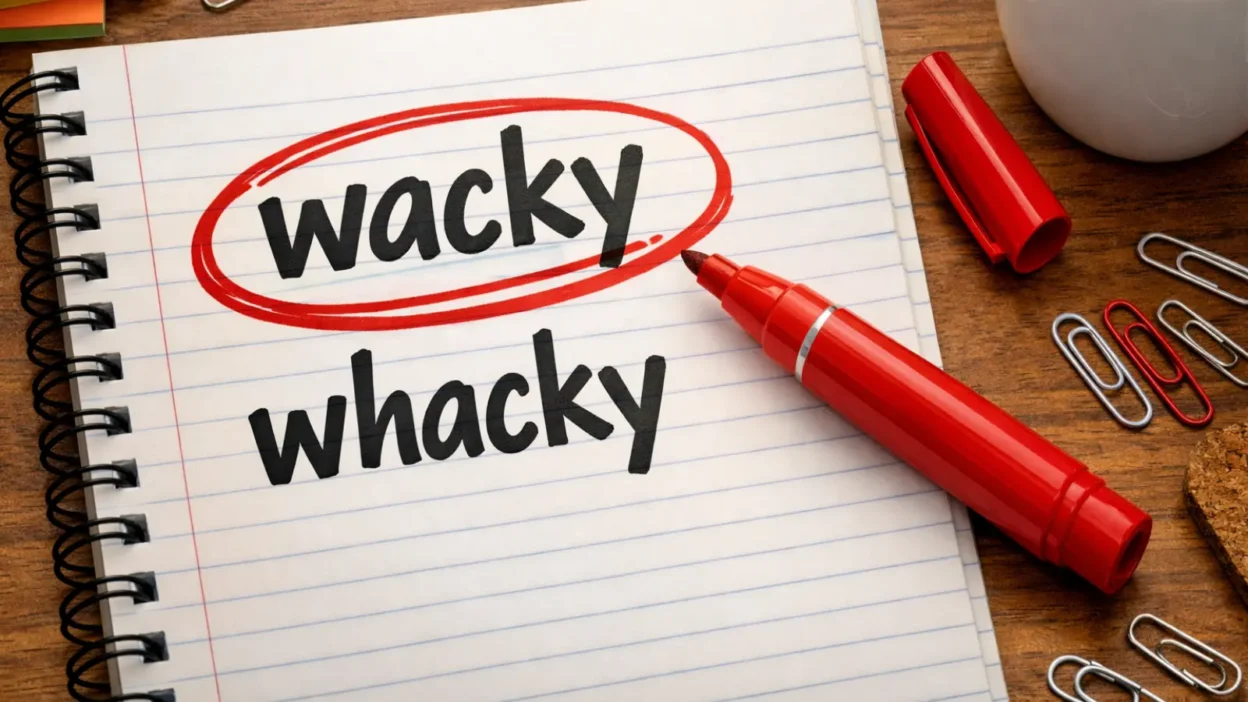
Wacky is the standard spelling for something that is silly, strange, amusingly unusual, or eccentric. Whacky exists as a variant, but it is far less common.
This guide explains the difference between wacky and whacky, why the two spellings exist, how the word is used, its tone and meaning, and which spelling you should choose in American English.
Quick Answer
Wacky is the standard and widely preferred spelling in American English.
Whacky is an accepted variant spelling in some dictionaries, but it is much less common. For everyday writing, blogs, social media, schoolwork, and most other situations, wacky is the safer and more natural choice.
Example:
- Correct and preferred: That was a wacky idea.
- Less common variant: That was a whacky idea.
When in doubt, choose wacky.
Wacky vs Whacky at a Glance
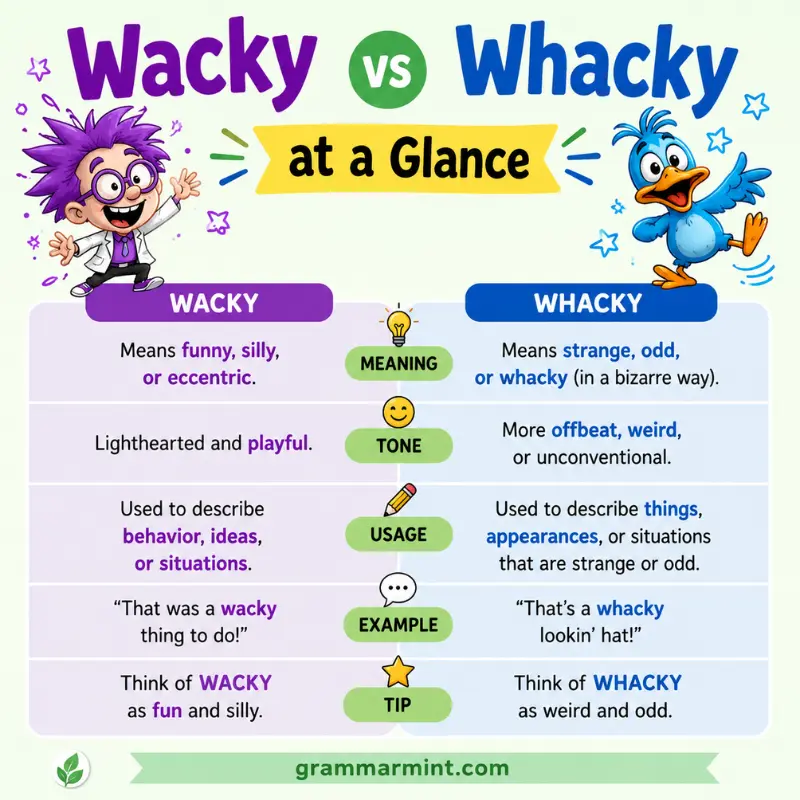
| Feature | Wacky | Whacky |
|---|---|---|
| Standard spelling | Yes | Usually treated as a variant |
| Common in American English | Yes | Much less common |
| Meaning | Silly, odd, eccentric, unusual | Same general meaning |
| Tone | Informal and playful | Informal and playful |
| Best for everyday writing | Yes | Usually no |
| Best for US audiences | Yes | Rarely |
| Formal writing | Often replace with a more precise word | Usually avoid |
The easiest rule to remember is simple:
Use “wacky” unless you have a specific reason to preserve “whacky,” such as a brand name, title, quotation, or intentionally unusual spelling.
What Does Wacky Mean?
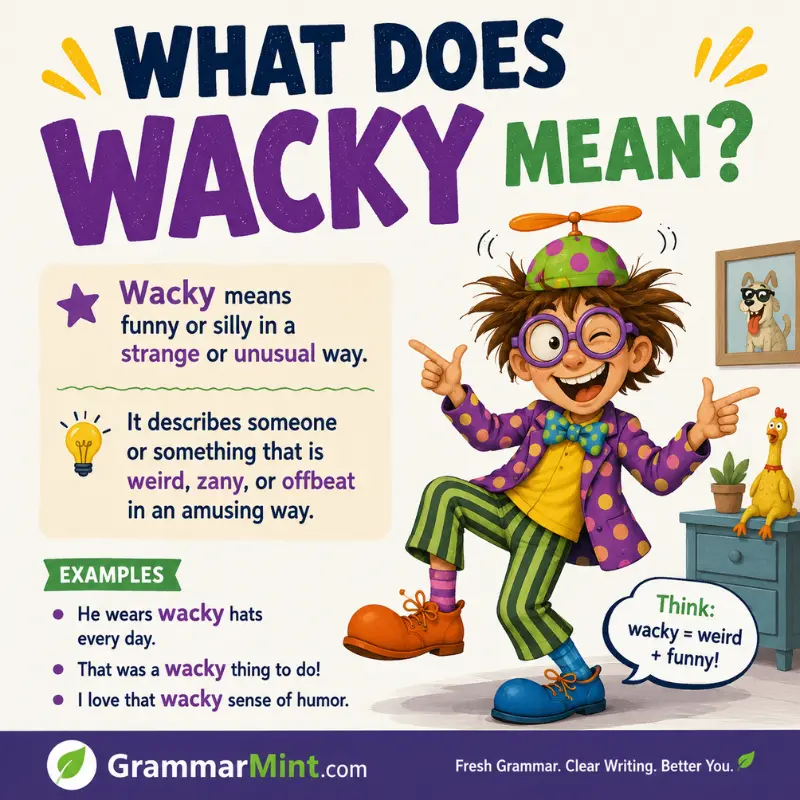
Wacky is an informal adjective used to describe something that seems strange, silly, unconventional, eccentric, or amusingly unusual.
It often has a playful tone rather than a strongly negative one.
For example:
- He wore a wacky costume to the party.
- The show is full of wacky characters.
- She came up with a wacky idea for the school project.
- They sell wacky gifts and novelty items.
- His wacky sense of humor always makes us laugh.
In these sentences, wacky suggests that something is unusual in an entertaining, surprising, or lighthearted way.
However, tone matters. Calling an idea, outfit, story, design, or invention wacky can sound playful. Calling a person wacky can sometimes sound dismissive or insulting depending on the situation.
Is Whacky a Real Word?
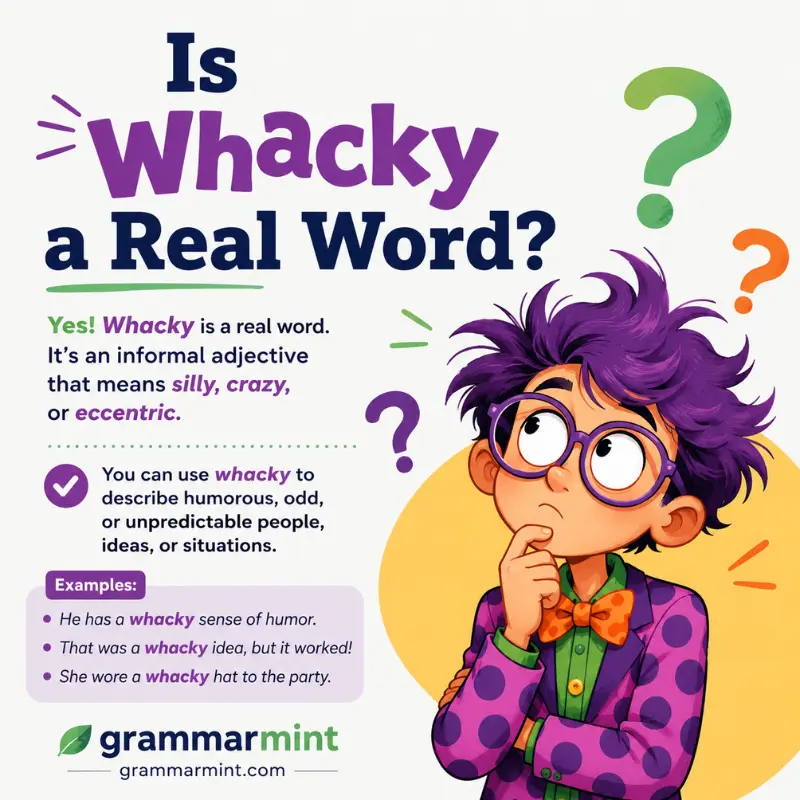
Yes. Whacky is a real variant spelling, but it is not the form most American readers expect.
You may occasionally encounter it in older writing, informal material, creative titles, business names, or intentionally quirky branding.
That does not mean you should normally choose it.
Consider the difference between something being technically recognized and something being the preferred modern form. When readers see wacky, the spelling generally looks ordinary and familiar. Whacky is more likely to make a reader pause or wonder whether it is a misspelling.
For polished modern American English, wacky is usually the better choice.
Why Are There Two Spellings?
The confusion between wacky and whacky is understandable because the adjective is historically associated with forms related to whack.
English spelling does not always preserve every letter when words develop into related forms. As usage changes over time, one spelling can become dominant even when another form appears logical.
Because people already know the spelling whack, some naturally assume that adding -y should produce whacky.
However, modern usage settled much more strongly on wacky.
That creates a useful distinction:
- whack — a separate word
- wacky — the standard adjective meaning amusingly strange or eccentric
For example:
Whack:
- He gave the ball a whack.
Wacky:
- That is a wacky-looking bicycle.
The similarity between the two words helps explain the spelling confusion, but it does not mean the adjective normally needs the h.
Is Wacky American or British English?
The difference between wacky and whacky is not a standard American-versus-British spelling distinction like color/colour or center/centre.
Wacky is widely recognized in both American and British English.
You should therefore avoid assuming:
American English = wacky
British English = whacky
That rule does not hold.
For a US audience, wacky is clearly the safest choice. British readers are also familiar with wacky, while whacky remains a much less common alternative.
How Is Wacky Pronounced?
Wacky is normally pronounced:
WAK-ee
It rhymes with words such as:
- tacky
- lackey
- Jackie
The pronunciation is another reason the extra h in whacky is unnecessary for most modern writing. The two spellings are generally intended to represent the same adjective rather than two words with different pronunciations.
What Part of Speech Is Wacky?
Wacky is primarily an adjective.
An adjective describes a noun.
For example:
- a wacky story
- a wacky costume
- a wacky invention
- a wacky comedy
- a wacky character
You can also form related words.
Wackier
Wackier is the comparative form.
Example:
His second idea was even wackier than the first.
Wackiest
Wackiest is the superlative form.
Example:
That may be the wackiest advertisement I’ve ever seen.
Wackiness
Wackiness is a noun referring to the quality of being wacky.
Example:
The movie embraces its own wackiness.
Notice that the standard forms normally continue without the h:
- wacky
- wackier
- wackiest
- wackiness
What Tone Does Wacky Have?
Wacky is informal.
It usually creates a playful, conversational, humorous, or slightly exaggerated tone.
It works especially well when describing:
- jokes
- costumes
- cartoons
- characters
- party themes
- inventions
- games
- children’s stories
- unusual ideas
- quirky designs
- humorous behavior
For example:
The restaurant has a wacky space-themed interior.
The word suggests that the design is unusual and fun rather than simply incorrect or unpleasant.
In formal writing, however, wacky may sound too casual.
Compare:
Informal:
The proposal sounds a little wacky.
Professional:
The proposal is unconventional.
Academic:
The theory differs substantially from the conventional interpretation.
Choosing a more precise word can make formal writing sound clearer and more professional.
Wacky vs Crazy: Are They the Same?
Not exactly.
Wacky often describes something in a humorous, harmless, or quirky way.
Crazy can have a much wider range of meanings and may sound stronger, more judgmental, or less precise.
Compare:
That’s a wacky hat.
This usually means the hat looks funny, unusual, or eccentric.
That’s a crazy hat.
This may express surprise or exaggeration but can sound stronger.
When describing a person, wacky can also be preferable in lighthearted contexts, although both words should be used carefully.
For neutral writing, alternatives such as unusual, unconventional, quirky, eccentric, imaginative, or unexpected may communicate your meaning more precisely.
The comedian wore a wacky suit covered in cartoon bananas.
This sounds humorous and playful.
There was a weird noise coming from the basement.
Here, weird suggests something strange or possibly unsettling.
Weird simply means strange or unusual and can carry either a neutral or negative tone depending on context.
Compare:
The comedian wore a wacky suit covered in cartoon bananas.
This sounds humorous and playful.
There was a weird noise coming from the basement.
Here, weird suggests something strange or possibly unsettling.
If you want to describe harmless eccentricity or silliness, wacky often works better.
Wacky vs Quirky: Which Should You Use?
Quirky is usually softer and can sound more positive or stylish than wacky.
Consider:
The café has quirky decorations.
This may suggest charm, personality, or originality.
The café has wacky decorations.
This suggests something more exaggerated, silly, or visually unusual.
Use quirky when the unusual quality feels charming or distinctive.
Use wacky when it feels more humorous, exaggerated, unpredictable, or silly.
Which Spelling Should You Use?
For most modern writing, use wacky.
It works naturally in:
- casual conversations
- text messages
- social media posts
- blog articles
- advertisements
- entertainment writing
- children’s books
- humorous content
- product descriptions
- informal workplace chats
For example:
That’s a wacky marketing idea, but it could work.
My son invented a wacky superhero named Captain Pancake.
The store sells wacky socks for every holiday.
You generally do not gain anything by replacing wacky with whacky. The variant may simply look unusual to readers.
When Might Whacky Be Appropriate?
There are a few situations where you should preserve whacky.
Brand Names
If a company deliberately spells its name with whacky, do not “correct” the official name.
Book, Movie, or Product Titles
Always preserve the official spelling of a title.
Direct Quotations
If you are quoting someone who wrote whacky, reproduce the quotation accurately unless your style rules require otherwise.
Deliberately Playful Writing
A writer may intentionally use whacky because the unusual spelling itself fits a playful theme.
Outside these situations, wacky remains the better default.
Should You Use Wacky in Formal Writing?
Usually, a more precise word is better.
Wacky is useful for casual language, but it can sound vague in professional, academic, legal, technical, or highly formal writing.
Instead of:
The company introduced a wacky strategy.
Try:
The company introduced an unconventional strategy.
Instead of:
The researcher proposed a wacky theory.
Try:
The researcher proposed an unusual theory.
Instead of:
The building has a wacky design.
Try:
The building has an eccentric architectural design.
The best replacement depends on what you actually mean.
Better Formal Alternatives to Wacky
Here are several alternatives and the meanings they emphasize:
| Word | Best Used When Something Is… |
| Unusual | Different from what is normal |
| Unconventional | Different from accepted practices |
| Eccentric | Noticeably unusual in style or behavior |
| Quirky | Unusual in an interesting or charming way |
| Whimsical | Playfully imaginative |
| Bizarre | Extremely strange |
| Odd | Simply strange or unexpected |
| Novel | New or original |
| Imaginative | Creative and inventive |
| Unorthodox | Different from established methods |
Do not choose a synonym only because it sounds more sophisticated. Choose the word that accurately expresses your intended meaning.
Common Mistakes With Wacky and Whacky
Mistake 1: Treating Whacky as the Standard Form
Incorrect preference:
That was a whacky idea.
Better:
That was a wacky idea.
Although whacky exists, wacky is the conventional choice.
Mistake 2: Assuming Whacky Is British
There is no simple regional rule making whacky the normal British equivalent of American wacky.
Use wacky unless a particular source, title, or style requires otherwise.
Mistake 3: Switching Spellings in One Article
Avoid writing wacky in one paragraph and whacky later unless you are specifically discussing both spellings.
Consistency makes your writing look more polished.
Mistake 4: Using Wacky in Highly Formal Writing
Avoid vague informal language when precision matters.
Instead of:
The results were wacky.
Write what you actually mean:
The results were unexpected.
Mistake 5: Using Wacky Negatively About People
Be careful when labeling people.
He’s wacky could sound humorous among close friends but dismissive or insulting in another setting.
When possible, describe the specific behavior rather than labeling the person.
Everyday Examples of Wacky
Text Message
Did you see his wacky dance moves last night?
Social Media
Trying this wacky new ice cream flavor today!
Parenting
My toddler told me a wacky story about a flying dinosaur.
Children’s Story
The wacky wizard turned his shoes into sandwiches.
Workplace Chat
It sounds like a wacky idea, but it might actually solve the problem.
Entertainment Review
The movie combines wacky humor with surprisingly emotional moments.
Fashion
She wore a wacky pair of neon sunglasses.
Marketing
The campaign uses wacky characters to attract attention.
Professional Rewrite
Informal:
That’s a wacky approach.
More professional:
That’s an unconventional approach.
Wacky or Whacky in Different Contexts
| Context | Best Choice | Reason |
| Casual text message | Wacky | Standard and natural |
| Social media post | Wacky | Familiar to readers |
| Children’s story | Wacky | Playful and standard |
| Marketing headline | Wacky | Clear and recognizable |
| Comedy blog | Wacky | Matches the informal tone |
| Product description | Wacky | Works for playful products |
| Academic paper | Usually neither | Use precise formal language |
| Business report | Usually neither | Prefer “unusual” or “unconventional” |
| Official brand name | Use official spelling | Preserve the brand |
| Direct quotation | Preserve original | Quotations should remain accurate |
Easy Trick to Remember Wacky
If you struggle to remember wacky or whacky, think:
A wacky word drops the H.
The adjective you normally want is:
W-A-C-K-Y
not:
W-H-A-C-K-Y
You still write whack with an h when you mean a hit, blow, strike, or related use.
So remember:
whack → wacky
English spelling is not always perfectly predictable, but this simple distinction will keep your writing consistent.
FAQs
Is whacky a real word?
Yes. Whacky appears as a variant spelling of wacky, but it is much less common. For modern American English, wacky is normally the preferred spelling.
Which spelling is correct, wacky or whacky?
Wacky is the standard choice. Whacky exists as a variant, but most writers should use wacky, especially when writing for a US audience.
Is wacky informal?
Yes. Wacky is an informal adjective. It is especially common in conversations, entertainment, advertising, social media, and humorous writing.
Is whacky the British spelling?
No. Whacky should not be treated as the standard British counterpart of American wacky. Wacky is widely used in both varieties of English.
What does wacky mean?
Wacky generally means amusingly strange, silly, eccentric, unconventional, or unusual.
How do you use wacky in a sentence?
Example:
She wore a wacky hat shaped like a giant slice of pizza.
Here, wacky describes the hat as humorously unusual.
What is a professional alternative to wacky?
Depending on the context, use unusual, unconventional, eccentric, unorthodox, imaginative, or unexpected.
Is it wackier or whackier?
If you are using the standard spelling wacky, the comparative form is wackier and the superlative is wackiest.
Mini Quiz: Wacky or Whacky?
1. Which spelling is standard in American English?
A. Wacky
B. Whacky
2. Is “wacky” generally formal or informal?
A. Formal
B. Informal
3. Which sentence is the better choice for everyday American English?
A. That is a wacky costume.
B. That is a whacky costume.
4. Which word may be better in a formal business report?
A. Unconventional
B. Wacky
5. Is “whacky” specifically the British spelling?
A. Yes
B. No
Answer Key
- A — Wacky
- B — Informal
- A — That is a wacky costume.
- A — Unconventional
- B — No
Conclusion
When deciding between wacky or whacky, choose wacky in almost every situation. It is the standard, familiar, and widely preferred spelling in modern American English.
Whacky exists as a variant, but it is uncommon and usually unnecessary unless you are preserving a brand name, title, quotation, or intentionally unusual spelling.
Remember that wacky is also informal. It works especially well for humorous, playful, strange, or eccentric things, but professional and academic writing may call for a more precise alternative such as unusual, unconventional, eccentric, or unorthodox.
The simplest rule is:
Use “wacky” for the adjective. Use “whacky” only when a specific context requires that spelling.