
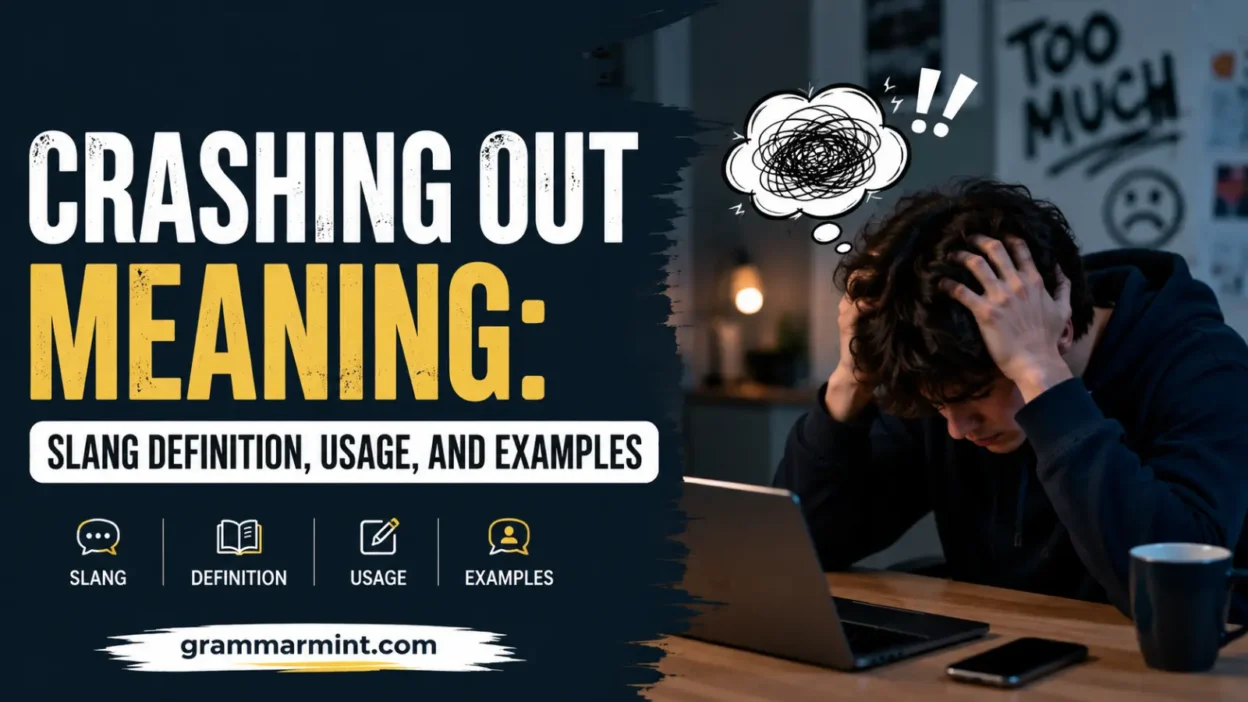
You may see “crashing out” in TikTok captions, group chats, memes, or everyday talk. The phrase often appears when someone becomes extremely angry, overwhelmed, or reckless. It may describe a real outburst or exaggerate a small frustration for humor.
The wording can confuse English learners. Older speakers may understand “crash out” as falling asleep from exhaustion. Sports reports may use it for a team leaving a competition. Modern slang gives the phrase a different emotional meaning.
Knowing the context helps you choose the right meaning. It also prevents awkward use in school, work, or serious conversations. This guide explains the slang meaning, grammar, pronunciation, older senses, and natural examples. You will also learn when the phrase fits and when clearer wording works better.
Quick Answer
Crashing out meaning in modern slang is losing emotional control and reacting impulsively. Someone may yell, lash out, start an argument, or make a reckless choice.
TL;DR
• It usually means losing control because of intense emotions.
• The phrase is informal slang.
• It can be serious, playful, or exaggerated.
• Older meanings include sleeping and leaving a competition.
• Context shows which meaning fits.
What Crashing Out Means in Plain English
To crash out means to reach an emotional limit and react without thinking clearly. The reaction is often sudden, intense, and likely to cause regret.
A person might shout, send an angry message, break a plan, or confront someone. The phrase can also describe a complete emotional shutdown. The exact behavior depends on the situation.
People often use the phrase loosely for humor. Someone might say, “I’m crashing out,” after dropping lunch or missing a bus. In that case, no major outburst may happen.
The expression can also describe serious behavior. It may involve aggression, reckless choices, or damage to relationships. Context and tone show how strongly the speaker means it.
“Crashing out” is not a formal medical diagnosis. It is everyday slang for a reaction or behavior. Do not use it to diagnose another person.
Modern Slang Meaning vs Older Meanings
The phrase has several established meanings. A nearby word or situation usually reveals the intended sense.
| Context | Best Choice | Why |
|---|---|---|
| Social post about anger | Lose emotional control | This is the modern slang sense. |
| Late-night conversation | Fall asleep quickly | This is an older informal sense. |
| Sports report | Be eliminated | This sense describes leaving a competition. |
For example, “I crashed out after work” often means “I fell asleep.” However, “I crashed out over the schedule” suggests an angry or reckless reaction.
“Can I crash at your place?” is a different expression. It means staying overnight at someone’s home.
Pronunciation, Grammar, and Word Forms
Say “crashing out” as KRASH-ing out. The first word carries the strongest stress.
“Crash out” is mainly a phrasal verb. It combines the verb “crash” with the particle “out.”
Common forms include:
• Base form: “Don’t crash out.”
• Third-person form: “He crashes out over small problems.”
• Past form: “She crashed out yesterday.”
• -ing form: “They are crashing out in the comments.”
“Crashing out” can form part of a continuous verb phrase. It can also name the general action in casual speech.
“Crashout” may appear as a one-word noun. It can describe a highly reactive or reckless person. This noun is very informal and may sound insulting.
Use two words for the verb: “He might crash out.” Use one word only when the noun clearly fits: “They called him a crashout.”
How to Use Crashing Out
The phrase works naturally with words that show a cause. Common patterns include “over,” “about,” “because,” and “when.”
• “She crashed out over a canceled order.”
• “He is crashing out because his account was locked.”
• “They nearly crashed out when the flight changed.”
• “Don’t crash out about one mistake.”
“I’m about to crash out” predicts an emotional reaction. It may be a warning, a joke, or an exaggeration.
“Don’t crash out” means “stay calm” or “do not act recklessly.” Friends may use it before someone sends an angry text.
The past form can be ambiguous. “He crashed out last night” may mean he slept. Add the cause when you mean the slang sense.
Clearer: “He crashed out over the argument last night.”
Tone, Context, and When Not to Use It
“Crashing out” is casual and expressive. It fits texts, social posts, memes, and relaxed conversations.
The phrase can sound mocking or judgmental. Calling someone a “crashout” may reduce a difficult moment to a joke. It may also suggest that the person is reckless.
Avoid the slang in formal reports, school essays, and sensitive health discussions. Use precise wording instead.
Better choices include:
• “She became overwhelmed.”
• “He had an emotional outburst.”
• “They reacted impulsively.”
• “She lost her composure.”
• “He became extremely distressed.”
Do not use the phrase to dismiss a person seeking help. A playful caption and a real crisis require different responses.
Real-Life Examples of Crashing Out
These examples show how meaning changes with context.
Modern slang
• “I missed the deadline, and I’m about to crash out.”
• “Why is he crashing out over a parking spot?”
• “She crashed out in the group chat.”
• “Don’t crash out before you hear the full story.”
• “He nearly crashed out, then stepped outside.”
• “The comments made her want to crash out.”
Playful exaggeration
• “The café sold the last cookie. I might crash out.”
• “My show ended on a cliffhanger, and I’m crashing out.”
• “The printer jammed again. Please do not let me crash out.”
Older meanings
• “I was exhausted, so I crashed out at nine.”
• “The team crashed out in the first round.”
• “After the long drive, everyone crashed out quickly.”
The surrounding details matter. Words about anger suggest slang, while bedtime details suggest sleep.
Origin and Modern Spread
The emotional slang sense has roots in African American English and Southern rap culture. Online examples appeared before the phrase reached wider audiences.
A 2017 rap lyric is often credited with helping popularize this use. The phrase spread widely on social platforms during the early 2020s. It became especially visible in 2024.
Some accounts connect “crashout” with “crash dummy.” That term describes someone who risks everything without considering the outcome. The connection is plausible, but the full history remains unclear.
As the phrase spread, its meaning became broader and lighter. Some speakers now use it for minor frustration or dramatic humor. Others still use it for dangerous, reckless behavior.
The sleeping and competition senses are older. They remain common enough to cause confusion.
Related Terms, Synonyms, and Antonyms
Several phrases come close to “crashing out,” but their meanings are not identical.
• Freak out: React with strong fear, anger, or distress.
• Snap: Suddenly lose emotional control.
• Lose it: Become unable to stay calm.
• Melt down: Have an intense emotional collapse.
• Lash out: Direct anger toward another person.
• Blow up: Become suddenly and openly angry.
• Spiral: Become worse over time, often emotionally.
“Burnout” is related but different. Burnout usually develops gradually. Crashing out describes a sudden reaction or breaking point.
“Crash and burn” usually means failing badly. “Crash at someone’s place” means staying there overnight.
There is no perfect one-word antonym. Useful opposites include “calm down,” “stay composed,” and “keep control.” “De-escalate” also works when tension is growing.
Common Mistakes and Mini Quiz
A common mistake is assuming the phrase always means sleeping. Check whether the sentence mentions anger, stress, bedtime, or sports.
Another mistake is writing the verb as one word. Write “crash out” when describing an action. Reserve “crashout” for the informal noun.
Do not call every strong feeling a crash out. The slang usually suggests lost control, impulsive action, or extreme distress.
Avoid using it as a clinical label. Describe the actual behavior when accuracy matters.
Mini quiz
- What does “I crashed out at 8 p.m.” probably mean?
- What does “Don’t crash out over one typo” mean?
- Which verb spelling is correct: “crashout” or “crash out”?
- What happened if a team “crashed out in the semifinals”?
- Is “crashing out” suitable for a formal incident report?
Answer key
- The person fell asleep early.
- Do not lose control over a small mistake.
- “Crash out” is correct for the verb.
- The team was eliminated.
- Usually not. More precise wording is better.
FAQs
What does crashing out mean in slang?
It means losing emotional control and reacting in an impulsive way. The reaction may involve anger, distress, reckless behavior, or an emotional shutdown.
What does crashing out mean on TikTok?
On TikTok, it usually describes someone reaching a breaking point. People also use it jokingly for small frustrations or dramatic reactions.
Does crashing out mean going to sleep?
Yes, it can. The older informal meaning is falling asleep quickly because of exhaustion. Context separates that meaning from the newer slang sense.
What is a crashout person?
A “crashout” is a highly reactive person who may ignore consequences. The label is very informal and can sound insulting.
Is crash out one word or two?
Use “crash out” as a two-word phrasal verb. “Crashout” may appear as a noun for a person or event.
Can crashing out mean crying?
It can include crying, but crying is not required. The phrase usually suggests a broader loss of control or impulsive reaction.
Conclusion
The crashing out meaning depends on context, but modern slang usually describes losing control. Use it casually, and choose clearer language for serious situations.
Check nearby details before deciding whether it means anger, sleep, or elimination.