
You may see authentic on product listings, restaurant menus, certificates, reviews, or social media. People also use it when talking about someone’s personality or behavior.
The word has several related meanings. It can describe something genuine rather than fake. It can also describe information that deserves trust.
When used for people, authentic often means sincere and true to yourself. The exact meaning depends on what the word describes.
Understanding these differences helps you use the word more naturally. This guide explains the authentic meaning, pronunciation, grammar, examples, synonyms, and common mistakes.
Quick Answer
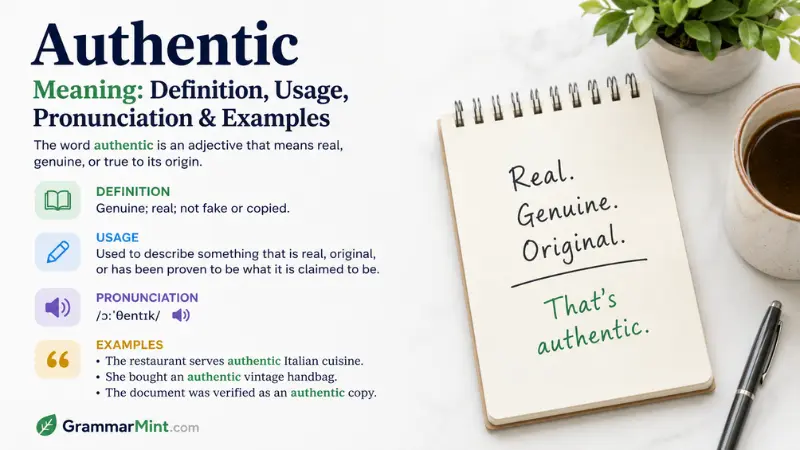
Authentic meaning is usually “real, genuine, or truly what something claims to be.” It can also describe trustworthy information or a sincere person.
TL;DR
• Authentic usually means real or genuine.
• It is an adjective.
• It can describe people, objects, food, and information.
• It can also mean trustworthy or believable.
• For people, it often means sincere and true to oneself.
• It is not mainly a slang word.
Authentic Meaning in Plain English
The simplest meaning of authentic is real and genuine, rather than fake or falsely presented.
For example:
• an authentic painting
• an authentic signature
• an authentic antique
• an authentic experience
The word often tells us that something really is what it claims to be.
Imagine someone sells a bag as a designer product. If experts confirm it came from that designer, it is authentic.
The word can also describe honesty or sincerity. An authentic person behaves in a way that reflects their real beliefs and personality.
Pronunciation and Part of Speech
Authentic is pronounced roughly:
aw-THEN-tik
The stress falls on the middle part: THEN.
It normally has three spoken parts:
au • then • tic
The word is an adjective. Adjectives describe people, things, experiences, ideas, or other nouns.
Examples:
• an authentic document
• authentic Mexican food
• an authentic response
• an authentic personality
It can also appear after linking verbs.
For example:
• The signature looks authentic.
• Her reaction seemed authentic.
• The restaurant feels authentic.
The noun form is authenticity. The common adverb is authentically.
Main Meanings of Authentic
The meanings of authentic are closely connected. However, the exact sense changes with context.
Real or genuine
This is the most common meaning.
An authentic object is really what people claim it is. It is not a counterfeit pretending to be something else.
Example:
“The collector confirmed that the signed jersey was authentic.”
Based on facts or worthy of trust
Authentic can describe information, reports, records, or accounts.
Here, the word suggests accuracy and reliability.
Example:
“The museum wanted an authentic account of the event.”
True to a person’s real character
People can also be authentic.
In this sense, the word means sincere and true to your actual personality or values.
Example:
“Her interviews feel relaxed and authentic.”
Faithful to an original style or tradition
Something can feel authentic because it closely follows an established style or method.
This use often appears with food, clothing, historical settings, and performances.
Example:
“The restaurant focuses on authentic regional dishes.”
How to Use Authentic
The most common structure is:
authentic + noun
Examples include:
• authentic artwork
• authentic documents
• authentic cuisine
• authentic communication
• authentic experiences
You can also place authentic after certain verbs.
Common patterns include:
be + authentic
“His explanation was authentic.”
seem + authentic
“The message seems authentic.”
feel + authentic
“The dialogue feels authentic.”
look + authentic
“The reproduction looks authentic.”
Remember that authentic describes something. It does not normally describe an action.
For an adverb, use authentically.
Correct:
“She expressed herself authentically.”
Not:
“She expressed herself authentic.”
Authentic for People and Personality
When authentic describes a person, it usually refers to sincerity.
An authentic person does not constantly pretend to be someone else. Their words and behavior generally reflect their actual beliefs or character.
You may hear expressions such as:
• authentic person
• authentic voice
• authentic self
• authentic leadership
• authentic communication
For example:
“Jordan speaks in an authentic way during interviews.”
This does not mean authentic people share every private thought. It mainly suggests that their behavior feels sincere rather than artificial.
The phrase authentic self usually refers to someone’s genuine personality, values, or identity.
Example:
“She became more comfortable showing her authentic self.”
Authentic for Objects, Food, and Experiences
Authentic works especially well when origin or accuracy matters.
With objects, it can mean genuine rather than counterfeit.
“The dealer confirmed the watch was authentic.”
With documents, it can mean genuine or properly verified.
“They needed to determine whether the letter was authentic.”
With food, it often means prepared in a way associated with a particular culinary tradition.
“We tried authentic regional dishes during the trip.”
However, authentic does not automatically mean “best.” It describes genuineness or faithfulness, not personal taste.
The word also appears with experiences.
“The tour gave visitors a more authentic view of local life.”
Here, authentic suggests something natural or faithful rather than staged.
Authentic vs Genuine, Real, and Original
These words overlap, but they are not always interchangeable.
| Word | Common Meaning | Example |
|---|---|---|
| Authentic | Truly what it claims to be | an authentic signature |
| Genuine | Not fake or counterfeit | genuine leather |
| Real | Actually existing or true | a real problem |
| Original | First form, not a copy | the original painting |
Authentic often carries an idea of confirmed identity, origin, or faithfulness.
Genuine strongly emphasizes that something is not fake.
Real is broader. It can describe anything actual rather than imaginary.
Original refers to the first version or source.
A reproduction can therefore be authentic in style without being the original object.
Synonyms and Antonyms of Authentic
The best synonym depends on context.
Useful synonyms include:
• genuine — really what it claims to be
• real — actual rather than fake
• true — correct or faithful
• sincere — honest in feelings or behavior
• trustworthy — deserving belief
• reliable — dependable or accurate
• bona fide — genuine or made in good faith
Not every synonym works in every sentence.
For example, sincere fits people better than antiques.
Common antonyms include:
• fake
• false
• counterfeit
• inauthentic
• fraudulent
• insincere
Again, the correct opposite depends on context.
A counterfeit handbag is not authentic. An insincere performance may also feel inauthentic.
Origin and Word Family
Authentic entered English through older French and Latin forms. Its deeper roots trace back to Greek.
Its historical development became connected with ideas of genuineness, authority, and originality.
Several common English words belong to the same family.
Authenticity is a noun.
“The expert questioned the painting’s authenticity.”
Authentically is an adverb.
“The actor portrayed the character authentically.”
Authenticate is a verb.
“The specialist will authenticate the signature.”
Authentication is a noun.
“Two-step authentication protects the account.”
Be careful with these forms because their grammar differs.
Common Mistakes With Authentic
One common mistake is assuming authentic always means original.
It does not.
An authentic historical reproduction can faithfully match an earlier style. However, it is still a reproduction.
Another mistake is using authentic as an adverb.
Incorrect:
“She spoke authentic about her experience.”
Correct:
“She spoke authentically about her experience.”
You can also write:
“Her comments were authentic.”
Do not assume authentic means perfect or superior.
An authentic dish may follow a traditional recipe. Whether someone likes it remains a personal judgment.
Finally, authentic is not primarily modern slang.
Casual words such as legit can sometimes express a similar idea. However, authentic remains standard English.
Authentic Examples in Sentences
Here are several natural examples.
• Museum experts confirmed that the document was authentic.
• Before purchasing the jersey, I checked its authenticity.
• Her reaction felt genuine and authentic.
• Visitors enjoyed authentic Korean dishes at the restaurant.
• Through his writing, he developed an authentic voice.
• Experts questioned the authenticity of the old painting.
• Filmmakers created an authentic 1980s atmosphere for the movie.
• Online profiles often feel stronger when they appear authentic.
• After checking the certificate, we accepted the item as authentic.
• Although his story sounded authentic, we verified the details.
• Costume designers worked carefully to create an authentic historical look.
• Over time, she became comfortable showing her authentic self.
These examples show why context matters. The word can describe origin, reliability, style, or sincerity.
Mini Quiz
Choose the best answer.
1. What does authentic usually mean?
A. Expensive
B. Genuine or real
C. Modern
D. Unusual
2. What part of speech is authentic?
A. Adjective
B. Verb
C. Pronoun
D. Conjunction
3. Which sentence is correct?
A. She spoke authentic.
B. She spoke authentically.
C. She authentic spoke.
D. She spoke authenticity.
4. Which word is a close synonym of authentic?
A. Genuine
B. Temporary
C. Silent
D. Narrow
Answer key: 1-B, 2-A, 3-B, 4-A.
FAQs
What does authentic mean in simple words?
Authentic means real, genuine, or truly what something claims to be. It can also describe something reliable or sincere.
What does authentic mean in a person?
An authentic person usually seems sincere and true to their real personality or values. They do not appear to be pretending.
Can authentic describe a person?
Yes. You can describe someone as authentic when their words and actions seem genuine and sincere.
You can also say authentic personality, authentic voice, or authentic self.
How do you pronounce authentic?
A simple pronunciation is aw-THEN-tik. The strongest stress falls on THEN.
What is the difference between authentic and genuine?
Both can mean real rather than fake. Authentic often emphasizes verified identity, origin, faithfulness, or sincerity.
Genuine often emphasizes that something is not counterfeit or artificial.
Is authentic the same as original?
Not always. Original usually means the first version rather than a copy.
Authentic means genuine or faithful to what is claimed. An authentic reproduction is still a reproduction.
Is authentic a positive word?
It usually has a positive meaning because it suggests genuineness, honesty, or reliability. However, its exact tone depends on context.
Conclusion
Authentic meaning usually centers on being real, genuine, trustworthy, or true to what is claimed.
Use the context to decide which sense fits. With practice, authentic becomes an easy and useful word in everyday English.