You may see nonchalant in books, conversations, schoolwork, texts, and social media posts. People also use it when talking about dating, personality, and someone’s reaction to a situation.
The word often describes someone who stays calm when others expect a stronger response. That calmness may look confident, relaxed, distant, or even uncaring.
Because of this, nonchalant can have a positive or negative tone. The exact meaning depends on the situation.
Understanding the word helps you describe behavior more accurately. It also prevents confusion with words such as calm, indifferent, casual, and apathetic.
This guide explains the meaning of nonchalant in plain English. You will also learn its pronunciation, grammar, word forms, tone, examples, synonyms, relationship meaning, and common mistakes.
Quick Answer
Nonchalant meaning refers to appearing calm, relaxed, and not very worried or concerned.
A nonchalant person may seem confident and composed. In other situations, the person may appear uninterested or emotionally distant.
TL;DR
• Nonchalant means calmly unconcerned or relaxed.
• It is mainly an adjective.
• Its tone depends on the situation.
• It can suggest confidence or indifference.
• Nonchalantly is the adverb form.
• Nonchalance is the noun form.
Nonchalant Meaning in Plain English
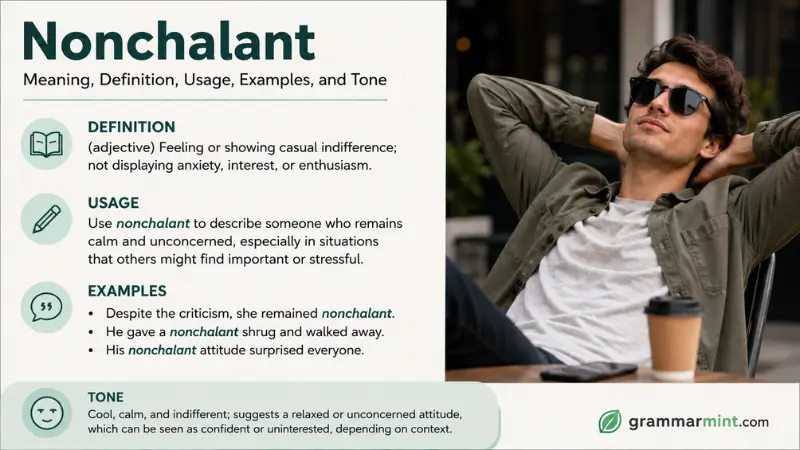
Nonchalant means calm and relaxed in a way that shows little worry or concern.
It usually describes how someone appears on the outside. The person may still feel nervous, worried, or excited inside.
For example, imagine a student walking into a difficult exam without looking nervous. Someone might describe that student as nonchalant.
The student may actually feel confident. They may also be hiding their stress.
The word can describe a person, attitude, voice, smile, shrug, or response.
Common examples include:
• a nonchalant attitude
• a nonchalant smile
• a nonchalant shrug
• a nonchalant response
• a nonchalant tone
The main idea is calm behavior that suggests little concern.
Nonchalant is not exactly the same as relaxed. A relaxed person may simply feel comfortable.
A nonchalant person seems less concerned than people might expect.
Pronunciation, Part of Speech, and Word Forms
A common American pronunciation of nonchalant is:
non-shuh-LAHNT
The final syllable receives the strongest stress.
Nonchalant is an adjective. It describes a person, manner, attitude, or behavior.
Examples:
• She remained nonchalant during the interview.
• He gave me a nonchalant smile.
• Her nonchalant attitude surprised everyone.
The main related forms are:
• nonchalant — adjective
• nonchalantly — adverb
• nonchalance — noun
Example with the adverb:
• He nonchalantly checked his phone.
Example with the noun:
• Her nonchalance impressed the audience.
Do not use nonchalant when you need an adverb.
Incorrect:
• He walked nonchalant into the room.
Correct:
• He walked nonchalantly into the room.
The correct spelling is nonchalant.
Avoid misspellings such as:
• nonchalent
• nonchallant
• nonchalent
How to Use Nonchalant
Use nonchalant when someone appears unusually calm or unconcerned.
It works especially well when the situation could normally cause worry, excitement, embarrassment, or stress.
For example:
• Maya was nonchalant about the delay.
• He gave a nonchalant shrug.
• She answered in a nonchalant tone.
• Jake seemed nonchalant before the final game.
A person can also appear nonchalant because of confidence.
For example:
• The player made the difficult shot look nonchalant.
Here, the word sounds positive. It suggests skill and composure.
The word can sound negative in other situations.
For example:
• His nonchalant attitude toward the deadline annoyed his manager.
Here, the calm attitude suggests carelessness.
Use the surrounding context to understand the intended tone.
Tone and Context: Positive, Negative, or Neutral?
Nonchalant does not always have the same emotional tone.
Sometimes it describes admirable calmness. Other times, it suggests that someone does not care enough.
| Context | Likely Meaning | Why |
|---|---|---|
| Difficult competition | Calm confidence | The person stays composed |
| Small inconvenience | Relaxed reaction | The issue seems unimportant |
| Someone else’s feelings | Indifference | The person may seem uncaring |
| Serious responsibility | Carelessness | The calmness may seem inappropriate |
Consider these sentences:
She was nonchalant before the presentation.
This may suggest confidence.
He was nonchalant about the safety problem.
This sounds negative because the issue is serious.
A useful clue is what comes after about.
If someone is nonchalant about a small delay, the word may be neutral.
If someone is nonchalant about another person’s feelings, it may sound insensitive.
Nonchalant is therefore more specific than calm. It often suggests less concern than people expect.
Nonchalant in Relationships and Online Culture
In relationships, nonchalant often describes someone who appears emotionally distant or hard to read.
The person may respond casually, avoid showing excitement, or act unaffected by conflict.
For example:
• He seemed nonchalant after their argument.
• She acted nonchalant when he mentioned the date.
This behavior does not always mean the person has no feelings.
Someone may care deeply but avoid showing emotion.
Online, people often use nonchalant to describe an “unbothered” attitude.
A person may try to appear effortless, relaxed, or unaffected.
You may see comments such as:
• He is trying too hard to look nonchalant.
• She stayed nonchalant even after the surprise.
• Why is he so nonchalant about everything?
This modern use still comes from the normal English meaning.
It is not a completely different slang definition.
Synonyms, Antonyms, and Common Confusions
Several words are close to nonchalant, but their meanings are not identical.
Synonyms for Nonchalant
Calm
Calm means peaceful and free from strong worry.
It does not always suggest a lack of concern.
Composed
Composed means emotionally controlled.
It often has a positive tone.
Unruffled
Unruffled means not visibly upset or disturbed.
It often describes someone handling pressure well.
Casual
Casual can mean relaxed or informal.
It has a broader meaning than nonchalant.
Unconcerned
Unconcerned means showing little worry.
It is very close to nonchalant in many contexts.
Indifferent
Indifferent means showing little interest or care.
It often sounds more negative than nonchalant.
Laid-back
Laid-back means relaxed and easygoing.
It is more informal and often describes personality.
Antonyms for Nonchalant
Possible opposites include:
• concerned
• interested
• attentive
• engaged
• worried
• anxious
• agitated
The best opposite depends on the sentence.
If nonchalant means “not concerned,” use concerned.
If it means “calm,” words such as anxious or agitated may work better.
Nonchalant vs Confident
Nonchalant and confident can overlap, but they are not the same.
A confident person believes in their ability.
A nonchalant person appears calm and unconcerned.
Confidence can cause someone to act nonchalant.
However, a person can also act nonchalant without feeling confident.
Example:
• Mia confidently explained her answer.
• Mia gave a nonchalant shrug after answering.
The first sentence focuses on belief in her ability.
The second focuses on her relaxed manner.
Nonchalant vs Indifferent
Indifferent usually suggests less interest or concern.
Nonchalant focuses more on someone’s relaxed outward behavior.
For example:
• He seemed nonchalant about the result.
• He was indifferent to the result.
The first sentence focuses on how he appeared.
The second more strongly suggests that he did not care.
That difference can make indifferent sound harsher.
Nonchalant vs Apathetic
Apathetic usually describes a lack of interest, emotion, or motivation.
It is stronger and more negative than nonchalant.
Someone can appear nonchalant while still caring about the situation.
An apathetic person usually lacks motivation or concern more deeply.
Example:
• She looked nonchalant during the discussion.
• She became apathetic and stopped participating.
These sentences describe different levels of emotional involvement.
Nonchalant vs Aloof
Aloof describes someone who seems emotionally or socially distant.
It often refers to how a person interacts with others.
Nonchalant focuses more on appearing calm and unconcerned.
For example:
• The new student seemed aloof at lunch.
• The new student was nonchalant about the test.
Aloof relates more to social distance.
Nonchalant relates more to reaction and concern.
Origin and History
Nonchalant came into English from French.
Its earlier history is connected to an old French verb associated with disregard or lack of concern.
English speakers began using the word centuries ago.
Its central meaning has stayed fairly consistent.
The word has long described someone who appears casually unconcerned.
The spelling can make people wonder whether chalant should be its opposite.
However, English borrowed nonchalant as a complete word.
Because of that history, traditional English does not normally use chalant as the standard opposite.
Today, people sometimes use chalant jokingly or playfully online.
In formal writing, words such as concerned, interested, or engaged are clearer.
Examples of Nonchalant in Sentences
These examples show how nonchalant works in everyday English.
• Jordan looked nonchalant before his driving test.
• She gave a nonchalant shrug when the meeting was delayed.
• The goalkeeper seemed nonchalant after making the difficult save.
• His nonchalant response made me think he was not worried.
• Ava sounded nonchalant, although she had practiced for weeks.
• The manager disliked his nonchalant attitude toward the deadline.
• He tried to appear nonchalant when his name was announced.
• Her nonchalant smile made the presentation look easy.
• My brother was nonchalant about the canceled flight.
• The coach warned the team not to become nonchalant.
The word can also describe an action through its adverb form.
Examples:
• She nonchalantly walked into the room.
• He nonchalantly tossed the keys onto the table.
• Maya nonchalantly changed the subject.
Common Mistakes With Nonchalant
One common mistake is assuming nonchalant is always positive.
It can describe calm confidence, but it can also suggest indifference.
Another mistake is using it as a synonym for relaxed in every situation.
A person sitting comfortably at home may simply be relaxed.
Nonchalant usually suggests that the person is not worried about something.
Writers also sometimes confuse the adjective and adverb forms.
Incorrect:
• He nonchalant answered the question.
Correct:
• He nonchalantly answered the question.
Incorrect:
• Her nonchalantly attitude bothered me.
Correct:
• Her nonchalant attitude bothered me.
Another mistake is assuming that a nonchalant person truly does not care.
The word often describes visible behavior.
Someone may appear nonchalant while feeling strong emotions inside.
Mini Quiz
Choose the best answer.
1. What part of speech is nonchalant?
a) noun
b) adjective
c) adverb
2. Which sentence is correct?
a) She nonchalant opened the door.
b) She gave a nonchalant wave.
c) She walked very nonchalant.
3. Which word is the adverb form?
a) nonchalance
b) nonchalantly
c) nonchalantness
4. Can nonchalant have a negative tone?
a) yes
b) no
5. Which is a clear opposite of nonchalant?
a) concerned
b) casual
c) relaxed
Answer Key: 1-b, 2-b, 3-b, 4-a, 5-a
FAQs
What does it mean when someone is nonchalant?
It means the person appears calm, relaxed, and not very concerned.
The person may truly feel calm, or they may simply hide their emotions well.
What is a nonchalant person?
A nonchalant person often appears easygoing and difficult to upset.
However, the term can also suggest that the person seems uninterested or detached.
Is nonchalant a bad thing?
Not always.
It can describe confidence and composure in stressful situations.
It can sound negative when someone seems careless or insensitive.
What is an example of nonchalant behavior?
Imagine someone receiving surprising news and simply shrugging.
That relaxed response could be described as nonchalant.
What does nonchalant mean in a relationship?
It often describes someone who appears emotionally casual or distant.
They may show little excitement, concern, or visible reaction.
This does not always mean they have no feelings.
Is nonchalant slang?
No.
Nonchalant is a standard English word.
It is also common in modern social media and dating conversations.
Is chalant the opposite of nonchalant?
Not in traditional standard English.
People sometimes use chalant jokingly online.
Words such as concerned, interested, and engaged are clearer opposites.
How do you pronounce nonchalant?
A common American pronunciation is non-shuh-LAHNT.
The final syllable receives the strongest stress.
Conclusion
The nonchalant meaning centers on appearing calm, relaxed, and unconcerned.
The word can suggest confidence, indifference, or emotional distance. Context tells you which meaning fits best.
Use it when someone’s reaction seems calmer or less concerned than expected.