“Engrained” and “ingrained” look like two different words, but they point to the same idea. Both describe something that is deeply fixed in a person’s mind, behavior, or system. The confusion comes from spelling, not meaning.
In modern American English, one form is clearly more common and widely accepted. The other still appears but is less standard in everyday writing.
This guide breaks down the difference in a simple, practical way so you can choose the right form with confidence.
Quick Answer
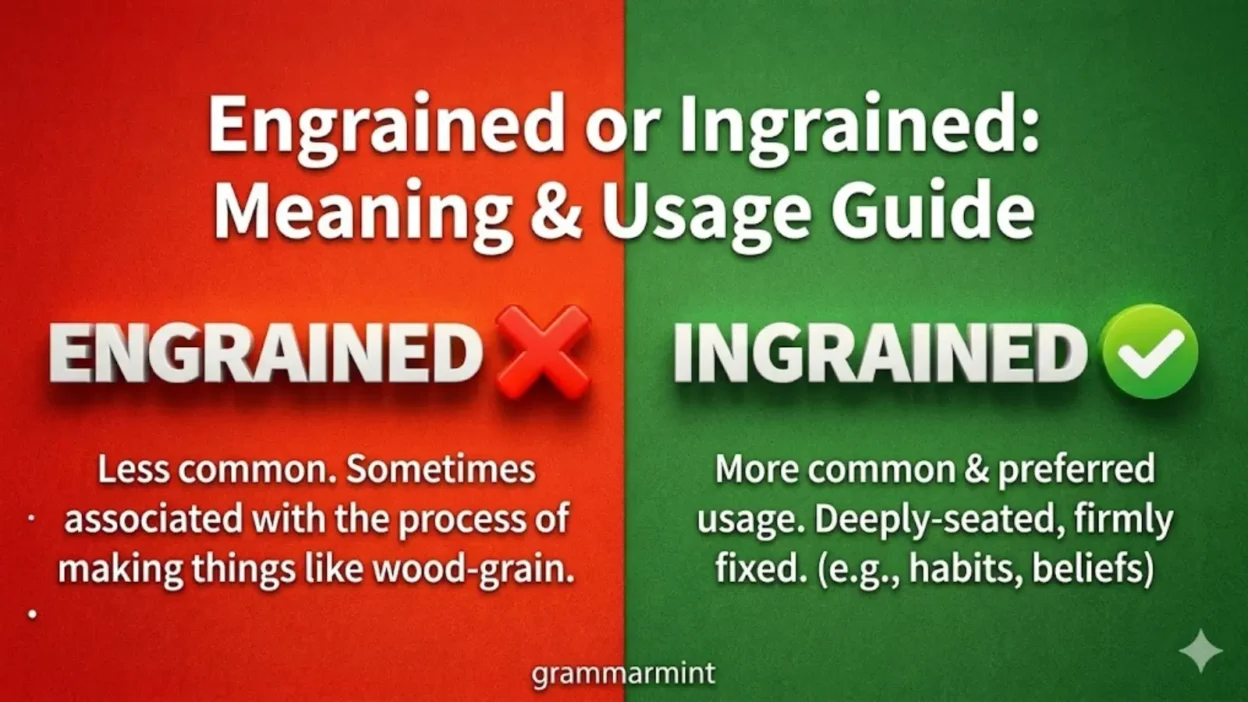
“Ingrained” is the correct and preferred spelling in modern American English.
“Engrained” is a less common variant that carries the same meaning but is used far less in formal or everyday writing.
If you are unsure, always choose ingrained.
Why People Confuse Them
The confusion happens for a few simple reasons.
First, both words are pronounced the same way. You won’t hear any difference in conversation.
Second, English often uses both “in-” and “en-” at the beginning of words, which makes both spellings feel believable. Words like “enable” and “inside” reinforce this pattern.
Third, readers often encounter “engrained” in older writing or informal usage, which keeps the variation alive even though it is less standard today.
So the confusion is not about meaning—it’s about spelling habits.
Key Differences At A Glance
| Context | Best Choice | Why |
|---|---|---|
| Academic writing | Ingrained | Standard modern form |
| Professional communication | Ingrained | Widely accepted spelling |
| Everyday writing | Ingrained | Most natural and familiar |
| Historical or stylistic usage | Engrained | Older or variant spelling |
Meaning and Usage Difference
There is no difference in meaning between “engrained” and “ingrained.”
Both describe something deeply set or fixed, especially:
- habits
- beliefs
- behaviors
- cultural patterns
For example, an ingrained habit is something you do automatically because it has become part of your routine over time.
The only difference is spelling preference.
- Ingrained: standard modern spelling used in most writing today
- Engrained: alternate spelling seen less often
In real-world usage, “ingrained” is the form readers expect.
Tone, Context, and Formality
“Ingrained” fits smoothly into all writing situations. It works in academic essays, business emails, and casual writing without drawing attention.
“Engrained,” on the other hand, can feel slightly outdated or less polished depending on the audience. Even though it is understandable, it is not the form most editors prefer.
If you are writing for a broad audience in the United States, “ingrained” keeps your writing consistent with modern expectations.
Which One Should You Use?
The safest and clearest choice is always ingrained.
Use it when writing:
- essays
- reports
- articles
- emails
- social content
Use “engrained” only when:
- quoting older text exactly
- preserving historical spelling
- intentionally reflecting a variant style
Outside of those cases, “ingrained” is the better option.
When One Choice Sounds Wrong
To many readers, “engrained” can look like a spelling error even though it is still recognizable.
This can distract from your message in professional writing. It may also lead readers to pause or question the correctness of the sentence.
“Ingrained” does not create that issue. It reads smoothly and feels familiar.
So even if both are understood, only one looks natural in most contexts.
Common Mistakes (and Quick Fixes)
A few simple mistakes appear often with these words:
- Using “engrained” in formal writing → switch to ingrained
- Thinking both spellings are equally standard → only “ingrained” is preferred today
- Overthinking the prefix → just remember “ingrained = correct modern form”
- Mixing usage in one document → stay consistent with “ingrained” throughout
A quick rule helps: if you are writing for clarity and modern readers, use “ingrained.”
Everyday Examples
Here’s how the word naturally appears in real sentences:
- Years of practice made the routine ingrained in her daily life.
- The habit of waking up early is deeply ingrained in him.
- Those ideas are ingrained in the company’s culture.
- He has an ingrained response to double-check everything before leaving.
- Older texts sometimes used “engrained,” but modern writing prefers “ingrained.”
These examples show how the word is used in everyday communication without sounding formal or technical.
Dictionary-Style Word Details
Verb
- Engrained: Not commonly used as a verb in modern English.
- Ingrained: Rare as a verb; primarily used in adjective form in everyday writing.
Noun
- Engrained: Not used as a noun.
- Ingrained: Not used as a noun in standard usage.
Synonyms
- Engrained: closest plain alternatives → fixed, embedded
- Ingrained: closest plain alternatives → deep-seated, rooted, fixed, established
These words carry similar ideas but are not perfect replacements in every sentence.
Example Sentences
- Engrained: His engrained habits reflected older writing conventions.
- Ingrained: Her punctuality is ingrained in her daily routine.
- Ingrained: The safety rules are ingrained in every employee from day one.
Word History
- Engrained: An older variant spelling that appeared in earlier forms of English writing.
- Ingrained: Became the dominant modern spelling in standard usage and remains the preferred form today.
Both forms share the same underlying idea, but usage trends shifted toward “ingrained” over time.
Phrases Containing
- Engrained: rarely used in fixed expressions today
- Ingrained: ingrained habit, deeply ingrained belief, ingrained behavior, ingrained response
These phrases are common in everyday English and appear across writing styles.
FAQs
1. Is “engrained” ever correct, or is it always wrong in modern English?
“Engrained” is not completely wrong, but it is considered a less common variant in modern English. The standard and widely accepted spelling today is “ingrained.” You may still find “engrained” in older books, informal writing, or stylistic choices, but most editors, teachers, and publications prefer “ingrained.” In everyday American English, using “engrained” can look outdated or less polished, even though it is still understandable. So, while it is not technically invalid, it is rarely recommended for modern writing.
2. What does “ingrained” actually mean in simple terms?
“Ingrained” means something that is deeply fixed or firmly established over time. It is often used to describe habits, behaviors, beliefs, or ways of thinking that are hard to change. For example, if someone has an ingrained habit of waking up early, it means they do it naturally without thinking about it. The idea is that the behavior has become part of the person or system, almost automatic. It usually implies something long-lasting rather than temporary.
3. Why do people sometimes write “engrained” instead of “ingrained”?
People often write “engrained” because it sounds exactly the same as “ingrained,” so the difference is not noticeable when spoken. Also, English spelling patterns can be confusing because both “in-” and “en-” appear in many words. Some writers assume both forms are equally correct or simply repeat what they have seen in older texts. In reality, “ingrained” became the preferred modern spelling, while “engrained” remained as a less common variation.
4. Is there any difference in meaning between “engrained” and “ingrained”?
No, there is no difference in meaning between the two words. Both describe something deeply fixed, especially habits, beliefs, or behaviors that are difficult to change. The only difference is spelling usage and preference. “Ingrained” is the standard modern form, while “engrained” is an older or less commonly used variant. So if you see either word in a sentence, they are communicating the same idea.
5. Which spelling should I use in academic or professional writing?
In academic, business, and professional writing, you should always use “ingrained.” This form is widely accepted in modern English and aligns with current style expectations. Using “engrained” in formal writing may appear outdated or inconsistent, even if it is still understandable. To keep your writing clear, professional, and aligned with standard usage, “ingrained” is the safest and most correct choice.
6. Can “ingrained” be used for both good and bad habits?
Yes, “ingrained” can describe both positive and negative patterns. For example, a person might have ingrained discipline, which is positive, or ingrained laziness, which is negative. The word itself does not carry judgment; it simply means something is deeply established over time. The context of the sentence determines whether the meaning is positive, negative, or neutral.
7. Why is “ingrained” more commonly used than “engrained” today?
“Ingrained” became the dominant spelling because it aligns more closely with modern standard English usage patterns. Over time, dictionaries, editors, and writing guides adopted “ingrained” as the preferred form. As a result, it appears far more often in books, articles, and academic writing today. “Engrained” gradually became less common and is now mostly seen as a variant rather than the standard choice.
8. What are some real-life examples of “ingrained” behavior?
In everyday life, “ingrained” is often used to describe habits or patterns that people do automatically. For example, checking your phone first thing in the morning can become an ingrained habit. In workplaces, safety rules may become ingrained in employees after repeated training. Cultural traditions can also be ingrained in communities over generations. In all these cases, the behavior feels natural and automatic rather than forced.
9. Is “ingrained” only used for people, or can it describe systems and culture too?
“Ingrained” is not limited to people. It can also describe systems, organizations, and cultures. For example, a company may have ingrained policies that guide how employees behave. A culture may have ingrained traditions passed down for generations. Even systems of thinking in society can be described as ingrained if they are deeply established and resistant to change. The word is flexible and widely used in both personal and larger social contexts.
10. What is the easiest way to remember the correct spelling?
A simple way to remember is: “Ingrained = In standard English.” The “in-” prefix helps you connect it with modern usage, while “engrained” is just a less common variation. If you are ever unsure, choose “ingrained” because it is the version you will see most often in books, articles, and professional writing. Over time, remembering that “ingrained” is the standard form will help you avoid mistakes naturally.
Conclusion
“Engrained” and “ingrained” mean the same thing, but they are not used equally today.
“Ingrained” is the clear, modern, and widely accepted spelling in American English. It fits all writing contexts and reads naturally to most audiences.
“Engrained” still exists but is far less common and usually avoided in formal writing.
If you want simple, correct, and natural English, ingrained is the word to use.