English has many small grammar pairs that look simple but confuse a lot of people in real writing and speaking.
One of the most common is “neither nor or neither or.”
At first glance, both versions look almost the same. They even feel like they should both be correct. But only one of them follows standard English grammar rules.
This guide explains everything in a clear and practical way so you never mix them up again. You’ll see how the structure works, why one form is wrong, and how to use the correct version naturally in everyday sentences.
Quick Answer
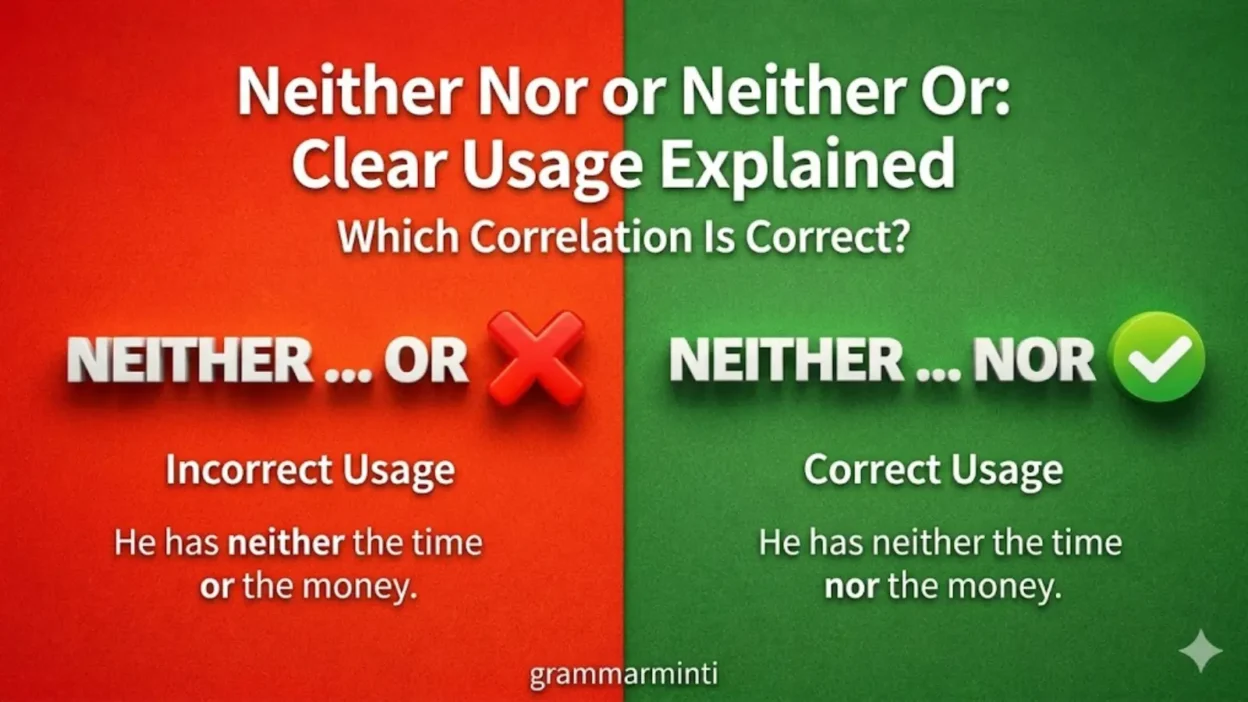
The correct form is: neither…nor
The incorrect form is: neither…or
“Neither” always pairs with “nor,” not “or,” when connecting two negative ideas.
Why People Confuse Them
This confusion usually comes from another common structure in English:
- either…or
Because “either” pairs with “or,” many people assume “neither” might also pair with “or.” That logic feels natural, but grammar does not follow a simple mirror rule here.
Instead, English uses fixed partnerships called correlative pairs. These pairs must stay consistent:
- either…or
- neither…nor
- both…and
- not only…but also
So the mistake happens when learners mix patterns from different pairs.
Another reason for confusion is spoken English. In casual conversation, people sometimes say incorrect forms quickly without noticing the structure, and it becomes a habit.
Key Differences At A Glance
| Feature | Neither Nor | Neither Or |
|---|---|---|
| Correctness | Standard English structure | Not grammatically correct |
| Grammar Role | Correlative conjunction pair | Broken or incorrect pairing |
| Meaning | Shows two negative choices | No standard meaning in grammar |
| Usage | Formal and informal English | Not recommended in writing or speech |
Meaning and Usage Difference
The phrase “neither…nor” is used to connect two negative ideas. It tells the reader or listener that both options are not true or not included.
For example:
- Neither the manager nor the assistant was available.
This means:
- The manager was not available
- The assistant was not available
Both sides are negative, and “nor” keeps the structure balanced.
Now compare that with “neither or.”
“Neither or” is not recognized as a correct grammatical structure. It breaks the expected pairing and does not properly connect the ideas.
English requires balance in correlative structures. That balance is what makes sentences clear and predictable.
Tone, Context, and Formality
“Neither…nor” works in all levels of English communication:
- Casual speech
- School writing
- Emails
- Professional documents
- Academic writing
It is neutral in tone and widely accepted.
Example in casual speech:
- I want neither pizza nor burgers tonight.
Example in formal writing:
- Neither proposal nor alternative plan was approved.
On the other hand, “neither or” does not fit standard usage in any formal context. It may appear in speech errors, but it is considered incorrect in writing.
Which One Should You Use?
Always choose neither…nor when you want to express two negative options.
Use it when both items are excluded or not true.
Examples:
- Neither the phone nor the tablet is working.
- She likes neither tea nor coffee.
- Neither option nor backup plan was successful.
A simple way to remember it:
If you start with neither, you must complete the pair with nor.
When One Choice Sounds Wrong
“Neither or” sounds incorrect because it breaks a fixed grammatical relationship.
English depends on predictable pairing patterns. When you replace one half of the pair, the sentence loses structure.
Compare:
- Correct: Neither Jack nor Sam attended.
- Incorrect: Neither Jack or Sam attended.
Even though the second version may sound understandable in casual speech, it does not follow standard grammar rules.
This is why it often feels “off” to readers and listeners.
Common Mistakes (and Quick Fixes)
Mistake 1:
- Neither the coach or the players agreed.
Fix:
- Neither the coach nor the players agreed.
Mistake 2:
- I like neither apples or oranges.
Fix:
- I like neither apples nor oranges.
Mistake 3:
- Neither he or she was ready.
Fix:
- Neither he nor she was ready.
Mistake 4:
- Neither of them or their friends came.
Fix:
- Neither of them nor their friends came. (or restructure for clarity: Neither they nor their friends came.)
These mistakes happen when “or” is used automatically instead of “nor.”
Everyday Examples
Here are natural sentences you might hear or use in the United States:
- Neither the game nor the concert was fun.
- She wants neither sugar nor cream in her coffee.
- Neither the app nor the website is working today.
- I have neither time nor energy for that right now.
- Neither the teacher nor the students understood the question.
These examples show how flexible and common the structure is in everyday communication.
Dictionary-Style Word Details
Verb
- Neither Nor: Not used as a verb. It functions as a fixed grammatical pairing in sentences.
- Neither Or: Not used as a verb and is not a valid structure in standard grammar.
Noun
- Neither Nor: Not a noun. It is a correlative conjunction phrase used to connect two negative ideas.
- Neither Or: Not a noun and not a recognized grammatical phrase.
Synonyms
- Neither Nor: closest plain alternatives include “not either…or” (restructured meaning in informal speech)
- Neither Or: no valid synonyms as a standard form because it is not grammatically correct
Example Sentences
- Neither Nor: Neither the lights nor the power outlet worked during the storm.
- Neither Nor: She enjoys neither running nor swimming in cold weather.
- Neither Or: (Incorrect usage) Neither the lights or the power outlet worked.
Correct form: Neither the lights nor the power outlet worked.
Word History
- Neither Nor: This structure developed in English as part of correlative conjunction patterns used to balance two negative ideas in a sentence. The pairing became standardized in grammar usage over time.
- Neither Or: This is not an established historical grammatical form. It likely appears due to confusion with the “either…or” structure rather than a separate development in English grammar.
Phrases Containing
- Neither Nor: neither here nor there, neither fish nor fowl, neither one thing nor another, neither more nor less
- Neither Or: not used in standard phrase structures
FAQs: Neither Nor or Neither Or
1. Is it “neither nor” or “neither or”?
The correct form is “neither…nor.”
“Neither…or” is not standard English grammar and should be avoided in writing and formal speech.
2. Why is it “nor” instead of “or”?
English uses fixed correlative pairs.
“Neither” always pairs with “nor” to keep the sentence balanced in meaning and structure.
3. Can I ever use “neither or” in spoken English?
In casual speech, some people may say it by mistake, but it is still considered incorrect in standard English. In writing, it should always be corrected to “neither…nor.”
4. What is the rule for “neither…nor”?
The rule is simple:
Use neither…nor to connect two negative ideas or choices.
Example:
- Neither the teacher nor the students were ready.
5. Is “neither…nor” formal or informal?
It works in both.
You can use it in everyday conversation, school writing, emails, and formal documents.
6. What is the most common mistake with “neither…nor”?
The most common mistake is replacing “nor” with “or.”
Incorrect:
- Neither John or Mike came.
Correct:
- Neither John nor Mike came.
7. Is “neither…nor” only used for two things?
Yes, it typically connects two items, ideas, or choices.
For more than two items, the sentence is usually restructured for clarity.
8. What is the difference between “either…or” and “neither…nor”?
- Either…or = one of two choices is true
- Neither…nor = both choices are not true
Examples:
- Either coffee or tea is fine.
- Neither coffee nor tea is available.
Conclusion
The correct and standard form in English is neither…nor.
It is a fixed grammatical pair that connects two negative ideas clearly and correctly. The alternative “neither or” is not part of standard grammar and should be avoided in writing and formal communication.
Once you remember that “neither” always partners with “nor,” the confusion disappears quickly.
Using the correct form makes your English clearer, more natural, and grammatically accurate in any situation.