“Where” and “were” are two English words that cause constant confusion, especially in writing and texting. They look similar, and when spoken quickly, they can even sound almost identical. But their roles in grammar are completely different.
“Where” is connected to places, locations, and positions. “Were” is connected to past situations and actions. Mixing them can change the meaning of a sentence or make it incorrect.
This guide breaks down the difference in a simple, practical way so you can confidently choose the right word every time you write or speak.
Quick Answer
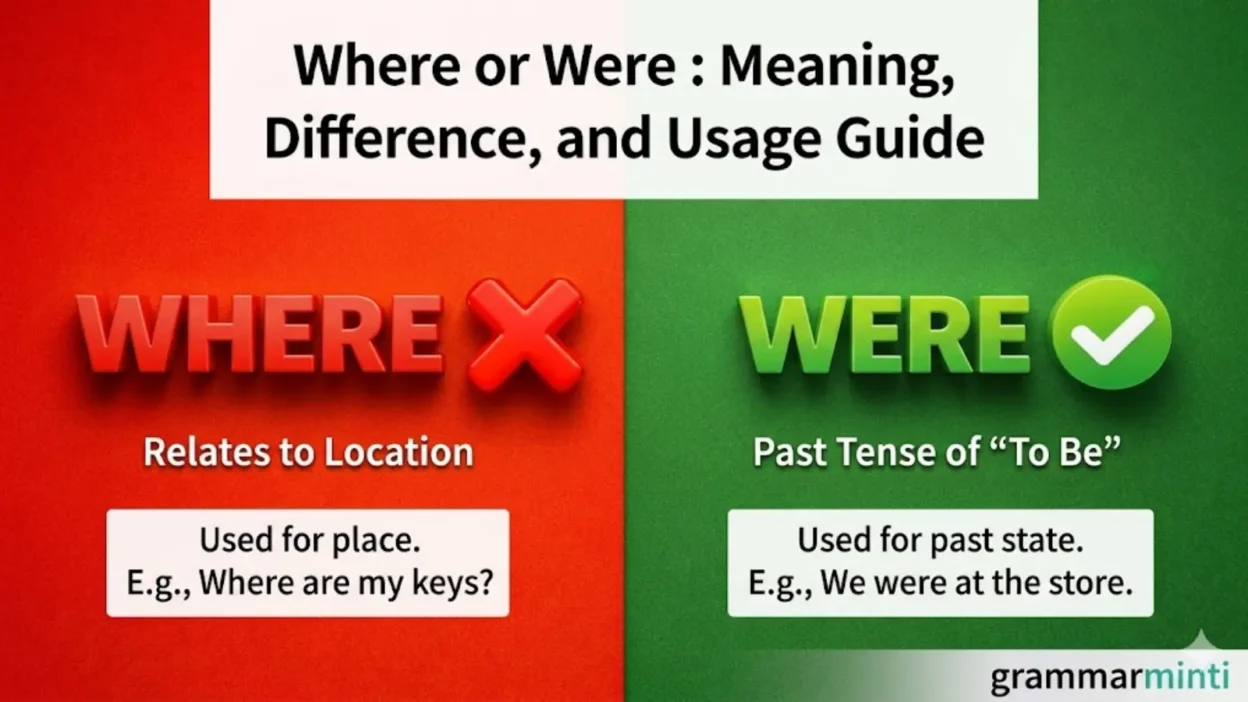
“Where” is used for location or place.
“Were” is the past tense form of “to be” for plural subjects and “you.”
Simple rule:
- Use where when asking or describing a place.
- Use were when talking about something that happened in the past.
Examples:
- Where is the station?
- They were at the station yesterday.
Why People Confuse Them
The confusion between “where” and “were” happens for a few clear reasons.
First, they sound nearly identical in fast or casual speech. In many accents, the vowel sounds become very close, making them hard to distinguish by listening alone.
Second, both words appear in very common sentences. “Where are you?” and “They were here” are both everyday expressions. Because learners hear them frequently, they start to rely on sound instead of meaning.
Third, typing mistakes play a big role. On phones or keyboards, fast typing often leads to swapping the two words without noticing.
Finally, beginners sometimes treat English as sound-based rather than meaning-based. But these two words only make sense when you focus on context, not pronunciation.
Key Differences At A Glance
| Context | Best Choice | Why |
|---|---|---|
| Talking about a place or location | Where | It refers to position or place |
| Talking about the past | Were | It shows past state or action |
| Feature | Where | Were |
|---|---|---|
| Grammar role | Question word / relative word | Verb (past tense of “to be”) |
| Time reference | Present or general | Past |
| Main idea | Location or direction | Past situation or condition |
| Sentence function | Asks or connects place info | Describes past state |
This simple breakdown helps separate meaning-based usage from grammar-based usage.
Meaning and Usage Difference
The real difference between “where” and “were” is not just spelling—it is function.
Where
“Where” is used when you are talking about a place, position, or direction. It often appears in questions but can also appear in statements.
Examples:
- Where are you now?
- I don’t know where he went.
- This is the house where I grew up.
In all cases, the idea of location is present. Even when it is not a direct question, it still connects to a place.
“Where” can also link ideas in a sentence, especially when describing location in storytelling or explanation.
Were
“Were” is the past tense form of the verb “to be.” It is used with plural subjects and with “you.”
Examples:
- They were at the meeting yesterday.
- You were very helpful.
- We were late to school.
It describes a past state, condition, or situation. Unlike “where,” it does not relate to place. It relates to time.
A helpful way to think about it:
- “Where” = place
- “Were” = past existence or condition
Tone, Context, and Formality
Both words are neutral in tone and used across all levels of English—from casual conversation to formal writing.
“Where” often appears in questions, instructions, and explanations. It is common in both spoken and written English, especially when giving directions or asking for information.
“Were” is often found in storytelling, reports, and descriptions of past events. It is also common in everyday conversation when talking about what happened earlier.
Neither word is more formal or informal. The difference lies entirely in their grammatical role.
In texting or casual writing, confusion between the two is more likely because people rely on sound instead of structure. In formal writing, the distinction becomes more important because incorrect usage can change meaning.
Which One Should You Use?
Choosing between “where” and “were” becomes easy when you check the meaning of your sentence.
Ask yourself these two questions:
- Am I talking about a place or location?
→ Use where - Am I talking about something in the past?
→ Use were
Quick mental trick:
- If you can replace the word with “at what place,” use where.
- If you can replace it with “was/were” in past context, use were.
Examples:
- Where did you leave your bag? (place)
- You were very tired yesterday. (past condition)
When One Choice Sounds Wrong
Using the wrong word often makes the sentence confusing or incorrect.
Wrong usage of “where”
- They where happy at the party. ❌
This incorrectly suggests location instead of past condition.
Correct:
- They were happy at the party. ✔
Wrong usage of “were”
- Were is the store you bought this? ❌
This removes the idea of place.
Correct:
- Where is the store you bought this? ✔
When you hear a sentence and it feels “off,” it is often because the word does not match the meaning category (place vs past time).
Common Mistakes (and Quick Fixes)
• One common issue is writing based on sound instead of meaning. To fix this, first identify whether the sentence refers to a place or a past-time action.
• Another mistake happens when words get swapped during fast typing. A simple fix is to re-read each sentence before sending it.
• Many learners forget that “were” is the past tense form of “to be.” A helpful trick is to connect it with “was” and “are” for better memory.
• Sometimes “where” is used incorrectly in past-time sentences. The rule is simple: if time is involved, use “were,” not “where.”
• Confusion also occurs in questions. Remember that questions about place usually begin with “where.”
Everyday Examples
Here are more natural examples to show real usage:
- Where are you going after school?
- I don’t remember where I put my phone.
- They were very excited about the concert.
- You were supposed to call me yesterday.
- Where did everyone sit during lunch?
- We were at the wrong location.
- Where is the nearest coffee shop?
- She said they were not ready yet.
These examples show how “where” stays tied to location while “were” stays tied to past situations.
Dictionary-Style Word Details
Verb
• Where: Not used as a verb in standard English.
• Were: Verb form of “to be” used in past tense for plural subjects and “you.”
“Were” is essential in forming correct past sentences involving states or conditions.
Noun
• Where: Not used as a noun in standard usage.
• Were: Not used as a noun in standard English grammar.
Neither word functions as a noun in typical usage.
Synonyms
• Where: closest plain alternatives include “at what place,” “in which place”
• Were: closest plain alternatives include “was” (for singular past reference), “existed” (context-based meaning)
These are not perfect replacements but help clarify meaning.
Example Sentences
Where (place-related questions and meanings):
• Where did the meeting happen?
• I know where she parked her car.
• Where are you heading this weekend?
Were (past form of “to be”):
• They were late to class today.
• You were very quiet during the call.
• We were at home all evening.
Word History
• Where: Comes from Old English roots meaning “at what place” or “in what situation.” It has always been tied to location and inquiry.
• Were: Comes from Old English forms of the verb “to be,” used to express past conditions for plural subjects and “you.”
Both words have long histories in English but developed completely different grammatical roles over time.
Phrases Containing
• Where: where are you from, where in the world, where to next, know where you stand
• Were: were you there, were not able, were going to, were supposed to
These phrases show how each word functions naturally in real communication.
FAQs
1. What is the main difference between where and were?
“Where” is used to talk about location or place, while “were” is the past tense form of “to be” used for plural subjects and “you.”
2. Can where and were sound the same when spoken?
Yes, in fast or casual speech they can sound very similar, which is why many people confuse them. However, their meanings are completely different.
3. How do I remember when to use where?
Think of where = place. If your sentence is asking about or describing a location, use “where.”
Example: Where is the nearest store?
4. How do I remember when to use were?
Think of were = past time. If you are talking about something that already happened, use “were” with plural subjects or “you.”
Example: They were at school yesterday.
5. Is were always past tense?
Yes. “Were” is the past tense form of the verb “to be” used for plural subjects and “you.”
6. Can I use where in past tense sentences?
Only if you are talking about a place in the past. “Where” still refers to location, not time.
Example: Where were you yesterday?
7. What is a common mistake with where and were?
A common mistake is writing “where” instead of “were,” especially in sentences about past situations.
Wrong: They where happy.
Correct: They were happy.
8. Why do people confuse where and were so often?
Because they look similar and sound almost the same in spoken English, especially in fast conversation or texting.
9. Can were be used with singular subjects?
Yes, but mainly with the word “you” or in hypothetical/conditional sentences.
Example: If I were you, I would wait.
10. Is where only used in questions?
No. “Where” is used in both questions and statements.
Conclusion
“Where” and “were” may look similar, but they belong to completely different parts of English grammar. One deals with location, and the other deals with past time. Once you connect each word to its core role, the confusion becomes much easier to avoid.
The key is simple: think place for “where,” think past for “were.” With practice, choosing the right word becomes automatic.