If you write schoolwork, emails, captions, or work messages, choosing Has or Have has-or-have can feel tricky at first. However, the rule is simple once you find the subject. This guide explains has vs have, grammar rules, example sentences, pronouns, singular nouns, plural nouns, questions, negatives, present perfect forms, and common mistakes. You’ll also see quick practice lines, so the rule sticks. By the end, you’ll know whether to write “she has,” “they have,” “does he have,” or “I have” without second-guessing yourself.
Quick Answer
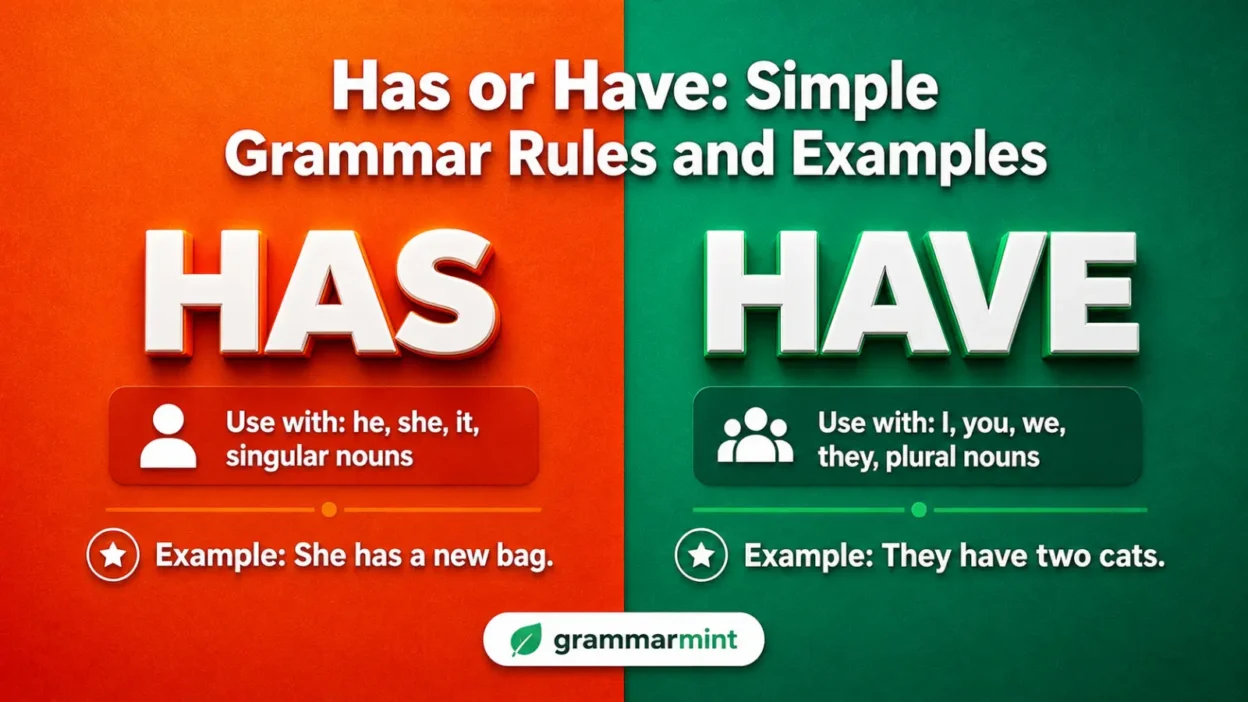
Has or have depends on the subject. Use has with he, she, it, and one person or thing; use have with I, you, we, they, and plural subjects.
TL;DR
• He, she, and it take has.
• I, you, we, and they take have.
• Plural nouns usually take have.
• Questions with does use have.
• Past tense uses had for everyone.
Has Or Have Difference
The difference starts with the subject. In simple terms, subject agreement means the verb must match who or what the sentence is about. Therefore, a singular subject often takes has, while a plural subject usually takes have.
• She has a meeting today.
• They have a meeting today.
• The dog has a collar.
• The dogs have collars.
• He has a new idea.
• We have several new ideas.
• It has a cracked screen.
• The phones have cracked screens.
• A teacher has lesson plans.
• Teachers have lesson plans.
• My friend has your number.
• My friends have your number.
• The rule changes with the subject.
• Start there, and you’ll choose faster.
Has Or Have Examples
Examples make the rule much easier. These example sentences use everyday English, so you can hear the correct form in real context. Also, read each line aloud to notice the pattern.
• I have a busy morning.
• You have a clear answer.
• She has a kind smile.
• He has three assignments due.
• It has a blue cover.
• We have enough time.
• They have two extra chairs.
• Maria has a new laptop.
• The students have sharp pencils.
• This app has useful features.
• Those apps have different settings.
• My brother has soccer practice.
• Our neighbors have two cats.
• The store has fresh bread.
Use Of Has And Have
Has and have can show possession, but they also show an experience or a relationship. In addition, they help form longer verb phrases. So, the meaning depends on the rest of the sentence.
• I have a question.
• She has my jacket.
• They have a small apartment.
• He has a younger sister.
• We have a problem.
• The car has leather seats.
• Those books have helpful charts.
• You have my full attention.
• The baby has a fever.
• My parents have good advice.
• The team has strong players.
• Both teams have loyal fans.
• This lesson has clear steps.
• These lessons have review notes.
Has Or Have In A Sentence
A sentence pattern helps you place the verb correctly. Sometimes has or have works as a main verb. Other times, it works as a helping verb before another action.
• She has a red notebook.
• She has finished her homework.
• We have a family dinner.
• We have planned the menu.
• He has a dentist appointment.
• He has brushed his teeth.
• I have a fresh idea.
• I have written the draft.
• They have a new coach.
• They have improved this season.
• The cat has soft fur.
• The cat has slept all day.
• You have a strong voice.
• You have made your point.
Has Or Have Grammar Rules
The basic rule works in the present tense. Use has for the third-person singular, and use have almost everywhere else. Also, after do or does, use the base form have.
• I have is correct.
• You have is correct.
• He has is correct.
• She has is correct.
• It has is correct.
• We have is correct.
• They have is correct.
• A child has is correct.
• Children have is correct.
• Does she have is correct.
• Do they have is correct.
• Never write does she has.
• Never write do they has.
• Had works for past time.
Has Or Have With I
With the first person, always use I have in the present. This is true even though I talks about one person. Therefore, never write “I has” in standard English.
• I have a pencil.
• I have two sisters.
• I have a math test.
• I have seen that movie.
• I have finished the form.
• I have a quick question.
• I have your email.
• I have no extra cash.
• I have a strong opinion.
• I have learned the rule.
• I have a doctor’s note.
• I have enough practice now.
• I have made fewer mistakes.
• I have used this correctly.
Has Or Have With You
With the second person, always use you have. This rule works for one person and many people. As a result, singular you and plural you share the same verb.
• You have a nice bag.
• You have two options.
• You have my support.
• You have enough time.
• You have made progress.
• You have seen the answer.
• You have a clear voice.
• You have several missed calls.
• You have a strong reason.
• You have finished early today.
• You have good study habits.
• You have the correct form.
• You have learned this pattern.
• You have fewer errors now.
Has Or Have With He She It
He, she, and it all take has. So, write he has, she has, and it has when the sentence is present tense. However, use have after does in a question or negative.
• He has a blue car.
• She has a music class.
• It has four wheels.
• He has finished lunch.
• She has called twice.
• It has stopped raining.
• He has no umbrella.
• She has a bright future.
• It has a strange sound.
• Does he have tickets?
• Does she have homework?
• Does it have batteries?
• He doesn’t have cash.
• She doesn’t have time.
Has Or Have With Names
A proper noun works like the pronoun it replaces. If the name means one person, one animal, or one thing, use has. A company name can also take has when treated as one organization.
• Kevin has a new bike.
• Maya has piano lessons.
• Grandma has fresh cookies.
• Mr. Lewis has office hours.
• The school has new lockers.
• Apple has many products.
• The restaurant has outdoor seating.
• Chicago has cold winters.
• My laptop has low battery.
• Friday has a lighter schedule.
• The puppy has white paws.
• Your cousin has great timing.
• That website has clear instructions.
• This movie has a surprising ending.
Has Or Have With Plural Subjects
A plural noun usually takes have. A compound subject with two people or things also takes have. In short, when the subject can become they have, use have.
• The boys have matching shirts.
• The girls have art supplies.
• Cats have sharp claws.
• Dogs have strong noses.
• Books have different covers.
• Phones have many settings.
• Emma and Jack have tickets.
• Rice and beans have flavor.
• My shoes have mud stains.
• These cookies have chocolate chips.
• Those houses have big yards.
• Both answers have good points.
• Several students have questions.
• Many families have weekend plans.
Has Or Have Questions
Question words can hide the subject. Still, the question form becomes easier when you look for do or does. Use does have with one he, she, it, or named subject; use do have with I, you, we, they, and plurals.
• Does she have a pen?
• Does he have your address?
• Does it have a charger?
• Does Maria have a ride?
• Does the store have milk?
• Do you have a minute?
• Do they have homework?
• Do we have practice today?
• Do the kids have snacks?
• Do these shoes have laces?
• What does he have?
• What do you have?
• Why does she have two?
• Why do they have more?
Has Or Have Negative Sentences
A negative sentence often uses don’t or doesn’t. Use doesn’t have after he, she, it, and one named subject. Use don’t have with I, you, we, they, and plural subjects.
• I don’t have change.
• You don’t have permission.
• We don’t have tickets.
• They don’t have enough chairs.
• She doesn’t have homework.
• He doesn’t have a license.
• It doesn’t have a handle.
• Mike doesn’t have practice.
• The dog doesn’t have water.
• The dogs don’t have leashes.
• My friends don’t have class.
• The office doesn’t have parking.
• These jeans don’t have pockets.
• That answer doesn’t have support.
Has Or Have Present Perfect
The present perfect uses has or have with a past participle. It often shows a completed action that still matters now. Therefore, the same subject rule still controls the first verb.
• I have eaten breakfast.
• You have passed the quiz.
• We have cleaned the room.
• They have left already.
• She has opened the gift.
• He has lost his keys.
• It has started again.
• Rachel has sent the file.
• The birds have flown away.
• My parents have arrived safely.
• The meeting has ended early.
• These plans have changed quickly.
• Our team has won twice.
• Their teams have played well.
Has Have Had Difference
Has and have talk about now. Had is the past tense form for every subject. Still, a time marker like yesterday, last week, or before school can make the choice clearer.
• I have lunch now.
• I had lunch earlier.
• She has a cold today.
• She had a cold yesterday.
• They have soccer practice.
• They had practice last night.
• We have a new plan.
• We had another plan before.
• He has your notebook.
• He had your notebook yesterday.
• It has a small crack.
• It had no crack before.
• You have extra time today.
• You had extra time Monday.
Has Or Have Exercises
Use grammar practice to make the choice automatic. Try each fill-in-the-blank, then check the answer key right after. Also, say the full sentence aloud.
• She ___ a purple backpack.
• Answer: She has a purple backpack.
• They ___ a science project.
• Answer: They have a science project.
• I ___ three missed calls.
• Answer: I have three missed calls.
• The baby ___ tiny socks.
• Answer: The baby has tiny socks.
• We ___ enough plates.
• Answer: We have enough plates.
• Does he ___ a ticket?
• Answer: Does he have a ticket?
• The players ___ new uniforms.
• Answer: The players have new uniforms.
Common Has Or Have Mistakes
Most common mistakes happen when the subject is hidden. So, use a quick check: find the subject first, then choose the subject match. After that, read the sentence once more.
• Wrong: She have a bike.
• Right: She has a bike.
• Wrong: They has homework.
• Right: They have homework.
• Wrong: Does he has one?
• Right: Does he have one?
• Wrong: I has an idea.
• Right: I have an idea.
• Wrong: The kids has snacks.
• Right: The kids have snacks.
• Wrong: My phone have power.
• Right: My phone has power.
• Wrong: We has a plan.
• Right: We have a plan.
FAQs
What Is The Difference Between Has And Have?
Has and have are present forms of the verb “to have.” Use has with he, she, it, and one person or thing. Use have with I, you, we, they, and plural subjects.
When Should You Use Has?
Use has when the subject is one person, one animal, or one thing. For example, “She has a book” and “The car has new tires” are correct.
When Should You Use Have?
Use have with I, you, we, they, and plural nouns. For example, “I have time,” “You have a choice,” and “The students have homework” are correct.
Can Has And Have Be Used In The Same Sentence?
Yes, they can appear in the same sentence with different subjects. For example, “She has a bike, and her friends have scooters” uses both correctly.
Why Do People Confuse Has And Have?
People confuse them because both come from the same verb. Also, long sentences can hide the real subject, so the wrong form slips in.
Is There A Difference Between British And American English?
The basic rule is the same in British and American English. However, casual phrases may differ, especially with “have got” and “has got.”
How Can I Remember Has Or Have Easily?
Remember this simple pattern: he, she, and it use has. I, you, we, and they use have, so check the subject first.
Conclusion
Choosing Has or Have has-or-have gets easy when you match the verb to the subject. Use has for he, she, it, and one subject; use have for I, you, we, they, and plural subjects. Keep practicing with short sentences, and the right choice will start to sound natural.