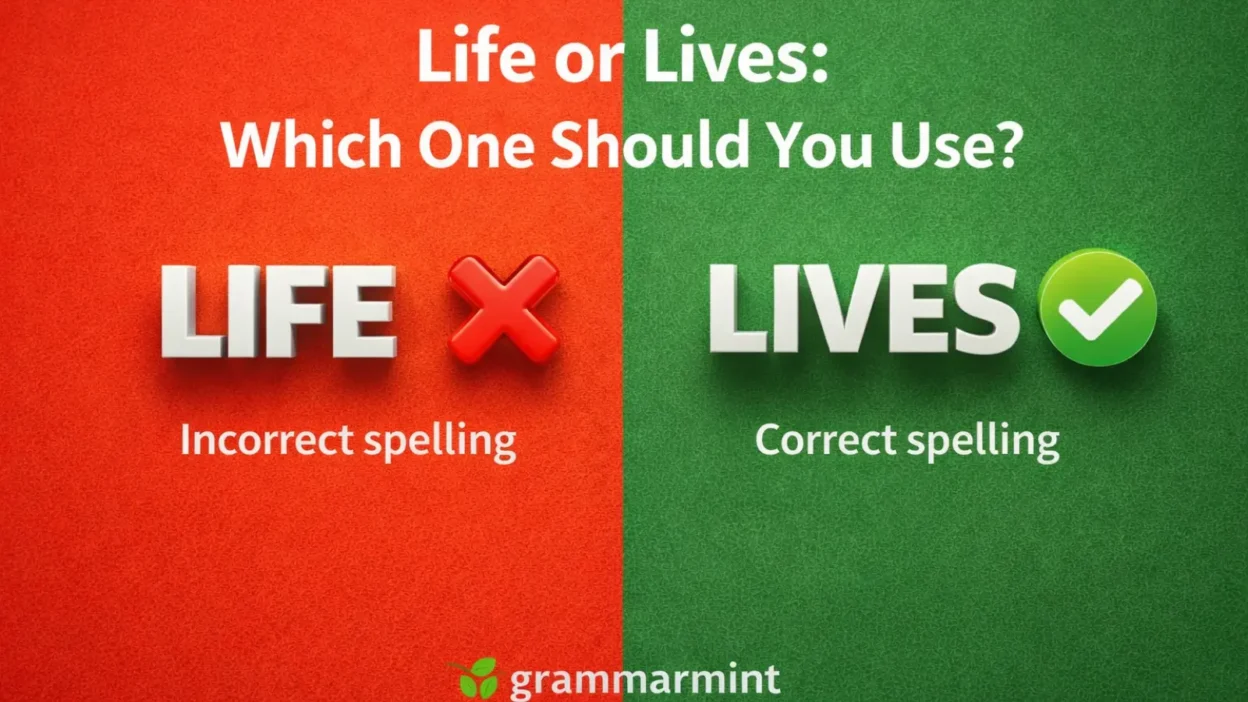
Life or Lives can confuse students, writers, and everyday English learners because the words look close, sound close, and shift by context. You might see them in emails, schoolwork, captions, grammar questions, daily routines, personal stories, and even art terms like still life. This guide clears up the difference between singular noun, plural noun, possessive form, verb form, spelling rule, and common usage in plain American English. It also shows where phrases like people’s lives, our lives, and daily life sound natural, plus where writers often pause and second-guess the right form. The core rule is straightforward: life is singular, and lives is usually the plural.
Quick Answer
Life or Lives depends on number and context: use life for one person, one existence, or one general concept, and use lives for more than one life. Also, lives can be a verb, as in “She lives in Boston.”
TL;DR
• Life is singular
• Lives is usually plural
• Lifes is not standard English
• Life’s shows possession or contraction
• Context decides noun or verb
• Still lifes is a special exception
Plural Of Life
The main rule is simple. Start here, and most mistakes disappear.
When you need more than one, use lives, not lifes. Irregular plural forms can feel tricky at first, but this one is standard and stable.
• Life means one living existence
• Lives means more than one life
• Correct form is always lives
• One child has one life
• Many children have many lives
• A cat supposedly has nine lives
• Heroes can save many lives
• Some stories change lives
• We value human lives deeply
• The accident cost two lives
• Their private lives stayed quiet
• Writers often compare different lives
When To Use Life
Use life when you mean one existence or one broad idea. In many sentences, singular feels cleaner and more natural.
Also, one person often points you to life. The word can mean a whole existence, a lifestyle, or life in general.
• One person usually takes life
• Use it with my
• Use it with his
• Use it with her
• Use it with a
• Use it with one
• My life changed fast
• Her life feels busy now
• He lived a quiet life
• Life is full of surprises
• College life can feel intense
• City life moves quickly
• Farm life feels slower
• Life after school looks different
When To Use Lives
Use lives when the sentence refers to several people or several separate existences. That is the normal plural choice.
However, context matters because more than one can be literal or figurative. You can talk about actual survival, separate experiences, or different ways people live.
• More than one calls for lives
• Plural noun fits many people
• Use it with their
• Use it with our
• Many lives were affected
• Rescue teams saved lives
• Their lives changed overnight
• We lead busy lives
• Artists imagine past lives
• Public lives stay visible
• Private lives stay hidden
• Different lives follow different paths
• Those choices shaped their lives
• Books often explore human lives
Lifes Or Lives
This is one of the easiest fixes in English. Use lives, not lifes.
Even so, learners write misspelling forms because many nouns just add s. Here, standard English changes f to ves.
• Misspelling alert: avoid lifes
• Standard English uses lives
• Lifes is not the plural
• Write three lives
• Write many lives
• Write our lives
• Write people’s lives
• Never write saved lifes
• Never write past lifes
• Never write private lifes
• Check spelling before posting
• Proofread captions and essays
• Auto-correct may miss it
• This mistake is very common
Life’s Or Lives
These forms look close, but they do different jobs. One is possessive or contracted, and one is plural.
That means apostrophe choice matters. Possessive form and plural form should never be mixed up.
• Life’s can show possession
• Life’s can mean life is
• Lives is the plural noun
• Life’s meaning can change
• Life’s short, so begin
• Life’s best moments stay small
• Many lives were helped
• Their lives felt calmer
• Don’t swap these forms
• Apostrophes do real work
• Plurals usually need none
• Read the sentence aloud
• Check what the word owns
• Check whether number changed
Life, Live, And Lives
This family of words causes a lot of mix-ups. Spelling stays close, but function changes.
So, slow down and check the job of each word. Verb form, adjective, and noun meaning do not behave the same way.
• Life is a noun
• Live can be a verb
• Live can be an adjective
• Lives can be a verb
• I live in Texas
• She lives in Miami
• We watched a live show
• Life feels sweeter now
• Their lives improved slowly
• Verb live uses short vowel
• Adjective live uses long vowel
• Noun life rhymes with wife
• Plural lives rhymes with knives
• Context tells you everything
Why Life Becomes Lives
English has a pattern where some words ending in f change in the plural. Life follows that pattern.
Still, not every word does this, so it helps to memorize the common forms. The f to ves pattern is useful, but real usage matters most.
• F to ves explains the shift
• Irregular pattern helps memory
• Life becomes lives
• Wife becomes wives
• Wolf becomes wolves
• Leaf becomes leaves
• Knife becomes knives
• Sound changes with spelling
• English keeps old patterns
• Not every f-word changes
• So memorize common pairs
• Practice builds fast recall
• Short drills help learners
• Examples make rules stick
Is Lives Singular Or Plural
Usually, lives is plural. But sometimes it is a verb.
Because of that, context clue is everything. Look at the subject and the sentence job before you decide.
• Noun use: plural of life
• Verb use: from live
• She lives downtown
• He lives alone there
• Many lives were changed
• Their lives felt fuller
• The doctor saves lives
• My aunt lives nearby
• Separate meanings share spelling
• Subject helps you decide
• Verb matches he or she
• Noun follows quantity words
• Articles signal noun meaning
• Verbs cannot take articles
My Life Or My Lives
Most of the time, my life is correct. One person usually has one life.
Still, writers may use literal meaning or memoir tone creatively. In fiction, games, or jokes, plural can work on purpose.
• Literal meaning favors my life
• Memoir tone often uses my life
• My life changed last year
• My life feels calmer now
• My life needs balance
• Use my lives for gaming
• Use my lives for fantasy
• Use my lives in jokes
• Use my lives for reincarnation
• Singular is usually safest
• Plural needs clear context
• Readers expect singular first
• Creative writing allows exceptions
• Everyday writing prefers life
Our Life Or Our Lives
This choice depends on what you mean. Are you describing one shared experience, or many separate experiences?
So, both forms can work. Group perspective matters more than a hard blanket rule.
• Shared life stresses one joint experience
• Individual lives stresses separate people
• Our life together feels peaceful
• Our lives changed after college
• Our life as parents is busy
• Our lives as parents are busy
• Couples often choose singular
• Teams often choose plural
• Families can use either
• Shared identity favors life
• Separate stories favor lives
• Meaning should guide choice
• Read for nuance first
• Both forms appear naturally
In Their Life Or Lives
This is a nuance section. You may see both forms, and context changes the best fit.
If singular they points to each person individually, singular can work. If the sentence clearly means several separate experiences, plural is often smoother.
• Singular they can take life
• Style choice affects the sentence
• Everyone should try this once in their life
• Many people change careers in their lives
• Each student remembers that moment in their life
• Older speakers may prefer singular
• Some editors prefer plural
• Both can sound natural
• Singular highlights each person
• Plural highlights many experiences
• Check nearby wording carefully
• Stay consistent in tone
• Choose clarity over rules
• Natural rhythm matters too
People’s Life Or People’s Lives
This one is usually straightforward. Because people is plural, lives is normally the better choice.
That’s why writers usually say people’s lives, not people’s life. Plural possession and clear agreement point in the same direction.
• Plural possession usually needs lives
• Agreement favors people’s lives
• People’s lives are complex
• Social change affects people’s lives
• Good policy improves people’s lives
• Books reveal people’s lives
• News stories reshape people’s lives
• We respect people’s lives
• Avoid people’s life usually
• Singular sounds less natural
• Plural matches the owner
• Formal writing prefers lives
• Everyday speech prefers lives
• This is a high-confidence rule
Daily Life Or Daily Lives
Both forms exist, but they do different things. One is general, and one is individual.
For instance, ordinary experience often uses singular. But if you compare many people, plural can sound better.
• Daily routines often pair with life
• Ordinary experience favors daily life
• Daily life feels hectic sometimes
• School changed daily life
• Phones shape daily life
• Daily lives of nurses differ
• Daily lives of students vary
• Daily lives became busier
• Singular sounds broad and general
• Plural sounds more specific
• Use life for society talk
• Use lives for people talk
• Headlines often pick singular
• Profiles often pick plural
Common Sentences With Lives
Examples make the rule feel real. These are natural, modern, and easy to copy.
Also, they show how saved lives differs from private lives and other fixed phrases. Real lives often appears in contrast with fiction or online image.
• Saved lives is very common
• Private lives fits personal context
• Real lives contrasts with fantasy
• Firefighters saved many lives
• Seat belts protect lives
• Social workers change lives
• Fame can disrupt private lives
• Real lives rarely look perfect
• Their lives took new turns
• Good teachers shape lives
• Vaccines have saved lives
• Wars damage countless lives
• Hard choices affect lives
• Great stories mirror lives
Still Life Or Still Lifes
Here is the exception many pages skip. The art term works differently.
In art, the compound noun usually becomes still lifes, not still lives. That special case is widely noted in dictionary-style guidance.
• Art term changes the pattern
• Compound noun matters here
• One painting is a still life
• Two paintings are still lifes
• Don’t write still lives here
• Art usage follows convention
• The phrase names a genre
• Compound terms can surprise learners
• This is a memorization case
• Standard plural is still lifes
• Galleries use this form
• Teachers often test this
• It breaks the usual pattern
• Edge cases deserve attention
Examples With Life And Lives
Now bring the rule into everyday editing. These short pairs help you choose faster.
As you practice, sentence examples and editing tips make the difference stick. Word choice gets easier when you test meaning first.
• Sentence examples speed up learning
• Editing tips catch mistakes early
• My life feels full
• Our lives feel full
• Her life changed forever
• Their lives changed forever
• He lives in Seattle
• These books changed lives
• Life in college moves fast
• People’s lives need privacy
• Daily life can feel rushed
• Still lifes hang upstairs
• Life’s greatest lesson came late
• Check number before spelling
FAQs
What is the plural of life?
The plural of life is lives. That spelling is standard in major dictionaries and learner references.
Is lifes ever correct?
In standard English, lifes is treated as a misspelling when you mean the plural of life. Use lives instead.
Is lives a noun or a verb?
It can be either. Lives is the plural noun form of life, and it is also the third-person singular verb form of live.
Should I write people’s life or people’s lives?
Usually write people’s lives. Because people is plural, the plural noun sounds natural and matches everyday English usage.
Should it be our life or our lives?
Both can work. Use our life for one shared experience, and use our lives when you mean separate people and separate experiences.
What is the plural of still life?
The usual plural of the art term still life is still lifes. It is a recognized exception to the usual life → lives pattern.
Conclusion
When you choose between Life or Lives, think about number first, then context.
Use life for one, lives for more than one, and watch for special cases like life’s and still lifes.
When in doubt, read the sentence aloud and let the meaning lead.