Writers, students, travelers, shoppers, and business teams often pause at cancellation or cancelation because both spellings appear online. Still, one choice looks clearer in emails, forms, contracts, travel notices, and customer messages. This guide explains the difference in plain English, using spelling, grammar, usage, meaning, and regional style together.
You’ll also see how the word connects to canceled, cancelled, canceling, cancelling, cancelable, and cancellable. By the end, you’ll know which spelling to use almost every time.
Quick Answer
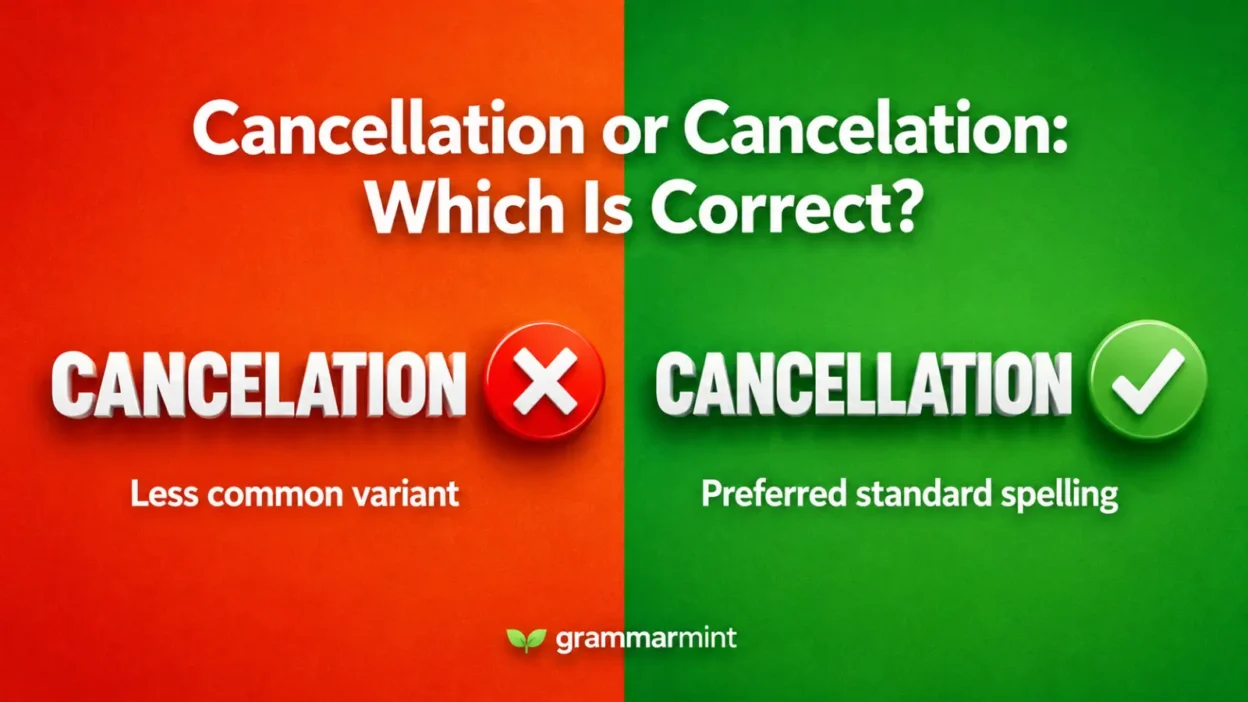
Cancellation or cancelation means the same thing, but “cancellation” is the safer and more common spelling. For US writing, use “cancellation” in emails, forms, policies, articles, and business messages.
TL;DR
• Use “cancellation” almost every time.
• “Cancelation” exists, but looks uncommon.
• US writers still prefer “cancellation.”
• British English also uses “cancellation.”
• “Canceled” is different from “cancellation.”
• Keep related spellings consistent.
Cancellation Vs Cancelation
Cancellation vs cancelation is mainly a spelling choice, not a meaning change. However, preferred spelling matters because readers notice unusual forms fast. So, “cancellation” is the stronger choice in modern English, while “cancelation” remains a rare variant.
• “Cancellation” is the safer spelling.
• “Cancelation” means the same thing.
• Most readers expect two L’s.
• Formal writing favors “cancellation.”
• Business forms look cleaner with two L’s.
• Teachers usually prefer “cancellation.”
• Editors rarely choose “cancelation.”
• Searchers often compare both spellings.
• The meaning does not change.
• The style impression does change.
• Use one spelling throughout.
• When unsure, choose “cancellation.”
Cancelation Or Cancellation
Cancelation or cancellation asks the same question in reverse. Still, the answer stays simple. The double L form is the standard spelling, while the single L form can look odd to many readers.
• Choose “cancellation” for polished writing.
• Avoid “cancelation” in resumes.
• Use two L’s in schoolwork.
• Use two L’s in client emails.
• Use two L’s in public notices.
• Use two L’s in website copy.
• Use two L’s in forms.
• Use two L’s in invoices.
• Use two L’s in policies.
• Use two L’s in contracts.
• Use two L’s in support replies.
• Save “cancelation” for rare references.
Cancellation Spelling
The cancellation spelling surprises people because “canceled” often has one L in US English. However, this word form behaves differently. The spelling rule around the suffix helps explain why the noun keeps two L’s.
• “Cancel” becomes “cancellation.”
• The ending changes the sound.
• Two L’s feel normal here.
• The noun is widely fixed.
• “Canceled” follows another pattern.
• “Canceling” follows another pattern too.
• Spelling patterns can split.
• English often keeps exceptions.
• Dictionaries support the two-L noun.
• Style guides favor simple consistency.
• Readers expect familiar word shapes.
• Proofread this word carefully.
Cancelation Meaning
Cancelation meaning is not different from cancellation meaning. It refers to the same idea, but the spelling has limited use. Therefore, treat “cancelation” as a variant spelling with the same meaning, not a better choice.
• It means calling something off.
• It can describe a voided plan.
• It can describe a stopped service.
• It can describe a withdrawn order.
• It can describe an ended agreement.
• It can describe a removed booking.
• It can appear in US writing.
• It may look outdated.
• It may look like a typo.
• It can distract careful readers.
• It rarely improves clarity.
• Replace it with “cancellation.”
Cancellation Meaning
Cancellation is a noun for the act of canceling something. Usually, it names the end of a planned event, booking, order, contract, service, or arrangement. In everyday use, it simply means something expected will no longer happen.
• A meeting cancellation stops the meeting.
• A flight cancellation stops the trip.
• A contract cancellation ends the agreement.
• A subscription cancellation stops renewal.
• An order cancellation stops fulfillment.
• A reservation cancellation releases the spot.
• A class cancellation removes the session.
• A show cancellation ends the performance.
• A policy cancellation ends coverage.
• A booking cancellation changes plans.
• A payment cancellation blocks the charge.
• A cancellation notice explains the change.
Cancellation In American English
In American English, “cancellation” is still the best choice. Some US writers expect one L because of “canceled,” but the noun usually keeps two. Therefore, use “cancellation” for professional writing across the United States.
• Americans write “canceled” often.
• Americans still write “cancellation.”
• The noun keeps two L’s.
• The variant can seem awkward.
• Newspapers may vary occasionally.
• Companies need consistent wording.
• Schools expect the common form.
• Legal documents favor clarity.
• Customer pages should feel familiar.
• Apps should use “cancellation.”
• Forms should use “cancellation.”
• One-L spelling is rarely helpful.
Cancellation In British English
In British English, cancellation is also the normal spelling. This matches UK spelling patterns like “cancelled” and “cancelling.” Because the double consonant already appears there, “cancelation” looks especially unusual.
• British usage favors “cancellation.”
• “Cancelled” usually has two L’s.
• “Cancelling” usually has two L’s.
• “Cancellation” fits that family.
• UK readers expect two L’s.
• Formal UK writing avoids “cancelation.”
• British schools teach the common form.
• British businesses use the common form.
• Global brands should choose “cancellation.”
• Mixed audiences understand it easily.
• It works across regions.
• It avoids needless spelling friction.
Canceled Vs Cancelled
Canceled vs cancelled is a different question. The past tense often changes by regional spelling, so “canceled” is common in US style and “cancelled” is common in British style. Still, “cancellation” remains the usual noun in both places.
• “Canceled” is common in America.
• “Cancelled” is common in Britain.
• Both mean the same thing.
• Pick the form your audience expects.
• US emails can use “canceled.”
• UK emails can use “cancelled.”
• Global copy can choose consistently.
• “Cancellation” stays widely accepted.
• Don’t copy “canceled” into “cancelation.”
• The noun has its own pattern.
• Related words can differ.
• Consistency matters more than cleverness.
Canceling Vs Cancelling
Canceling vs cancelling follows the same regional split. The present participle can be a one-L form in the United States and a two-L form in British English. Meanwhile, “cancellation” usually keeps two L’s either way.
• Americans often write “canceling.”
• British writers often write “cancelling.”
• Both describe an ongoing action.
• “We are canceling” sounds American.
• “We are cancelling” sounds British.
• Both are understandable.
• Match your spelling system.
• Keep your brand style steady.
• Don’t mix forms randomly.
• “Cancellation” remains the noun.
• Grammar tools may flag inconsistency.
• Human readers notice mixed spelling.
Cancellable Vs Cancelable
Cancellable vs cancelable is another related spelling pair. The adjective form describes something that can be canceled, such as a plan, ticket, policy, or booking. For strong policy wording, choose one consistent spelling and keep it across the page.
• “Cancelable” is common in US writing.
• “Cancellable” appears widely too.
• Both describe something changeable.
• A cancelable ticket can be voided.
• A cancellable booking can be ended.
• Policies should define the term.
• Forms should match help pages.
• Contracts should avoid mixed spelling.
• Apps should keep labels consistent.
• Customer messages need plain wording.
• Use the form your style uses.
• Pair it with “cancellation” cleanly.
Cancellation Examples
Good cancellation examples make the spelling easier to remember. Each sentence example below gives clear context for everyday writing. As a result, you can copy the pattern without second-guessing the word.
• We received your cancellation request.
• The cancellation fee applies today.
• Her appointment cancellation was confirmed.
• The cancellation notice arrived by email.
• Please review our cancellation policy.
• A cancellation number appears below.
• The cancellation deadline is Friday.
• Weather caused the game cancellation.
• The hotel accepted our cancellation.
• Your cancellation form is complete.
• Late cancellation may cost extra.
• Their cancellation changed our schedule.
Cancellation Synonyms
Cancellation synonyms help when the exact word feels too broad. However, synonyms like termination and annulment can sound more formal. So, choose the word that matches the setting and reader.
• “Termination” suits formal endings.
• “Annulment” suits voided arrangements.
• “Revocation” suits withdrawn approval.
• “Rescission” suits contract contexts.
• “Withdrawal” suits pulled requests.
• “Calling off” sounds casual.
• “Abandonment” can sound final.
• “Discontinuation” fits stopped services.
• “Suspension” may be temporary.
• “Voidance” sounds technical.
• “Canceling” names the action.
• “Cancellation” stays most natural.
Flight Cancellation
Flight cancellation is one of the most common real-world uses. A travel notice may mention an airline update, schedule change, storm, staffing issue, or weather delay. Therefore, clear wording matters because travelers need fast answers.
• Your flight cancellation is confirmed.
• Check the airline app first.
• Save the cancellation email.
• Ask about rebooking options.
• Review refund rules carefully.
• Weather may change schedules fast.
• Gate agents may have updates.
• Travel insurance may help.
• Keep receipts after disruption.
• Use “cancellation,” not “cancelation.”
• Clear spelling reduces confusion.
• Travelers skim under stress.
Contract Cancellation
Contract cancellation needs especially careful wording. Because contract terms can affect rights and duties, a formal notice should use plain language. Still, “cancellation” is the safer word for an agreement ending.
• Read the cancellation clause first.
• Check notice deadlines carefully.
• Follow the required delivery method.
• Keep proof of sending.
• State the contract name clearly.
• Include the effective date.
• Avoid vague wording.
• Use “cancellation” in the notice.
• Confirm receipt in writing.
• Save all related messages.
• Ask a professional when needed.
• Don’t rely on casual texts.
Order Cancellation
Order cancellation appears in shopping, shipping, and support messages. The phrase connects to order status, a customer message, or a refund request. Because customers want quick clarity, the spelling should feel familiar.
• Your order cancellation was successful.
• The seller canceled shipment.
• Refund timing may vary.
• Check the confirmation email.
• Keep your order number.
• Contact support for delays.
• Some orders cannot be canceled.
• Custom items may have limits.
• Marketplace rules can differ.
• Use clear subject lines.
• Write “cancellation request” plainly.
• Avoid the uncommon one-L spelling.
Subscription Cancellation
Subscription cancellation is common for apps, memberships, streaming, software, and services. A clear subscription policy should explain renewal, billing, access, and account settings. Also, good wording helps customers complete the process without frustration.
• Find the cancellation page.
• Check your renewal date.
• Save the confirmation message.
• Review remaining access time.
• Cancel before the billing date.
• Watch for free-trial rules.
• Screenshots can help later.
• Support may confirm manually.
• Some plans renew automatically.
• Use “cancellation” in help text.
• Keep button labels clear.
• Avoid hiding the process.
FAQs
Which Is Correct, Cancellation Or Cancelation?
“Cancellation” is the better choice almost every time. “Cancelation” exists as a rare variant, but it can look unusual or mistaken.
Is Cancelation Wrong?
It is not always wrong, but it is rarely the best option. In most US writing, “cancellation” looks clearer, safer, and more professional.
Is Cancellation Spelled With One L Or Two?
“Cancellation” is spelled with two L’s. That spelling is standard in American and British English.
Is Cancelation American English?
“Cancelation” can appear in American English, but it is not the usual choice. American writers commonly use “cancellation” for the noun.
Why Is Cancellation Spelled With Two L’s?
The noun form developed with two L’s and became the accepted spelling. English spelling has exceptions, so it does not always match “canceled.”
What Does Cancellation Mean?
Cancellation means the act or result of calling something off. It can apply to flights, meetings, orders, subscriptions, contracts, and bookings.
What Is The Difference Between Cancellation And Cancelation?
The meaning is the same. The difference is spelling, frequency, and how natural the word looks to readers.
Conclusion
Cancellation or cancelation is easy once you know the practical rule: use “cancellation” almost every time. It works for US readers, British readers, businesses, schools, travel notices, orders, and subscriptions.