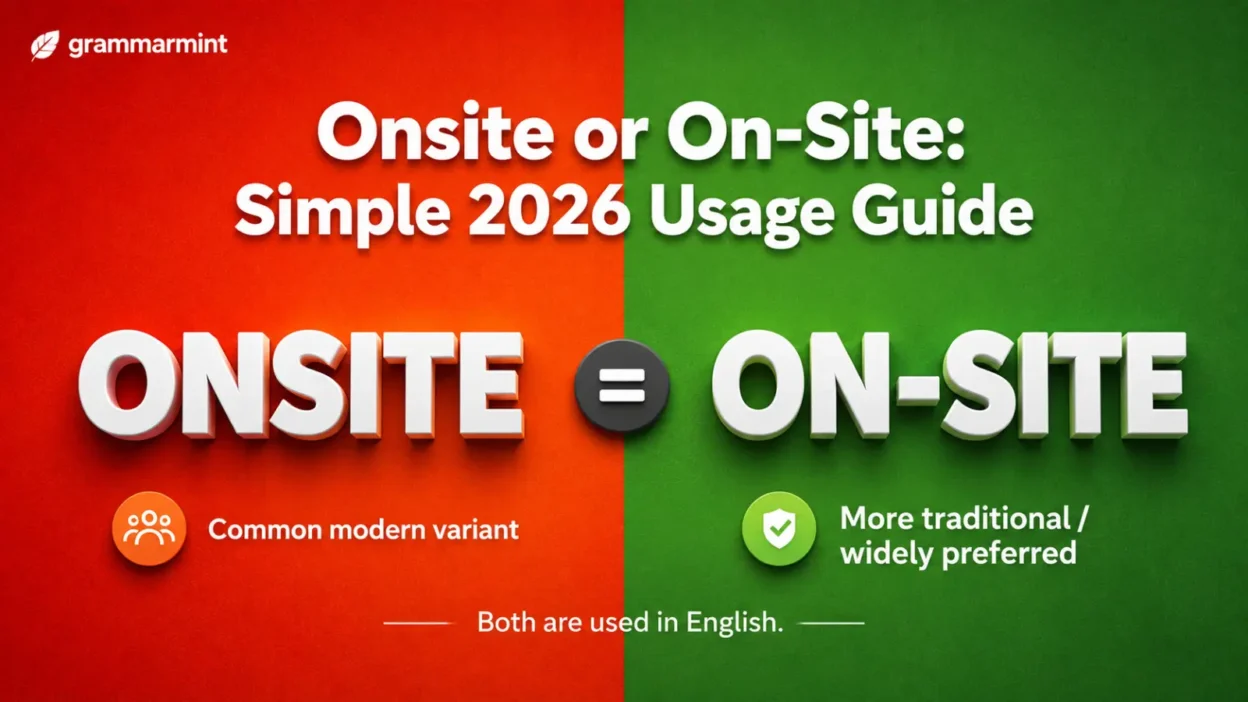
Writers, job seekers, managers, and students often pause over one tiny choice: Onsite or On-Site. The terms look almost the same, yet hyphen, one word, two words, workplace, formal writing, business email, and physical location all affect the best choice. In everyday American writing, onsite is common and easy to read. However, on-site still feels safer in formal documents. Meanwhile, on site works best when you mean someone or something is physically at a location. This guide keeps the rules simple, so your emails, job posts, reports, and service pages sound polished.
Quick Answer
Onsite or on-site can both be correct, but on-site is the safer formal choice before a noun. Use on site as two words when you mean “at the location.”
TL;DR
• Use on-site for formal noun descriptions.
• Use onsite for modern business writing.
• Use on site for location only.
• Pick one style and stay consistent.
• Let your audience guide the choice.
Onsite Or On-Site
This choice depends on role, tone, and reader expectations. However, the fastest rule is simple: use the form your audience expects.
• Correct spelling depends on sentence purpose.
• Use a hyphen for formal compound descriptions.
• Business writing often accepts onsite today.
• On-site feels clearer before important nouns.
• Onsite feels cleaner in casual workplace copy.
• On site means location, not description.
• Choose one form across each document.
• Avoid switching spellings in nearby sentences.
• Formal readers may prefer the hyphen.
• Modern teams may prefer the closed form.
• Clarity matters more than personal taste.
• When unsure, use on-site before nouns.
Onsite Vs On-Site
Onsite and on-site often mean the same thing. Still, the hyphen can make the phrase easier to parse.
• Grammar changes how the phrase works.
• Formal writing often favors on-site.
• Modern usage often favors onsite.
• Onsite reads smoothly in quick messages.
• On-site separates the two word parts.
• The hyphen helps before complex nouns.
• Both forms describe location-based things.
• Audience expectations should guide your choice.
• Company style should decide final spelling.
• Use one spelling in each project.
• Job ads commonly use onsite.
• Reports often look better with on-site.
On Site Vs Onsite
On site is different because it works as a phrase. It usually answers “where?” instead of “what kind?”
• Two words show actual location.
• A location phrase follows action words.
• A modifier usually comes before nouns.
• “The team is on site” works.
• “On site support” looks unfinished.
• Use onsite support for modern copy.
• Use on-site support for formal copy.
• Use on site after arrival verbs.
• Use on site after presence verbs.
• Avoid on site before service nouns.
• Read the sentence aloud first.
• Ask whether it answers “where?”
On-Site Meaning
On-site means located or happening at a specific place. Therefore, it often describes services, work, checks, visits, and facilities.
• At a particular place is the core idea.
• Premises means the actual business location.
• Physical location separates it from remote work.
• On-site meetings happen in person.
• On-site support happens at the customer’s place.
• On-site storage stays at the facility.
• On-site teams work from the office.
• On-site care happens at the location.
• On-site testing occurs where needed.
• The hyphen links the idea tightly.
• It often appears before a noun.
• It suits careful professional writing.
Onsite Meaning
Onsite usually means located at the place involved. In addition, it often appears in workplace, tech, training, travel, and service writing.
• Workplace use makes onsite familiar.
• On premises means not somewhere else.
• Local service can happen onsite.
• Onsite teams work at company locations.
• Onsite events happen at the venue.
• Onsite staff support daily operations.
• Onsite clinics serve people nearby.
• Onsite parking sits near the building.
• Onsite restaurants are part of facilities.
• Onsite options feel fast and convenient.
• Use it where readers expect it.
• Keep it consistent in branded copy.
Onsite Examples
Examples make the choice easier. As a result, you can copy the pattern and adjust the noun.
• Business email can mention onsite training.
• A job listing may require onsite work.
• A company policy can define onsite days.
• We offer onsite support every weekday.
• The onsite manager starts at eight.
• Our onsite clinic opens on Monday.
• She handles onsite onboarding for interns.
• They added onsite parking for guests.
• The onsite team resolved the issue.
• Please review onsite safety rules today.
• Onsite childcare helps working parents.
• Onsite services reduce travel time.
On-Site Examples
On-site examples often sound more formal. Therefore, they fit contracts, reports, policies, manuals, and inspection notes.
• A compound adjective describes one noun.
• A formal document may prefer on-site.
• An inspection report often uses on-site.
• The on-site audit begins tomorrow.
• On-site registration closes at noon.
• The on-site supervisor approved repairs.
• Our on-site nurse checked employees.
• On-site security covers the lobby.
• The on-site review found damage.
• On-site testing confirmed the result.
• On-site storage requires locked access.
• The on-site team filed notes.
Onsite In A Sentence
Use onsite when it reads naturally and your setting allows it. Also, make sure the word describes a thing, service, person, or action.
• Adjective use comes before nouns.
• Adverb use appears in some workplaces.
• Sentence clarity decides the best form.
• Our onsite staff greeted visitors.
• The hotel has onsite dining.
• We scheduled onsite interviews Tuesday.
• Their onsite technician fixed everything.
• Onsite coaching starts next quarter.
• Please complete onsite check-in first.
• Onsite storage costs extra monthly.
• The onsite gym closes early.
• Her onsite role begins tomorrow.
On Site In A Sentence
Use on site when you mean someone is physically there. Likewise, use it when something happens at that place.
• Where it happens is the key test.
• Physical presence points to on site.
• A site visit may require travel.
• The plumber is on site now.
• We met on site after lunch.
• Inspectors stayed on site overnight.
• She arrived on site early.
• Materials were delivered on site.
• The crew worked on site.
• Security remains on site daily.
• Repairs will happen on site.
• Keep visitors safe on site.
Onsite Or On-Site In Formal Style
Formal style rewards consistency and caution. Because of that, on-site is usually the safer pick in polished documents.
• A style guide may control spelling.
• A dictionary may list preferred forms.
• Consistency matters across every page.
• Use on-site in contracts.
• Use on-site in legal reports.
• Use on-site in academic prose.
• Use on-site in safety manuals.
• Use on-site in formal policies.
• Ask editors before final delivery.
• Follow house style when available.
• Avoid mixing onsite and on-site.
• When unsure, choose the hyphen.
Onsite Vs Remote
Onsite and remote describe where work happens. However, this workplace meaning is separate from the spelling question.
• Office-based work happens at company locations.
• Remote work happens away from offices.
• Collaboration can shape the best model.
• Onsite roles often involve face time.
• Remote roles rely on digital tools.
• Onsite teams may solve issues faster.
• Remote teams may reduce commuting stress.
• Some jobs require physical equipment access.
• Customer-facing roles may need presence.
• Desk roles may work remotely.
• Job posts should define location clearly.
• Spelling should match company voice.
Onsite Vs Hybrid
Hybrid work combines office and remote time. So, location words should be extra clear in job descriptions and policies.
• Hybrid work blends location types.
• In-office days need clear wording.
• Flexibility should not create confusion.
• Say which days are onsite.
• Explain when remote work applies.
• Define required office attendance plainly.
• Avoid vague location phrases.
• Use onsite for casual policy summaries.
• Use on-site for formal HR documents.
• Mention travel needs when relevant.
• Separate hybrid rules from benefits.
• Keep schedules easy to scan.
On-Site Work Meaning
On-site work means the job happens at a physical workplace. In job posts, the phrase should set expectations before candidates apply.
• A worksite can be an office.
• Office attendance may be required daily.
• Role expectations should be direct.
• On-site work may require commuting.
• It may involve equipment access.
• It may include client interaction.
• It can support faster training.
• It often helps new employees.
• It may limit schedule freedom.
• It should be stated early.
• Job posts need clear location details.
• Benefits should match attendance requirements.
Onsite Training
Onsite training happens where employees, students, or clients are located. Because learners are together, it often supports practice and discussion.
• Employee training can happen onsite.
• A workshop may need shared equipment.
• Hands-on lessons benefit from presence.
• Onsite training supports live questions.
• Trainers can observe real workflows.
• Teams can practice together immediately.
• New hires meet coworkers faster.
• Safety lessons may require demonstrations.
• Equipment training often works best onsite.
• Attendance rules should be clear.
• Materials should be ready beforehand.
• Follow-up notes help learners retain skills.
Onsite Support
Onsite support means help is provided at the customer’s or company’s location. It often appears in tech, maintenance, facilities, and customer service.
• Technical support may require device access.
• A service call brings help nearby.
• Customer location details prevent delays.
• Onsite support can fix hardware issues.
• It helps when remote steps fail.
• Technicians can inspect the environment.
• Service teams should confirm addresses.
• Arrival windows should be specific.
• Scope should be explained clearly.
• Emergency support may cost more.
• Follow-up notes reduce repeat visits.
• Website search pages may spell it differently.
On-Site Inspection
On-site inspection sounds formal because inspections often involve rules, records, and risk. Therefore, the hyphenated form usually fits well.
• A safety inspection checks real conditions.
• A construction site needs careful wording.
• A field report should stay consistent.
• On-site inspections happen at the property.
• Inspectors document visible issues.
• Crews may need access approval.
• Photos can support the report.
• Findings should use plain language.
• Deadlines should be easy to see.
• Use on-site before inspection nouns.
• Use on site after action verbs.
• Keep reports consistent throughout.
FAQs
Is it onsite or on-site?
Both onsite and on-site can be correct. Use on-site when you want the safer formal spelling before a noun, and use onsite when your workplace style accepts the modern one-word form.
Is onsite one word or two?
Onsite is one word. On site is two words, but it works differently because it usually means “at the location.”
What is the difference between onsite and on-site?
Onsite and on-site often describe the same idea. The difference is usually style: onsite feels modern and simple, while on-site feels more formal and traditional.
When should I use on site as two words?
Use on site when the phrase answers “where?” For example, “The crew is on site” means the crew is physically at that place.
Is onsite correct in professional writing?
Yes, onsite can be correct in professional writing. Still, formal reports, legal text, and careful editorial work may look better with on-site.
Should on-site be hyphenated before a noun?
Yes, on-site is a strong choice before a noun. The hyphen helps the two words work together as one description.
What does on-site mean?
On-site means located or happening at a specific place. It often describes services, teams, inspections, training, or work done at a physical location.
Conclusion
Onsite or on-site is not as tricky once you check the sentence role. Use on-site for formal descriptions, onsite for modern workplace wording, and on site when you mean “at the location.” Then, stay consistent so your writing feels clean and confident.