
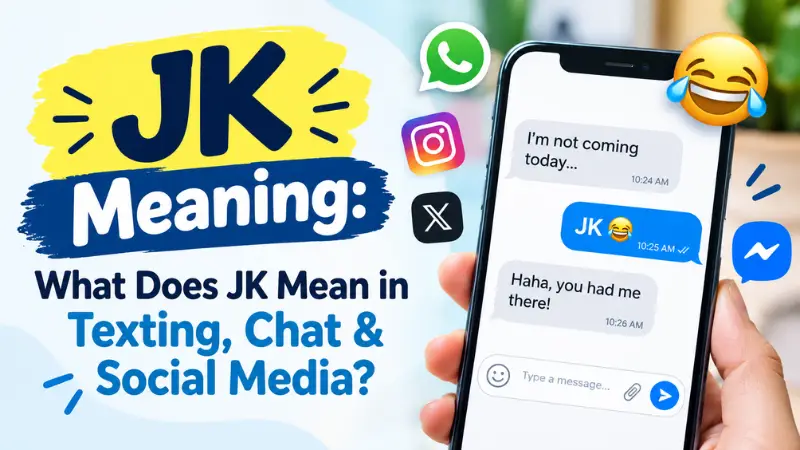
JK usually means “just kidding.” It is a common abbreviation used in texting, online chats, social media, and casual conversations to show that something you just said was a joke and should not be taken seriously.
For example, if someone texts, “I’m moving to another country tomorrow… JK!”, they are saying that the statement was only a joke.
The abbreviation is especially common in informal communication because it lets people quickly clarify their tone without writing out “just kidding.”
What Does JK Mean?
JK means “just kidding.”
People typically add JK after a humorous, exaggerated, teasing, or intentionally misleading statement to let the other person know they were not being serious.
Simple example
“I ate the last slice of pizza. JK, it’s still in the fridge.”
Here, JK tells the reader that the first statement was not true and was intended as a joke.
JK meaning at a glance
| Term | Meaning | Common use |
|---|---|---|
| JK | Just kidding | Texting, chats, social media |
| J/K | Just kidding | Older or alternative spelling |
| Just kidding | I was joking | Casual conversations |
| Just joking | Similar meaning | Informal communication |
JK Meaning in Texting
In texting, JK is used to quickly signal that a previous message was a joke.
Because text messages do not always communicate facial expressions or tone, a short abbreviation such as JK can help prevent confusion.
For example:
Person 1: “You owe me $500 for that coffee.”
Person 2: “Wait, what?!”
Person 1: “JK 😂”
The second message makes it clear that the $500 claim was only a joke.
JK Meaning on Social Media
On social media platforms, JK can have the same meaning: just kidding.
You may see it in:
- Instagram comments
- TikTok captions and comments
- Facebook posts
- Snapchat messages
- X posts
- Reddit discussions
- Discord chats
- Online gaming conversations
For example:
“I’m deleting all my social media accounts. JK 😂”
The person is telling readers that they were joking.
How Is JK Used in a Sentence?
JK can appear at the beginning or end of a message, although placing it at the end is particularly common.
Examples
At the end:
“You really thought I was going to eat your fries? JK!”
At the beginning:
“JK, I actually finished the whole assignment.”
As a standalone message:
“JK 😂”
After teasing someone:
“You’re officially the worst driver ever. JK!”
The exact wording depends on the conversation and the relationship between the people communicating.
10 Examples of JK in Text Messages
Here are some natural examples of how people may use JK:
- “I’m never talking to you again. JK 😂”
- “You have to buy me dinner now. JK!”
- “I forgot your birthday… JK, happy birthday!”
- “I just spent all your money. JK.”
- “You look terrible today. JK 😂”
- “I’m going to tell everyone your secret. JK!”
- “That was the worst movie ever. JK, I actually loved it.”
- “I’m quitting my job tomorrow. JK.”
- “You owe me a new phone. JK!”
- “I hate pizza. JK—pizza is life.”
These examples show that JK can be used for harmless jokes, teasing, exaggeration, and playful statements.
JK vs. LOL, LMAO, and Other Text Abbreviations
JK is sometimes confused with other internet abbreviations, but they serve different purposes.
| Abbreviation | Meaning | Purpose |
|---|---|---|
| JK | Just kidding | Shows that a statement was a joke |
| LOL | Laughing out loud | Indicates amusement or laughter |
| LMAO | Laughing my ass off | Stronger expression of amusement |
| LMK | Let me know | Requests a response or information |
| TBH | To be honest | Introduces an honest opinion |
| IDK | I don’t know | Expresses uncertainty |
| BTW | By the way | Adds another point to a conversation |
| OMG | Oh my God | Expresses surprise or excitement |
For example:
“I’m going to eat your entire birthday cake. JK.”
Here, JK explains that the statement was a joke.
By contrast:
“That video was hilarious. LOL.”
Here, LOL expresses laughter rather than explaining that a previous statement was a joke.
Is JK the Same as J/K?
Yes. JK and J/K generally mean the same thing: “just kidding.”
The version with a slash was more common in some earlier forms of internet communication, while JK is now a widely recognized shortened form.
You may also see:
- JK
- J/K
- just kidding
- just joking
The meaning is usually clear from context.
When Should You Use JK?
JK works best in casual and informal communication.
You can use it when:
- Teasing a friend
- Making a harmless joke
- Exaggerating something for humor
- Clarifying that you were not serious
- Making a playful comment online
- Following up on a sarcastic statement
Example
“I’m charging you $100 for being late. JK, just get here when you can.”
The abbreviation quickly changes the tone of the message from potentially serious to playful.
When Should You Avoid Using JK?
Although JK is common online, it is not appropriate for every situation.
Avoid relying on JK when discussing:
- Serious workplace issues
- Legal matters
- Financial decisions
- Emergencies
- Sensitive personal situations
- Professional communications where the meaning could be misunderstood
For example, saying:
“You’re fired. JK!”
might be confusing or inappropriate in a professional setting.
In formal communication, it is usually better to communicate your meaning clearly rather than relying on internet slang.
Can JK Sound Sarcastic?
Yes. The meaning and tone of JK depend heavily on context.
For example:
“Wow, you are so organized. JK.”
This could be friendly teasing between friends, but the same wording could sound sarcastic or insulting depending on the relationship and situation.
Emojis can sometimes make the intended tone clearer:
“You’re seriously the worst 😂 JK!”
However, emojis do not guarantee that everyone will interpret a message in the same way.
Is JK Rude?
JK itself is not rude. It simply means “just kidding.”
However, the statement before JK can still be offensive, embarrassing, or hurtful. Adding “JK” does not automatically make every joke harmless.
For example:
“I told everyone your private information. JK.”
Even if the speaker claims it was a joke, the message could still cause concern or discomfort.
The best use of JK is with jokes that are appropriate for the relationship and situation.
Why Do People Use JK?
People use JK because written communication can make humor difficult to recognize.
In a face-to-face conversation, people can use:
- Facial expressions
- Voice tone
- Gestures
- Laughing
- Body language
Text messages do not provide those same signals. Adding JK gives the reader an immediate clue that the previous statement was not meant literally.
Quick Answer: What Does JK Mean?
JK means “just kidding.” It is an informal texting and internet abbreviation used to tell someone that a previous statement was intended as a joke rather than a serious statement.
Example:
“I’m taking your car tonight. JK!”
Meaning:
“I’m joking—I’m not actually taking your car.”
FAQs
JK stands for “just kidding.” It is used in casual texts and online conversations to show that something was meant as a joke.
On Snapchat, JK generally means “just kidding.” Someone may add it after a teasing or humorous message to clarify that they were not being serious.
On Instagram, JK means “just kidding.” It can appear in comments, captions, direct messages, or replies.
JK means “just kidding” and clarifies that something was a joke. LOL means “laughing out loud” and is generally used to express amusement.
Yes. J/K is another way of writing “just kidding,” and its meaning is generally the same as JK.
JK is informal internet and texting slang. It is appropriate for many casual conversations but is generally not suitable for formal business or professional writing.
Yes. People often use JK after sarcastic or teasing comments to indicate that they were not being serious. However, the reader may still interpret the message differently depending on context.
Your response depends on the conversation. You might simply laugh, send an emoji, or continue the joke. For example, “Haha, you got me 😂” is a natural casual response.
Final Thoughts on JK Meaning
JK means “just kidding,” and it is one of the common abbreviations used in casual texting and online communication. It helps people quickly show that a previous statement was intended as a joke, tease, or exaggeration.
You will commonly see JK in texts, social media posts, comments, gaming chats, and other informal conversations. Remember that context matters: while JK can clarify playful humor, it does not automatically make a potentially hurtful statement appropriate.
If you come across JK in a message, the simplest interpretation is usually “just kidding” or “I was joking.”
SEO metadata
Meta title: JK Meaning: What Does JK Mean in Texting?
Meta description: JK means “just kidding.” Learn what JK means in texting, social media, Snapchat, Instagram, and online chats with examples and FAQs.
URL slug: /jk-meaning/


[…] Not For Sale is common. In casual conversations, No Funny Stuff may be intended, while Not Feeling Social appears in some personal chats. Gamers commonly use NFS for Need for Speed, and technology professionals […]