You may see ROFL in a text, group chat, social media comment, or gaming conversation. It is a short way to show that something made you laugh very hard.
For many people, the phrase can look confusing at first. The letters do not resemble the words they represent, and the expression sounds more dramatic than a simple “haha.”
ROFL stands for “rolling on the floor laughing.” It describes an exaggerated reaction to something extremely funny. The person usually is not literally rolling on the floor.
This expression is informal and works best in casual digital conversations. It can appear by itself or at the end of a message.
This guide explains the meaning of ROFL, how people use it, how to pronounce it, and when it fits. You will also see realistic examples and answers to common questions.
Quick Answer: What Does ROFL Mean?
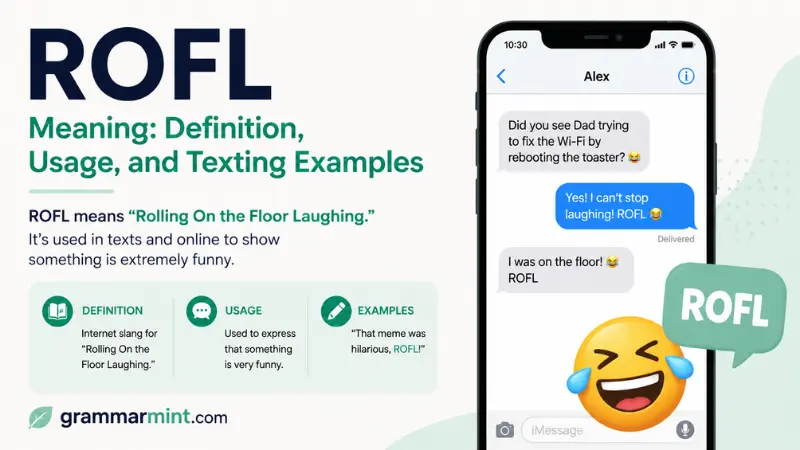
ROFL means “rolling on the floor laughing.” It is an informal internet abbreviation used to show that something is extremely funny.
For example: “That video was hilarious. ROFL!”
ROFL Meaning in Plain English
In plain English, ROFL means “That was really funny” or “I am laughing really hard.”
The expression creates a funny mental image. It suggests that someone is laughing so hard that they have fallen onto the floor.
Most of the time, this is not literal. It is simply an exaggerated way to show strong amusement.
For example:
“Your impression of the teacher was perfect. ROFL!”
The sender probably is not actually rolling across the floor. They are emphasizing how funny they found the impression.
ROFL can also react to something strange, surprising, or absurd.
“You wore two different shoes to the interview? ROFL!”
Here, the laughter comes from the unexpected situation.
What Does ROFL Mean in Texting and Chat?
In texting, ROFL is a quick reaction to something funny. You might see it after a joke, meme, photo, video, or funny story.
It can work as a complete response:
Friend: “I just walked into the wrong classroom.”
You: “ROFL!”
It can also appear inside a longer message:
“ROFL, I cannot believe you actually said that.”
The tone is usually playful and casual. However, context matters when the joke involves another person’s mistake or embarrassment.
For example, this may sound friendly:
“You really sent that message to the wrong group chat? ROFL!”
But laughter at someone’s serious problem may sound insensitive.
ROFL generally communicates amusement, not anger or confusion. The surrounding conversation helps determine the exact tone.
How to Use ROFL in a Sentence
ROFL is flexible in casual digital writing. You can use it alone, at the beginning, or at the end of a message.
As a standalone reaction
“ROFL!”
This is common when you are responding directly to something funny.
At the beginning of a message
“ROFL, that was the worst excuse ever.”
This makes the laughter the first reaction.
At the end of a message
“I cannot believe he tried that. ROFL!”
This adds emphasis to the statement.
In a casual sentence
“That clip had me ROFL.”
This treats ROFL as a verb-like expression.
You may also see forms such as ROFLing in very informal online writing. These forms are understandable, but they are not suitable for formal writing.
Common mistake: Using ROFL in a school essay or business email.
Better choice: Write “That was very funny” or another normal sentence.
ROFL Pronunciation and Part of Speech
ROFL is commonly pronounced like “roff-ul” when spoken as one word. Some people simply say the individual letters: “R-O-F-L.”
The one-word pronunciation is similar to the sound of “waffle” without the initial “wa.”
ROFL is an informal abbreviation used in internet and text communication. It can also behave like a noun-like reaction or a verb in casual online writing.
For example:
“ROFL!”
Here, it works as a reaction.
You may also see:
“That meme made me ROFL.”
Here, it acts like a verb in informal usage.
For beginners, the safest description is simple: ROFL is an informal internet abbreviation for “rolling on the floor laughing.”
ROFL Examples in Real Conversations
Seeing ROFL in context makes its meaning easier to understand.
Example 1: A funny message
Alex: “I studied for three hours and forgot everything during the test.”
Sam: “ROFL, that is painfully relatable.”
Here, ROFL shows strong amusement.
Example 2: A funny mistake
Jordan: “I waved back at someone who wasn’t waving at me.”
Taylor: “ROFL! I hate when that happens.”
The reaction is playful because the mistake is harmless.
Example 3: A meme
Mia: “Look at this cat trying to open the refrigerator.”
Chris: “ROFL 😂”
The abbreviation emphasizes the person’s laughter.
Example 4: A surprising story
Ben: “My little brother told everyone he was the family CEO.”
Chris: “ROFL. What happened next?”
Here, ROFL shows amusement while keeping the conversation going.
Example 5: Self-directed humor
“I locked myself out of my own apartment again. ROFL.”
This use shows that the writer is laughing at their own mistake.
ROFL vs. LOL, LMAO, and ROTFL
These expressions all relate to laughter, but they are not identical in form or tone.
| Expression | Meaning | Typical feel |
|---|---|---|
| ROFL | Rolling on the floor laughing | Strong, playful laughter |
| LOL | Laughing out loud | General or lighter amusement |
| LMAO | Laughing my ass off | Strong, very casual laughter |
| ROTFL | Rolling on the floor laughing | Same basic meaning as ROFL |
ROFL usually gives a more exaggerated image than LOL. Still, people do not always use these expressions according to a strict level of laughter.
ROTFL simply includes the word “the.” Both expressions refer to the same basic idea.
LMAO contains profanity in its full form. Because of that, ROFL can feel like a cleaner choice in some casual conversations.
When to Use ROFL and When to Avoid It
ROFL fits relaxed communication with friends, family, classmates, and online communities.
Good settings include:
• Text messages
• Group chats
• Social media comments
• Gaming chats
• Casual online conversations
• Friendly messages
The abbreviation is less appropriate in formal settings.
Avoid ROFL in:
• Business emails
• Formal letters
• Academic essays
• Professional reports
• Serious workplace messages
Instead, explain your reaction directly.
For example, instead of:
“ROFL, your presentation was hilarious.”
A professional message could say:
“Your presentation was very funny and engaging.”
Tone also matters. ROFL can sound mocking if someone is laughing at another person’s serious problem.
When the situation is sensitive, use clearer and kinder language.
Is ROFL Still Used Today?
Yes, people still recognize and use ROFL in digital conversations. Current dictionary sources continue to list it as an informal expression for strong amusement.
However, digital laughter has many forms today. People also use LOL, LMAO, laughing phrases, GIFs, and emojis such as 😂 and 🤣.
This means ROFL may feel more casual, playful, or classic than some newer reactions. Its exact frequency can vary by person, age group, platform, and conversation.
The important point is that ROFL remains understandable in English-language online communication.
If someone sends you “ROFL,” they are usually telling you that they found something very funny.
Common Mistakes With ROFL
A few mistakes can make the expression confusing.
Mistake 1: Taking ROFL literally
ROFL does not usually mean that someone is physically lying on the floor.
Better understanding: It is an exaggerated expression of laughter.
Mistake 2: Using ROFL in formal writing
ROFL belongs to casual digital communication.
Better choice: Use standard wording in professional or academic writing.
Mistake 3: Confusing ROFL with ROLF
The letters in ROFL follow the phrase:
Rolling
On
Floor
Laughing
“ROLF” changes the order of the final letters.
Mistake 4: Assuming every ROFL has the same tone
ROFL usually signals laughter, but context can change the feeling.
It may sound friendly, playful, sarcastic, or mocking. Look at the surrounding message before deciding what the sender means.
Frequently Asked Questions About ROFL
What does ROFL mean in texting?
ROFL means “rolling on the floor laughing.” People use it to show that something is extremely funny or made them laugh hard.
It is an informal expression for casual messages and online conversations.
What does ROFL stand for?
ROFL stands for “rolling on the floor laughing.” The phrase describes an exaggerated reaction to something very funny.
The person usually is not literally rolling on the floor.
Is ROFL the same as LOL?
Both express laughter, but they have different full forms. LOL means “laughing out loud,” while ROFL means “rolling on the floor laughing.”
ROFL often sounds more dramatic, but people use both expressions flexibly.
What is the difference between ROFL and ROTFL?
ROFL and ROTFL have the same basic meaning. ROTFL includes the T from the word “the.”
Both are informal expressions for strong amusement.
How do you pronounce ROFL?
ROFL can be pronounced “roff-ul” as one word. Some speakers say each letter separately as “R-O-F-L.”
The written abbreviation is much more common than its spoken form.
Is ROFL formal or informal?
ROFL is informal internet slang. It is appropriate for casual texts, chats, comments, and friendly online conversations.
It should generally be avoided in formal school or professional writing.
Is ROFL still used today?
Yes. ROFL remains recognizable and is still used in casual digital communication.
People also have many other ways to show laughter, including LOL, LMAO, and laughing emojis.
Mini Quiz: Test Your Understanding of ROFL
1. What does ROFL mean?
A. Read Out Funny Lines
B. Rolling on the floor laughing
C. Really online for laughs
2. Which setting is best for ROFL?
A. A business report
B. A formal application
C. A casual group chat
3. Is ROFL usually literal?
A. Yes
B. No
4. What is ROTFL?
A. A completely different expression
B. An alternative form of ROFL
C. A formal writing abbreviation
Answer key:
- B
- C
- B
- B
Conclusion
ROFL means “rolling on the floor laughing.” It is an informal way to show strong amusement in texts, chats, and online conversations.
Use it when the situation is genuinely casual and funny. For formal writing, choose clear standard language instead.