You may hear someone described as passive-aggressive at work, home, school, or online. The term often appears when a person seems polite but also appears annoyed.
The behavior can be confusing because the anger is not expressed directly. Someone may agree with a request but then resist it through actions. They might delay, make a pointed remark, or avoid discussing the problem.
Understanding the term helps you describe communication more accurately. It also prevents you from calling every rude or quiet response passive-aggressive.
This guide explains the meaning, pronunciation, grammar, common examples, and correct usage. It also explains how the term appears in relationships, texts, and emails.
Quick Answer
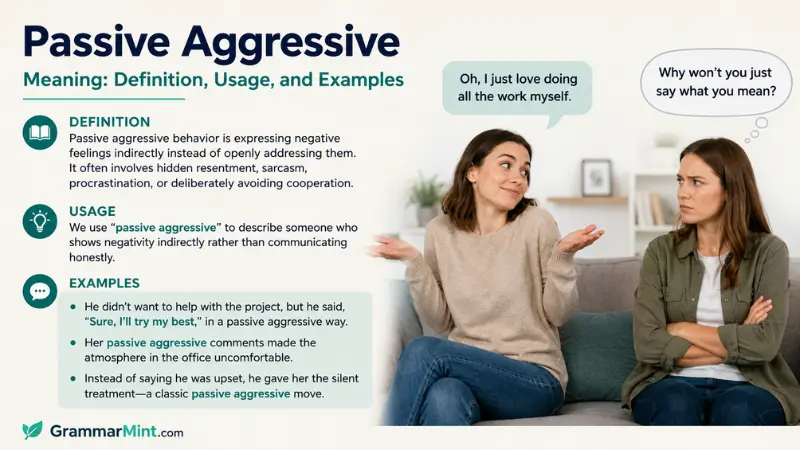
Passive aggressive meaning refers to expressing anger, resentment, or resistance indirectly rather than openly. A person may sound agreeable while their words or actions communicate frustration.
TL;DR
• It usually describes indirect anger or resistance.
• Passive-aggressive is mainly an adjective.
• The adjective is normally hyphenated.
• Sarcasm can be passive-aggressive in some contexts.
• One awkward comment does not prove a pattern.
• Passive aggression is the related noun form.
What Does Passive Aggressive Mean?
Passive-aggressive means showing negative feelings indirectly instead of stating them clearly. Those feelings may include anger, resentment, irritation, or opposition.
The person may avoid direct confrontation. However, their actions or comments can still communicate displeasure.
For example, imagine that Mia dislikes a new work assignment. She tells her manager, “Sure, no problem.”
She then repeatedly delays the task without explaining her concerns. That behavior could be described as passive-aggressive if the delay expresses her resentment.
The key idea is indirect expression. The words and actions may send different messages.
Part of Speech and Pronunciation
Passive-aggressive is mainly an adjective. It describes a person, remark, response, behavior, tone, or communication style.
Examples:
• a passive-aggressive comment
• passive-aggressive behavior
• a passive-aggressive response
• a passive-aggressive email
Merriam-Webster also records noun use for a person described this way. However, adjective use is clearer and more common for learners.
The related noun is passive aggression.
Example: “The conversation was filled with passive aggression.”
The adverb is passive-aggressively.
Example: “He responded passive-aggressively instead of explaining why he was upset.”
Pronunciation
A simple pronunciation is:
PASS-iv uh-GRESS-iv
The strongest stress falls on GRESS. Oxford and Cambridge give similar US pronunciation patterns.
What Passive-Aggressive Behavior Looks Like
Passive-aggressive communication often creates a gap between what someone says and what they appear to feel.
Someone may agree verbally but show resistance in another way.
Possible examples include:
• repeatedly delaying something because of resentment
• giving a pointed or backhanded compliment
• refusing to discuss why they are angry
• intentionally doing a requested task poorly
• making indirect remarks instead of stating the problem
• using silence to communicate displeasure
Mayo Clinic includes procrastination, resistance, and intentional mistakes among possible signs. Cleveland Clinic also discusses sarcasm and silent treatment.
Context still matters. Forgetting one task does not automatically make someone passive-aggressive.
Passive-Aggressive Examples in Daily Life
The meaning becomes clearer when you see it in ordinary situations.
At work
Your coworker dislikes a deadline but does not discuss the issue.
Instead, they say, “Of course. I have nothing else to do anyway.”
The comment sounds cooperative at first. However, it indirectly communicates annoyance.
At home
A roommate is upset about cleaning duties.
They say everything is fine but deliberately leave their assigned chores unfinished.
With friends
A friend feels excluded from an event.
Instead of explaining their feelings, they say, “Looks like you had fun without me.”
The sentence may carry indirect resentment.
In school
A student dislikes a group decision.
They agree to help but repeatedly avoid completing their assigned part.
These situations can be passive-aggressive when the indirect action communicates negative feelings.
Meaning in Relationships, Texts, and Emails
Passive-aggressive behavior can appear in almost any type of communication. The setting often changes how it looks.
In relationships
A partner may say, “Nothing is wrong,” while clearly withdrawing because they are upset.
Another example is agreeing to plans while repeatedly creating delays because of hidden resentment.
In text messages
Tone can be difficult to judge through text.
A short message such as “Fine. Do whatever you want” may sound passive-aggressive in some situations.
However, the words alone are not enough. Context, history, and the surrounding conversation matter.
In emails
Workplace messages can also carry indirect criticism.
For example:
“Just reminding you again, since my earlier message may have been missed.”
That sentence is not automatically passive-aggressive. Its meaning depends on tone, purpose, and context.
Calling every firm email passive-aggressive can weaken the term’s meaning.
How to Use Passive-Aggressive Correctly
Use passive-aggressive when describing indirect expressions of anger, hostility, resentment, or resistance.
• “Her response sounded passive-aggressive.”
• “That was a passive-aggressive comment.”
• “They avoided direct discussion and became passive-aggressive.”
• “The message had a passive-aggressive tone.”
The adjective is usually written with a hyphen:
passive-aggressive behavior
The noun form is different:
passive aggression
Example:
“Passive aggression made the disagreement harder to resolve.”
Avoid assuming that a person has hidden motives when you lack enough context. Describe the specific behavior when possible.
Is Passive Aggressive Slang?
No. Passive-aggressive is not simply internet slang.
It is an established English adjective recorded by major dictionaries. It also appears in psychological and communication contexts.
However, people also use it casually.
Someone might say:
“That text felt passive-aggressive.”
In casual speech, the term sometimes gets applied too broadly. Not every sarcastic, unfriendly, or indirect statement fits the meaning.
Synonyms, Related Terms, and Opposites
There is no perfect synonym for passive-aggressive in every situation.
Close expressions include:
• indirectly hostile
• resentful
• uncooperative
• subtly antagonistic
• indirectly resistant
These expressions overlap with the meaning but are not always interchangeable.
Related terms include passive aggression, sarcasm, resentment, and indirect communication.
Sarcasm is not always passive-aggressive. It can also be playful, humorous, or openly critical.
A useful contrast is assertive communication. Assertive communication states concerns directly while respecting the other person.
Common Mistakes to Avoid
Mistake: Calling every quiet person passive-aggressive
Being quiet does not automatically express hidden anger.
Better: Look at the behavior and situation before using the label.
Mistake: Treating every sarcastic joke as passive-aggressive
Sarcasm can serve many purposes.
Better: Consider whether the remark indirectly expresses resentment or hostility.
Mistake: Writing the adjective without its usual hyphen
Less clear: “a passive aggressive comment”
Standard adjective form: “a passive-aggressive comment”
Mistake: Treating one action as proof of someone’s personality
Anyone can communicate indirectly at times.
Better: Describe what happened instead of making a broad judgment.
Mistake: Confusing passive aggression with direct aggression
Passive aggression hides or softens the expression of hostility.
Direct aggression expresses hostility openly.
Mini Quiz
1. What does passive-aggressive usually describe?
A. Direct praise
B. Indirect anger or resistance
C. Complete agreement
2. Which form is normally correct before a noun?
A. passive aggressive comment
B. passive-aggressive comment
C. passively aggression comment
3. Which is the related noun form?
A. passive aggression
B. passive aggressively
C. passiveness aggressive
4. Is every sarcastic statement passive-aggressive?
A. Yes
B. No
Answer Key
- B
- B
- A
- B
FAQs
What does passive aggressive mean?
Passive-aggressive means expressing negative feelings indirectly instead of discussing them openly. The feelings may include anger, frustration, resentment, or resistance.
What are examples of passive-aggressive behavior?
Examples can include intentional procrastination, pointed remarks, indirect resistance, or deliberately poor cooperation. Silence or sarcasm can also fit certain situations.
What are signs someone is being passive-aggressive?
Watch for a repeated difference between what the person says and what they do. They may verbally agree while indirectly showing resentment or resistance.
What does passive-aggressive mean in a relationship?
It means frustration or resentment is being communicated indirectly. A partner may avoid discussing a problem while showing displeasure through words or actions.
Can passive-aggressive behavior be unintentional?
Yes. People can communicate this way without fully recognizing the pattern. Cleveland Clinic notes that passive-aggressive behavior may sometimes occur unintentionally.
Is passive-aggressive behavior a mental illness?
Passive-aggressive behavior itself is not considered a distinct mental illness. Mayo Clinic states that the behavior can occur alongside different mental health conditions.
Is sarcasm always passive-aggressive?
No. Sarcasm can be humorous, playful, openly critical, or indirectly hostile.
It becomes relevant when it indirectly communicates resentment or aggression.
Conclusion
Passive aggressive meaning is mainly about expressing anger or resistance indirectly rather than openly.
Use the term when the behavior truly carries that indirect message. When possible, describe the specific words or actions clearly.