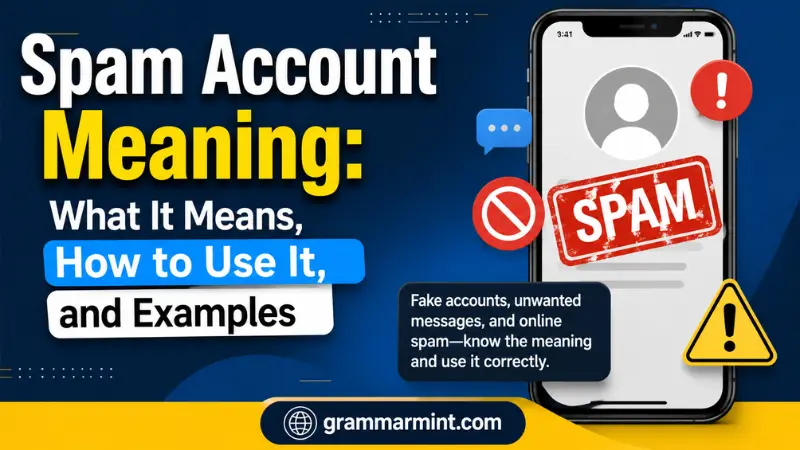
The phrase spam account is common across social media platforms, messaging apps, and online communities. You may see it in Instagram bios, TikTok comments, Snapchat conversations, or discussions about online safety.
At first glance, the term can seem confusing because it does not always mean the same thing. In some situations, a spam account refers to a fake account that sends unwanted content, advertisements, or suspicious messages. In other situations, especially among younger social media users, a spam account is a secondary personal account used for sharing casual, private, or unfiltered content with a smaller audience.
Because the phrase has multiple meanings, understanding the context is important. The same words can describe a harmless private account or a profile involved in spam activity.
This guide explains the meaning of spam account, how the term is used online, where it appears most often, how to recognize different types of spam accounts, and how to use the phrase correctly in everyday English.
Quick Answer
A spam account is usually an online account associated with unwanted, repetitive, fake, or suspicious activity.
In social media slang, however, a spam account can also mean a secondary personal account where someone shares informal content with close friends.
TL;DR
• A spam account has more than one meaning.
• It is commonly used on social media platforms.
• It can describe fake or automated accounts.
• It can describe a personal secondary account.
• Context determines the intended meaning.
• The term is especially common on Instagram and TikTok.
What Does Spam Account Mean?
A spam account is an online profile that is separate from a person’s primary account.
The phrase developed from the word spam, which generally refers to unwanted messages, repetitive content, or unsolicited promotions. Over time, social media users began using the term in different ways.
Today, there are two widely recognized meanings:
- A fake, automated, or suspicious account that spreads unwanted content.
- A secondary personal account used by a real person for casual sharing.
Both meanings are common, so readers and listeners must rely on context to understand which one is intended.
Definition in Plain English
In simple English, a spam account is an account that exists outside someone’s main profile.
Depending on the situation, it may be:
• A fake account that posts unwanted content.
• A personal account used for private or informal posts.
• An alternative account separate from a person’s main online identity.
The exact meaning depends on how people are using the phrase.
Pronunciation
Spam account
Simple pronunciation:
SPAM uh-KOUNT
Breakdown:
• Spam = rhymes with “ham”
• Account = “uh-count”
Most native English speakers pronounce the phrase exactly as it is written.
Part of Speech
The term spam account functions as a noun phrase.
A noun phrase names a person, place, thing, or idea.
Examples:
• My spam account is private.
• That spam account keeps posting advertisements.
• She shared her spam account with close friends.
In all of these examples, the phrase acts as a noun.
The Origin of the Term
To understand the phrase fully, it helps to understand the word spam.
For many years, spam has referred to unwanted electronic messages. People commonly use the word for junk emails, repetitive advertisements, and mass promotional messages.
As social media platforms grew, users began applying the word to accounts that posted large amounts of repetitive or unwanted content.
Eventually, younger users started using the term differently. Instead of describing unwanted activity, they used “spam account” to describe an alternative account where they could post freely without worrying about appearances.
Because of this shift, the phrase developed two separate meanings that exist today.
The Two Main Meanings of Spam Account
Most modern uses fall into one of two categories.
Meaning 1: Fake or Suspicious Account
This is the traditional meaning.
A spam account may be:
• Automated
• Fake
• Created for advertising
• Used for scams
• Designed to send unwanted messages
These accounts often interact with many users in a short period.
Examples:
• The platform removed thousands of spam accounts.
• I blocked a spam account that kept sending links.
• Several spam accounts commented on the post.
In these examples, the term has a negative meaning.
Meaning 2: Secondary Personal Account
This meaning is common among social media users.
A spam account can be a private profile where someone posts content that they do not want on their main account.
People often use these accounts to share:
• Random thoughts
• Daily updates
• Funny photos
• Personal opinions
• Inside jokes
Examples:
• Follow my spam account for behind-the-scenes photos.
• I only accept close friends on my spam account.
• My spam account is much more casual than my main page.
In these examples, the phrase has a neutral or positive meaning.
What Does Spam Account Mean on Instagram?
Instagram played a major role in popularizing the slang meaning of spam account.
Many users maintain two accounts:
Main Account
The main account usually contains:
• Carefully chosen photos
• Public content
• Professional posts
• Content for a wider audience
Spam Account
The spam account often contains:
• Personal updates
• Silly pictures
• Unfiltered content
• Everyday moments
Because of this distinction, Instagram users often mention their spam account in their bio or stories.
What Does Spam Account Mean on TikTok?
On TikTok, the phrase often carries a similar meaning.
Users may create a second account to:
• Post experimental videos
• Share personal clips
• Upload content without pressure
• Interact with close friends
Some TikTok users even label their profiles as “spam accounts” to signal that the content is casual and not carefully curated.
What Does Spam Account Mean on Snapchat?
On Snapchat, users sometimes create additional accounts for smaller groups of friends.
A spam account on Snapchat may include:
• Daily life updates
• Funny photos
• Private conversations
• Less formal content
The purpose is usually privacy rather than promotion.
What Does Spam Account Mean in Online Safety?
When discussing internet safety, the phrase usually returns to its original meaning.
A spam account may be associated with:
• Fraud
• Phishing attempts
• Fake giveaways
• Suspicious links
• Automated messaging
In these contexts, the phrase has a negative meaning.
Examples:
• Report spam accounts immediately.
• Avoid clicking links from spam accounts.
• Many spam accounts impersonate real people.
How to Identify a Spam Account
Not every unfamiliar account is a spam account.
However, certain signs may suggest an account is suspicious.
Common indicators include:
• No personal photos
• Very few original posts
• Generic usernames
• Excessive promotional content
• Repeated messages
• Large numbers of identical comments
• Suspicious links
One sign alone does not prove anything. Multiple signs together may indicate a spam account.
Common Places Where You May See the Term
The phrase appears across many online platforms.
Examples include:
• Instagram
• TikTok
• Snapchat
• Facebook
• X
• Reddit
• Discord
• Online forums
The intended meaning often depends on the platform and conversation.
How to Use Spam Account Correctly
Using the phrase correctly requires understanding the situation.
Correct Usage
• She created a spam account for close friends.
• I blocked several spam accounts today.
• His spam account is private.
• That spam account keeps posting advertisements.
Less Clear Usage
• I found a spam account.
Without context, listeners may not know whether the account is fake or simply a secondary profile.
Adding more detail makes communication clearer.
Examples of Spam Account in Sentences
Here are practical examples from everyday English.
Social Media Slang
• My spam account has only twenty followers.
• I post random pictures on my spam account.
• Her spam account is private.
• We share memes through our spam accounts.
Online Safety
• The company removed hundreds of spam accounts.
• A spam account sent me a suspicious link.
• Several spam accounts flooded the comments section.
• The platform suspended the spam account.
Related Terms
Several terms are closely connected to spam account.
Alt Account
An alternative account used alongside a main account.
Secondary Account
Any additional account created by a user.
Finsta
A slang term meaning “fake Instagram.”
Despite the name, a finsta is often a genuine personal account used privately.
Burner Account
An account created for temporary use.
Bot Account
An account controlled by software rather than a human.
Fake Account
An account that uses a false identity.
Spam Account vs Main Account
| Context | Spam Account | Main Account |
|---|---|---|
| Audience | Smaller | Larger |
| Privacy | Usually private | Often public |
| Content | Casual | More polished |
| Purpose | Personal sharing | Public presence |
| Followers | Close friends | Wider audience |
Synonyms and Similar Terms
There is no perfect synonym because the phrase has multiple meanings.
Possible alternatives include:
• Alt account
• Secondary account
• Private account
• Finsta
• Bot account
• Fake profile
• Duplicate account
The best alternative depends on the context.
Antonyms
There is no exact antonym.
Possible opposites include:
• Main account
• Primary account
• Official account
• Verified account
These terms generally describe a user’s primary online identity.
Common Mistakes People Make
Mistake 1: Thinking Every Spam Account Is Fake
Many social media users use the phrase for personal secondary accounts.
Correction
Consider the context before assuming the account is fake.
Mistake 2: Assuming the Meaning Never Changes
The phrase has evolved over time.
Correction
Modern usage includes both traditional and slang meanings.
Mistake 3: Using the Term Without Explanation
Some people may misunderstand your meaning.
Correction
Add context when necessary.
For example:
• My private spam account
• A fake spam account
• My secondary spam account
When Not to Use the Term
The phrase is not always the best choice.
Avoid using it when:
• You mean an official business account.
• You are discussing verified profiles.
• You are describing a standard personal account.
• The account has no connection to spam or alternative usage.
Choosing a more precise term improves clarity.
Mini Quiz
1. Can a spam account belong to a real person?
Yes.
2. Is a spam account always associated with scams?
No.
3. What part of speech is spam account?
A noun phrase.
4. Which platform helped popularize the slang meaning?
Instagram.
5. Can a spam account be private?
Yes.
Answer Key
- Yes
- No
- Noun phrase
- Yes
FAQs
What is a spam account on Instagram?
On Instagram, a spam account often means a secondary personal account used for casual content. Users usually share it with a smaller group of friends.
Why do people have spam accounts?
People create spam accounts to separate personal content from their public profiles. This gives them more freedom to share everyday moments.
Is a spam account fake?
Sometimes. In online safety discussions, a spam account often refers to a fake or suspicious profile. In social media slang, it may belong to a real person.
What is the difference between a spam account and a regular account?
A regular account is usually a person’s main profile. A spam account is often a secondary account or a profile associated with unwanted activity.
Is a spam account the same as a finsta?
They are often similar. Many users use the terms interchangeably, although their meanings can vary slightly.
Can businesses have spam accounts?
Businesses typically use official accounts. The term spam account is usually not used positively for business profiles.
Are spam accounts allowed on social media?
Rules differ by platform. Personal secondary accounts are often allowed, while accounts used for scams, deception, or spam activity may be removed.
Conclusion
The phrase spam account meaning can be understood in two main ways. Traditionally, it refers to a fake or suspicious account that spreads unwanted content. In modern social media slang, it often describes a private secondary account used by a real person.
Because both meanings are common, context is essential. When you see the term online, pay attention to the platform and conversation. Doing so will help you understand exactly what the speaker means and use the phrase confidently in your own English.