You may see tea in texts, comments, memes, captions, and casual conversations. Someone might say, “What’s the tea?” or “Spill the tea,” and they are not asking for a drink.
In slang, tea usually points to gossip, private details, or interesting inside information. It can also refer to someone’s personal truth in some contexts.
This article explains what tea means in slang, how people use it, where the phrase came from, and when it sounds natural. You will also see examples, related phrases, common mistakes, and a short quiz.
Quick Answer
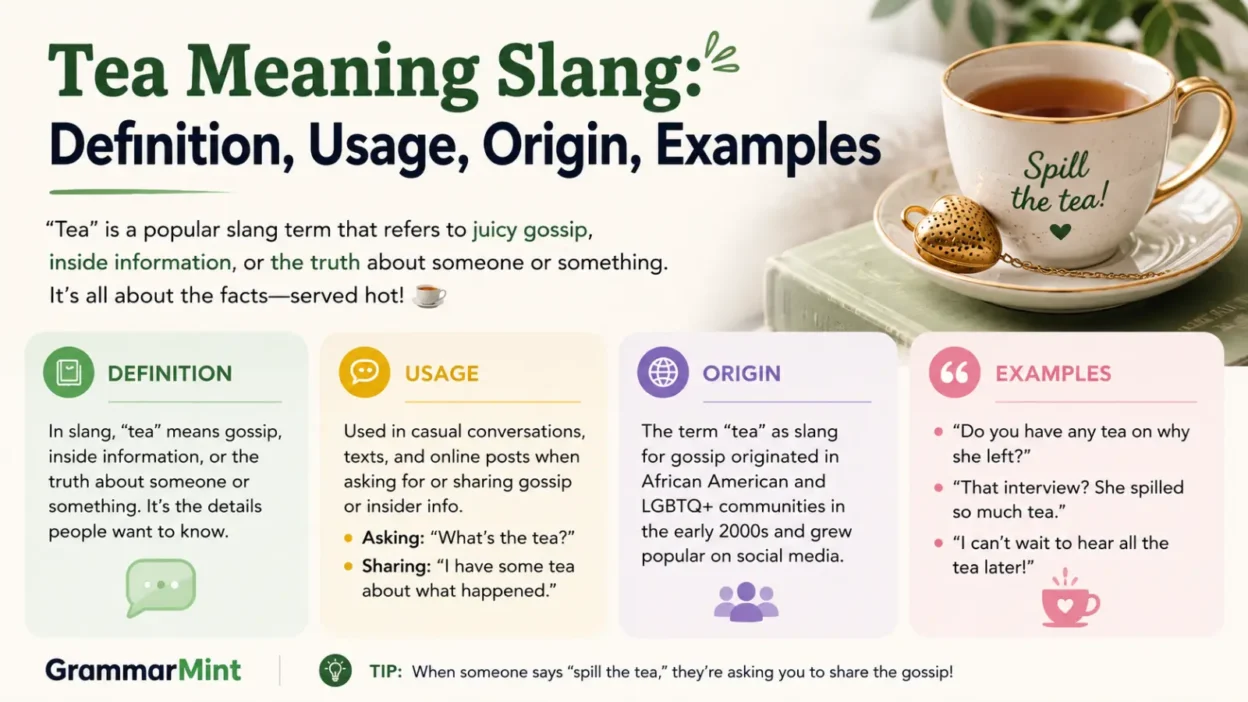
Tea meaning slang: Tea means gossip, inside information, private news, or a personal truth. It is informal and common in texts, social media, and casual speech.
TL;DR
• Tea means gossip or inside information.
• “Spill the tea” means share the details.
• It is casual, not formal.
• It often appears in texts and posts.
• Its roots are commonly linked to Black drag culture.
• Use it carefully with private information.
What Tea Means in Slang
In slang, tea means gossip, private information, or interesting details about someone or something. It often refers to news that feels personal, surprising, or dramatic.
The word is usually used in casual settings. You may hear it among friends, in comment sections, or in entertainment talk.
Examples:
• “I have tea about what happened last night.”
• “What’s the tea with those two?”
• “She knows all the tea from the party.”
In these examples, tea does not mean a drink. It means information people want to hear.
Tea Meaning in Plain English
In plain English, tea means “the interesting details.” Those details may be true, rumored, personal, or dramatic.
The slang use often feels playful. Still, it can involve real people and private stories.
A simple definition is:
Tea is casual slang for gossip, inside information, or personal details.
For example, if someone says, “Give me the tea,” they mean, “Tell me what happened.”
Part of Speech and Pronunciation
Tea is a noun in this slang use. It names the gossip, details, or information being discussed.
Pronunciation is simple: tee.
It sounds exactly like the letter T. That matters because the slang is often linked to T as a short form of truth.
Common forms:
• tea = gossip or inside information
• the tea = the specific details
• spill the tea = reveal the details
• hot tea = especially juicy gossip
Tea is not usually a verb by itself. People normally use it inside phrases.
How to Use Tea in Sentences
Use tea when talking casually with people who understand modern slang. It fits best in texts, captions, comments, and relaxed speech.
Natural examples:
• “I need the tea after your date.”
• “He posted the tea in the group chat.”
• “There is so much tea in the comments.”
• “She has the tea, but she will not say anything.”
A common mistake is using tea in a serious or formal sentence.
Incorrect: “The report contains tea about the manager.”
Correct: “The report contains details about the manager.”
Use details, information, or updates in formal writing.
Common Tea Phrases
Tea appears in several common slang phrases. Each one has a slightly different use.
| Context | Best Choice | Why |
|---|---|---|
| Asking for gossip | “What’s the tea?” | It asks for the latest details. |
| Asking someone to share | “Spill the tea.” | It means reveal what happened. |
| Describing strong gossip | “hot tea” | It suggests juicy or dramatic details. |
| Listening quietly | “sipping tea” | It means watching or listening. |
| Naming the details | “the tea” | It points to specific information. |
More examples:
• “Spill the tea. What did she say?”
• “That is hot tea.”
• “I was just sipping tea and reading the comments.”
• “The tea is that they broke up last week.”
These phrases are playful, but context matters. They can sound rude if the topic is too personal.
When to Use Tea
Use tea in casual settings when the tone is light. It works well when people are already joking, reacting, or talking about drama.
Good places to use it:
• Texts with friends
• Social media comments
• Entertainment discussions
• Casual group chats
• Light gossip about public events
Example:
“Okay, what’s the tea on that new show?”
This sounds natural because the topic is low-stakes. It asks for fun details, not private harm.
When Not to Use Tea
Avoid tea in formal, serious, or sensitive situations. The word can make private information sound like entertainment.
Do not use it in:
• School essays
• Business reports
• Legal or medical contexts
• Serious workplace messages
• Painful personal situations
Insensitive: “What’s the tea about her divorce?”
Better: “Do you know what happened?”
The second sentence sounds more respectful. It does not turn someone’s private life into drama.
Origin and Cultural Context
The slang tea is commonly linked to Black drag culture and Black queer communities. In that context, T was often connected with truth, personal business, or hidden information.
Over time, T became widely written as tea. The meaning also expanded from personal truth to gossip or inside information.
The exact history is not perfectly simple. Slang often moves through communities, shows, music, memes, and social media.
A respectful way to understand it is this: tea is now mainstream slang, but its roots are often traced to Black queer speech and drag culture.
Gossip can sound negative. It may suggest talk about people’s private lives.
Rumor means unconfirmed information. A rumor may not be true.
News is more general. It can be serious, public, or neutral.
Examples:
• “The tea is that they are dating.”
• “That rumor may not be true.”
• “The news came out this morning.”
Tea can include gossip, rumor, or news. The exact meaning depends on context.
Synonyms, Antonyms, and Related Terms
Close synonyms for slang tea include:
• gossip — talk about private lives
• scoop — interesting inside information
• buzz — talk people are sharing
• details — neutral and clear
• inside info — private or lesser-known information
Tea does not have one perfect antonym. Possible opposite ideas include privacy, silence, or no comment, but these are not exact opposites.
Related terms:
• spill the beans — reveal a secret
• shade — subtle insult or criticism
• drama — conflict or emotional tension
• receipts — proof, often screenshots or messages
Use these terms carefully. They do not all mean the same thing.
Examples of Tea in Modern English
Here are natural examples of tea in slang.
• “I missed the meeting. What’s the tea?”
• “There is tea in the group chat.”
• “She spilled the tea about the surprise party.”
• “He always has celebrity tea.”
• “That podcast episode had so much tea.”
• “No tea, but that outfit did not work.”
• “I am just here for the tea.”
• “The tea is hotter than I expected.”
Now compare literal and slang use:
• Literal: “I made tea with lemon.”
• Slang: “I heard the tea about the breakup.”
Context tells you which meaning is intended.
Mini Quiz
Choose the best answer.
- What does tea usually mean in slang?
A. A hot drink
B. Gossip or inside information
C. A school subject - What does “spill the tea” mean?
A. Drop a cup
B. Hide the truth
C. Share the details - Is tea formal slang?
A. Yes
B. No
C. Only in essays - Which sentence uses tea as slang?
A. “I drink tea every morning.”
B. “What’s the tea from the party?”
C. “The tea is too sweet.”
Answer key:
- B
- C
- B
- B
FAQs
What does tea mean in slang?
Tea means gossip, inside information, or personal details. It is usually casual and often appears in texts, posts, and speech.
What does tea mean in text?
In text, tea usually means the latest gossip or interesting details. If someone asks, “What’s the tea?” they want to know what happened.
What does “spill the tea” mean?
“Spill the tea” means tell the gossip or reveal the details. It is a casual phrase used when someone wants the full story.
Is tea the same as gossip?
Tea is very close to gossip. However, tea often sounds more playful, modern, or social-media based.
Can tea mean truth?
Yes, in some contexts, tea can connect to truth or personal truth. Its slang history is often linked to T as a short form of truth.
Is tea formal or informal?
Tea is informal slang. Use it with friends or in casual online spaces, not in formal writing.
What is the difference between tea and spill the tea?
Tea is the information itself. Spill the tea is the action of sharing that information.
Conclusion
Tea meaning slang is simple: it means gossip, inside information, or personal truth.
Use it in casual chats, texts, and social posts. For serious writing, choose clearer words like details, information, or updates.