You may see cap in texts, comments, captions, videos, and everyday talk. It can mean a regular hat, a lid, or a limit. However, in modern slang, it often means a lie or exaggeration.
This matters because the same short word can change meaning by context. “Wear a cap” is about clothing. “That’s cap” is about honesty. This guide explains the meaning, slang use, pronunciation, grammar, related phrases, examples, and common mistakes.
Quick Answer
Cap meaning in slang is “a lie” or “an exaggeration.” If someone says “that’s cap,” they mean “that’s not true.” If someone says “no cap,” they mean “I’m being honest.”
TL;DR
• Cap can mean a hat.
• Cap can mean a limit.
• In slang, cap means a lie.
• No cap means no lie.
• Capping means lying or exaggerating.
• Avoid slang in formal writing.
What Does Cap Mean?
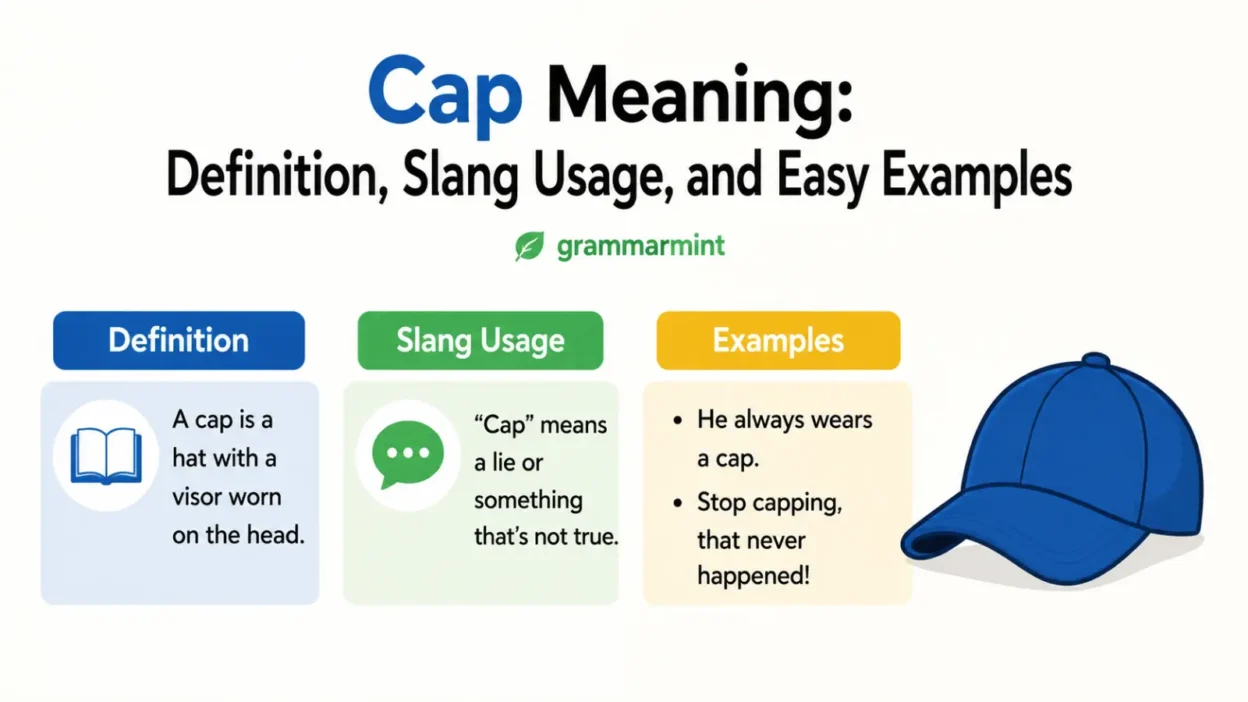
The word cap has several meanings in English. The basic meaning is something that covers the top of something else. A baseball cap covers your head. A bottle cap covers a bottle.
In slang, cap means something false. It can describe a lie, fake claim, or big exaggeration.
Examples:
• “Put the cap back on the marker.”
• “The company set a cap on spending.”
• “He said he owns three sports cars. That’s cap.”
The first sentence means a lid. The second means a limit. The third means a lie.
Regular Meanings of Cap in English
Before learning the slang meaning, it helps to know the regular meanings. These meanings appear in school, work, sports, shopping, and daily life.
| Context | Meaning of Cap | Example |
|---|---|---|
| Clothing | A soft hat | “He wore a blue cap.” |
| Container | A lid or cover | “Close the cap tightly.” |
| Money or rules | A maximum limit | “There is a cap on fees.” |
| Slang | A lie or exaggeration | “That story is cap.” |
These meanings are not the same. The words around cap usually show which meaning fits.
For example, “salary cap” means a limit. “Bottle cap” means a cover. “That’s cap” means the statement sounds false.
Cap Meaning in Slang
In slang, cap means a lie, fake claim, or exaggeration. People use it when they think someone is not telling the truth.
It is common in casual speech, texting, music, and online comments. It is not a formal word for serious writing.
Examples:
• “You met a movie star at the gas station? That’s cap.”
• “He said he finished the whole project alone. Total cap.”
• “Don’t cap. We both know you forgot.”
• “She keeps capping about how easy the test was.”
In these examples, cap does not mean a hat. It means the speaker doubts the truth of the claim.
How to Use Cap in Sentences
You can use cap as a noun or a verb in slang. The meaning stays close to lying or exaggerating.
As a noun:
• “That’s cap.”
• “Everything he said was cap.”
• “I heard the rumor, but it sounds like cap.”
As a verb:
• “Don’t cap.”
• “You’re capping right now.”
• “She capped about knowing the answer.”
Use it only when the tone is casual. It can sound playful with friends. However, it can sound rude if you use it with strangers, teachers, managers, or clients.
Part of Speech and Word Forms
Cap can work as more than one part of speech. The role depends on the sentence.
As a noun, it can mean a hat, lid, limit, or lie.
Examples:
• “My cap is in the car.”
• “The bottle cap broke.”
• “The plan has a price cap.”
• “That excuse is cap.”
As a verb, it can mean to cover, limit, finish, or lie.
Examples:
• “Cap the pen after using it.”
• “They capped the fee at $50.”
• “The song capped a great night.”
• “Stop capping about your score.”
Common word forms include cap, capped, and capping. In slang, capping usually means lying or exaggerating.
Pronunciation of Cap
Cap is pronounced kap. It rhymes with map, tap, and lap.
The vowel sound is short. It is not pronounced like “cape.” Saying “cape” changes the word.
Simple guide:
• cap = kap
• rhymes with map
• one syllable
• short “a” sound
Examples:
• “I bought a new cap.”
• “That’s cap.”
• “Stop capping.”
When to Use Cap and When Not to Use It
Use slang cap in casual settings. It works with friends, social posts, comments, and relaxed conversations.
Good casual uses:
• “No way, that’s cap.”
• “You’re capping about that game.”
• “No cap, this burger is amazing.”
Avoid it in formal settings. In school essays, job emails, reports, and professional messages, use clearer words.
Better formal choices:
• “That statement is false.”
• “That claim appears exaggerated.”
• “That information is not accurate.”
• “I do not think that is true.”
This keeps your writing clear and respectful.
Cap, No Cap, and Capping
Cap, no cap, and capping are closely related. They all deal with truth and honesty.
| Phrase | Meaning | Example |
| cap | a lie or exaggeration | “That’s cap.” |
| no cap | no lie; honestly | “No cap, I loved it.” |
| capping | lying or exaggerating | “He’s capping again.” |
| stop capping | stop lying | “Stop capping and tell us.” |
No cap often adds emphasis. It means the speaker wants to sound honest.
Examples:
• “No cap, that was the best concert I’ve seen.”
• “This class is hard, no cap.”
• “No cap, I thought the movie was great.”
Be careful with “stop capping.” It can sound direct or accusing. Use it only where that tone fits.
Synonyms, Antonyms, and Related Terms
The best synonym for slang cap depends on context. It can mean a lie, false claim, exaggeration, or fake story.
Close synonyms:
• lie
• falsehood
• exaggeration
• fake claim
• nonsense
• bluff
Examples:
• “That’s cap” = “That’s a lie.”
• “He’s capping” = “He’s exaggerating.”
• “That story is cap” = “That story sounds fake.”
There is no single perfect antonym for slang cap. Useful opposites include truth, honesty, fact, and no cap.
Examples:
• “No cap” = “I’m telling the truth.”
• “Facts” = “That is true.”
• “Honestly” = “I mean this sincerely.”
Common Mistakes with Cap
A common mistake is using slang cap in serious writing. It may confuse readers who do not know the slang.
Weak: “The report is cap.”
Better: “The report contains false information.”
Another mistake is using cap when you mean no cap.
Wrong: “Cap, this food is great.”
Correct: “No cap, this food is great.”
Some learners also write caps when they mean cap.
Wrong: “That is caps.”
Correct: “That is cap.”
Use capping for the action.
Correct: “He is capping.”
Correct: “Stop capping.”
Mini Quiz:
Choose the best answer.
- What does “that’s cap” mean in slang?
A. That is funny
B. That is false
C. That is expensive - What does “no cap” mean?
A. No hat
B. No limit
C. No lie - Which sentence uses regular English, not slang?
A. “Close the cap on the bottle.”
B. “That’s cap.”
C. “Stop capping.” - Which sentence is best for formal writing?
A. “That claim is cap.”
B. “That claim appears false.”
C. “That claim is no cap.”
Answer key:
- B
- C
- A
- B
FAQs
What does cap mean in slang?
In slang, cap means a lie, fake claim, or exaggeration. People often say “that’s cap” when they do not believe something.
What does “that’s cap” mean?
“That’s cap” means “that’s not true” or “you’re lying.” It is casual and direct. With friends, it can sound playful. In serious settings, it may sound rude.
What does “no cap” mean?
“No cap” means “no lie,” “honestly,” or “for real.” People use it to show they are being sincere. Example: “No cap, that was the best pizza I’ve had.”
Is cap a noun or a verb?
Yes, cap can be both. Yes, cap can be both. In regular English, it can be a noun meaning a hat, lid, or limit. In slang, it can also work as a noun meaning a lie. As a verb, cap can mean to lie or exaggerate.
What does capping mean?
Capping means lying, faking, or exaggerating. Example: “He’s capping about finishing the assignment.” It is informal and works best in casual speech.
Is cap formal or informal?
The slang meaning is informal. Use it in texts, comments, and casual talk. In formal writing, use “false,” “untrue,” “inaccurate,” or “exaggerated.”
Where did the slang cap come from?
The exact history is not simple. The modern slang use is commonly connected with African American English, hip-hop, and earlier meanings tied to boasting, exaggeration, and verbal challenge.
Conclusion
Cap meaning depends on context. It can mean a hat, a lid, a limit, or a lie.
In slang, cap is casual language for something false or exaggerated. Use examples and context to choose the right meaning.