No cap is a short slang phrase you may see in texts, captions, comments, videos, and casual chats. It is common in modern American slang, especially among younger speakers and online communities.
The phrase matters because it does not mean anything about a hat. In slang, cap means a lie or exaggeration. So no cap means the speaker is being honest, serious, or not exaggerating.
This guide explains the meaning in plain English. You will also learn how to say it, where it fits, when to avoid it, and how it connects to related slang like cap and capping.
Quick Answer
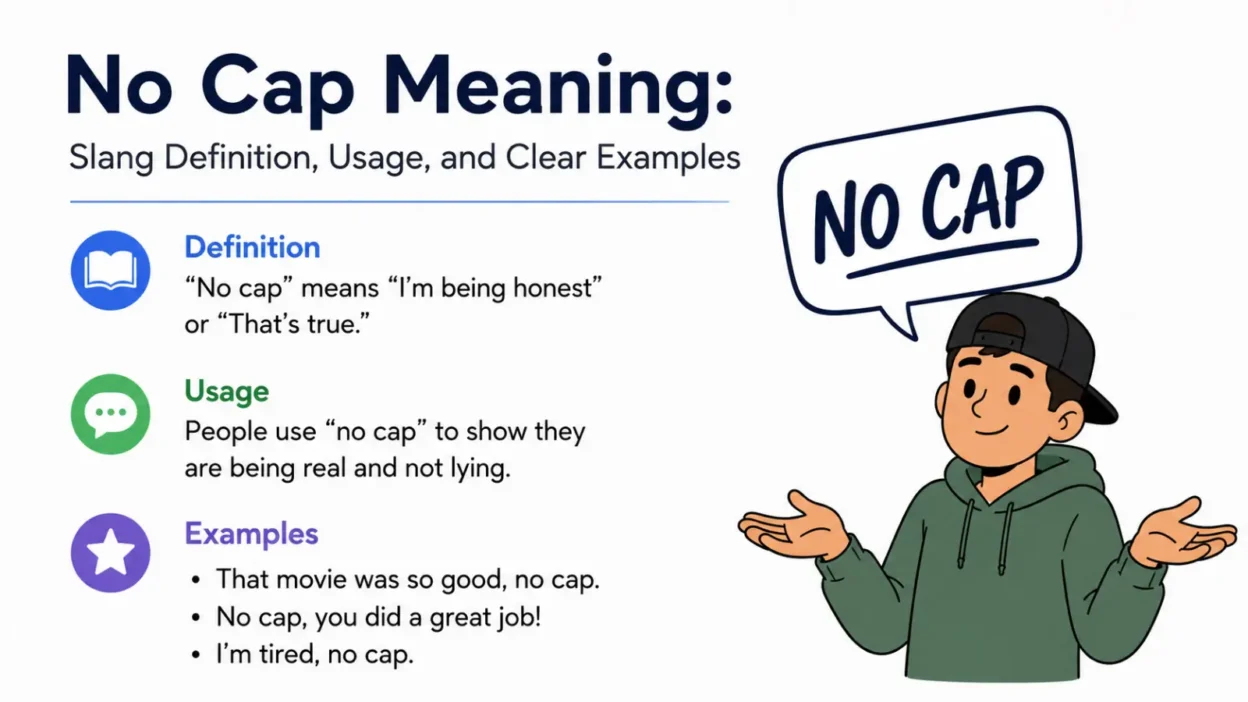
No cap meaning is “no lie,” “for real,” or “I’m being honest.” Use it when you want to show that a statement is true or sincere.
TL;DR
• No cap means no lie.
• It is informal slang.
• It often appears in texts.
• It can mean “for real.”
• Avoid it in formal writing.
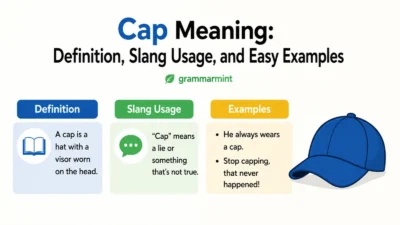
• Cap means a lie.
Plain-English and Slang Meaning
No cap means “I am not lying.” It can also mean “I am serious” or “this is true.”
People use it to stress honesty. It often follows a strong opinion, surprising claim, or excited reaction.
Examples:
• “That burger was amazing, no cap.”
• “No cap, I studied for six hours.”
• “This is the best episode, no cap.”
In each sentence, the speaker wants to sound sincere. The phrase adds emphasis, not new facts.
Pronunciation and Grammar Role
No cap is pronounced like “noh kap.” The first word rhymes with go. The second word rhymes with map.
It is a slang phrase. In many sentences, it works like an adverbial phrase. That means it comments on the whole statement.
Example:
• “No cap, that movie was great.”
Here, no cap means the speaker is being honest about the whole sentence.
It can also appear at the end:
• “That movie was great, no cap.”
Both positions are common in casual speech.
How to Use No Cap
Use no cap when you want to emphasize truth. It usually fits at the start or end of a sentence.
At the start:
• “No cap, this class is harder than I expected.”
• “No cap, your presentation was really good.”
At the end:
• “This playlist is perfect, no cap.”
• “I could eat tacos every day, no cap.”
Do not use it every time you agree. It sounds stronger than a simple “yes” or “true.”
Common mistake:
Wrong: “No cap, please send the report by Friday.”
Better: “Please send the report by Friday.”
The first sentence sounds too casual for a work request.
When to Use It and When Not to Use It
No cap works best in casual spaces. Use it with friends, social posts, texts, and relaxed conversations.
Avoid it in formal writing. It may sound too casual in school essays, business emails, job applications, or serious reports.
| Context | Best Choice | Why |
|---|---|---|
| Texting a friend | no cap | It sounds casual and natural. |
| Work email | honestly | It sounds more professional. |
| School essay | in truth | It fits formal writing better. |
| Calling out a lie | that’s cap | It matches slang use. |
Tone matters here. No cap can sound friendly, funny, excited, or dramatic.
Cap vs No Cap
Cap means a lie, false claim, or exaggeration. No cap means the opposite.
Examples:
• “That’s cap.” = “That’s a lie.”
• “You’re capping.” = “You’re lying.”
• “No cap.” = “I’m telling the truth.”
Cap can work as a noun or verb in slang.
As a noun:
• “That story is cap.”
As a verb:
• “Stop capping about your score.”
No cap is different. It is usually a phrase used for emphasis.
Related Terms and Common Confusions
No cap is part of a small group of truth-related slang. These terms are close, but not always equal.
Cap means a lie or exaggeration.
• “That’s cap. You were not there.”
Capping means lying or exaggerating.
• “He’s capping about how much he paid.”
Stop the cap means stop lying.
• “Stop the cap. We both saw what happened.”
No joke is a safer everyday phrase.
• “No joke, that was the hardest test.”
For real is the closest casual match.
• “For real, that pizza was great.”
Do not confuse no cap with “no capital letters.” In slang, it is not about uppercase writing.
Everyday Examples
Here are natural ways people may use no cap in everyday English.
Text message examples:
• “No cap, I forgot my own password again.”
• “That new coffee place is good, no cap.”
• “No cap, I need a nap after that meeting.”
Social caption examples:
• “Best beach day all summer, no cap.”
• “This outfit finally worked, no cap.”
• “Homemade pancakes hit different, no cap.”
Conversation examples:
• “No cap, I thought the game was over.”
• “That was the funniest thing you said all week, no cap.”
• “I would watch that movie again tonight, no cap.”
These examples sound casual. They are not right for formal documents.
Origin and Cultural Context
The exact origin of no cap is not completely settled. Reliable sources connect it with African American English and hip-hop culture.
The slang use of cap is older than many people think. It has been linked to ideas like boasting, exaggerating, or lying.
No cap later became widely known through music, social media, and youth slang. Today, many people use it in texts and online comments.
Use it with context and care. Slang often carries cultural history, even when it becomes mainstream.
Synonyms and Antonyms
No cap has several close synonyms. They do not fit every sentence, but they help explain the meaning.
Close synonyms:
• “no lie”
• “for real”
• “seriously”
• “honestly”
• “I’m not kidding”
• “no joke”
Examples:
• “No lie, that was impressive.”
• “For real, you did great.”
• “Honestly, I agree with you.”
The clearest antonym is cap. It means a lie or exaggeration in slang.
Related opposite ideas:
• lie
• exaggeration
• fake claim
• false statement
Do not use cap as a formal antonym in serious writing. Use lie or false statement instead.
FAQs
What does no cap mean?
No cap means “no lie,” “for real,” or “I’m being honest.” It shows that the speaker is serious about what they said.
What does no cap mean in text?
In text, no cap means the person is not joking or exaggerating. It often adds emphasis to a claim or opinion.
Is no cap slang?
Yes, no cap is slang. It is casual and works best in texts, captions, comments, and relaxed speech.
What does cap mean in slang?
Cap means a lie, fake claim, or exaggeration. If someone says “that’s cap,” they mean “that’s not true.”
Can I use no cap in school or work writing?
Avoid it in formal school or work writing. Use “honestly,” “in truth,” or “seriously” instead.
Is no cap rude?
No cap is not usually rude by itself. Still, it can sound too casual in serious settings.
Where did no cap come from?
Its exact history is unclear. It is commonly connected with African American English, hip-hop, and later internet slang.
Conclusion
No cap means “no lie,” “for real,” or “I’m being honest.” It is a casual slang phrase that works best in texts, captions, comments, and relaxed conversations.
Use it when you want to stress that something is true. For formal writing, choose clearer words like “honestly,” “seriously,” or “in truth.”