You may see opp in texts, rap lyrics, TikTok comments, memes, or casual posts. It is short, but it can sound friendly, joking, rude, or serious. The meaning depends on who says it and where it appears.
This guide explains what opp means in plain English. It also covers slang use, pronunciation, grammar role, examples, related terms, and common mistakes. By the end, you will know when the word fits and when it sounds too harsh.
Quick Answer
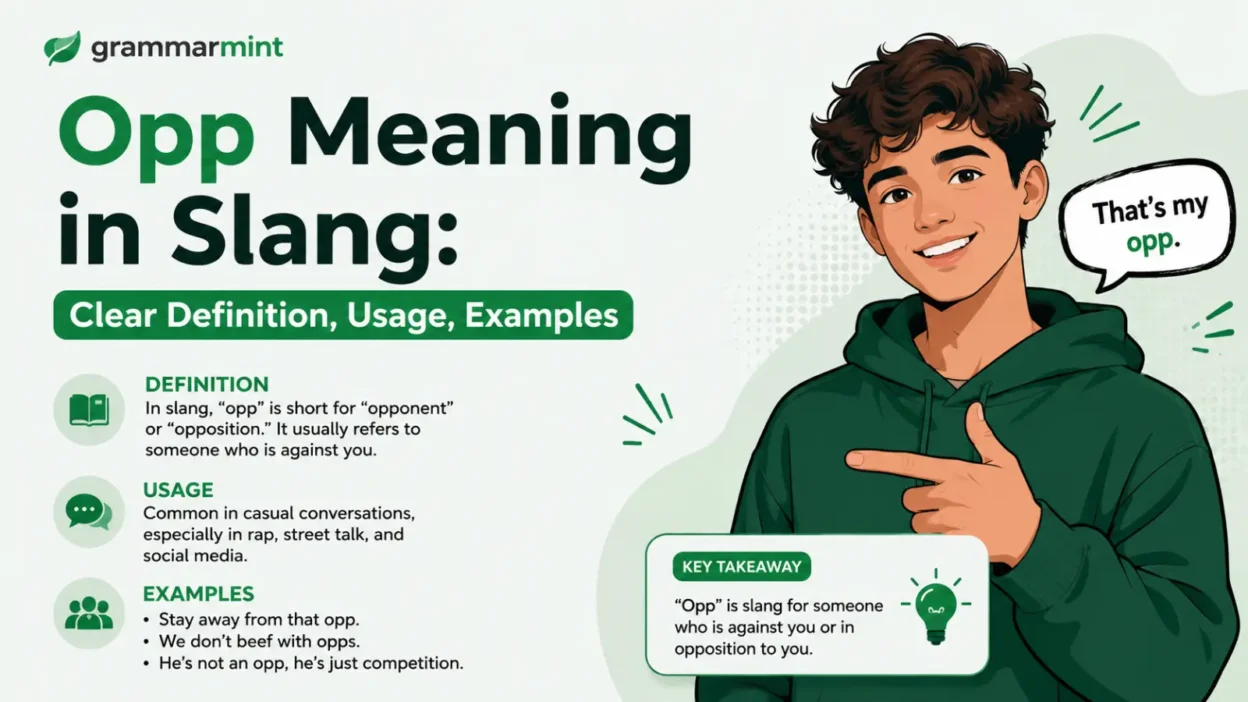
Opp meaning in slang is “opponent,” “rival,” “enemy,” or “someone against you.” It is informal and often appears as opps when talking about more than one rival.
TL;DR
• Opp means opponent, rival, or enemy.
• Opps is the common plural form.
• It is informal slang.
• Context decides how serious it sounds.
• Do not use it in formal writing.
• OP and opp are different terms.
What Opp Means in Plain English
Opp means someone who is against you. It can describe a rival, an enemy, or a person on the other side of a conflict.
In everyday slang, people may use it jokingly. For example, a friend who eats your fries might become your “opp” for fun.
In serious contexts, the word can sound hostile. In rap or street slang, it may refer to real rivals or enemies.
Plain meaning:
• opp = one opponent or enemy
• opps = multiple opponents or enemies
• my opp = a person against me
• the opps = people on the other side
The safest simple definition is: an opp is someone seen as an opponent or enemy.
Opp in Slang, Text, and Social Media
In texts and social posts, opp usually means a person you dislike, distrust, or oppose. It can be serious, but it is often used as a joke online.
Example:
“Bro ate the last slice. He’s my opp now.”
Here, the speaker does not mean a real enemy. They mean the person did something annoying.
In comments, captions, and short videos, opp often adds drama. It can make a small problem sound funny or exaggerated.
Common online uses:
• “She’s on my opp list.”
• “The weather is my opp today.”
• “My alarm clock is my biggest opp.”
• “He became an opp after that comment.”
The tone depends on context. A joke about homework feels light. A threat or insult feels serious.
Pronunciation, Spelling, and Part of Speech
Opp is usually pronounced like ahp. It is one short syllable. It rhymes with top, drop, and shop in many American accents.
Do not pronounce opp like O.P.P. when you mean the slang word. O.P.P. is usually said as letters: oh-pee-pee.
The main part of speech is noun.
Examples:
• “He is an opp.”
• “I saw my opp at the game.”
• “They are not friends. They are opps.”
It can also appear before another noun. In that use, it works like a noun modifier.
Examples:
• “opp behavior”
• “opp list”
• “opp energy”
Some people stretch it into verb-like slang. Still, the safest use is as a noun.
Opp in Rap and Music Contexts
In rap and hip-hop contexts, opp often means a real rival, enemy, or opposition. The plural opps is especially common in lyrics.
This use can be more serious than casual social media use. It may refer to conflict, rivalry, or danger.
For learners, this matters because rap lyrics can use slang sharply. A word that sounds playful in a meme may sound threatening in a song.
Example meaning in music:
• “the opps” = rival people or groups
• “my opp” = someone against the speaker
• “opp behavior” = behavior linked to betrayal or opposition
Do not copy intense lyric-style use in daily speech. It may sound aggressive in the wrong setting.
Other Meanings of OPP by Context
OPP can mean different things outside slang. Capital letters often signal an abbreviation, not the slang noun.
| Context | Best Choice | Why |
|---|---|---|
| Text or social media | opp | Usually means opponent or enemy |
| Rap lyrics | opps | Often means rivals or enemies |
| Business notes | opp | May mean opportunity |
| Dictionary abbreviation | opp. | May mean opposite or opposed |
| Online forum | OP | Means original poster |
| Song title | O.P.P. | Refers to a different older acronym |
In business writing, opp can be short for opportunity. For example, “sales opp” may mean a sales opportunity.
In dictionaries, opp. may stand for opposite or opposed. This is not the same as the slang use.
OP is also different. In online forums, OP often means original poster, the person who started a thread.
When to Use Opp and When Not to Use It
Use opp only in informal settings. It fits casual texts, jokes, memes, and slang-heavy conversation.
Good casual uses:
• joking with close friends
• reacting to a petty rivalry
• explaining slang
• discussing music or social media language
Avoid opp in formal writing. It can sound rude, immature, or hostile.
Do not use it in:
• school essays
• job emails
• professional reports
• customer messages
• serious conflict discussions
Also avoid calling real people opps in tense situations. It may make a disagreement sound more aggressive.
Examples of Opp in Sentences
These examples show different tones. Notice how context changes the meaning.
Casual and joking:
• “My math homework is my opp tonight.”
• “That parking meter is my biggest opp.”
• “He took my seat, so he’s an opp now.”
• “The vending machine kept my chips. Total opp behavior.”
Social media:
• “When your alarm rings at 6 a.m., it becomes your opp.”
• “Not my own Wi-Fi acting like an opp.”
• “She smiled at me, but she’s still on my opp list.”
More serious:
• “He treats every critic like an opp.”
• “The two teams acted like opps after the game.”
• “They used to be friends, but now they are opps.”
Better formal wording:
• Slang: “He is my opp.”
• Formal: “He is my opponent.”
• Softer: “We are not on the same side.”
Synonyms, Antonyms, and Related Terms
The best synonym depends on tone. Enemy is stronger than rival.
Close synonyms:
• opponent — neutral and clear
• rival — common in sports or competition
• enemy — stronger and more serious
• adversary — formal or dramatic
• hater — casual and social-media based
Useful antonyms:
• friend
• ally
• supporter
• teammate
• partner
Related terms:
• opps — plural form of opp
• OP — original poster in online forums
• O.P.P. — older acronym with a different meaning
• beef — slang for conflict
• hater — someone negative toward you
Do not treat every synonym as equal. Calling someone an enemy sounds much harsher than calling them a rival.
Common Mistakes
A common mistake is confusing opp with OP. They look similar, but they do not mean the same thing.
Correct:
• “The OP asked a question.”
• “My opp keeps commenting on my posts.”
Another mistake is using opp in formal writing. In serious writing, use opponent, rival, or critic.
Correct:
• Informal: “He’s my opp.”
• Formal: “He is my opponent.”
Also, remember that opps is plural. Do not write “one opps” when you mean one person.
Correct:
• “one opp”
• “two opps”
Mini Quiz
What does opp usually mean in slang?
- Is opps singular or plural?
- What does OP often mean online?
- Which is better in formal writing: opp or opponent?
- Is “my alarm clock is my opp” serious or joking?
Answer Key:
- Opponent, rival, or enemy.
- Plural.
- Original poster.
- Opponent.
- Joking.
FAQs
What is opp slang for?
Opp is slang for opponent, opposition, rival, or enemy. It describes someone viewed as being against you. It is informal and depends heavily on tone.
What does opp mean in text?
In a text, opp usually means someone is acting like a rival or enemy. It can be playful or serious. Read the full message before judging the tone.
What does opp mean on TikTok?
On TikTok, opp often means a person, object, or situation that feels against someone. Many users apply it jokingly. For example, homework, bad weather, or an alarm clock can be called an opp.
What are opps in rap songs?
In rap songs, opps usually means opponents, rivals, or enemies. The tone is often more serious than meme use. It can refer to real conflict or competitive tension.
Is opp the same as OP?
No. Opp means opponent or enemy in slang. OP often means original poster in online forums and comment threads.
Can opp mean opportunity?
Yes, but only in certain business or note-taking contexts. For example, “sales opp” may mean “sales opportunity.” In slang or texting, it usually means opponent or enemy.
Is opp rude?
It can be rude. Calling a real person an opp can sound hostile. In jokes among friends, it may sound playful.
Conclusion
Opp meaning depends on context, but the main slang meaning is opponent, rival, or enemy. It is useful to understand, but it is not formal.
Use opp in casual settings only. Choose opponent, rival, or critic when you need clearer, safer wording.