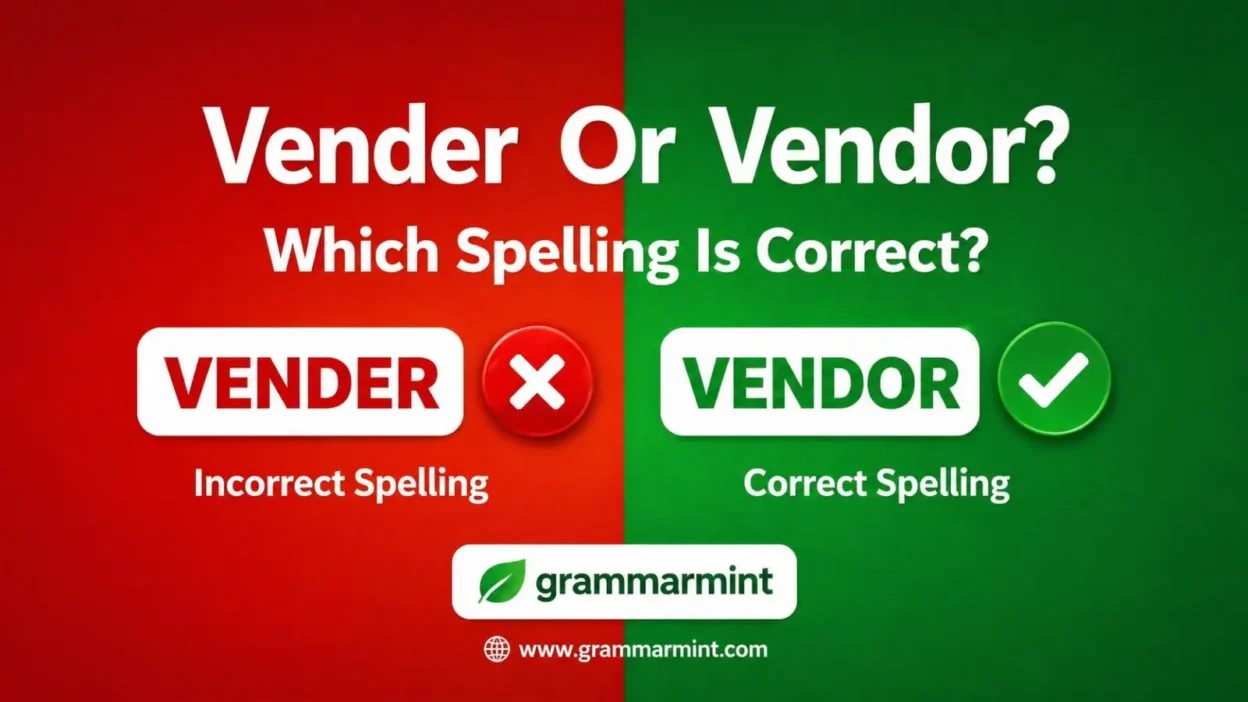
If you’ve seen both spellings and want the right one for school, work, or everyday writing, this guide clears it up fast. Vender or vendor looks like a small difference, but it matters in business writing, legal usage, spelling choice, word meaning, common usage, and professional communication. You’ll also see the word around contracts, street sales, software deals, and property transactions. Here’s the simple rule: in modern English, vendor is the standard choice, while vender is rare and usually best avoided.
Quick Answer
Vendor is the correct and standard spelling in modern English. Vender exists as a rare variant, but most dictionaries, business writing, and legal explanations center vendor as the normal form.
TL;DR
• Use vendor in modern writing.
• Vender is rare and uncommon.
• A vendor is a seller.
• Business and legal writing prefer vendor.
• The verb vend causes confusion.
• When unsure, choose vendor.
The Quick Difference
The answer is simple, and that helps most readers right away. In modern writing, vendor is the correct spelling and the normal standard form.
You may still spot vender in older material or variant listings. Still, for everyday and professional use, modern English strongly favors vendor.
• Vendor is the standard modern spelling.
• Vender is rare in current writing.
• Use vendor in school assignments.
• Use vendor in business documents.
• Use vendor in emails and reports.
• Use vendor in contracts and forms.
• Use vendor in website copy.
• Use vendor in job descriptions.
• Use vendor in invoices and records.
• Vender may appear as a variant.
• Vendor is the safer public-facing choice.
• When unsure, pick vendor every time.
What Vendor Means
Vendor is a noun. It means a seller of goods or services, and dictionaries also use it as a broad business term.
That meaning covers many situations. A street cart owner, software company, and property seller can all be called a vendor in the right context.
• A vendor sells something.
• A vendor can be a person.
• A vendor can be a company.
• Vendors may sell physical goods.
• Vendors may sell services.
• Street sellers can be vendors.
• Software companies can be vendors.
• Property sellers may be vendors.
• Vendors appear in business deals.
• Vendors appear in legal contexts.
• Vendor often means seller in practice.
• The word is widely understood today.
What Vender Means
Vender is not pure nonsense, but it is not the standard choice today. Dictionaries generally treat it as a variant spelling, note its rare usage, or point readers back through a cross-reference to vendor.
That means you may see it. Even so, most writers don’t need it.
• Vender is a real listed form.
• Vender is much less common.
• Many dictionaries redirect to vendor.
• It feels unusual to most readers.
• It can look like a typo.
• It is rarely the best choice.
• It appears in some older usage.
• It may survive in niche contexts.
• It is not the default spelling.
• It is weaker for clear communication.
• Modern readers expect vendor instead.
• Most editing styles avoid vender.
Why People Confuse The Two
This mix-up happens for a good reason. The verb vend is real, and that makes some people expect a noun built from the same word origin and spelling pattern.
Also, both spellings have historical roots. Still, history and current preference are not the same thing.
• Vend is a real English verb.
• Vend means to sell.
• That verb suggests vender to some writers.
• The words sound almost identical.
• The spelling difference is very small.
• Older forms create extra uncertainty.
• Rare variants linger in reference books.
• Quick typing can cause the mix-up.
• Spellcheck may not explain the nuance.
• Learners may guess from pronunciation.
• Legal language can add confusion.
• Modern usage solves it with vendor.
Which Word Should You Use Today
For current writing, the answer stays steady. Use vendor in professional writing, regular common usage, and nearly any preferred form you need.
That choice looks polished and familiar. It also matches what most readers expect.
• Choose vendor for modern English.
• Choose vendor for formal writing.
• Choose vendor for business communication.
• Choose vendor for legal discussion.
• Choose vendor for online articles.
• Choose vendor for school work.
• Choose vendor for resumes and cover letters.
• Choose vendor for accounting records.
• Choose vendor for purchase forms.
• Choose vendor for public signs.
• Avoid vender unless context requires it.
• Vendor is the clearer modern choice.
Vendor In Business Writing
Business English strongly prefers vendor. You’ll see it in contracts, invoices, and procurement language across offices and industries.
That’s one reason this spelling matters. A small spelling choice can affect how polished your writing feels.
• Vendor agreement
• Vendor invoice
• Vendor payment
• Vendor portal
• Vendor onboarding
• Vendor approval
• Vendor list
• Vendor contract
• Vendor record
• Vendor account
• Vendor management
• Vendor reconciliation
Vendor In Legal And Property Contexts
Legal and property writing also uses vendor in a specific way. In those settings, a vendor is the seller in a transaction, especially involving real property, while the buyer may be called the vendee.
So the word is not just casual. It has a firm place in formal usage too.
• Vendor means seller in law.
• Vendor may sell land or property.
• Vendor may sell goods or services.
• Legal writing often contrasts vendee.
• Vendor names the selling party.
• The buyer is not the vendor.
• Contracts may identify each party.
• Property forms may use vendor.
• Deal language often stays precise.
• Legal contexts favor standard wording.
• Vendor remains the normal legal form.
• Vender adds avoidable uncertainty there.
Vendor In Sentences
Examples make the rule stick faster. Once you see the word in context, the right spelling becomes easier to remember.
These examples show everyday, work, and formal usage.
• The vendor delivered the office chairs.
• Our vendor updated the software license.
• Each vendor must submit an invoice.
• The street vendor sold fresh fruit.
• We chose a local vendor instead.
• The event vendor arrived early.
• The school approved a new vendor.
• Their vendor handles monthly maintenance.
• The property vendor accepted the offer.
• Ask the vendor for pricing details.
• One vendor canceled at noon.
• The vendor answered every contract question.
Common Types Of Vendors
The word covers more than one type of seller. A street vendor, software vendor, or service provider can all fit, depending on the situation.
That broad use explains why the word shows up in many fields.
• Street vendor
• Food vendor
• Market vendor
• Software vendor
• Hardware vendor
• Office supply vendor
• Event vendor
• Service vendor
• Clothing vendor
• Property vendor
• Equipment vendor
• Online marketplace vendor
Vendor Vs. Seller
A seller and a vendor are close in meaning, and that helps. In many cases, vendor is simply a more formal transaction word tied to a buyer relationship.
Still, the best word can depend on tone. “Seller” feels broader and more everyday.
• Every vendor is a seller.
• Not every seller sounds business-focused.
• Vendor often feels more formal.
• Seller feels more general.
• Vendor fits contracts well.
• Seller fits casual conversation well.
• Vendor works in procurement language.
• Seller works in marketplace language.
• Vendor often implies an ongoing relationship.
• Seller may describe one-time sales.
• Both words point to the selling side.
• Vendor is common in office settings.
Vendor Vs. Supplier
People often treat these as the same word, but they are not always identical. A supplier may focus on providing materials or stock, while a vendor describes the selling party in a business relationship tied to products, services, or inventory.
In real writing, companies may still use both terms loosely. Context matters.
• Supplier often emphasizes providing stock.
• Vendor often emphasizes the selling party.
• A supplier can also be a vendor.
• A vendor may not make products.
• Suppliers may work upstream.
• Vendors may face the buyer directly.
• Procurement teams may separate the terms.
• Smaller firms may use them interchangeably.
• Inventory discussions often mention suppliers.
• Payment records often mention vendors.
• Both words can overlap in practice.
• Company style guides may choose one.
Vendor Vs. Contractor
This is another common workplace mix-up. A contractor often performs project work, while a vendor may provide goods or ongoing services across a broader arrangement.
Some people or firms can be both. Even then, the labels are not exactly the same.
• Contractors usually perform defined work.
• Vendors often sell goods or services.
• Contractors may be hired per project.
• Vendors may support ongoing needs.
• A web designer may be a contractor.
• An office supplier is usually a vendor.
• Contractors often have scoped deliverables.
• Vendors may send recurring invoices.
• Contractor language stresses the work performed.
• Vendor language stresses the selling relationship.
• The same business may wear both labels.
• Company policy may define each term.
How To Pronounce Vendor
The pronunciation is simple once you hear it. Standard dictionaries give pronunciation close to VEN-der, with stress on the first syllable in spoken English.
That spoken form helps explain why vender looks tempting on the page.
• Say VEN-der.
• Stress the first syllable.
• The second syllable sounds softer.
• It rhymes loosely with tender.
• It sounds the same in daily speech.
• Pronunciation does not justify vender.
• Spoken form can mislead spelling.
• Dictionaries show vendor as the entry.
• Audio guides use vendor pronunciation.
• Most speakers recognize it instantly.
• The word is easy to say.
• The spelling choice matters more.
Plurals And Related Word Forms
The plural is vendors, and related forms include vend and vending. These related word forms help explain the spelling family, even though the standard noun remains vendors under modern use.
Knowing the family makes editing easier. It also clears up why the wrong form appears.
• One vendor, two vendors.
• Vend is the base verb.
• Vended is the past form.
• Vending is the -ing form.
• Vending machine comes from vend.
• Vendors is the normal plural.
• Vendor’s shows singular possession.
• Vendors’ shows plural possession.
• Vendoring is not standard.
• Vender is not the usual plural base.
• These forms support the main pattern.
• Still, the noun stays vendor.
Is Vendor Used In American And British English?
Yes, vendor appears in both American English and British English, though some contexts may lean more heavily on other terms too. Current dictionaries show shared usage clearly.
That means this is not a US-only answer. The standard spelling travels well.
• American English uses vendor.
• British English also uses vendor.
• Business English recognizes vendor.
• Legal English recognizes vendor.
• Property contexts may use vendor.
• Street-sale contexts may use vendor.
• Regional preferences may vary by field.
• Other terms may compete by context.
• Seller can feel more everyday.
• Supplier can feel more industry-specific.
• Vendor still remains widely understood.
• The spelling stays stable across regions.
Easy Memory Tricks
A quick trick helps most learners hold the rule. Use a simple memory tip plus an editing rule every time you write.
That way, you won’t need to rethink it. You’ll just spot the right choice faster.
• Vendor is the standard dictionary headword.
• Vendor appears in contracts and invoices.
• Vendor looks familiar to most readers.
• Vender often looks like a typo.
• When unsure, follow modern usage.
• Think: office writing uses vendor.
• Think: software vendor sounds natural.
• Think: street vendor is widely recognized.
• Save vender for rare special cases.
• Check business forms for vendor.
• Use vendor in final proofreading.
• Make vendor your default spelling.
FAQs
Is vender a real word?
Yes, vender appears in some dictionaries, but usually as a rare variant or pointer back to vendor. In modern writing, vendor is still the standard choice.
Which is correct: vender or vendor?
Vendor is the correct and expected spelling for modern English, especially in business and formal writing. Vender is uncommon and usually best avoided.
Is vendor a buyer or seller?
A vendor is the seller in a transaction. The buyer is the purchaser or customer, and in some legal contexts the opposite party may be called the vendee.
Is vendor used in legal writing?
Yes. Legal and property sources use vendor for the selling party, including in real-property transactions.
Is vendor used in British English too?
Yes. Current dictionary sources show vendor in both American and British/business usage. It is not limited to one region.
Why do people write vender?
Many writers assume the noun should match the verb vend more closely. Historical variation also adds confusion, but modern usage still favors vendor.
Conclusion
If you’re choosing between vender or vendor, use vendor in nearly every modern situation. It’s the standard spelling, it fits business and legal writing, and it reads naturally to today’s audience.