You may see the word “simp” in texts, comments, livestream chats, memes, and social posts. It often appears when someone is giving another person a lot of attention, praise, gifts, or support.
The word matters because it can sound playful or insulting. A friend might use it as a joke. A stranger might use it to mock someone.
This guide explains what “simp” means in plain English. You will learn its slang meaning, older meaning, pronunciation, grammar role, examples, origin, and safe usage.
Quick Answer
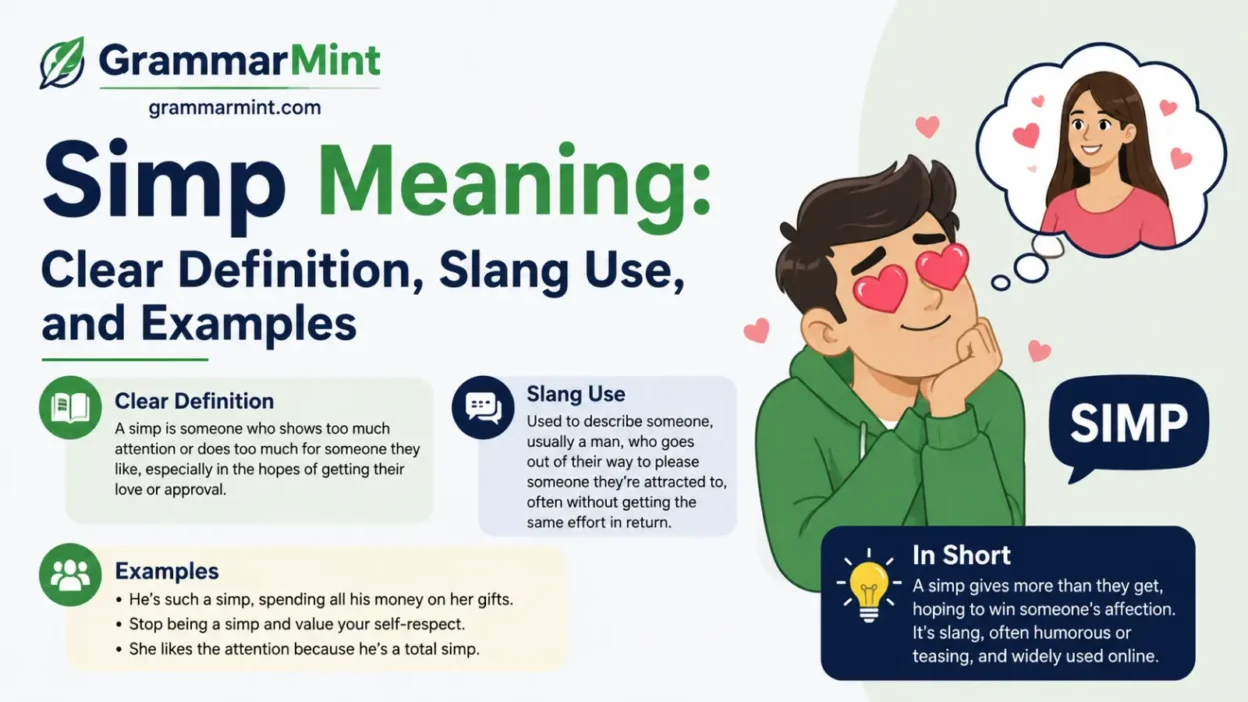
Simp meaning is someone who gives too much attention, devotion, or praise to another person, often hoping for affection back. It is usually slang and can sound insulting.
TL;DR
• “Simp” is informal slang.
• It often means too much one-sided devotion.
• It can be a noun or verb.
• It may sound rude or playful.
• Kindness alone is not simping.
• Context changes the meaning.
What Does Simp Mean?
A simp is a person who tries too hard to please someone. The effort is often one-sided. The other person may not return the same care.
In modern slang, the word often describes romantic attention. It can also describe extreme fan behavior.
Plain meaning: a simp gives too much approval, affection, or support. The person may ignore their own dignity or needs.
Examples:
• “He bought her gifts all week, but she never replies.”
• “Everyone called him a simp for defending his favorite singer.”
• “I am such a simp for that actor.”
The word is not always serious. Friends may use it as a joke. Still, it can hurt when used to shame someone.
Simp Meaning in Slang
In slang, “simp” usually means someone who acts overly devoted. The person may want attention, love, approval, or romantic interest.
It is common in online jokes. People may say it when someone praises a crush too much.
Example:
“Bro, stop simping. She left you on read again.”
This means the person is trying too hard for someone who is not showing equal interest.
The word can also be used lightly:
“I’m a simp for good coffee.”
Here, it means “I really like good coffee.” It is playful, not harsh.
A common mistake is thinking any kind person is a simp. That is not true. Respect, care, and affection are normal. Simping suggests excess, imbalance, or self-disrespect.
Pronunciation and Part of Speech
“Simp” is pronounced like this:
simp = simp
It rhymes with “limp.”
The word can work as a noun.
Example:
“He is acting like a simp.”
It can also work as a verb.
Example:
“She simps for that musician.”
The verb forms are simple:
• simp
• simps
• simped
• simping
You will often see “simp for” or “simp over.”
Examples:
• “I simp for that character.”
• “They are simping over the new singer.”
• “He simped for someone who ignored him.”
How to Use Simp in a Sentence
Use “simp” only in casual settings. It fits texts, jokes, memes, and informal comments.
Do not use it in formal writing. It is also risky around people you do not know well.
Here are natural examples:
• “I’m not a simp. I just like being nice.”
• “She called herself a simp for her favorite band.”
• “He keeps simping for someone who treats him badly.”
• “Stop calling every respectful guy a simp.”
• “I simp over fictional characters way too much.”
The safest use is self-joking.
Example:
“I’m a simp for chocolate cake.”
That sounds playful. Calling another person a simp can sound rude.
Common Contexts for Simp
You may see “simp” in many casual spaces. The meaning changes with tone.
| Context | Best Choice | Why |
|---|---|---|
| Texting friends | Use carefully | It may sound like teasing |
| Work email | Avoid it | It is too informal |
| Commenting on a crush | Use only as a joke | It can sound mocking |
| Talking about fandom | Often playful | Fans use it about themselves |
| Serious relationship talk | Avoid it | It can dismiss real feelings |
It may suggest someone has no boundaries.
When Not to Use Simp
Do not use “simp” when respect is the real issue. A person is not a simp for being kind.
Avoid it in serious situations. It can shame someone for caring.
Do not use it at work, school papers, or formal messages. It sounds casual and immature there.
Also avoid it when someone feels hurt. Calling them a simp may make things worse.
Better choices:
• “You may be giving too much.”
• “This seems one-sided.”
• “You deserve effort back.”
• “Try setting a boundary.”
These are clearer and kinder.
Origin and History of Simp
The older word “simp” comes from “simpleton.” That meaning refers to a foolish or silly person.
The modern slang meaning developed later. It became linked with someone seen as overly soft, submissive, or devoted.
The word became more visible online through memes, chats, and social platforms. It is now common in casual digital speech.
Its full history is not perfectly simple. Some online posts treat it as an acronym. Reliable modern use does not require that idea.
Today, most people use “simp” to mean excessive devotion. The older “foolish person” meaning still exists, but it is less common online.
Related Terms and Common Confusions
“Simp” is close to a few other casual words. They are not exact matches.
“Crush” means romantic interest. A crush is normal. A simp goes too far.
“Stan” means a very devoted fan. It can be positive or intense. A simp may admire someone in a one-sided way.
“Fan” is neutral. A fan likes someone or something. A simp suggests too much devotion.
“Pushover” means someone lets others take advantage of them. A simp may act like a pushover in romantic or fan situations.
Common confusion:
Wrong: “He opened the door for her. What a simp.”
Better: “He was being polite.”
Kindness is not the problem. Losing balance is the problem.
Synonyms and Antonyms
“Simp” has no perfect formal synonym. It is slang, so many matches change the tone.
Close words may include:
• admirer — softer and more neutral
• devotee — serious and more formal
• fan — neutral and broad
• pushover — stronger and negative
• doormat — harsh and negative
Use these with care. “Admirer” does not mean the same as “simp.” It lacks the idea of doing too much.
There is no clean antonym. A close opposite could be someone with self-respect or strong boundaries.
Better phrase:
“Someone who keeps healthy boundaries.”
That is clearer than forcing one opposite word.
Mini Quiz
Choose the best answer.
- Is “simp” formal or informal?
- Can “simp” be a verb?
- Does kindness always make someone a simp?
- Which sounds safer: “You’re a simp” or “This seems one-sided”?
- What does “simp for” usually mean?
Answer key:
- Informal.
- Yes.
- No.
- “This seems one-sided.”
- To show strong or excessive admiration.
FAQs
What does simp mean?
A simp is someone who shows too much attention, praise, or devotion. The feeling is often one-sided. The word is informal and can sound insulting.
What is simp on TikTok?
On TikTok, “simp” often describes someone trying too hard for a crush, creator, or celebrity. It can be teasing. It can also be used as a self-joke by fans.
What is a female simp?
A female simp is a girl or woman who shows excessive devotion to someone. The word is more often used for men. Still, modern slang can apply it to anyone.
Is it bad to be a simp?
It depends on the meaning. Caring about someone is not bad. Ignoring your own boundaries for someone who gives little back is the problem.
Is the word simp offensive?
Yes, it can be offensive. It may shame someone for caring or showing respect. With friends, it may sound playful, but tone matters.
What does simp mean in chat?
In chat, “simp” often means someone is doing too much for attention or affection. It can also mean someone strongly admires a celebrity, character, or creator.
What does simp stand for?
In common use, “simp” does not need to stand for a phrase. The older meaning connects to “simpleton.” Some acronym claims exist online, but they are not needed for normal usage.
Conclusion
Simp meaning depends on context, tone, and relationship. It usually points to excessive or one-sided devotion.
Use the word carefully. When in doubt, choose a clearer and kinder phrase.