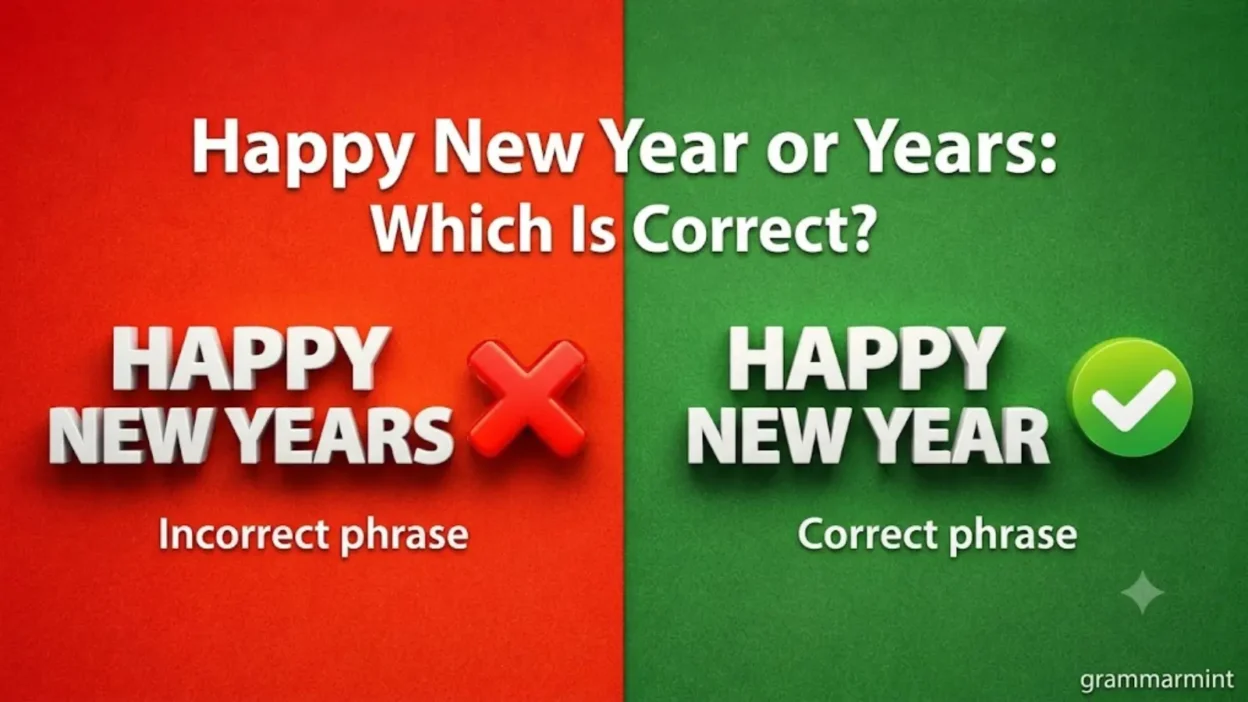
The correct holiday greeting is Happy New Year.
Use years only when you mean more than one year, as in “three years,” “many years,” or “the past few years.” By itself, Years is not a complete New Year greeting.
The confusion usually comes from hearing people say phrases that end with an “s” sound. That sound can belong to New Year’s, as in New Year’s Eve or New Year’s Day. But the standard greeting does not need that ending.
Quick Answer
Write Happy New Year when you are wishing someone well at the start of a new calendar year.
Do not write Happy New Years in standard US English. In that greeting, year should stay singular because you are welcoming one new year, not several new years at once.
Correct: Happy New Year, everyone!
Incorrect: Happy New Years, everyone!
Use years only when you are talking about more than one year.
Correct: We have celebrated together for five years.
Why People Confuse Them
People confuse Happy New Year and Years because speech hides the difference between some forms.
The words years and year’s sound the same in everyday speech. That makes the written form easy to mix up.
There is also a real phrase with an “s” sound: New Year’s Eve. In that phrase, the apostrophe shows a relationship: the eve of the New Year. The same pattern appears in New Year’s Day and New Year’s resolution.
But when the greeting stands alone, the clean form is Happy New Year.
Key Differences At A Glance
Compact comparison:
- Happy New Year: a complete greeting for the holiday or the start of the year.
- Years: a plural noun that means more than one year.
- Happy New Years: not the standard greeting.
- New Year’s: a separate possessive form used in phrases like New Year’s Eve.
The main difference is grammar. Happy New Year works as a set greeting. Years works as a plural noun, not as the name of the greeting.
Meaning and Usage Difference
Happy New Year means “I hope you have a happy new year.” It is a warm greeting, like Happy Birthday or Happy Thanksgiving.
You can use it in texts, cards, emails, captions, speeches, and casual conversations.
Example: Happy New Year! Hope 2026 brings you peace and good health.
Years means more than one year. It can refer to time, age, history, experience, or repeated events.
Example: She lived in Chicago for eight years.
So the choice is simple. Use Happy New Year for the greeting. Use years when you are counting or describing more than one year.
Tone, Context, and Formality
Happy New Year works in both casual and formal settings.
You can send it to a friend:
Happy New Year! Let’s catch up soon.
You can also send it at work:
Happy New Year, Jordan. I hope your 2026 is off to a great start.
Years has no greeting tone by itself. It is neutral and practical. It belongs in normal sentences about time.
Example: After years of planning, the family finally opened the restaurant.
Pronunciation matters only because it explains the mistake. Years and year’s sound alike, but they do different jobs in writing. Years is plural. Year’s is possessive.
Which One Should You Use?
| Context | Best Choice | Why |
|---|---|---|
| Greeting someone on January 1 | Happy New Year | It is the standard holiday greeting. |
| Writing a New Year card | Happy New Year | It sounds polished and correct. |
| Talking about several calendar years | years | It means more than one year. |
| Saying something happened for a long time | years | It measures time. |
| Referring to December 31 | New Year’s Eve | The possessive form belongs in the holiday name. |
| Referring to January 1 | New Year’s Day | The possessive form belongs in the holiday name. |
| Writing the greeting with an added s | Avoid it | Happy New Years is not standard. |
For most readers, the safest choice is Happy New Year.
Use years only when the sentence clearly needs a plural time word.
When One Choice Sounds Wrong
Happy New Year sounds right as a greeting because it points to one new year beginning.
Years sounds wrong if you use it as the greeting because it turns the idea plural. That makes the message feel grammatically off.
Wrong: Happy Years!
Wrong: Happy New Years!
Right: Happy New Year!
But years sounds right in a sentence like this:
Right: We have known each other for years.
The key is whether you are sending a greeting or talking about time.
Common Mistakes (and Quick Fixes)
Mistake: Happy New Years!
Fix: Happy New Year!
Mistake: Happy New Year’s!
Fix: Happy New Year!
Mistake: I hope you have many happy New Year.
Fix: I hope you have many happy years ahead.
Mistake: We waited year for this.
Fix: We waited years for this.
Mistake: New Years Eve starts soon.
Fix: New Year’s Eve starts soon.
The most common mistake is adding s to the greeting. Leave it off.
Everyday Examples
Correct greeting examples:
Happy New Year, Mom!
Happy New Year! I hope this year is good to you.
Wishing you a peaceful and healthy New Year.
Happy New Year from our family to yours.
Happy New Year, team. Thank you for all your hard work.
Correct years examples:
We have lived here for six years.
Those were some of the best years of my life.
It took years to finish the project.
She has years of experience in customer service.
They spent the early years of their marriage in Texas.
Incorrect greeting examples:
Happy New Years, friends!
Happy Years, everyone!
Happy New Year’s, everyone!
Dictionary-Style Word Details
Verb
Happy New Year: Not commonly used as a verb in standard US English. It is a greeting phrase.
Years: Not commonly used as a verb in this form. The verb yearn is a different word and should not be confused with years.
Noun
Happy New Year: As a full phrase, it works mainly as a greeting. Inside the phrase, Year is a noun referring to the calendar year beginning or recently begun.
Years: A plural noun. It means more than one year.
Example: The company grew quickly over the next three years.
Synonyms
Happy New Year: Exact synonyms do not really exist because it is a set greeting. Closest plain alternatives include:
- Best wishes for the new year.
- Wishing you a happy New Year.
- Have a wonderful new year.
A true antonym does not clearly fit this greeting.
Years: Closest plain alternatives include:
- multiple years
- several years
- many years
- a long time
The singular form year is the number contrast, but it is not an antonym in meaning.
Example Sentences
Happy New Year:
Happy New Year! I’m glad we got to celebrate together.
Happy New Year, Carlos. I hope work starts smoothly this week.
We sent a card that said, “Happy New Year from the Parkers.”
Years:
It has been years since we visited Seattle.
She saved money for two years before buying the car.
The old photos brought back years of memories.
Word History
Happy New Year: The phrase is built from common English words: happy, used in greetings, and New Year, meaning the calendar year that is starting or has just started. No special origin story is needed to use it correctly.
Years: Years is the regular plural form of year. It simply means more than one year.
Phrases Containing
Happy New Year:
- Happy New Year!
- Wishing you a Happy New Year
- Happy New Year from our family
- Happy New Year, everyone
Years:
- for years
- in recent years
- over the years
- many years ago
- years of experience
- the best years of my life
FAQs
Is it Happy New Year or Happy New Years?
The correct greeting is Happy New Year. Do not add s at the end of year when you are wishing someone well for the new year.
Why is Happy New Years wrong?
Happy New Years is wrong in standard writing because the greeting refers to one new year, not several years. The correct phrase is Happy New Year.
Is Happy New Year’s correct?
Happy New Year’s is not the correct standalone greeting. Use Happy New Year. The possessive form New Year’s is correct in phrases like New Year’s Eve, New Year’s Day, and New Year’s resolution.
When should I use years?
Use years when you mean more than one year. For example: “We have been friends for ten years” or “Those were difficult years.”
Should Happy New Year be capitalized?
In a greeting, Happy New Year is often capitalized, especially in cards, messages, titles, and captions. In a normal sentence, lowercase can also work: “I hope you have a happy new year.”
Can I say Happy New Year after January 1?
Yes. You can say Happy New Year during the first few days of January, especially when seeing or messaging someone for the first time that year.
What is the best professional greeting?
A simple professional version is: Happy New Year. Wishing you a successful and healthy year ahead.
What is the safest form for cards and messages?
The safest and most natural form is Happy New Year! It works for texts, cards, emails, captions, and professional messages.
Conclusion
Use Happy New Year as the greeting.
Use years only when you mean more than one year.
The phrase Happy New Years is common enough to see online, but it is not the standard form in careful US writing. For cards, captions, texts, emails, and professional messages, Happy New Year is the clean and correct choice.