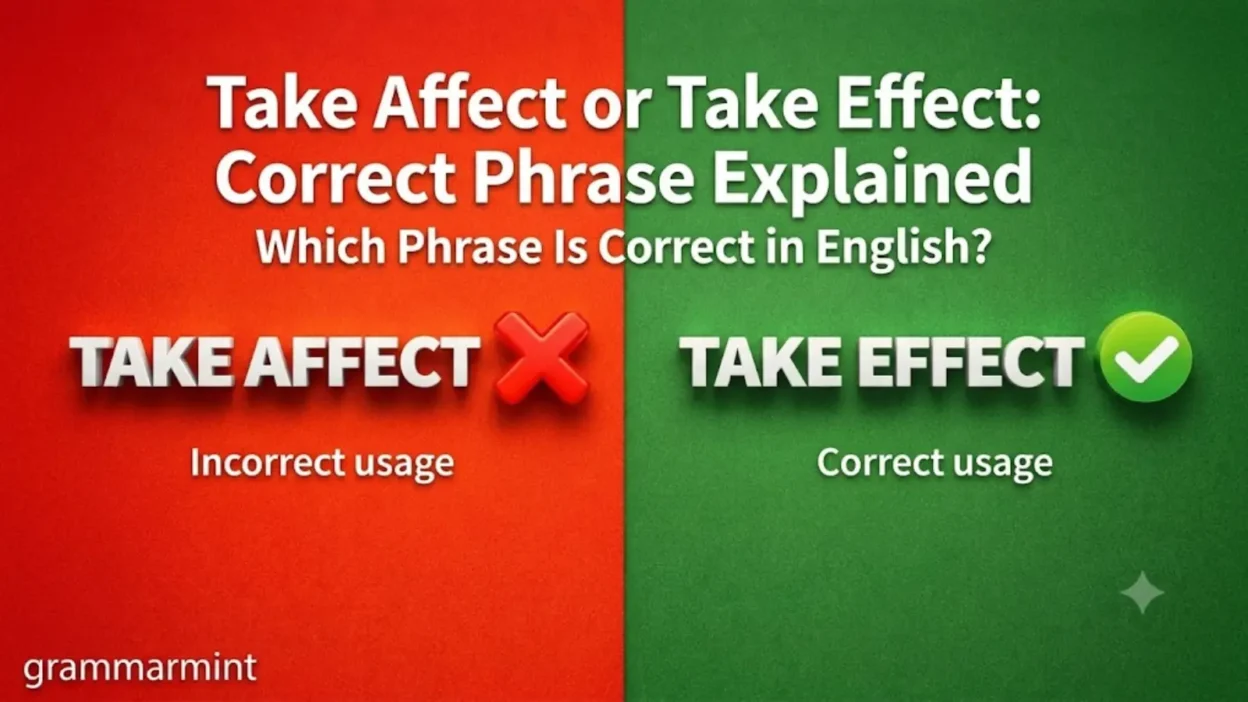
The correct phrase is take effect, not take affect.
Use take effect when something begins to work, starts to apply, or begins to produce results. A law can take effect. A rule can take effect. A medicine can take effect. A new price can take effect. A company policy can take effect.
Take affect is usually a mistake. It comes from the common confusion between affect and effect. The words sound almost the same in everyday speech, but they do different jobs in most sentences.
Here is the simple idea:
Effect is the word you need in the phrase take effect because it points to a result, operation, or working state. When something takes effect, its effect begins.
Affect is usually a verb. It means to influence or change something. That meaning does not fit the phrase take effect.
So, if you are writing for school, work, business, law, health, or everyday communication, the safe and standard choice is take effect.
Quick Answer
Write take effect when you mean “begin to work,” “start to apply,” or “become active.”
Correct:
The new schedule will take effect on Monday.
Incorrect:
The new schedule will take affect on Monday.
The phrase take effect is common in US English because it works in many real situations. You can use it for rules, laws, contracts, medicine, fees, subscriptions, changes, warnings, updates, and decisions.
Examples:
The new tax rate will take effect on January 1.
The pain medicine should take effect within 20 minutes.
The company’s remote-work policy takes effect next week.
The discount will take effect after checkout.
The change does not take effect until your next billing cycle.
The phrase take affect does not work in these examples. The word affect usually means “to influence,” as in:
The delay may affect our travel plans.
Stress can affect sleep.
The new manager’s decision will affect the whole team.
That is the key difference. Affect usually shows influence. Effect usually points to a result. Since the phrase means “begin producing a result,” the correct form is take effect.
Why People Confuse Them
People confuse take affect and take effect because affect and effect are one of the most commonly mixed-up word pairs in English.
The confusion is understandable. The words look similar. They sound similar. They also both connect to change. That overlap makes the wrong phrase feel possible, even when it is not the standard choice.
The phrase take effect can also be confusing because the word take has many meanings. In this phrase, take does not mean “grab,” “carry,” or “choose.” It means something closer to “begin to have force” or “begin to work.”
That is why take effect is common in official writing. You may see it in notices like:
This policy takes effect on June 1.
Your coverage takes effect after approval.
The new rule takes effect immediately.
In each sentence, the phrase tells readers when something starts applying.
The word affect gets pulled into the phrase by mistake because it often means “influence.” A writer may think, “This rule will affect people, so maybe it takes affect.” But the phrase is not about the rule influencing someone. It is about the rule becoming active.
That is why the correct phrase is take effect.
Key Differences At A Glance
The easiest way to separate the two is to look at the job each phrase tries to do.
Compact comparison:
- Take effect means something begins to work, apply, or produce results.
- Take affect is usually a mistaken form of take effect.
- Effect fits the phrase because it can mean a result or operating force.
- Affect usually works as a verb meaning to influence.
- Affect can be a noun in psychology, but that does not make take affect correct in normal writing.
- Take effect is the form expected in school, work, legal, medical, and business writing.
A simple memory trick helps:
If you can replace the phrase with start working, use take effect.
The medicine will start working soon.
The medicine will take effect soon.
The rule will start applying tomorrow.
The rule will take effect tomorrow.
The new price will start applying next month.
The new price will take effect next month.
This test does not support take affect. You would not say the medicine will “take influence” or the policy will “take emotional expression.” That is another clue that affect is the wrong word in this fixed phrase.
Meaning and Usage Difference
Take effect means “to begin working,” “to become active,” or “to start producing a result.”
It often appears with time words because people use it to show when something begins:
The rule takes effect today.
The policy takes effect next month.
The update took effect last night.
The change will take effect after approval.
You can also use it when talking about medicine or treatment:
The allergy medicine should take effect soon.
The local anesthetic took effect before the procedure.
The treatment may take effect gradually.
In these examples, take effect means the medicine or treatment begins to produce the intended result.
Take affect does not have that standard meaning. It is not the phrase people expect when talking about a rule, medicine, policy, or change becoming active.
The word affect is useful in other sentences, but it needs a different structure.
Correct uses of affect:
The storm may affect flights.
The new law could affect small businesses.
The smell of smoke affected her breathing.
A lack of sleep can affect focus.
In those sentences, affect is a verb. It tells what is being influenced or changed.
The key point is structure. You can affect something, but a rule does not usually take affect. A rule takes effect.
Tone, Context, and Formality
Take effect works in both formal and everyday English.
It sounds natural in business writing:
The new pricing plan will take effect on August 15.
It sounds natural in workplace messages:
The updated schedule takes effect next Monday.
It sounds natural in health writing:
The medication may take effect within an hour.
It also sounds natural in everyday speech:
My new phone plan takes effect tomorrow.
The phrase is clear, professional, and widely understood.
Take affect, on the other hand, usually sounds like an error. It may distract readers, especially in writing that needs to sound careful. In a workplace memo, legal notice, school essay, or client email, take affect can make the sentence look unedited.
There is one important note about pronunciation. In normal speech, affect and effect often sound very close. Many speakers say both with a soft first syllable and a strong second syllable: uh-FEKT or ih-FEKT. That sound similarity is one reason the written forms get mixed up.
The noun affect also exists in psychology and is often pronounced with stress at the start: AFF-ekt. It refers to a person’s visible emotional state. For example, a clinician might describe a patient’s affect. But that special noun use does not change the phrase take effect.
For normal US writing, the phrase you want is still take effect.
Which One Should You Use?
Use take effect almost every time you are choosing between take affect and take effect.
| Context | Best Choice | Why |
|---|---|---|
| A law begins applying | take effect | Laws become active or operative. |
| A rule starts on a date | take effect | The rule begins to apply. |
| Medicine starts working | take effect | The medicine begins producing results. |
| A policy begins at work | take effect | The policy becomes active. |
| A subscription change begins | take effect | The change starts applying to the account. |
| A price update begins | take effect | The new price becomes active. |
| A delay influences plans | affect | Here you need the verb meaning “influence.” |
| A decision changes people’s lives | affect | The decision acts on or changes someone or something. |
This table shows the practical difference. When the idea is “begin,” “apply,” “activate,” or “start working,” use take effect. When the idea is “influence” or “change,” use affect by itself as a verb.
Compare these two sentences:
The new rule will take effect tomorrow.
The new rule will affect every employee.
Both sentences are correct, but they mean different things.
The first sentence tells when the rule starts.
The second sentence tells who the rule influences.
That is why take effect and affect should not be swapped.
When One Choice Sounds Wrong
Take affect sounds wrong when the sentence is about a start date, active date, rule, treatment, or result.
Wrong:
The new law will take affect in July.
Correct:
The new law will take effect in July.
Wrong:
The medicine should take affect soon.
Correct:
The medicine should take effect soon.
Wrong:
The company policy took affect last week.
Correct:
The company policy took effect last week.
Wrong:
The discount takes affect after you enter the code.
Correct:
The discount takes effect after you enter the code.
The wrong version may not stop readers from guessing your meaning, but it weakens the sentence. Readers may notice the mistake because take effect is a familiar phrase.
There is also a different mistake to watch for: using effect when you need the verb affect.
Wrong:
The new policy will effect our hours.
Correct:
The new policy will affect our hours.
In that sentence, you are not saying when the policy starts. You are saying what the policy changes. So the verb affect is correct.
Another correct version would be:
The new policy will take effect on Monday and affect our hours.
That sentence uses both words correctly. Take effect tells when the policy starts. Affect tells what the policy changes.
Common Mistakes (and Quick Fixes)
Mistake 1: Writing take affect for a start date.
Incorrect:
The new benefits package will take affect on May 1.
Correct:
The new benefits package will take effect on May 1.
Quick fix: If the sentence answers “When does it start?” use take effect.
Mistake 2: Using effect as a verb in a normal influence sentence.
Incorrect:
The weather may effect attendance.
Correct:
The weather may affect attendance.
Quick fix: If the sentence means “influence,” use affect.
Mistake 3: Thinking effect is never a verb.
This can confuse advanced writers. Effect can be a verb in formal writing, meaning “to bring about” or “to cause to happen.”
Correct:
The new director hopes to effect change.
But that is not the same as take effect. In take effect, the whole phrase means “begin working” or “become active.”
Mistake 4: Thinking affect is never a noun.
Affect can be a noun in psychology, where it refers to visible emotional expression. But that use is specialized.
Correct in a clinical context:
The notes described the patient’s flat affect.
Still incorrect for the common phrase:
The rule will take affect tomorrow.
Mistake 5: Choosing by sound.
Because affect and effect sound alike, spelling by ear can lead to the wrong choice. Do not rely only on pronunciation. Ask what the sentence means.
If it means “begin working,” choose take effect.
If it means “influence,” choose affect.
Everyday Examples
Here are clear examples of take effect in natural US English.
The new parking rules take effect on Monday.
Our rent increase takes effect next month.
The coupon takes effect once you add the item to your cart.
The software update will take effect after you restart the device.
The new school policy took effect at the start of the semester.
The medicine usually takes effect within 30 minutes.
The change in hours will take effect after Labor Day.
The insurance coverage takes effect after the first payment.
The pay raise takes effect at the beginning of the next pay period.
The warning does not take effect until the system detects motion.
Now compare those with sentences using affect correctly.
The new parking rules will affect downtown workers.
The rent increase may affect our monthly budget.
The coupon will not affect the final price unless it is applied.
The software update could affect battery life.
The school policy may affect after-school activities.
The medicine can affect your appetite.
The change in hours will affect weekend shoppers.
The insurance rule may affect new customers.
The pay raise will affect taxes and benefits.
The warning system could affect how quickly people leave the building.
Notice the pattern. Take effect often sits near a date, time, condition, or start point. Affect usually takes an object: workers, budget, price, battery life, activities, appetite, customers, taxes, or people.
That object is the thing being influenced.
Here is one sentence that uses both:
The new policy takes effect on Friday and may affect everyone’s schedule.
This is a useful model. The policy takes effect because it starts. It affects schedules because it changes them.
Dictionary-Style Word Details
Verb
Take Affect:
Not commonly used as a standard verb phrase in US English. The words take and affect can appear next to each other by accident, but take affect is not the accepted phrase for “begin working” or “become active.”
The word affect alone is commonly used as a verb. It means to influence, act on, or change someone or something.
Correct:
The decision may affect the whole department.
Incorrect:
The decision may take affect tomorrow.
Take Effect:
Commonly used as a verb phrase. It means to become active, begin to apply, or start producing a result.
Correct:
The new safety rule will take effect next week.
The phrase can change tense like a normal verb phrase:
Present: The rule takes effect today.
Past: The rule took effect yesterday.
Future: The rule will take effect tomorrow.
Perfect: The rule has taken effect already.
This is one reason the phrase is useful. It fits easily into many sentence patterns.
Noun
Take Affect:
Not commonly used as a noun phrase in standard US English. The word affect can be a noun in psychology, but that noun does not create the everyday phrase take affect.
As a noun, affect refers to visible emotional expression or emotional response, usually in clinical or academic contexts.
Example:
The report described the patient’s affect as calm.
That meaning is not the one needed when a law, policy, or medicine begins working.
Take Effect:
The phrase itself is not usually treated as a noun phrase. In the phrase, effect is the noun that carries the idea of result, force, or operation.
You can also use related noun phrases with effect, such as:
the effect of the change
the policy’s effect
the medicine’s effect
the rule’s effect
These noun phrases talk about the result or impact of something. But when you use the full phrase take effect, you are usually using it as an action phrase.
Example:
The policy’s effect was immediate.
The policy took effect immediately.
The first sentence uses effect as a noun. The second uses take effect as a phrase meaning the policy became active.
Synonyms
Take Affect:
No exact synonyms are needed because take affect is not the standard phrase. When writers use it by mistake, the intended meaning is usually one of these closest plain alternatives:
take effect
begin
start
go into effect
become active
start working
begin applying
Corrected example:
The policy will take effect tomorrow.
The policy will become active tomorrow.
If the writer actually means affect as a verb, then closer alternatives may include:
influence
change
shape
alter
impact
Example:
The policy may affect workers.
The policy may influence workers.
Take Effect:
Closest plain alternatives include:
begin
start
go into effect
become active
become operative
start working
begin applying
start producing results
For medicine:
The medicine should take effect soon.
The medicine should start working soon.
Antonyms depend on the sentence. Useful opposite ideas may include:
expire
end
stop applying
wear off
lose effect
be withdrawn
be canceled
Examples:
The rule takes effect today and expires next year.
The medicine took effect quickly but wore off after a few hours.
These opposites work only when the meaning fits the context.
Example Sentences
Take Affect:
The following sentences show the common mistake and the corrected version.
Incorrect:
The new fee will take affect next month.
Correct:
The new fee will take effect next month.
Incorrect:
The medicine should take affect in about 15 minutes.
Correct:
The medicine should take effect in about 15 minutes.
Incorrect:
The policy took affect after the meeting.
Correct:
The policy took effect after the meeting.
Incorrect:
The changes will take affect once the system updates.
Correct:
The changes will take effect once the system updates.
Take Effect:
These examples show the phrase used correctly.
The new rule takes effect at midnight.
The price change will take effect on April 1.
The refund policy took effect last week.
The medicine began to take effect after dinner.
The update will not take effect until you restart the app.
The contract takes effect once both parties sign it.
The city’s new parking law takes effect this summer.
The discount takes effect after the code is entered.
The safety measure took effect immediately.
The new schedule has already taken effect.
Each sentence shows a beginning point. Something starts working, applying, or producing results.
Word History
Take Affect:
There is no useful word history for take affect as a standard phrase because it is normally a confusion with take effect. The error comes from the wider confusion between affect and effect, not from a separate accepted phrase.
The word affect has its own history and uses, especially as a verb meaning to influence. It also has a specialized noun use in psychology. Those real uses do not make take affect correct when the meaning is “begin working.”
Take Effect:
The phrase take effect is an established English expression. Its structure makes sense because effect points to a result, force, or working state. When something takes effect, it begins to have the result or force it is meant to have.
That is why the phrase appears naturally in writing about rules, laws, medicine, policies, contracts, prices, and schedules. These are all things that can begin applying at a certain time or under a certain condition.
The useful modern rule is simple: when the idea is activation or results beginning, write take effect.
Phrases Containing
Take Affect:
No common standard phrases contain take affect as the correct form for “begin working” or “become active.” If you see it in that meaning, it usually should be changed to take effect.
Possible correction patterns:
take affect → take effect
takes affect → takes effect
took affect → took effect
taking affect → taking effect
taken affect → taken effect
Examples:
Incorrect:
The change is taking affect now.
Correct:
The change is taking effect now.
Incorrect:
The rule has taken affect.
Correct:
The rule has taken effect.
Take Effect:
Common forms and related phrases include:
take effect
takes effect
took effect
taken effect
taking effect
go into effect
went into effect
bring into effect
put into effect
in effect
Examples:
The policy takes effect today.
The law went into effect last year.
The new rule is now in effect.
The board voted to put the plan into effect.
The change has taken effect across all accounts.
These phrases are useful because they all connect to the idea of something beginning, applying, or operating.
Conclusion
The correct choice is take effect.
Use take effect when something begins working, starts applying, becomes active, or begins producing results. This phrase is the standard form in US English.