
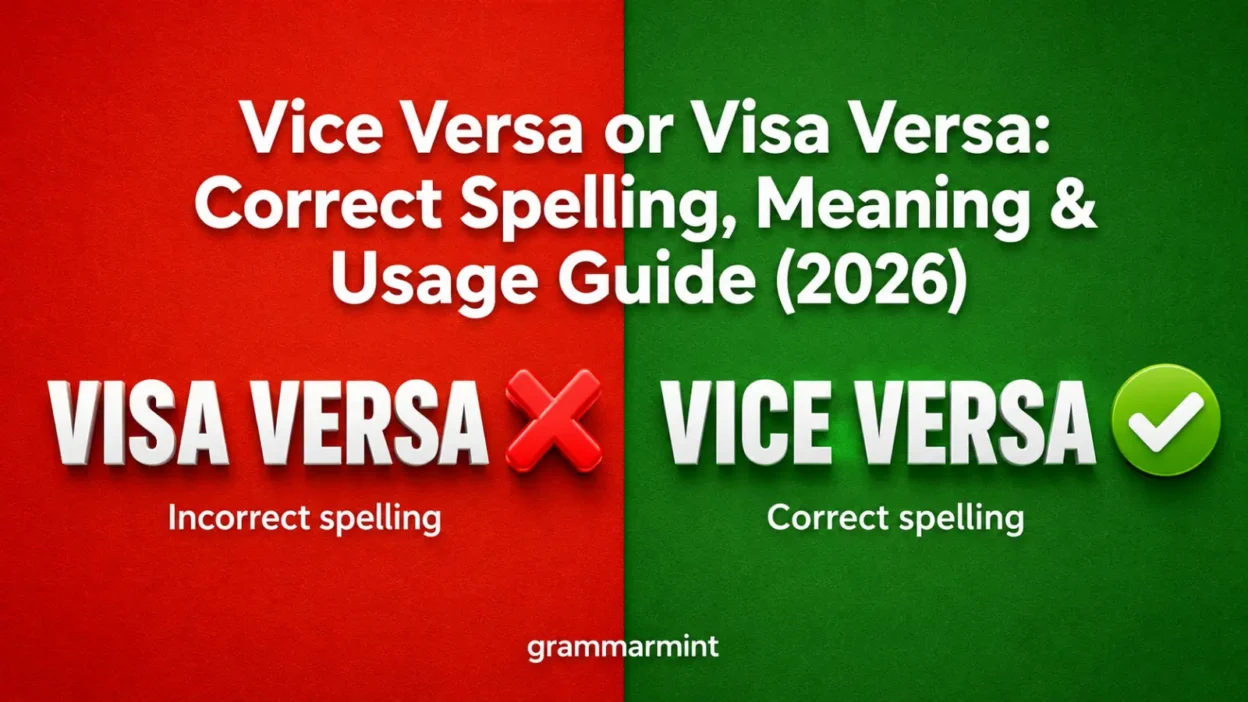
Many people in the United States encounter confusion when they need to express the idea of something being reversed or reciprocal. The phrase “vice versa” frequently appears in conversations, emails, reports, and school assignments, yet a common misspelling creates uncertainty.
Americans often hear the phrase spoken quickly in daily life and struggle to translate the sound into correct written form. This guide directly addresses the question: vice versa or visa versa? It provides clear, practical help for anyone who wants to communicate accurately in both casual and professional settings. Understanding this distinction improves writing confidence and helps avoid small errors that can affect how others perceive your work.
The difference between these two forms is straightforward once explained. One represents the established, correct choice used across American English, while the other is a widespread but incorrect variation. This article explores every important aspect to help you choose correctly every time.
Quick Answer
Vice versa is the only correct spelling and form in standard American English. Visa versa is a common misspelling and should always be corrected to “vice versa.”
This is not a matter of personal preference or regional style. “Vice versa” is the accepted phrase in dictionaries, style guides, and professional writing throughout the US. Using “visa versa” marks the text as containing an error, even though readers usually understand the intended meaning from context.
Why People Confuse Them
The confusion stems primarily from pronunciation. When spoken naturally, “vice versa” often comes out sounding like “vice-uh-vur-suh” or even “vis-uh-vur-suh.” The soft “uh” sound between syllables leads many people to associate it with the more familiar word “visa,” as in the travel document or credit card brand.
This phonetic mix-up is especially common among native speakers who learn the phrase by hearing it rather than seeing it written. In fast-paced American conversations, the exact spelling fades into the background. Non-native speakers sometimes face additional challenges because the Latin roots are unfamiliar, making the spelling seem arbitrary.
Another factor involves autocorrect and typing habits. People type quickly on phones or computers, and autocorrect sometimes fails to catch “visa versa” because both words exist individually in English. Over time, repeated exposure to the misspelled version in informal online comments reinforces the error for some writers.
Key Differences At A Glance
| Context | Best Choice | Why |
|---|---|---|
| Formal business writing | Vice versa | Accepted standard in professional US English |
| Academic papers | Vice versa | Required for clarity and correctness |
| Casual emails/texts | Vice versa | Maintains professionalism without stiffness |
| Social media posts | Vice versa | Avoids looking careless |
| Any published content | Vice versa | “Visa versa” appears unedited |
Feature Comparison
- Vice Versa: Established adverbial phrase with clear reciprocal meaning
- Visa Versa: Non-standard misspelling with zero accepted usage in formal English
Meaning and Usage Difference
Vice versa functions as an adverbial phrase meaning “the other way around” or “with the order reversed.” It indicates that a relationship or statement applies equally in the opposite direction. The phrase efficiently conveys reciprocity without needing extra explanation.
For instance, it shows mutual actions, swapped positions, or reversed conditions. It comes from Latin roots where “vice” relates to “in place of” and “versa” relates to “turned.” Together, they create a compact way to express two-way relationships.
Visa versa carries no distinct meaning. It exists only as an error when someone attempts to write “vice versa.” Using it does not change the intended message for most readers, but it introduces an unnecessary mistake that careful writers avoid.
The core distinction is simple: one form is correct and versatile across contexts, while the other is always incorrect in writing. There are no situations in standard US English where “visa versa” becomes acceptable.
Tone, Context, and Formality
Vice versa maintains a neutral to slightly formal tone that works across most American communication settings. It appears comfortably in corporate reports, legal documents, news articles, college essays, and everyday conversations. The phrase feels polished without being pretentious, striking a balance that many writers appreciate.
In highly formal contexts like academic journals or government communications, vice versa remains appropriate and expected. In casual settings such as text messages between friends or social media comments, it still fits naturally without sounding overly stiff.
Visa versa, by contrast, creates a noticeably informal or unpolished impression. It often appears in quick, unedited writing where the author prioritized speed over accuracy. In professional or academic environments, its presence can subtly undermine credibility because it signals a basic spelling oversight.
Pronunciation plays an interesting role here. Most Americans pronounce it as “VICE vur-suh” (three syllables) or “VICE-uh-VUR-suh” (four syllables). Both pronunciations are widely accepted in spoken American English. The four-syllable version more closely resembles “visa,” which explains why the misspelling persists in writing despite being incorrect.
Which One Should You Use?
Always use vice versa.
Choose it whenever you need to indicate that something applies in the reverse direction. It works especially well in sentences that establish a relationship between two things and then show the mutual nature of that relationship.
Consider your audience and purpose. In job applications, client emails, or schoolwork, vice versa demonstrates attention to detail. Even in informal writing, using the correct form shows care for clear communication. There are virtually no scenarios in American English where visa versa would be the better choice.
If you are unsure in a particular sentence, try replacing the phrase with “the other way around” or “conversely.” If the sentence still makes sense, vice versa is almost certainly the right fit.
When One Choice Sounds Wrong
“Visa versa” always sounds incorrect in written form to educated readers. It creates a jarring effect similar to other common misspellings like writing “recieve” instead of “receive.” Even if the reader understands your meaning, the error distracts from your message.
In spoken English, people rarely notice pronunciation variations because context fills in the gaps. However, when the same idea moves to writing, “visa versa” stands out immediately as non-standard. It may cause readers to question other aspects of your writing or editing process.
In contrast, “vice versa” never sounds wrong when used appropriately. It flows naturally in both speech and writing, enhancing rather than disrupting the sentence rhythm.
Common Mistakes (and Quick Fixes)
Several recurring errors appear with this phrase:
- Writing “visa versa” → Quick fix: Replace with “vice versa” every time. Train yourself to double-check this phrase during editing.
- Adding unnecessary words like “vice a versa” → Quick fix: Remove the extra “a.” The correct form has only two words.
- Hyphenating as “vice-versa” → Quick fix: Use two separate words. Hyphenation is not standard in modern American English for this phrase.
- Overusing the phrase → Quick fix: Vary your language with alternatives like “conversely” or “and the reverse is also true” when appropriate.
- Italicizing “vice versa” → Quick fix: No italics needed in regular text. Reserve italics for foreign words that have not been fully adopted into English.
A helpful memory technique involves connecting “vice” to “vice president” – both use the same spelling and relate to position or place. This association helps distinguish it from “visa,” which relates to travel or official permission documents.
Another practical approach involves reading your sentence aloud. If you naturally say something close to “vice-uh-vur-suh,” consciously note the correct spelling when typing.
Everyday Examples
Here are numerous realistic examples showing vice versa in natural American contexts:
In family life: “Children learn values from their parents, and vice versa, as kids often teach adults new perspectives on technology and culture.”
In the workplace: “The manager supports employee growth, and vice versa when staff members contribute ideas that improve company processes.”
In education: “Teachers shape student thinking, and vice versa through the fresh questions and viewpoints students bring to classroom discussions.”
In technology: “The software converts speech into text quite accurately, but not vice versa in its basic free version.”
In daily routines: “I drive my neighbor to the store each week, and vice versa when my car needs maintenance.”
In sports: “The coach pushes the athletes to improve, and vice versa as strong team performance motivates better coaching strategies.”
In relationships: “Partners who listen attentively build trust, and vice versa when feeling understood encourages more open communication.”
In consumer experiences: “Positive reviews help businesses grow, and vice versa when good products generate more positive feedback.”
In healthcare: “Doctors rely on patient honesty for accurate diagnoses, and vice versa as clear explanations from physicians build patient confidence.”
In community settings: “Volunteers strengthen neighborhoods, and vice versa when engaged communities inspire more volunteer participation.”
These examples demonstrate how vice versa efficiently connects ideas in both directions across many areas of American life. Notice how each usage feels natural and adds precision without complicating the sentence.
Expanding on usage patterns, vice versa appears most frequently in explanatory or analytical writing where relationships between concepts need clear expression. It helps writers avoid longer, more cumbersome explanations while maintaining flow.
Dictionary-Style Word Details
Verb
- Vice Versa: Does not function as a verb in English.
- Visa Versa: Does not function as a verb in English.
Noun
- Vice Versa: Does not function as a noun. It operates strictly as an adverbial phrase.
- Visa Versa: Does not function as a noun for the same reason.
Synonyms
- Vice Versa: Closest plain alternatives include “conversely,” “the other way around,” “in reverse,” and “mutually.”
- Visa Versa: No synonyms exist because it is not a recognized term.
Antonyms are limited for this phrase since it describes a structural relationship rather than a specific quality. Possible contrasts might involve phrases like “one way only” or “not reciprocal,” but these are contextual rather than direct antonyms.
Example Sentences
- Vice Versa: “The new policy benefits employees, and vice versa by improving overall company morale and productivity.”
- Vice Versa: “Strong communication strengthens marriages, and vice versa as healthy relationships encourage better dialogue.”
- Vice Versa: “Music influences fashion trends, and vice versa in today’s interconnected cultural landscape.”
- Visa Versa: This would be incorrect: “The coach trains the team hard, and visa versa.” The proper form is “and vice versa.”
Additional examples for deeper understanding:
- “Electric cars reduce emissions, and vice versa when cleaner air supports greater adoption of green technology.”
- “Readers inspire writers with their feedback, and vice versa through compelling stories that engage audiences.”
- “Exercise improves mental health, and vice versa when better emotional states motivate consistent physical activity.”
Word History
Vice versa entered English from Latin, where it literally translates to concepts of position and turning. It has been part of English usage for a very long time and remains fully integrated into modern American vocabulary. No separate history or development exists for “visa versa,” which emerged purely as a spelling error based on pronunciation similarities.
The phrase maintains consistent usage patterns in contemporary US English without significant shifts in meaning over recent decades.
Phrases Containing
- Vice Versa: Frequently appears within “and vice versa,” which is the most common construction. Other patterns include “or vice versa” and occasional standalone uses after a comma.
- Visa Versa: Does not form part of any standard English phrases or expressions.
FAQs
Q: Is it “vice versa” or “visa versa”? A: It is always “vice versa.” “Visa versa” is a common misspelling and is not correct in standard American English. Use “vice versa” in all writing.
Q: What does “vice versa” mean? A: “Vice versa” means “the other way around” or “with the positions reversed.” It shows that a statement or relationship works in both directions. For example, “She helps him, and vice versa” means he also helps her.
Q: How do you pronounce “vice versa”? A: Most Americans say it as VICE vur-suh (three syllables) or VICE-uh-VUR-suh (four syllables). Both pronunciations are acceptable in everyday speech. The four-syllable version often causes the “visa” misspelling because it sounds closer to the word “visa.”
Q: Can I use “vice versa” in formal writing? A: Yes. “Vice versa” is appropriate in business emails, academic papers, reports, and professional documents. It has a polished but natural tone that works well in American English.
Q: Should I italicize “vice versa” or use a hyphen (“vice-versa”)? A: No. Write it as two separate words without italics or a hyphen in modern US English. Italics are unnecessary because the phrase is fully adopted into English.
Q: What are good alternatives to “vice versa”? A: Strong alternatives include “conversely,” “the other way around,” “and vice versa,” “mutually,” or “in reverse.” Choose based on sentence flow. Example: “Parents teach kids, and conversely, kids teach parents.”
Q: Is “vice a versa” ever correct? A: No. “Vice a versa” is also incorrect. The proper form contains only two words: vice versa.
Q: Why do so many people write “visa versa”? A: It happens because of how the phrase sounds when spoken quickly. The “vice-uh” sound blends into something like “vis-uh,” leading writers to spell it like the familiar word “visa.”
Q: Does “vice versa” have any synonyms or antonyms? A: Closest alternatives (not exact synonyms): “conversely,” “reciprocally,” or “the reverse is also true.” True antonyms are limited, but phrases like “one way only” or “not mutual” can serve as contrasts depending on context.
Q: Can I start a sentence with “vice versa”? A: It is better not to. “Vice versa” usually works best in the second half of a sentence after a comma. Starting with it can sound awkward. Better: “The rule applies to adults. Vice versa for children.” → Improved: “The rule applies to adults, and vice versa for children.”
Q: Is “vice versa” still commonly used in 2026? A: Yes. It remains a standard phrase in both spoken and written American English across business, education, media, and daily conversation.
Q: What should I do if I already wrote “visa versa” in an important document? A: Simply replace every instance with “vice versa.” It is a quick fix that instantly makes the writing more professional.
Conclusion
Vice versa represents the correct and professional choice for expressing reciprocal relationships in American English. The alternative “visa versa” is simply a common misspelling driven by pronunciation habits rather than any legitimate linguistic variation.
By consistently choosing vice versa, you demonstrate attention to detail that strengthens your writing in school, work, and personal communication. The phrase offers an efficient way to convey complex mutual relationships without unnecessary wordiness.
Remember the key principle: when in doubt, choose the established form that appears in major dictionaries and style guides. Your readers will appreciate the clarity, and your writing will maintain higher standards. Use vice versa confidently whenever the situation calls for showing that something works both ways.
[…] Discrete can contrast with continuous• Discreet can suggest tact and restraint• The spelling difference changes the meaning• You can’t swap them […]