In everyday American conversation and writing, small phrase choices can make a big difference in how clear and professional you sound. One pair that frequently trips people up is “one in the same” versus “one and the same.” These two expressions sound very similar when spoken quickly, especially in casual settings across the United States.
Many people have heard both versions and wonder which one is actually correct. The confusion is understandable because English is full of idiomatic expressions that don’t always follow strict logic. This guide breaks down the real distinction between the two phrases so you can choose confidently in any situation — whether you’re writing a work email, posting on social media, preparing a school paper, or chatting with friends in Lahore or Los Angeles.
We’ll look at meanings, usage patterns, why the error happens so often, and plenty of realistic examples drawn from typical American life in 2026. By the end, you’ll know exactly when and how to use the right version.
Quick Answer
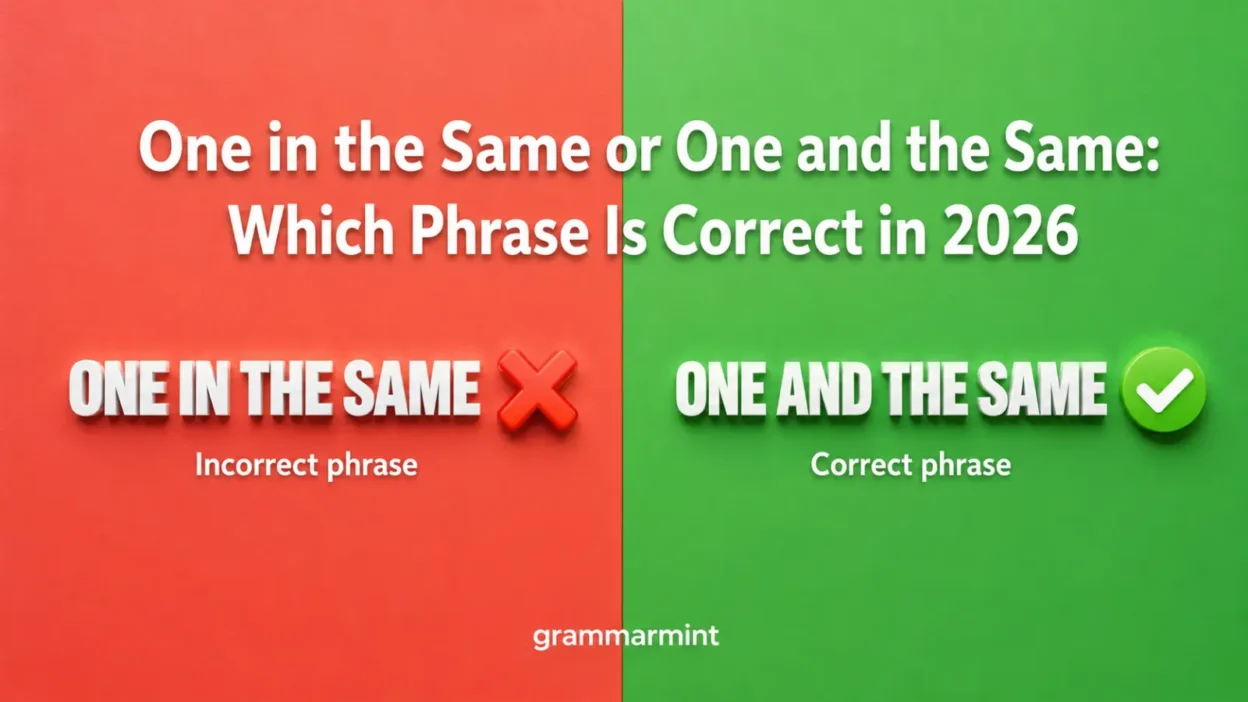
“One and the same” is the correct and standard phrase. “One in the same” is a common mistake and is not considered proper in standard American English.
Use “one and the same” whenever you want to emphasize that two things or people that appear different are actually identical. Stick with this version for clear, confident communication.
Why People Confuse Them
The biggest culprit is pronunciation. In fast American speech, “one and the same” often blends together. The “and” gets shortened to a quick “n” sound, making it come out sounding a lot like “one ‘n the same.” Our brains then interpret that sound as the more familiar word “in,” leading to the written version “one in the same.”
This type of mix-up is known as an eggcorn — a word or phrase substituted because it sounds similar and seems to make some logical sense. Here, “in” feels plausible because people might imagine one thing contained inside something else that is the same. But that interpretation doesn’t actually match what the original phrase intends.
Another reason for confusion is that English has many similar-sounding expressions. People encounter the mistake frequently online, in social media comments, casual texts, and even some published content. Over time, repeated exposure makes the incorrect version feel normal to many ears. Busy professionals in cities like New York, Chicago, or even expats in Pakistan often type quickly and rely on how the phrase sounds rather than its established written form.
Key Differences At A Glance
| Context | Best Choice | Why |
|---|---|---|
| Emphasizing two things are identical | One and the same | Standard idiom used in dictionaries and formal writing |
| Literal meaning of one thing inside another | One in the same (very rare) | Almost never fits real situations and sounds wrong to most readers |
| Professional emails or reports | One and the same | Maintains credibility and clarity |
| Casual conversation | One and the same | Still preferred; the other version can distract |
| Social media or texting | One and the same | Helps your message come across as polished |
Compact Bullet Comparison:
- One and the same: Stresses complete identity or sameness between two descriptions.
- One in the same: Lacks an established idiomatic meaning and is viewed as an error by major language references.
- Tone impact: The correct version sounds natural and educated; the incorrect one can make writing seem less careful.
Meaning and Usage Difference
“One and the same” is an idiom used to say that two or more things or people are exactly identical, even if they seem separate at first. It adds emphasis to the idea of sameness.
For example, when someone says the coach and the team leader are “one and the same,” they mean it’s the same person wearing two different hats. The phrase highlights unity despite different labels.
In contrast, “one in the same” does not carry this meaning in standard usage. Literally, it might suggest placing one item physically inside something else that is identical, but this rarely applies in normal conversation. Most times people write or say “one in the same,” they actually intend the meaning carried by the correct phrase.
This distinction matters because idioms in American English often carry cultural weight. Using the right one shows you understand subtle conventions that native speakers expect, especially in business, education, or public communication.
Parts of speech note: Both function primarily as adjective phrases or noun phrases when describing identity. Neither works as a standalone verb.
Tone, Context, and Formality
One and the same carries a neutral to slightly formal tone. It feels classic and reliable — suitable for business presentations in Dallas boardrooms, academic papers at universities, news articles, or even everyday talk among friends. It never feels outdated in 2026 American English.
One in the same comes across as informal at best and mistaken at worst. In job applications, client proposals, or important messages, it can unintentionally lower the reader’s perception of your attention to detail. Many editors and teachers flag it immediately.
In very relaxed settings like group chats with close friends, some people might overlook the error, but it’s still safer to use the correct form. Pronunciation of both phrases is nearly identical in casual speech (/wʌn ən ðə seɪm/ or /wʌn ɪn ðə seɪm/), which explains why the confusion persists even among fluent speakers.
Context examples:
- Formal report: “The two departments serve one and the same purpose.”
- Casual: “Dude, those two apps are basically one and the same.”
Which One Should You Use?
In almost every situation, choose “one and the same.” It is the safe, correct, and widely accepted choice across the United States.
Only in extremely rare literal contexts might “one in the same” theoretically fit (for example, describing nested identical objects), but even then most readers would find it awkward and unclear. The vast majority of times, default to the standard idiom.
This choice builds credibility. Whether you’re a student submitting assignments, a professional sending updates, or someone posting online, using the correct phrase helps your message land clearly and professionally.
When One Choice Sounds Wrong
Using “one in the same” often creates a subtle jarring effect for attentive readers or listeners. It can pull focus away from your main point and make the message feel slightly off.
In high-stakes situations — job interviews, legal documents, marketing copy, or academic work — the incorrect version stands out negatively. It may cause readers to question other parts of your communication.
Even in casual settings, consistent use of the correct phrase makes your speech flow more naturally. Native speakers in the US often notice these details, even if they don’t always correct others out loud.
Common Mistakes (and Quick Fixes)
Here are frequent errors with straightforward corrections:
Mistake 1: “The policy on remote work and flexible hours are one in the same.” Fix: “The policy on remote work and flexible hours are one and the same.”
Mistake 2: “Many people think success and happiness are one in the same.” Fix: “Many people think success and happiness are one and the same.”
Mistake 3: “Her online persona and real-life personality are one in the same.” Fix: “Her online persona and real-life personality are one and the same.”
Quick Memory Trick: Replace “in” with “and” and read the sentence slowly. If it still makes sense and sounds natural, you’re using the right version. Another tip: remember the phrase emphasizes connection (“and”) between oneness and sameness.
Mistake 4 (in speech): Saying it quickly without thinking and defaulting to the “in” sound. Fix: Slow down slightly when emphasizing the phrase or practice saying “one and the same” deliberately a few times.
Everyday Examples
Let’s look at how the correct phrase appears in real modern American life:
- In the workplace: “The project manager and the main decision-maker turned out to be one and the same person.”
- With family: “For the kids, their teacher and their soccer coach were one and the same during summer camp.”
- In entertainment: “Many fans say the actor and his most famous character feel like one and the same.”
- In politics or news: “The candidate’s public promises and private plans appeared to be one and the same.”
- In daily life: “In our small startup, the founder and the customer support team were often one and the same.”
- Online shopping context: “The basic model and the upgraded version are practically one and the same in terms of daily performance.”
- Friendship: “His sense of humor and his personality are one and the same — straightforward and honest.”
- Education: “The math concepts we learned last week and the ones on today’s test are one and the same.”
- Health discussion: “For many people, mental wellness and physical health are one and the same.”
- Technology: “The software update and the security patch were released as one and the same.”
Incorrect versions turned correct:
- Wrong: “My morning coffee routine and my daily meditation are one in the same.” Correct: “My morning coffee routine and my daily meditation are one and the same.”
These examples show how the phrase helps express unity in practical situations Americans encounter regularly.
Dictionary-Style Word Details
Verb
- One and the same: Not used as a verb in standard US English.
- One in the same: Not used as a verb.
Noun
- One and the same: Used as a noun phrase to refer to a single identical person or thing. Example: “They are one and the same.”
- One in the same: Sometimes appears in writing but is not recognized as a standard noun phrase.
Synonyms
- One and the same: Closest plain alternatives are “identical,” “the very same,” “exactly the same,” or “one person/thing.”
- One in the same: No accepted synonyms because it is not a standard expression. Antonyms for both: Different, distinct, separate, unrelated.
Example Sentences
- “The two signatures on the documents were one and the same.”
- “In many family businesses, the owner and the manager are one and the same.”
- “People often confuse ‘one in the same’ with the correct expression ‘one and the same.’”
- “The detective realized the anonymous tipper and the main suspect were one and the same.”
- “For dedicated athletes, training and lifestyle choices become one and the same.”
Word History “One and the same” has been part of English for centuries, tracing back to expressions emphasizing identity. It appears in major dictionaries as a standard idiom. “One in the same” developed as a spoken variation over time but has not gained acceptance in formal references.
Phrases Containing
- One and the same: Common in “are one and the same,” “is one and the same,” “one and the same person,” “one and the same thing,” “at one and the same time.”
- One in the same: Mostly appears in discussions of language mistakes and correction guides.
FAQs
- Is “one in the same” ever okay to use?
In extremely casual texting with close friends who won’t judge, it might be understood, but it’s still better to use the correct version. - Does this difference matter in professional settings?
Yes. Using the standard phrase helps maintain a polished image in emails, reports, and presentations. - How can I help others who use the wrong phrase?
A kind note like “I think you mean ‘one and the same’ — it’s a super common mix-up!” works well.
Conclusion
Mastering the difference between “one in the same” and “one and the same” is a small but meaningful step toward clearer American English. The correct choice — “one and the same” — reliably communicates identity and emphasis without confusion.
By understanding why the mix-up happens and practicing the standard form, you can write and speak with greater confidence in any context. Next time you need to highlight that two descriptions point to the exact same reality, reach for “one and the same.” Your communication will feel more polished, professional, and natural to American audiences.
This attention to precise language helps in careers, studies, and daily interactions. Keep practicing with the examples above, and the right phrase will soon become second nature.