Fliers or flyers can confuse students, writers, and business owners because both spellings appear in real English. In American usage, flyers, fliers, leaflets, handouts, advertising circulars, air travelers, and style guides all come into play. The good news is that the choice gets much easier once you match the spelling to the meaning and the audience.
Quick Answer
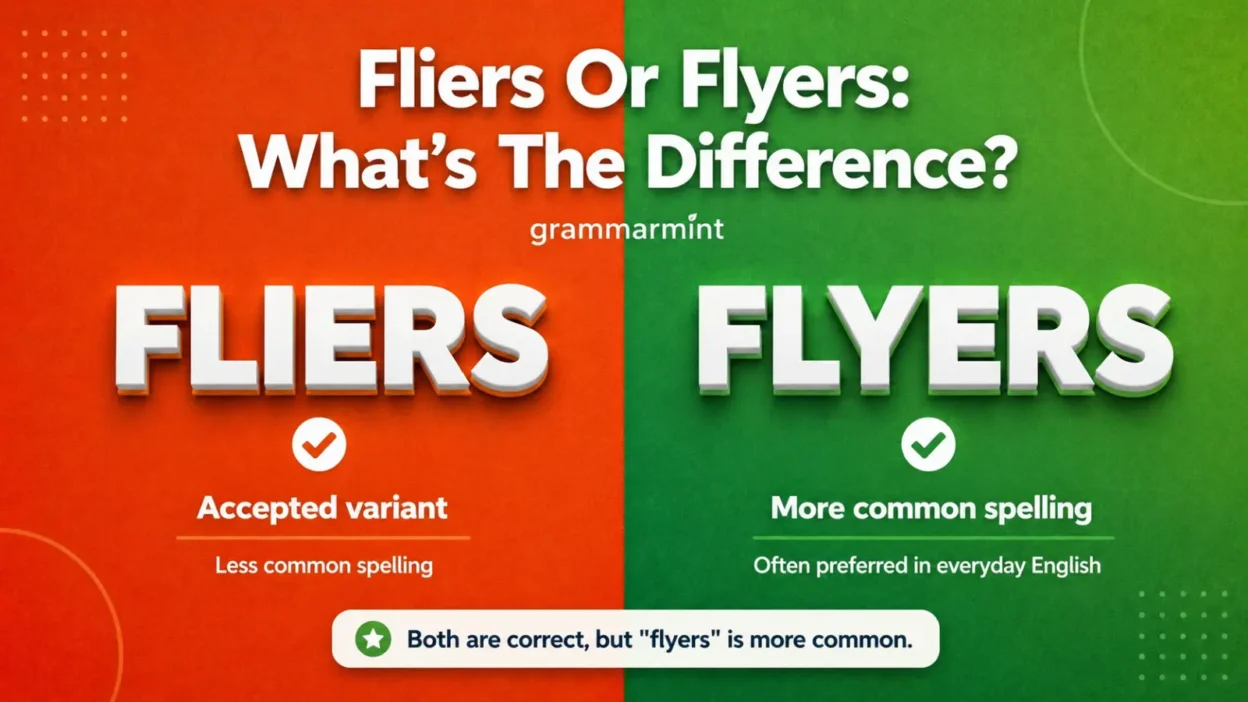
For most U.S. writing, flyers is the safer choice for printed advertising pieces, while fliers is still common for people or things that fly and in the phrase take a flier. Both spellings are accepted, but context matters.
TL;DR
• Use flyers for printed ads
• Use fliers for many flying meanings
• Both spellings are accepted
• U.S. business writing favors flyers
• Take a flier keeps the i
• Follow your style guide consistently
Flier Vs. Flyer: The Quick Rule
These words sound the same, so the confusion is normal. Still, one fast rule solves most cases.
If you mean a printed ad, choose flyer. If you mean someone or something that flies, flier often fits better.
• Flyer is best for printed promotions
• Flier often fits flying people
• Both forms are accepted English
• Meaning guides the better choice
• U.S. readers expect flyers first
• Context matters more than sound
• Pick one style and stay consistent
• Business writing usually prefers flyer
• Aviation writing often keeps flier
• Idioms may keep older spelling
• Plurals follow the same pattern
• Default to clarity over tradition
What Flyer Means
In everyday American writing, flyer usually means a printed piece used to promote something. That is the meaning most readers expect first.
This is the spelling you’ll usually want for schools, stores, events, and local advertising.
• A flyer is a printed handout
• It usually promotes an event
• It can advertise a business
• It may announce a sale
• It often appears on bulletin boards
• It’s usually one flat sheet
• It’s shorter than a brochure
• It’s easy to hand out
• It works for local promotions
• It often includes key details
• It’s common in school notices
• Readers recognize this meaning fast
What Flier Means
Flier often points to someone or something that flies. Because of that, it feels more natural in aviation or literal flying contexts.
You may also see it in a few set expressions. That includes one especially common idiom.
• A flier can be a pilot
• It can mean an air traveler
• It can describe a fast bird
• It can mean a flying thing
• It appears in aviation writing
• It sounds natural in literal use
• It can suggest movement or speed
• It fits many airborne contexts
• It appears in older style guidance
• It survives in fixed phrases
• It can describe skilled birds
• It often feels more traditional
When Flyer Is The Better Choice
Use flyer when your meaning is promotional, printed, or business-related. In plain terms, this is the best choice for most marketing copy.
That makes it the easy default for offices, schools, restaurants, and events.
• Choose flyer for paper ads
• Use it for event handouts
• Use it for sale announcements
• Use it for store promotions
• Use it for club notices
• Use it for school events
• Use it for neighborhood postings
• Use it for nonprofit outreach
• Use it for menu inserts
• Use it for grand openings
• Use it for service promotions
• Use it for bulletin board posts
When Flier Is The Better Choice
Use flier when you’re talking about real flying, not printed promotion. It works well in aviation, travel, and wildlife contexts.
Even so, not every editor will make this distinction. That’s why audience and house style still matter.
• Choose flier for a pilot
• Use it for a frequent traveler
• Use it for a soaring hawk
• Use it for a strong glider
• Use it for airborne creatures
• Use it for flight-based writing
• Use it for aviation contexts
• Use it for literal motion
• Use it for sky-related descriptions
• Use it for a daring airman
• Use it for bird behavior
• Use it for flight reports
Can Flyer Refer To Someone Who Flies?
Yes, it can. Some dictionaries and general usage sources accept flyer for a person or thing that flies too.
That said, many readers still expect flyer to mean a handout first. So the sentence may feel less clear.
• Yes, flyer can mean a pilot
• It can describe an air traveler
• Some dictionaries allow that use
• Some writers use it broadly
• It may sound less precise
• Readers may picture a leaflet
• Context must do more work
• Clarity matters in mixed settings
• Headlines can create confusion
• Business copy should avoid ambiguity
• Literal use is still accepted
• Audience expectation should guide choice
Can Flier Mean A Printed Handout?
Yes, flier can also mean a printed handout in some sources. Still, that spelling looks less natural to many U.S. readers in marketing copy.
So while it isn’t wrong, it often isn’t the clearest choice for a printed ad.
• Yes, flier can mean a handout
• Some dictionaries list that sense
• Older usage shows this form
• Some brands still prefer it
• It may look less familiar
• Marketing copy favors flyer more
• Readers may pause at flier
• Modern ads rarely need it
• It can fit house style
• It isn’t automatically wrong
• It may feel less current
• Choose it only with purpose
American English Preference
In American English, flyer usually wins for printed ads and promotional material. That makes it the safer everyday choice for most U.S. audiences.
If your readers are customers, parents, or general web visitors, flyers will usually feel most natural.
• U.S. writing favors flyer for ads
• Flyers looks familiar to readers
• Business copy leans toward flyers
• Schools often print flyers
• Stores post flyers in windows
• Event pages mention flyers often
• Local marketing uses flyers widely
• The spelling feels modern
• It reduces reader hesitation
• It fits plain-language writing
• It’s strong for general audiences
• It’s the safer U.S. default
British English And General Dictionary Usage
British and general dictionary usage can be broader. Some dictionaries list both forms freely, while others show a slight preference by meaning.
That’s why you may see mixed advice. The best move is to match your spelling to your audience and stay consistent.
• Dictionaries often list both forms
• British sources may use flyer widely
• Some entries show flier too
• Meaning can outweigh region
• House style still matters
• Mixed evidence causes confusion
• Modern dictionaries record variation
• General English accepts both spellings
• Audience should guide your choice
• Consistency beats random switching
• Regional habits can differ slightly
• Clear context prevents misunderstandings
AP Style Guidance
AP style now prefers flyer for both the handbill meaning and for a person flying in an aircraft. But AP keeps take a flier as the established phrase.
So if you write news copy or AP-based content, flyer is usually your default.
• AP style prefers flyer broadly
• AP uses flyer for handbills
• AP uses flyer for air passengers
• AP simplifies the spelling choice
• AP keeps take a flier
• Newsrooms often follow AP
• AP helps reduce inconsistency
• It favors reader familiarity
• It trims old distinctions
• It’s useful for journalism
• It supports a simple default
• Fixed phrases remain exceptions
Chicago Style Guidance
Chicago draws a clearer line between the meanings. It prefers flier for anyone or anything that flies and flyer for an advertising circular.
That makes Chicago helpful when you want a more meaning-based distinction.
• Chicago separates the meanings
• Flier fits flying people
• Flier fits flying things
• Flyer fits advertising sheets
• The split aids precision
• Editors may like the clarity
• Publishing teams may prefer it
• It supports neat distinctions
• It’s useful in formal editing
• It helps avoid mixed signals
• It’s a strong house-style model
• It differs from modern AP
Frequent Flier Or Frequent Flyer
This phrase trips people up because both versions appear in real life. Still, frequent flier has long been common, while some modern style systems may allow or prefer frequent flyer.
Your best move is to follow the wording your brand, airline, or style guide uses.
• Frequent flier is widely recognized
• Frequent flyer also appears often
• Travel brands may choose either
• Style guides may differ here
• Older usage favors flier more
• Modern simplification may use flyer
• Brand consistency matters most
• Readers understand both forms
• Loyalty programs may set usage
• Copy should match the source
• Avoid mixing both in one piece
• Check official brand wording first
The Idiom Take A Flier
This phrase means to take a risk or make a speculative move. In this expression, flier is the traditional spelling.
Because it’s a set phrase, you usually should not change it to flyer.
• Take a flier means risk something
• It suggests a speculative move
• It often appears in business talk
• It can mean a bold guess
• The phrase keeps flier
• It acts like a fixed expression
• Don’t modernize it casually
• Readers expect the i spelling
• It’s not about paper ads
• It’s not about flying literally
• It often implies uncertainty
• Context makes the idiom clear
Flyer, Leaflet, Handbill, Or Brochure
These words overlap, but they are not perfect matches. A flyer is usually a simple promotional sheet, while a brochure is often more polished and folded.
So when you choose the word, think about shape, purpose, and audience.
• A flyer is usually one sheet
• A leaflet is also brief
• A handbill is meant for handing out
• A brochure is often folded
• Brochures usually hold more detail
• Flyers are often cheaper to print
• Leaflets can feel more general
• Handbills sound slightly older
• A poster is larger
• A mailer is sent by post
• Pick the word by format
• Choose the clearest everyday label
Example Sentences With Flyer And Flier
Examples make the difference stick faster. Once you see the words in real contexts, the pattern feels much easier.
Read these like mini models for your own writing.
• We posted flyers for the concert
• The café printed bright flyers yesterday
• Parents received school flyers on Friday
• She designed a holiday flyer online
• The store mailed flyers to neighbors
• He’s a confident flier in storms
• Those geese are strong winter fliers
• Maya is a nervous first-time flier
• The pilot was an expert flier
• They took a flier on crypto
• Our team handed out flyers downtown
• The eagle is a graceful flier
Easy Memory Tricks And Final Choice
You don’t need a complicated rule here. A simple memory trick is enough for most writing situations.
Think y for your yard sale ad and i for in the air. That won’t cover every style guide, but it works well most of the time.
• Y fits your printed ad
• I fits in the air
• Use flyer for promotions
• Use flier for flight contexts
• Keep take a flier unchanged
• Default to audience expectations
• Choose clarity over cleverness
• Match your chosen style guide
• Stay consistent in one document
• Don’t overthink accepted variants
• When unsure, use flyers for ads
• When unsure, check the meaning
FAQs
Is flier or flyer correct?
Both are correct. In American everyday writing, flyer is usually the safer choice for printed ads, while flier often appears for people or things that fly.
Is it paper flyer or paper flier?
Paper flyer is the more natural choice for most U.S. readers. Paper flier isn’t always wrong, but it looks less standard in advertising contexts.
Is it marketing flyer or marketing flier?
Use marketing flyer. In business and promotional writing, flyer is the form most readers expect.
Is it frequent flier or frequent flyer?
Both appear, but frequent flier has a long history and still looks natural to many readers. Some modern style systems simplify toward flyer, so consistency matters.
Can flyer mean a person who flies?
Yes, it can. Still, many writers use flier when they want the flying meaning to feel clearer right away.
Can flier mean an advertising handout?
Yes, some dictionaries allow that meaning. Even so, flyer is usually the better pick for a printed advertisement in U.S. writing.
Conclusion
When choosing between fliers or flyers, start with the meaning and the audience. For most printed ads, flyers is the clearest choice, while fliers still works well for flying meanings and in take a flier.