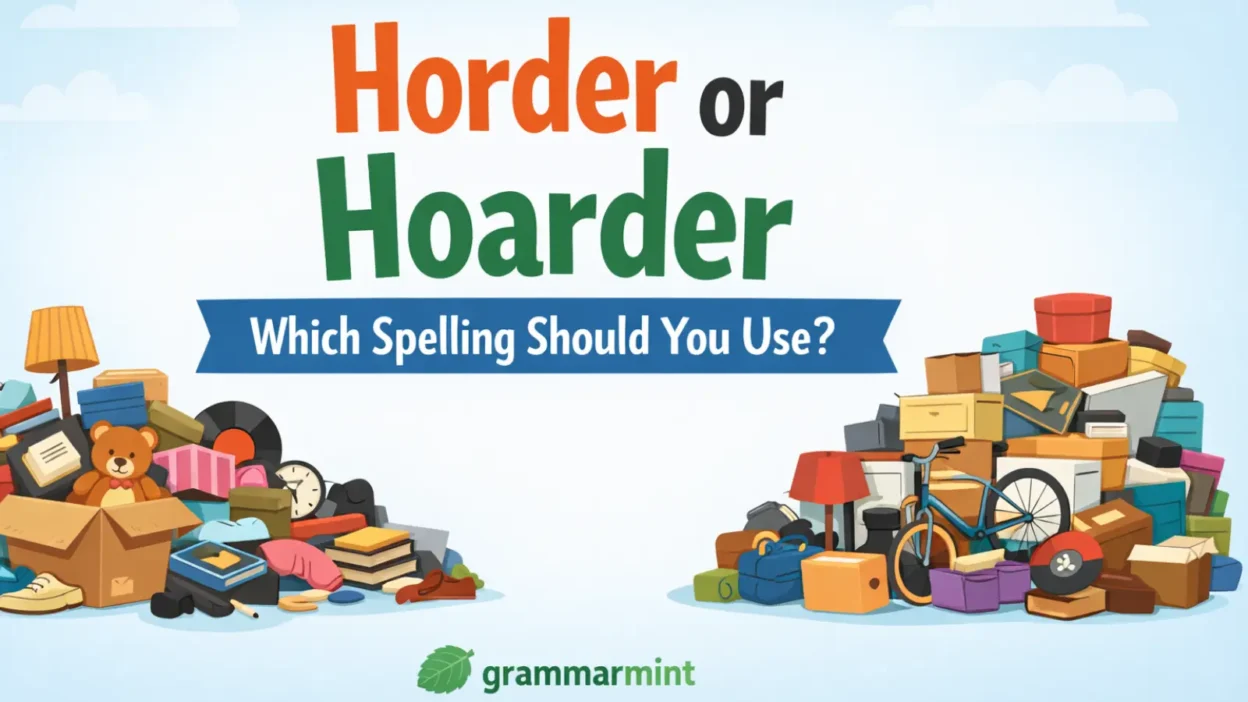
If you’re editing an email, essay, report, or caption, Horder or Hoarder can slow you down fast. The confusion usually comes from spelling, pronunciation, hoard, hoarding, and the nearby word horde, which sounds close but means something else. In standard modern English, major dictionaries record hoarder as the accepted form, built from the word hoard. So, the practical goal is simple: choose the right spelling, use the right tone, and avoid turning a small typo into a credibility problem.
Quick Answer
Horder or Hoarder: hoarder is correct. Horder is a misspelling in standard everyday English, so use hoarder in normal writing.
TL;DR
• Hoarder is the standard spelling.
• Horder is usually just a typo.
• The root word is hoard.
• Horde is a different word.
• US and UK both use hoarder.
Horder Or Hoarder
The rule is simple: correct spelling matters here, and standard English accepts only one form for ordinary writing. So, if you’re choosing between the two, treat horder as a misspelling and move on.
• Use hoarder in school papers.
• Use hoarder in work documents.
• Choose hoarder in blog posts.
• Choose hoarder in captions.
• Avoid horder in headlines.
• Avoid horder in resumes.
• Keep the a after ho.
• Spell-check won’t always save you.
• Dictionary lookups favor hoarder.
• Copy editors expect hoarder.
• US readers recognize hoarder.
• UK readers recognize hoarder.
Hoarder Meaning
The everyday definition is straightforward. A noun like hoarder usually means a person who keeps or stores too many things, and major references also allow the broader sense of a person or even an animal that hoards. Usage decides whether the tone feels casual, critical, or clinical.
• It names a person who hoards.
• It can describe an animal too.
• It often suggests excess.
• It may imply difficulty discarding.
• It’s a noun, not a verb.
• The plural form is hoarders.
• The related noun is hoarding.
• The base word is hoard.
• Tone changes with context.
• Casual use may sound teasing.
• Formal use can sound clinical.
• Audience matters every time.
Is Horder A Word?
For this meaning, typo is the safest way to think about it. In normal modern writing, horder is a nonstandard form and should be treated as an error, not as the preferred noun for someone who hoards.
• Don’t use it in essays.
• Don’t use it in reports.
• Don’t use it in applications.
• Don’t use it in news copy.
• Treat it like a spelling slip.
• Edit it before publishing.
• Replace it with hoarder.
• Searchers often test this form.
• Online repetition doesn’t legitimize it.
• Spoken English can mislead spelling.
• Standard references don’t choose it.
• Keep it only in quoted text.
Why People Misspell Hoarder
This mistake makes sense once you hear the word aloud. The pronunciation can hide the inner vowel, so a dropped vowel happens easily, especially during fast typing or quick search behavior. That’s why this typing error feels common even when the standard spelling is clear.
• The inner a gets blurred.
• Fast speech hides the spelling clue.
• Mobile typing drops vowels often.
• Learners trust sound too much.
• Quick searches encourage guessing.
• Nearby words add confusion.
• Horde pulls attention away.
• The root word feels less familiar.
• Many people hear it first.
• Fewer people study the word family.
• Online typos look deceptively normal.
• Rushed proofreading misses small changes.
Hoard, Hoarder, And Hoarding
The easiest fix is to learn the whole word family. The root word is hoard, the verb form is still hoard, and the noun form for the person is hoarder; meanwhile, hoarding names the act or condition.
• Hoard can be a noun.
• Hoard can be a verb.
• Hoarder names the person.
• Hoarding names the behavior.
• Hoarded describes stored items.
• Hoards marks plural or present verb.
• Every form keeps the a.
• The family shares one core meaning.
• Learn the stem before suffixes.
• Grouped words are easier to remember.
• Root-based editing feels faster.
• One family solves several typos.
Hoard Vs. Horde
This nearby pair matters because homophone confusion is a real driver here. A stash is a hoard, while a crowd is a horde, so the person word hoarder must stay linked to hoard, not horde.
• Hoard means stored supply.
• Horde means large crowd.
• Hoard fits objects.
• Horde fits people or swarms.
• Hoarder comes from hoard.
• Horder doesn’t fix this.
• Think treasure for hoard.
• Think tourists for horde.
• Don’t swap them in headlines.
• Check the sentence meaning first.
• One letter changes the idea.
• Context settles the choice quickly.
Hording Or Hoarding
This related typo follows the same pattern. The -ing form keeps the full base word, so spelling pattern logic says hoard + ing = hoarding, and the missing vowel version is wrong in standard writing.
• The correct form is hoarding.
• Keep oa together always.
• Add -ing after hoard.
• Don’t delete the middle vowel.
• This typo mirrors horder.
• It appears in rushed notes.
• It appears in weak drafts.
• Scan the word family together.
• Rewrite before you post.
• Proofread titles twice.
• Root memory fixes the pattern.
• The same rule keeps working.
Hoarder Pronunciation
Sound helps, but only if you connect it to spelling. In common American-style spoken form, the stressed syllable lands early, and that can make the vowel feel less obvious, which is why people need a visual memory instead of spelling by ear.
• Say it like HOR-der.
• Stress the first syllable.
• The middle vowel softens fast.
• Don’t spell from sound alone.
• Read hoard before hoarder.
• Then add -er mentally.
• Hearing can mislead beginners.
• Visual memory helps more.
• Practice both forms together.
• Slow speech shows the root.
• Fast speech invites shortcuts.
• Spelling still wins over sound.
Hoarder Origin
The etymology makes the spelling easier to trust. Word-history sources link it to Old English, and that word history shows the form growing out of hoard, with the person-ending -er added later.
• The root goes back centuries.
• Older senses involved treasure and stock.
• The person form came from hoard.
• The suffix -er marks a doer.
• History preserves the missing clue.
• That clue is the a.
• The modern form stayed stable.
• Later use became more negative.
• History supports current spelling.
• Etymology makes memory easier.
• Old roots still guide editors.
• Word history rewards careful readers.
American And British English
Here, the regional check is refreshingly easy. US English and UK English both use the same form, so there is no separate same spelling debate hiding behind this word.
• Americans write hoarder.
• Britons write hoarder.
• There’s no regional variant here.
• It’s not like color/colour.
• It’s not like organize/organise.
• Global readers expect one spelling.
• Style sheets don’t split it.
• Dictionaries stay aligned.
• Audience doesn’t change the rule.
• Regional myths waste editing time.
• One form works everywhere.
• That makes revision simpler.
Hoarder In Formal Writing
In serious contexts, professional tone matters as much as spelling. So use neutral wording, choose precise language, and make sure the label matches what you truly mean rather than what sounds dramatic.
• Prefer exact wording in reports.
• Use the term only when accurate.
• Define it once if needed.
• Keep examples calm and plain.
• Avoid sensational phrasing.
• Avoid mocking headlines.
• Be careful in legal writing.
• Be careful in medical writing.
• Serious topics need respectful language.
• Precision beats punchy wording.
• Tone should fit the subject.
• Clear wording protects credibility.
Hoarder In Everyday Speech
Casual language works differently. A joking use may feel harmless among friends, yet tone and context still matter because the same word can sound playful in one setting and harsh in another.
• Friends may joke about closets.
• Family jokes may still sting.
• Public labels land harder.
• Social posts spread fast.
• Humor should stay gentle.
• Strangers deserve extra care.
• Light teasing isn’t always light.
• Everyday speech still needs accuracy.
• Correct spelling still matters.
• Kind wording usually reads better.
• Context changes the emotional weight.
• Audience decides the safe choice.
Hoarder In Mental Health Context
This is the section where hoarding disorder, collecting, and person-first language really matter. Clinical sources separate hoarding disorder from ordinary collecting, and they focus on distress, clutter, daily impairment, and difficulty discarding possessions.
• A diagnosis is more specific.
• Collecting is not automatically disorder.
• Distress is part of the picture.
• Impairment matters too.
• Living-space blockage matters.
• Safety concerns can become serious.
• Animal hoarding is another issue.
• Respectful phrasing helps everyone.
• Person-first wording can reduce stigma.
• Casual jokes can blur real problems.
• Treatment exists and may help.
• Avoid diagnosing people from afar.
Hoarder Sentence Examples
Examples help because real sample sentence use makes the context clue clear. So here are short lines showing how example use can shift from casual to serious without changing the spelling.
• She’s a sticker hoarder at work.
• The film follows a retired hoarder.
• He jokes that he’s a sneaker hoarder.
• Reporters avoided mocking the hoarder.
• The therapist spoke with the hoarder calmly.
• Her aunt is a coupon hoarder.
• The landlord documented hoarder conditions.
• My brother calls me a notebook hoarder.
• The memoir never reduced the hoarder.
• They described him as a food hoarder.
• That attic belonged to a careful hoarder.
• The cleanup team supported one hoarder.
Common Mistakes To Fix
A clean proofread catches most of these fast. So focus on correction patterns, watch for the most common typo shapes, and check the full word family in one pass.
• Mistake: horder. Fix: hoarder.
• Mistake: hording. Fix: hoarding.
• Mistake: horder’s. Fix: hoarder’s.
• Mistake: horders. Fix: hoarders.
• Mistake: crowd meaning. Fix: horde.
• Mistake: stash meaning. Fix: hoard.
• Mistake: spell by ear. Fix: check root.
• Mistake: assume UK variant. Fix: same spelling.
• Mistake: drop the a. Fix: keep it.
• Mistake: mock clinical topics. Fix: stay neutral.
• Mistake: skip review. Fix: scan family words.
• Mistake: trust memory alone. Fix: verify quickly.
How To Remember Hoarder
A good spelling tip should be instant. The best one is to use the word root first, then do one quick check before you hit publish.
• Start with hoard.
• Keep the hidden a.
• Add -er for the person.
• Pair it with hoarding.
• Think treasure before clutter.
• Use root-based memory.
• Write hoard three times.
• Then write hoarder once.
• Compare it with horde separately.
• Say hoard plus er.
• Save one note in drafts.
• Build one reliable editing habit.
FAQs
Is “horder” ever correct?
In standard modern English for this meaning, no. The accepted form is hoarder, and major dictionaries list that spelling instead.
What does “hoarder” mean?
It usually means a person who keeps or stores too many things. Depending on context, it can be a casual label, a descriptive term, or part of a clinical discussion.
Is “hoarder” a medical term?
It can be used in medical and mental-health contexts, especially when discussing hoarding disorder. However, clinical sources are more precise, and phrases like “person with hoarding disorder” may be better in sensitive writing.
What is the difference between hoard and hoarder?
Hoard is the base word and can be a noun or a verb. Hoarder is the person word built from that base.
Is there a British spelling of hoarder?
No separate British variant shows up here. US and UK references use hoarder the same way.
Why do people write horder?
Mostly because the word’s pronunciation can hide the inner vowel, especially in fast speech or fast typing. Once you connect it to hoard, the spelling gets much easier to remember.
Conclusion
When choosing Horder or Hoarder, pick hoarder every time.
Keep the a from hoard, watch the tone, and use gentler wording when a diagnosis is involved.
That one small check will keep your writing cleaner, clearer, and more respectful.