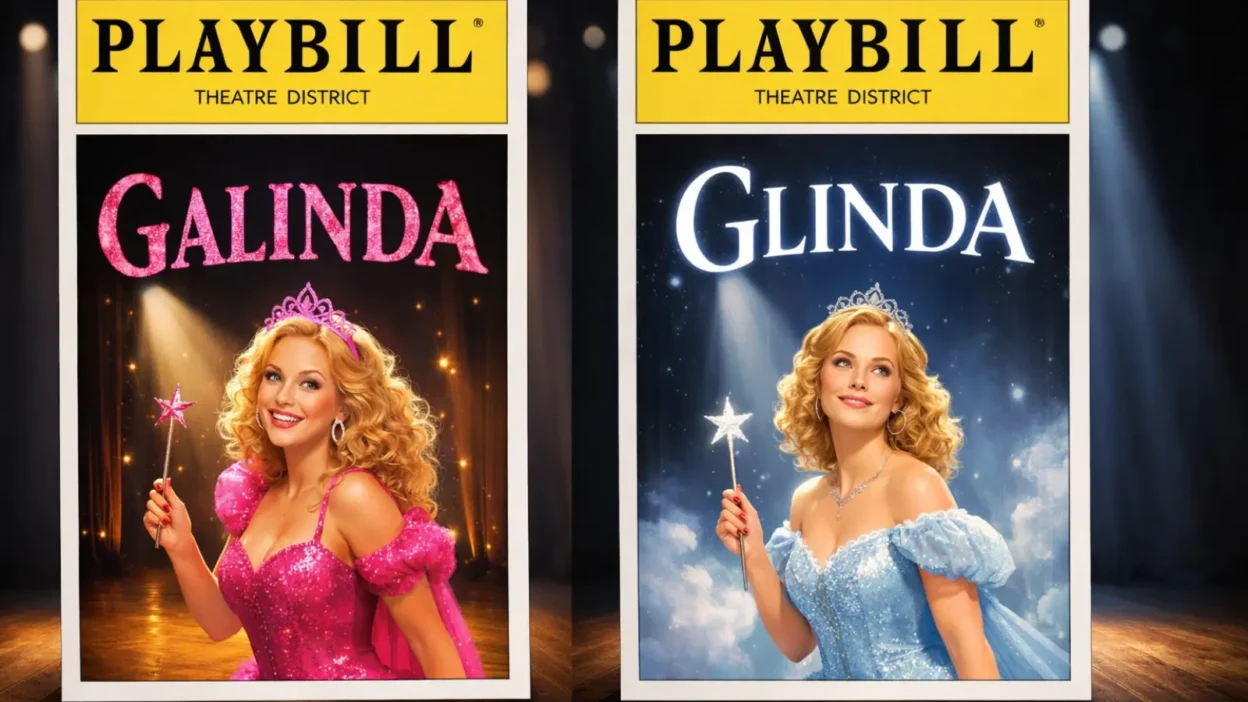
Galinda and Glinda are both correct names, but they are not simply alternative spellings. In Wicked, they refer to the same character at different points in her story.
She begins as Galinda Upland, a student at Shiz University. Later, she chooses the shorter name Glinda, the name associated with the familiar figure known as Glinda the Good.
So, which name should you use? It depends on the timeline and context. Use Galinda when referring to her earlier identity in Wicked, and Glinda for her later identity, public role, or the well-known character from the broader Oz tradition.
Quick Answer
Both Galinda and Glinda are correct.
- Galinda is her earlier name in Wicked, especially during her time at Shiz University.
- Glinda is the name she adopts later.
- Glinda the Good is the established name associated with the Good Witch of Oz.
- Both names refer to the same fictional character.
- Glinda is generally the better choice for a broad or general reference.
In short, the difference is about story timeline and character identity, not spelling correctness.
Why Are Galinda and Glinda Different?
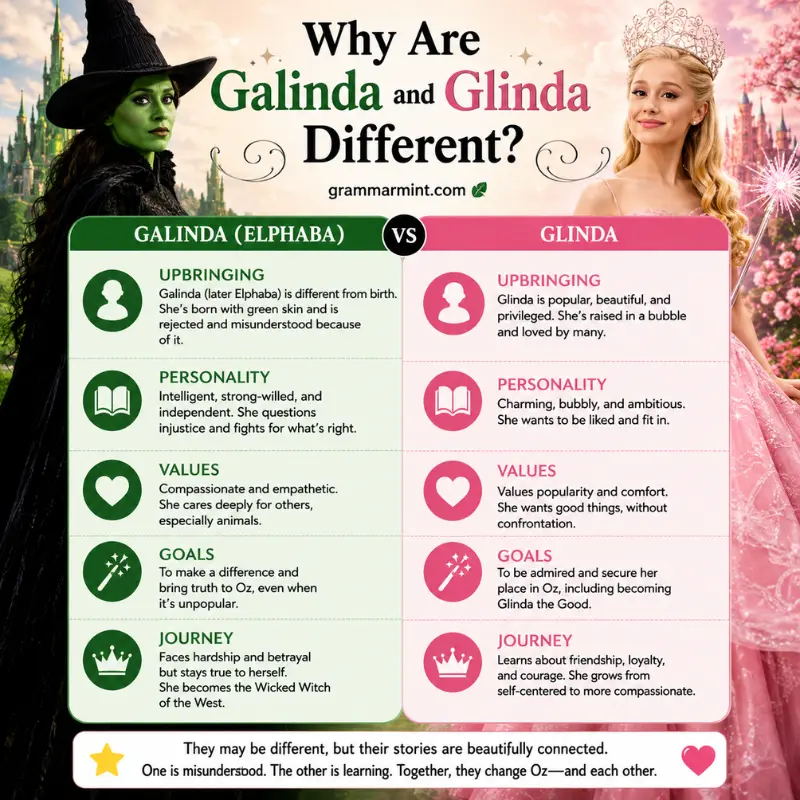
The name difference is intentional.
Early in Wicked, the character is introduced as Galinda Upland. During her time at Shiz University, she is known as Galinda and is closely connected to Elphaba.
Later, she drops the extra “a” and begins using Glinda. This change is part of her developing identity and public image.
Because most people already know the character as Glinda the Good, the name Galinda can initially seem like a typo. It is not.
The extra “a” is there deliberately:
- Galinda → earlier identity
- Glinda → later identity
This is why the two forms should not be treated as random spelling variants.
Galinda vs. Glinda at a Glance
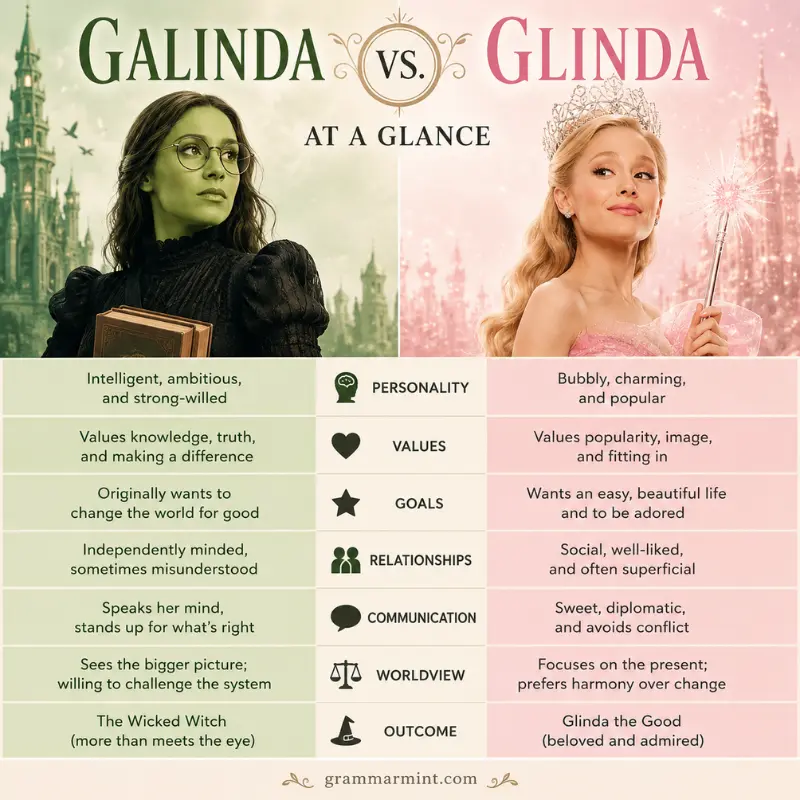
| Context | Best Choice | Why |
|---|---|---|
| Early Shiz University scenes | Galinda | This is her name during the earlier part of the story. |
| Her student years | Galinda | She has not yet adopted the shorter form. |
| After the name change | Glinda | She now uses the shorter name. |
| Glinda the Good | Glinda | This is her established public identity. |
| Original Oz stories | Glinda | The character is known as Glinda in the Oz tradition. |
| Discussing her complete journey | Galinda and Glinda | Both names help explain her development. |
| General reference to the character | Glinda | It is the more widely recognized name. |
What Does Galinda Mean?
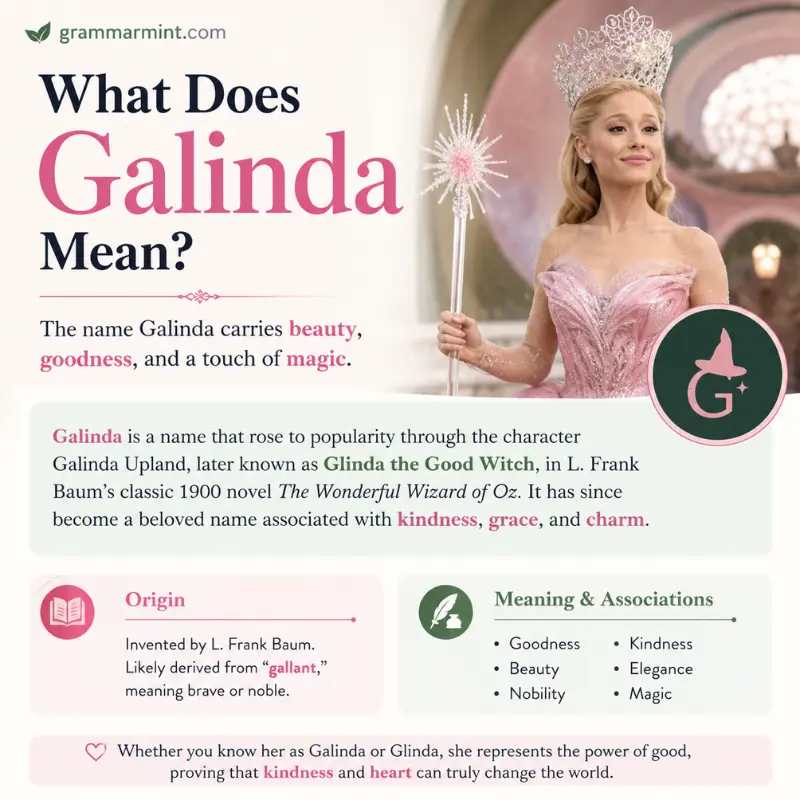
Galinda is a proper name rather than an ordinary English word with a separate dictionary definition.
In Wicked, it identifies the character during an earlier stage of her life. It is particularly appropriate when discussing her arrival at Shiz, her relationship with Elphaba, and her life before the name change.
For example:
Galinda becomes Elphaba’s roommate at Shiz University.
Here, Galinda is the more precise choice because the scene takes place before her name change.
What Does Glinda Mean?
Glinda is also a proper name. It is the familiar name of the Good Witch character in the Oz tradition and the name adopted by Galinda later in Wicked.
For example:
Glinda becomes one of the most recognizable figures in Oz.
Here, Glinda is appropriate because the sentence refers to her later identity and public role.
Galinda and Glinda Pronunciation
The two names are also pronounced differently.
- Galinda: usually pronounced guh-LIN-duh — three syllables
- Glinda: usually pronounced GLIN-duh — two syllables
The extra “a” in Galinda is pronounced. It is not silent.
This makes the difference more than a visual spelling change.
Is Galinda More Formal Than Glinda?
No.
There is no formal-versus-informal distinction between the two names. Galinda is not a more formal version of Glinda, and Glinda is not a casual nickname.
The distinction is primarily narrative and chronological.
Galinda points to her earlier identity, particularly her student years. Glinda points to the identity she adopts later and the public figure associated with Glinda the Good.
The name change can also be viewed as part of her character development, but it does not mean that she suddenly becomes an entirely different person.
Which Name Should You Use?
The easiest rule is:
Use the name that matches the point in the story you are discussing.
Use “Galinda” when:
- Discussing her early years at Shiz University
- Referring to her life before the name change
- Describing her early relationship with Elphaba
- Talking about her original identity in Wicked
- Referring to scenes in which she is still called Galinda
Use “Glinda” when:
- Discussing her later identity
- Referring to Glinda the Good
- Talking about her public role in Oz
- Discussing the established Oz character
- Making a general reference to the character
If you are discussing her entire character arc, introduce both names:
Galinda, later known as Glinda, begins her story as a student at Shiz University.
After that, choose the name that fits the specific period being discussed.
When Does Galinda Become Glinda?
The name change occurs during Wicked and is connected to Doctor Dillamond. Galinda decides to use the name Glinda, turning the change into a visible part of her developing public identity.
This moment is important because it connects her personal name with the public persona she eventually develops.
However, it is better to describe this as a name change and stage in her development rather than saying that Galinda and Glinda are completely different personalities.
She remains the same character.
Common Mistakes About Galinda and Glinda
1. Thinking “Galinda” Is a Typo
It is not.
Galinda is an intentional name used for the character in Wicked.
2. Assuming They Are Two Different Characters
They are not.
Galinda and Glinda are the same fictional character.
3. Calling the Original Oz Character “Galinda”
When discussing the established character from the original Oz tradition, Glinda is the appropriate name.
For example:
Glinda helps Dorothy in the original Oz story.
Using Galinda in this context can be misleading because the earlier Wicked name belongs to the character’s expanded backstory.
4. Saying the Name Change Creates a Completely New Person
The name change is meaningful, but it does not turn her into an entirely different character.
It is better to describe it as part of her character development, identity, and public image.
5. Pronouncing Both Names the Same Way
The names normally have different pronunciations:
- Galinda = three syllables
- Glinda = two syllables
6. Switching Between the Names Without Context
If your article discusses multiple points in the story, make the distinction clear on first mention.
A useful introduction is:
Galinda, later known as Glinda, is one of the central characters in Wicked.
Galinda and Glinda: Example Sentences
Here are some examples showing how each name works in context.
- Galinda arrives at Shiz University with high social expectations.
- Galinda and Elphaba initially struggle to get along.
- During her student years, the character is known as Galinda.
- Galinda later chooses to use the name Glinda.
- Glinda becomes an important public figure in Oz.
- The story follows Galinda’s development into Glinda the Good.
- Glinda is the more familiar name outside the early Wicked timeline.
- When discussing her arrival at Shiz, Galinda is the more precise name.
- When discussing her later public identity, Glinda is the better choice.
- Galinda and Glinda refer to the same character at different stages of her story.
Galinda and Glinda in the Oz Tradition
The distinction becomes clearer when you separate Wicked from the broader Oz tradition.
Glinda is the established name of the Good Witch in L. Frank Baum’s Oz stories.
Galinda, on the other hand, is the earlier name given to the character in Gregory Maguire’s Wicked. The stage musical and later film adaptations continued the idea of Galinda becoming Glinda.
This means the two names have different historical roles:
- Glinda belongs to the original Oz tradition.
- Galinda provides an earlier identity within the Wicked backstory.
- Glinda becomes the character’s later name in Wicked.
Galinda and Glinda: Names and Related Terms
Galinda
Related references include:
- Galinda Upland
- Young Galinda
- Galinda at Shiz
- Galinda and Elphaba
- Galinda before the name change
Glinda
Related references include:
- Glinda the Good
- Glinda the Good Witch
- Glinda of Oz
- Glinda and Elphaba
- Glinda’s bubble
These terms can refer to the same character, but they are not interchangeable in every context.
Is Galinda a Synonym for Glinda?
Not exactly.
Because both names refer to the same person, they can sometimes be used as references to the same character. However, they carry different timeline associations within Wicked.
For example:
Galinda meets Elphaba at Shiz.
This points to an earlier part of the story.
Meanwhile:
Glinda becomes a celebrated figure in Oz.
This points to her later identity.
So, while the names refer to the same person, choosing the correct form can make your writing more precise.
FAQs
Is Galinda or Glinda correct?
Both are correct. Galinda is the character’s earlier name in Wicked, while Glinda is the name she adopts later. They refer to the same person.
Why does Galinda change her name to Glinda?
Galinda changes her name during the story in connection with Doctor Dillamond. The change also becomes part of her developing identity and public image.
Are Galinda and Glinda the same person?
Yes. They are the same fictional character. Galinda refers to her earlier identity, while Glinda refers to her later identity and the familiar Good Witch character.
Is Galinda a misspelling of Glinda?
No. Galinda is not a misspelling. The extra “a” is intentional and is part of her earlier name in Wicked.
Which name should I use when writing about Wicked?
Use Galinda for early scenes before the name change and Glinda for later events and her established public identity. If you are discussing her complete journey, write “Galinda, later known as Glinda.”
How are Galinda and Glinda pronounced?
Galinda is usually pronounced guh-LIN-duh, while Glinda is pronounced GLIN-duh. Galinda has three syllables; Glinda has two.
Is Glinda the original name?
In the broader Oz tradition, Glinda is the established name of the Good Witch. Galinda was introduced later as an earlier name for the character in Wicked.
Conclusion
Galinda and Glinda are both correct, but context determines which one you should use.
Use Galinda when talking about her earlier identity, especially her student years at Shiz University. Use Glinda when discussing her later identity, her public role, or the familiar character known as Glinda the Good.
The difference is not a spelling mistake or a regional variation. It is an intentional part of the character’s story.
The simplest rule to remember is:
Galinda first, Glinda later.
And when you are talking about the character generally, Glinda is usually the clearest and most recognizable choice.
[…] correct spelling is […]