If you’ve ever paused before writing a question, this guide will help you choose with confidence. Whose or Who-s whose-or-who-s points to a common spelling problem: should you write whose or who’s? These words sound alike, yet they do different jobs. One shows ownership. The other shortens “who is” or “who has.” Because the apostrophe looks possessive, it tricks many writers in emails, essays, texts, captions, and work messages. Still, the rule is simple once you learn the test. In this guide, you’ll see clear examples, common mistakes, and quick fixes you can use right away.
Quick Answer
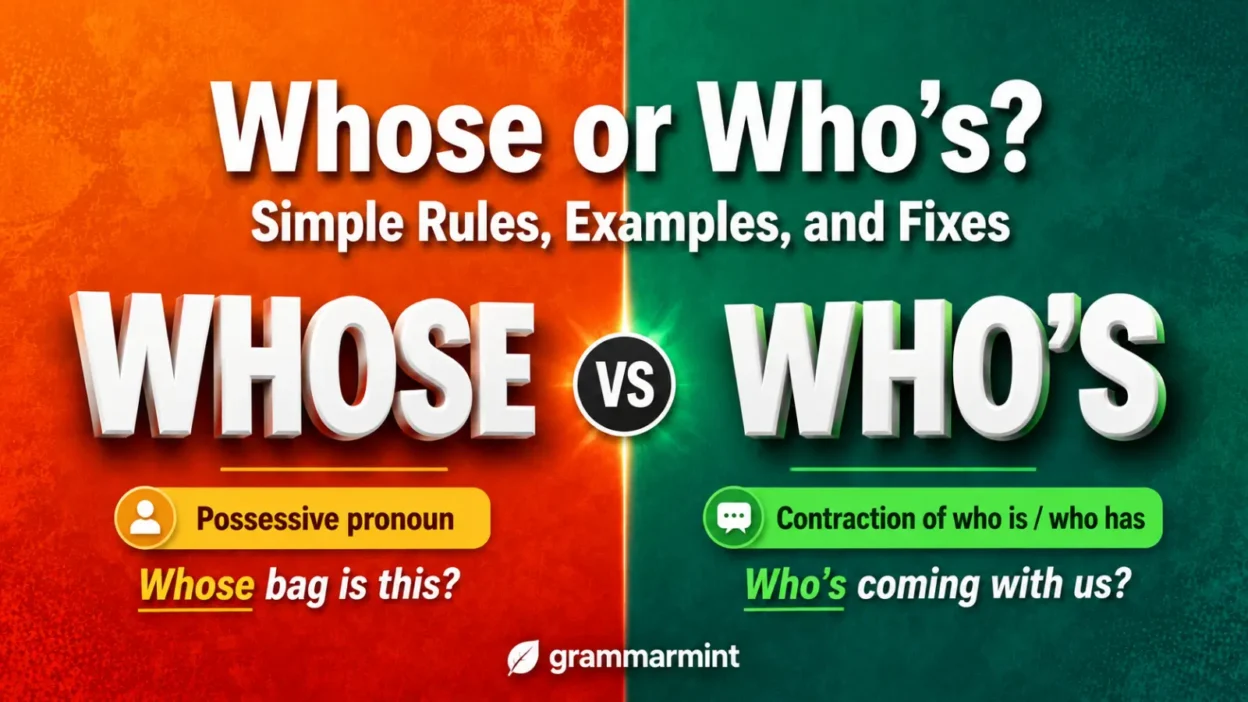
Whose or who’s depends on meaning. Use whose for ownership, and use who’s only when it means “who is” or “who has.”
TL;DR
• Whose shows ownership or belonging.
• Who’s means who is or who has.
• Replace who’s to test it.
• Apostrophes don’t make pronouns possessive.
• “Whose name” is usually correct.
• “Who’s coming” is usually correct.
Whose Or Who’s
Choosing between these words gets easier when you slow down for one second. First, decide whether the sentence shows possession. Then, check whether who’s can expand into “who is” or “who has,” because the apostrophe marks a shortened form.
• Use whose for ownership.
• Use who’s for who is.
• Use who’s for who has.
• Don’t use who’s for belongings.
• Try expanding who’s first.
• If expansion fails, use whose.
• Whose usually comes before a noun.
• Who’s usually comes before a verb.
• Whose can start a question.
• Who’s can start a question too.
• Meaning decides the spelling.
• Sound never decides the spelling.
Whose Vs Who’s
These two words are homophones, so your ears won’t help much. Instead, use the grammar job. Whose is a possessive pronoun, while who’s is short for who is or “who has.”
• Whose asks about an owner.
• Who’s asks about a person.
• Whose points to a belonging.
• Who’s points to an action.
• Whose can describe a person.
• Who’s can introduce a clause.
• Whose has no apostrophe.
• Who’s always has one.
• Whose is one complete word.
• Who’s is two words shortened.
• Whose connects to a noun.
• Who’s connects to a verb.
Who’s Meaning
Who’s is a shortened form of “who is” or “who has.” Therefore, it only works when one of those longer forms works. The apostrophe stands for missing letters, and sometimes the full phrase includes who has.
• Who’s ready means who is ready.
• Who’s been there means who has been there.
• Who’s calling means who is calling.
• Who’s finished means who has finished.
• Who’s next means who is next.
• Who’s responsible means who is responsible.
• Who’s seen it means who has seen it.
• Who’s driving means who is driving.
• Who’s chosen means who has chosen.
• Who’s at home means who is at home.
• Who’s available means who is available.
• Who’s helps casual writing sound natural.
Whose Meaning
Whose means belongs to whom. It shows ownership, but it can also show a close relationship. Because of that, it often appears before a person, thing, idea, role, name, plan, or place.
• Whose book asks about the owner.
• Whose idea asks who suggested it.
• Whose phone asks who owns it.
• Whose turn asks who goes next.
• Whose child asks about a parent.
• Whose team asks about membership.
• Whose report asks who wrote it.
• Whose fault asks who caused it.
• Whose car asks who has it.
• Whose voice asks who is speaking.
• Whose address asks where it belongs.
• Whose answer asks who gave it.
Who’s Vs Whose Examples
Examples make the rule feel natural. The best correct usage test is simple: rewrite the sentence with “who is” or “who has.” Then, compare the result with clear sentence examples during your own grammar check.
• Who’s texting you so late?
• Whose text did you miss?
• Who’s leading the meeting today?
• Whose meeting notes are these?
• Who’s taken the last seat?
• Whose seat was saved earlier?
• Who’s helping with dinner tonight?
• Whose recipe are we using?
• Who’s on the guest list?
• Whose invitation arrived yesterday?
• Who’s been using my charger?
• Whose charger is on the couch?
Whose Name Or Who’s Name
The phrase “whose name” is usually correct because a name belongs to someone. Since it is an ownership phrase, use the correct phrase without an apostrophe. Still, “who’s named” can work when it means “who is named.”
• Whose name is on the list?
• Whose name did you write?
• Whose name should I enter?
• Whose name appears first?
• Whose name was announced?
• Whose name belongs here?
• Whose name sounds familiar?
• Whose name did she forget?
• Whose name is misspelled?
• Who’s named after her grandfather?
• Who’s named in the report?
• Who’s naming the new puppy?
Whose House Or Who’s House
Use “whose house” when you ask about the house owner. It is a possession question, so “who’s house” is not natural English in standard writing. However, “who’s home?” is correct because it means “who is home?”
• Whose house are we visiting?
• Whose house has the red door?
• Whose house needs repairs?
• Whose house did you pass?
• Whose house is near school?
• Whose house hosted the party?
• Whose house has that garden?
• Whose house should we call?
• Whose house did they buy?
• Who’s home right now?
• Who’s selling the house?
• Who’s living there this year?
Whose Shoes Or Who’s Shoes
“Whose shoes” is correct because shoes belong to someone. The phrase uses a plural noun, and the question often includes these or those. So, when asking about an owner, write whose.
• Whose shoes are by the door?
• Whose shoes are these?
• Whose shoes are those?
• Whose shoes got muddy?
• Whose shoes match this jacket?
• Whose shoes did you borrow?
• Whose shoes need cleaning?
• Whose shoes are missing?
• Whose shoes were left outside?
• Whose shoes fit you best?
• Who’s wearing new shoes today?
• Who’s tying those shoes?
Who’s Coming Or Whose Coming
“Who’s coming” is correct because it means who is coming. Use the verb test here: if “who is” fits, choose who’s. Since coming is an action, the contraction usually wins.
• Who’s coming to dinner?
• Who’s coming with us?
• Who’s coming home late?
• Who’s coming to the game?
• Who’s coming after school?
• Who’s coming over tonight?
• Who’s coming from Chicago?
• Who’s coming to help?
• Who’s coming to class?
• Who’s coming on Friday?
• Whose coming was unexpected?
• Whose arrival changed the plan?
Whose In A Sentence
Whose often works as a question word, especially before a noun. It also appears in a relative clause, where it gives extra detail about a person, animal, thing, or idea. Most often, it begins a noun phrase.
• Whose backpack is under the desk?
• Whose birthday is in June?
• Whose laptop needs charging?
• Whose turn is next?
• Whose parents are waiting outside?
• Whose dog keeps barking?
• Whose painting won the prize?
• Whose advice did you follow?
• Whose story sounds true?
• The girl whose bike broke walked.
• The author whose book sold spoke.
• The car whose alarm rang stopped.
Who’s In A Sentence
Who’s works when the contraction test passes. Usually, it appears before a verb or a helping verb. In many questions, who’s also acts as the subject of the sentence.
• Who’s cooking breakfast today?
• Who’s been calling my phone?
• Who’s ready for the test?
• Who’s sitting near the window?
• Who’s helping your brother move?
• Who’s already finished the quiz?
• Who’s going to answer?
• Who’s working this weekend?
• Who’s joining the club?
• Who’s been reading my notes?
• Who’s standing outside?
• Who’s taking the photo?
Whose Used For Things
Whose can refer to inanimate objects in many modern sentences. Sometimes writers use “the roof of which” instead, but that can sound stiff. In modern English, whose is often smoother than of which.
• The house whose roof leaked sold.
• The book whose cover tore stayed.
• The car whose engine failed stopped.
• The city whose streets flooded recovered.
• The company whose logo changed grew.
• The phone whose screen cracked works.
• The tree whose branches fell died.
• The plan whose details changed passed.
• The movie whose ending shocked us won.
• The school whose library reopened celebrated.
• Use whose when it sounds smooth.
• Rewrite if the sentence feels awkward.
Who Vs Whom Vs Whose
Who, whom, and whose answer different grammar needs. Use who for the subject, whom for the object, and whose for possession. However, in everyday speech, whom is less common.
• Who called you last night?
• Whom did you call back?
• Whose call did you miss?
• Who wrote the note?
• Whom was the note for?
• Whose note was unsigned?
• Who sent the package?
• Whom was it sent to?
• Whose package arrived late?
• Who made the decision?
• Whom did it affect?
• Whose decision changed everything?
Whose Vs Whom
Whom is an object pronoun, while whose is a possessive form. Therefore, they do not replace each other. In formal writing, whom may appear more often, but whose still shows belonging.
• Whom did you invite?
• Whose invite was lost?
• Whom should I thank?
• Whose help mattered most?
• Whom does the letter mention?
• Whose letter mentions us?
• Whom are you meeting?
• Whose meeting starts soon?
• Whom did the teacher praise?
• Whose paper earned praise?
• Use whom after many prepositions.
• Use whose before owned nouns.
Possessive Pronouns And Apostrophes
Many writers get tricked by possessive pronouns. Words like his, hers, theirs, yours, its, and whose use no apostrophe. This is why its and it’s can help you remember who’s and whose.
• His coat needs no apostrophe.
• Hers also needs no apostrophe.
• Theirs stays plain too.
• Yours never becomes your’s.
• Its shows ownership.
• It’s means it is.
• Whose follows that same pattern.
• Who’s does not show ownership.
• Apostrophes can mark missing letters.
• Apostrophes can mark noun ownership.
• Pronouns follow their own pattern.
• When unsure, expand the contraction.
If you also get confused by pronoun choices in formal writing, our clear guide on whomever or whoever explains which form fits different sentence structures.
Common Mistakes With Whose And Who’s
Most common errors happen because writers trust sound or autocorrect. However, sound cannot help because the words match in speech. Use a quick fix before sending any email, essay, text, or post.
• Wrong: Who’s phone is ringing?
• Right: Whose phone is ringing?
• Wrong: Whose going with us?
• Right: Who’s going with us?
• Wrong: Who’s idea was that?
• Right: Whose idea was that?
• Wrong: Whose been here before?
• Right: Who’s been here before?
• Check nouns after the word.
• Check verbs after the word.
• Read the sentence slowly.
• Replace who’s before sending.
Still unsure about the object-pronoun rule? Read our simple guide on who vs whom to see when “who” sounds natural and when “whom” fits better in formal writing.
FAQs
What is the difference between whose and who’s?
Whose shows ownership or belonging. Who’s is a contraction that means “who is” or “who has.” If you can expand it, who’s is correct.
When should I use who’s or whose?
Use who’s when the sentence still works with “who is” or “who has.” Use whose when you are asking or telling who something belongs to.
Is “who’s name” correct?
Usually, no. “Whose name” is correct when you ask about the owner of a name. “Who’s named” can be correct because it means “who is named.”
Can whose refer to things as well as people?
Yes, whose can refer to things in many normal sentences. For example, “the house whose roof leaked” is clear and natural. You can rewrite it if your style needs a more formal tone.
Can who’s ever show possession?
No, who’s does not show possession. It only shortens “who is” or “who has.” For ownership, use whose.
How do I remember the difference between who’s and whose?
Replace who’s with “who is” or “who has.” If the sentence sounds right, use who’s. If it sounds wrong, use whose.
Whose house or who’s house?
Write “whose house” when asking who owns or lives in the house. Write “who’s home” when you mean “who is home.”
Conclusion
Whose or who’s becomes simple once you check meaning first. Use whose for ownership, and use who’s only for “who is” or “who has.” Before you publish or send a message, expand the contraction once and your choice will usually be clear.