“Homey” and “homie” look almost identical. That’s why people mix them up.
You’ll see these words in texts, social media captions, blogs, and casual conversation. Sometimes they even appear in songs or pop culture. But they do not mean the same thing.
Choosing the wrong one can shift your tone. It might make you sound unclear or overly informal. This guide explains the difference, where each fits, and what to avoid in professional writing.
Quick Answer
Both “homey” and “homie” are correct words. But they mean different things.
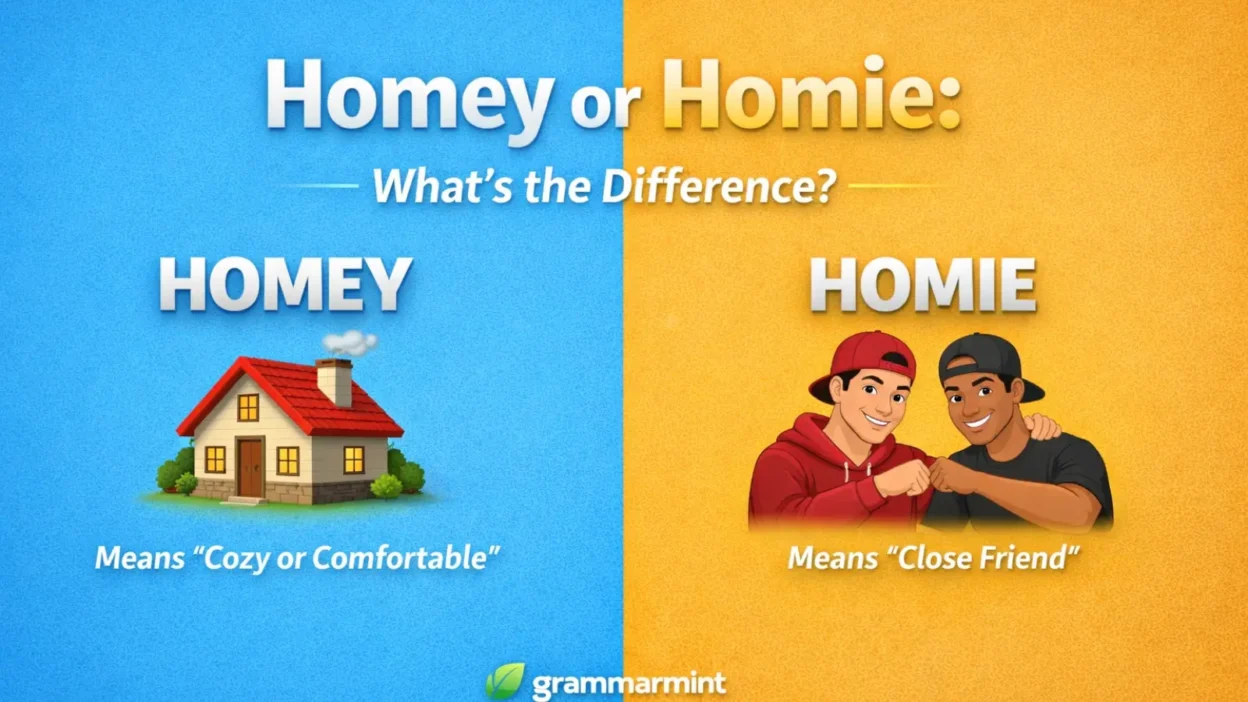
“Homey” usually describes something cozy or comfortable. “Homie” is informal slang for a close friend.
Key Differences at a Glance
| Feature | Homey | Homie |
| Part of speech | Adjective (main use) | Noun |
| Meaning | Cozy, warm, comfortable | Close friend |
| Tone | Neutral, casual | Informal slang |
| Professional writing | Sometimes acceptable | Usually avoid |
| Example | “The cabin feels homey.” | “He’s my homie.” |
Origin and Why Two Forms Exist
“Homey” comes from the word “home.” It describes something that feels like home.
According to Merriam-Webster, “homey” means homelike or cozy. It is standard American English.
“Homie” developed as slang for a close friend. Dictionary.com lists it as informal. It is often linked to American street slang and hip-hop culture.
The spellings differ because they serve different roles. One is descriptive. The other names a person.
British vs American English
This is not a US vs UK spelling issue.
“Homey” and “homie” are used in American English. The difference is meaning, not region.
Dictionaries like Cambridge Dictionary list both forms for American use.
Which One Should You Use?
• Casual description: Use “homey.”
Example: “Your apartment feels really homey.”
• Talking about a friend in relaxed conversation: Use “homie.”
Example: “That’s my homie from college.”
• Child-directed tone: “Homey” works well. It feels warm and safe.
• Professional or academic writing: Avoid “homie.” It sounds too informal.
Instead, say “friend,” “colleague,” or “associate.”
Common Mistakes (and Quick Fixes)
• Mistake: “He’s my homey from work.”
– Fix: “He’s my homie from work.”
• Mistake: “The cafe is very homie.”
– Fix: “The cafe is very homey.”
• Mistake: Using “homie” in a business email.
– Fix: Replace with “friend” or “colleague.”
• Mistake: Thinking the difference is US vs UK spelling.
– Fix: It’s about meaning, not region.
• Mistake: Using “homey” as slang without context.
– Fix: Make sure you mean cozy, not friend.
• Mistake: Writing “homy.”
– Fix: The correct spellings are “homey” or “homie.”
Everyday Examples (Real Contexts)
Text message:
“Your new place looks so homey!”
Social media caption:
“Game night with the homies.”
Parenting context:
“We added warm lights to make the room feel homey.”
Workplace email (too casual):
“Thanks, homie!”
Professional rewrite:
“Thanks for your help.”
Usage and Trends
Search data shows steady interest in both words.
“Homie” often appears in slang searches. It is strongly tied to informal speech.
“Homey” appears in home decor and lifestyle contexts. It stays closer to its original meaning.
Comparison Table
| Context | Best Choice | Why |
| Describing decor | Homey | Means cozy |
| Talking about a friend | Homie | Slang noun |
| Business email | Neither | Too informal |
| Casual text | Homie | Fits relaxed tone |
| Real estate listing | Homey | Warm description |
| Academic essay | Neither | Use formal language |
FAQs
What is the difference between homey and homie?
“Homey” describes something cozy. “Homie” refers to a close friend. They are not interchangeable.
What does homie mean?
“Homie” is informal slang for a close friend. It is common in casual speech.
Is homie slang?
Yes. Major dictionaries label it informal. It is not suitable for formal writing.
Is homey a compliment?
Yes. Calling a space homey usually means it feels warm and welcoming.
Can homey mean friend?
In rare slang contexts, some use it that way. However, “homie” is the clearer and more common choice.
Mini Quiz
- “That cabin feels so ___.”
- “She’s my best ___ from high school.”
- Which word is safer in a business email?
Answer Key:
- homey
- homie
- Neither
Conclusion
Homey or Homie may look similar, but they serve different purposes.
Use “homey” for comfort and warmth. Use “homie” for informal friendship.
When in doubt, think about tone and audience. Choose the word that fits the moment.