You may see “touch grass” in comments, group chats, gaming spaces, or short videos. The phrase often appears when someone seems too involved in online drama. It can sound funny between friends. However, it may also feel rude or dismissive.
Understanding the phrase matters because its tone changes with context. A friendly joke can become an insult when a stranger uses it. The words may sound literal, but speakers usually mean something broader. They want someone to step away from a screen and regain perspective.
This guide explains the touch grass meaning in plain English. You will learn its slang sense, grammar, pronunciation, tone, and common uses. You will also see realistic examples, polite alternatives, common mistakes, and answers to frequent questions.
Quick Answer
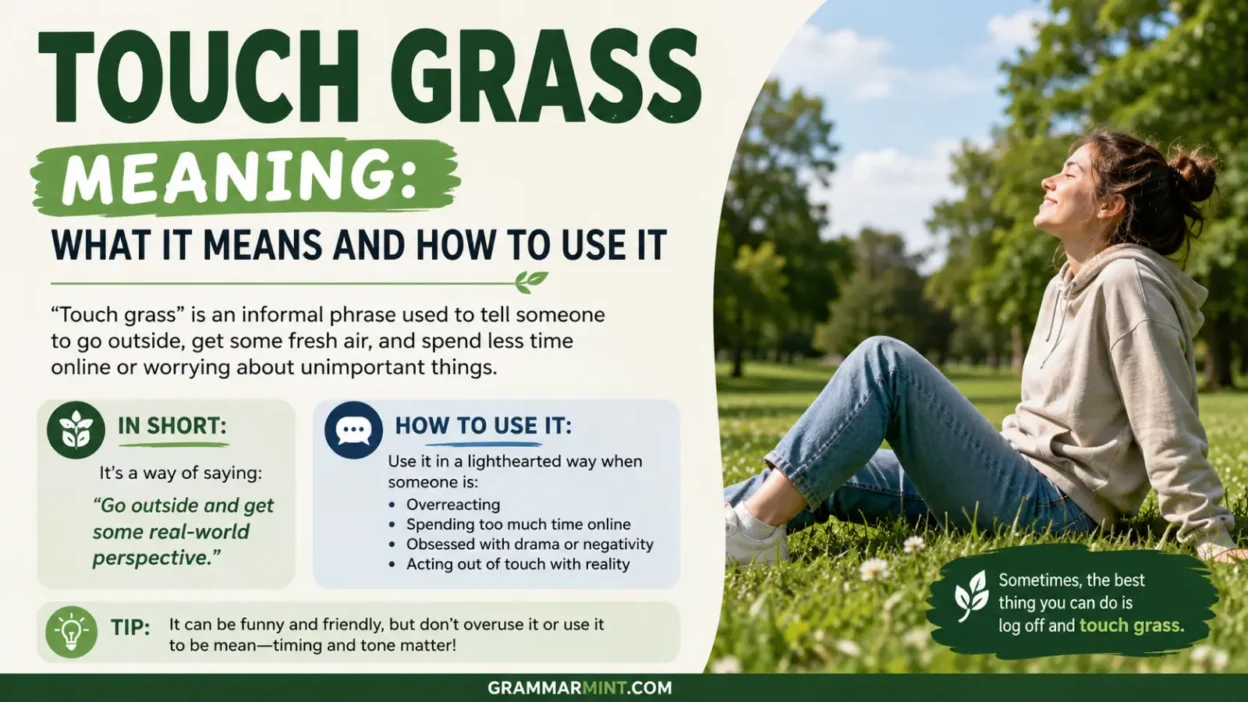
The touch grass meaning is to leave the online world for a while. It tells someone to go outside, experience real life, or regain perspective.
People often use it as a joke, criticism, or blunt reality check.
TL;DR
• “Touch grass” means step away from the internet.
• It often suggests going outside or living offline.
• The phrase is informal internet slang.
• It may sound playful, sarcastic, or insulting.
• Friends can use it jokingly with each other.
• Avoid it in professional or sensitive conversations.
What Does Touch Grass Mean?
“Touch grass” means spending time away from screens and online activity. It suggests reconnecting with ordinary life, nature, or other people.
The phrase often targets someone who seems overly invested in internet culture. That person may be arguing, gaming, scrolling, or discussing a minor issue intensely.
For example:
You have been debating that post for three hours. Go touch grass.
The speaker does not always expect the person to touch actual grass. The main message is to leave the online situation and regain perspective.
It can communicate several related ideas:
• Stop spending so much time online.
• Take a break from this argument.
• Go outside and clear your mind.
• Focus on something that matters offline.
• Return to a more realistic viewpoint.
Literal and Figurative Meaning
The phrase has both a literal image and a figurative message.
Literal meaning
Taken literally, “touch grass” means going outside and making contact with grass. Someone might walk through a park, sit on a lawn, or spend time in nature.
Example:
I worked indoors all week, so I went outside and touched grass.
Here, the speaker may truly have spent time outdoors.
Figurative meaning
The figurative meaning is more common online. It means stepping away from digital activity and reconnecting with real life.
Example:
That celebrity argument is not worth your whole afternoon. Touch grass.
The speaker is recommending distance and perspective. Actual grass is not required.
Someone could “touch grass” by visiting friends, exercising, cooking, shopping, or reading offline. The important idea is leaving the digital situation behind.
Tone: Is Touch Grass an Insult?
“Touch grass” often sounds insulting because it questions another person’s lifestyle or judgment. It may suggest that the person is socially disconnected or obsessed with the internet.
However, tone and relationship matter.
Playful use
Close friends may use the phrase as harmless teasing.
You finished the entire game in one weekend? Please touch grass.
Both people may understand that the comment is a joke.
Critical use
During an argument, the same phrase can dismiss another person’s opinion.
Your entire view comes from online rumors. Go touch grass.
This version sounds sharper. It implies that the person lacks real-world experience.
Self-directed use
People also use the phrase about themselves.
I have been scrolling since breakfast. I need to touch grass.
Self-directed use usually sounds humorous rather than insulting.
| Context | Best Choice | Why |
|---|---|---|
| Joking with a close friend | “You need to touch grass.” | Shared humor may soften the phrase. |
| Talking about yourself | “I need to touch grass.” | It sounds self-aware and light. |
| Workplace discussion | “Let’s step away and revisit this.” | This sounds calmer and more respectful. |
| Serious emotional moment | “Would a break help?” | It shows concern instead of dismissal. |
Part of Speech and Pronunciation
“Touch grass” is an informal idiom and verb phrase. It contains the verb “touch” and the noun “grass.”
The phrase often appears as an imperative. An imperative gives a command or instruction.
Touch grass.
The subject “you” is understood but not stated. The complete idea is “You should touch grass.”
Pronunciation
Say it as:
tuch grass
The first word rhymes with “much.” The second word sounds like the ordinary word “grass.”
Pronunciation is usually straightforward. The greater challenge is understanding the implied meaning.
Common grammatical forms
The phrase can change tense like a normal verb phrase:
• Base form: I need to touch grass.
• Third-person form: He never touches grass.
• Past form: We touched grass over the weekend.
• Continuous form: She is finally touching grass.
The command form remains the most common online:
Go touch grass.
How to Use Touch Grass Correctly
Use “touch grass” in casual conversations where everyone understands current internet slang. Pay close attention to your relationship with the listener.
As a direct command
You are taking this comment section too seriously. Touch grass.
This form is direct and may sound rude.
With “go”
Turn off the game and go touch grass.
“Go touch grass” has the same basic meaning. Adding “go” makes the instruction feel more complete.
About yourself
I have spent enough time reading reviews. I need to touch grass.
This is a natural way to joke about your own screen habits.
In the past tense
I deleted the app for a week and touched grass.
Here, the phrase describes taking a break from online life.
In a positive sense
We touched grass this weekend and went hiking together.
This version celebrates offline activity. It is less insulting because no one receives a command.
Common Contexts and Examples
The expression appears most often in digital conversations. Its exact message depends on what happened before it.
Online arguments
People use it when someone becomes highly emotional about a minor disagreement.
You have replied to every comment. It may be time to touch grass.
Gaming
A player may say it to someone who has played for many hours.
You reached the highest level already? Go touch grass.
Gaming uses are often humorous, but they can still feel mocking.
Social media drama
The phrase may criticize someone who follows every detail of an online dispute.
None of these people know you. Please touch grass.
Group chats
Friends might use it after someone sends too many updates about one topic.
That is your twentieth message about the show. Touch grass, Maya.
Doomscrolling
A person may say it after reading upsetting content for too long.
I have been doomscrolling all evening. I need to touch grass.
Fandom discussions
Fans sometimes use the phrase when another fan treats fiction as a serious personal conflict.
They are imaginary characters. Everyone needs to touch grass.
Offline conversations
The phrase has moved beyond comment sections. People now say it aloud during casual conversations.
My brother told me to touch grass after I checked my phone again.
When Not to Use Touch Grass
Avoid the phrase when it could minimize a serious problem. Someone who feels hurt may hear it as mockery rather than advice.
Do not use it during conversations about grief, anxiety, harassment, or personal safety. A caring response should acknowledge the person’s feelings first.
It is also a poor choice in formal settings. Avoid it in business emails, school assignments, customer messages, or official announcements.
Instead, choose language that matches your purpose:
• “Let’s take a short break.”
• “It may help to step away for a while.”
• “We can return to this discussion later.”
• “Would you like to get some fresh air?”
• “Let’s focus on the real issue.”
These options communicate the same general idea without insulting anyone.
Origin and Online Spread
The exact creator of “touch grass” is unknown. No single person has been reliably identified as its inventor.
Examples appeared online during the mid-2010s. The phrase later spread through gaming communities, social platforms, forums, and meme culture.
Its popularity grew as people spent more time discussing their lives online. “Touch grass” became a quick response to excessive scrolling, heated debates, and digital obsession.
The phrase was especially visible during the early 2020s. By then, people used it in several ways:
• As an insult during arguments
• As a joke between friends
• As advice to reduce screen time
• As a self-aware comment about online habits
Major dictionaries eventually recorded the phrase. That recognition shows that its use moved beyond a small online group.
Still, claims about one exact first use should be treated carefully. Internet expressions often develop across several communities at once.
Related Terms, Synonyms, and Opposites
No substitute matches every shade of “touch grass.” The closest choice depends on the desired tone.
Close alternatives
Log off
This directly tells someone to leave an online platform.
This debate is going nowhere. Log off for a while.
Go outside
This is more literal and slightly less slang-heavy.
You have been inside all day. Go outside.
Take a break
This sounds neutral and polite.
Take a break before answering those comments.
Get some perspective
This focuses on the person’s judgment.
Step away and get some perspective.
Reconnect with real life
This clearly explains the figurative meaning.
It may help to reconnect with real life.
Harsher related phrase
Get a life carries a similar insult. However, it usually sounds more personal and aggressive.
“Touch grass” focuses on online behavior. “Get a life” may attack someone’s whole lifestyle.
Opposites
There is no fixed antonym for “touch grass.” Possible opposite ideas include:
• Staying online
• Remaining glued to a screen
• Becoming absorbed in digital drama
• Being chronically online
“Chronically online” describes someone whose thinking seems heavily shaped by internet culture.
Common Mistakes and Quick Corrections
Mistake 1: Treating it as fully literal
Incorrect understanding:
The person must physically place a hand on grass.
Better understanding:
The person should leave the online situation and reconnect with real life.
Actual grass may be involved, but it is not required.
Mistake 2: Assuming it is always friendly
“Touch grass” can sound playful among friends. A stranger may hear it as a direct insult.
Quick correction: Check the relationship and situation before using it.
Mistake 3: Using it in professional writing
Unnatural:
The customer should touch grass before contacting support again.
Better:
The customer may benefit from taking a short break before continuing.
The revised version remains calm and professional.
Mistake 4: Adding “the” without intending a literal meaning
“Touch the grass” normally refers to particular grass.
Do not touch the grass because it was recently treated.
“Touch grass” without “the” is the established slang expression.
Mistake 5: Using it during serious distress
Dismissive:
You are upset again. Touch grass.
Supportive:
You seem overwhelmed. Would taking a break help?
The second response recognizes the person’s feelings.
Mini Quiz
1. What does “touch grass” usually mean online?
A. Start a garden
B. Step away from the internet
C. Clean a backyard
2. Which sentence uses the phrase about the speaker?
A. I need to touch grass after scrolling all morning.
B. The gardener touches the grass with a rake.
C. Grass touches the side of the fence.
3. Which setting is least suitable?
A. A playful group chat
B. A joke about your own screen time
C. A formal message to a customer
4. Is “touch grass” always a friendly expression?
A. Yes
B. No
5. Which option is the most polite alternative?
A. Get a life.
B. Nobody cares.
C. Let’s take a short break.
Answer Key
- B — It usually means leaving online activity for a while.
- A — The speaker jokes about needing an offline break.
- C — The phrase is too casual for customer communication.
- B — It may be playful, sarcastic, or insulting.
- C — It communicates the idea without attacking anyone.
FAQs
What does touch grass mean in slang?
It means stepping away from the internet and reconnecting with real life. The phrase may suggest going outside, meeting people, or gaining perspective.
Is touch grass an insult?
It often functions as an insult or dismissive command. Friends may also use it playfully, especially when teasing each other about screen time.
What does go touch grass mean on TikTok?
On TikTok, it usually tells someone to stop focusing on online drama. It suggests that the person needs an offline break or a reality check.
Can I say touch grass to a friend?
You can use it with a friend who understands your humor. Avoid it when your friend feels seriously upset or needs support.
Does touch grass literally mean go outside?
Going outside is part of the image behind the phrase. However, its deeper meaning is to leave digital activity and reconnect with ordinary life.
Where did touch grass come from?
Its exact origin is unclear. The expression appeared in online communities during the mid-2010s and later spread through gaming and social platforms.
What is the opposite of touch grass?
There is no official opposite. Ideas such as “stay online” or “be chronically online” express the reverse concept.
Conclusion
Understanding the touch grass meaning helps you recognize both its humor and its sharp tone.
Use it casually with people who understand the joke. In serious situations, choose a kinder way to suggest taking a break.