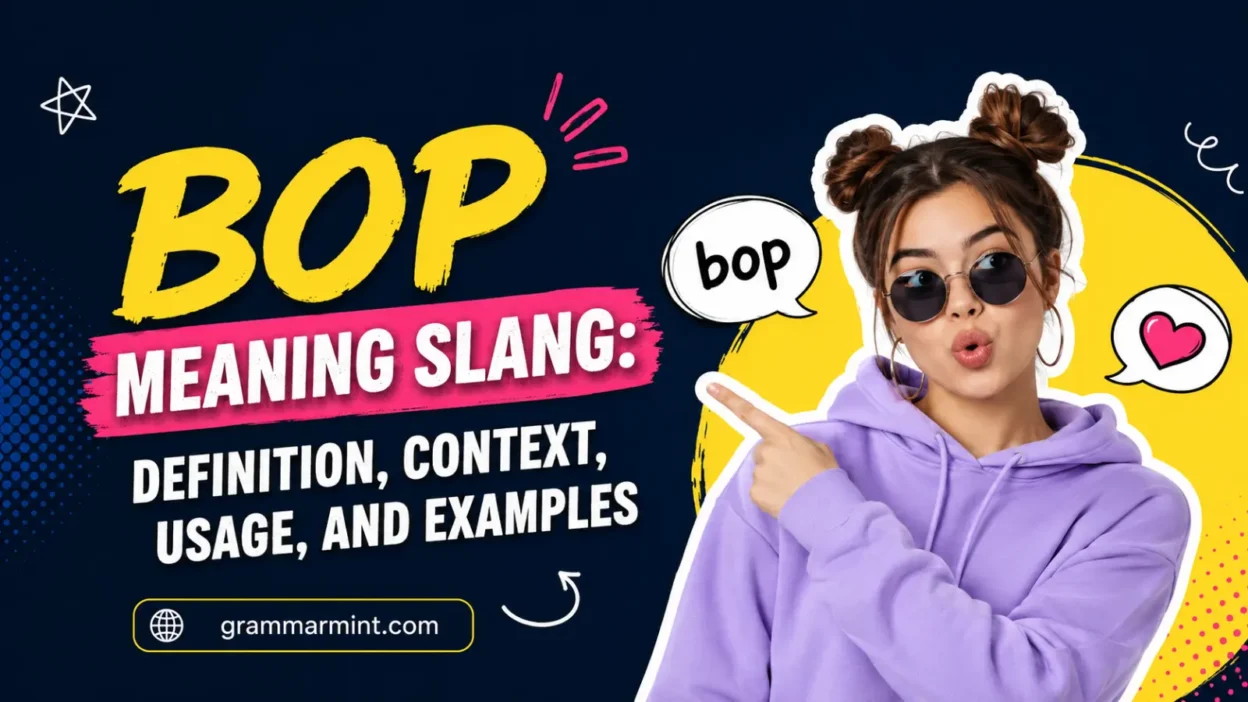
You may see “bop” in music reviews, group chats, school posts, or TikTok comments. The word can sound playful, but its meaning depends heavily on context.
When someone calls a song a bop, the comment is usually positive. It means the song is catchy, enjoyable, or easy to dance to. However, calling a person a bop can be insulting and harmful. That use often judges someone’s appearance, dating life, or sexual behavior.
This guide explains both modern slang meanings in plain English. You will learn how to spot each meaning from nearby words. You will also see pronunciation, grammar notes, examples, and common mistakes. A short history explains why the word now carries very different meanings.
Quick Answer
The bop meaning slang users intend depends on the target. A song called a “bop” is catchy and enjoyable. A person called a “bop” is usually being insulted or sexually judged.
TL;DR
• “A bop” often means a catchy, enjoyable song.
• Calling a person “bop” is usually insulting.
• The personal label often targets girls and women.
• Context reveals whether the meaning is positive or harmful.
• Pronounce “bop” to rhyme with “top.”
• Avoid using the personal label for anyone.
What Does Bop Mean in Slang?
“Bop” has two main slang meanings in current American English. One praises music, while the other labels a person.
The music meaning is friendly and positive. The personal meaning is usually disrespectful, sexualized, and harmful.
| Context | Meaning | Tone |
|---|---|---|
| “This track is a bop.” | A catchy, enjoyable song | Positive |
| “They called her a bop.” | A sexually judgmental label | Insulting |
| “We bopped around downtown.” | Moved or went somewhere casually | Informal and neutral |
The surrounding words matter more than the word alone. Check whether “bop” describes music, movement, or a person.
Bop as a Compliment for a Song
A “bop” can mean a very good, catchy, or danceable song. This use is common in music conversations and social posts.
People often use it after hearing a memorable chorus or beat. The speaker does not need to consider the song serious or artistic.
Examples:
• “That new single is a bop.”
• “The chorus turns the whole track into a bop.”
• “I played it once, and now I know every word.”
• “This summer playlist has nothing but bops.”
The plural form is “bops.” It refers to several enjoyable songs.
Close alternatives include “banger,” “jam,” “anthem,” and “hit.” These words overlap, but they are not always exact matches.
A “banger” often suggests strong energy. A “jam” may feel more personal or relaxed. An “anthem” usually feels large, memorable, or made for groups.
An “earworm” is different. It means a tune stays in your head. The song may be catchy without being enjoyable.
Informal opposites include “dud” and “skip.” A skip is a track someone does not want to hear again.
Bop as a Harmful Label for a Person
On social media, “bop” can label someone as sexually promiscuous or immodest. The label often targets girls and women.
It may refer to claimed sexual behavior, revealing posts, flirting, or dating several people. Those claims may be false, exaggerated, or based on rumors.
Examples of the harmful sense include:
• “Someone called her the school bop.”
• “The comments labeled him a bop.”
• “They posted a video naming supposed bops.”
• “She reported the post because it targeted her.”
This use can shame, embarrass, or bully someone. It also turns private behavior and appearance into public judgment.
The word can describe a boy or man. Still, it is more often directed at girls and women.
There is no respectful exact synonym for this label. Neutral wording should describe the actual situation instead.
For example, say “They are dating several people.” Do not replace the label with another sexual insult.
How Context Changes the Meaning
A short sentence can reveal the intended meaning. First, identify what the word describes.
When “bop” follows “song,” “track,” “album,” or “playlist,” it usually means enjoyable music. When it labels a person, it is often an insult.
| Signal | Likely Meaning | Example |
| Music words nearby | Catchy song | “That track is a bop.” |
| A person is named | Harmful label | “They called Maya a bop.” |
| A movement verb | Casual movement | “We bopped over to the store.” |
| Jazz discussion | Short form of bebop | “He studied early bop.” |
Tone also matters. Music praise often includes excitement, dancing, replaying, or favorite-song language.
The personal label may appear with gossip, body comments, dating claims, or school rumors. That setting signals disrespect.
Some groups may reclaim the word for themselves. Reclaimed use does not make it safe for everyone else.
Pronunciation and Part of Speech
Pronounce “bop” as BAHP in American English. It rhymes with “top,” “shop,” and “pop.”
The slang word is mainly a countable noun. You can say “a bop” or “two bops” when discussing songs.
Music examples:
• “This is a bop.”
• “Her album has three real bops.”
Personal-label example:
• “They used bop as an insult.”
“Bop” can also work as a verb outside these slang meanings. It may mean to hit lightly, dance, move, or go somewhere.
Examples:
• “He bopped the balloon with his hand.”
• “We bopped along to the music.”
• “I’ll bop over after lunch.”
The past tense is “bopped.” The -ing form is “bopping.”
Do not confuse the verb with the personal label. Grammar and context usually separate them clearly.
How to Use Bop and When to Avoid It
Use “bop” freely when praising a song in casual conversation. It sounds natural in texts, comments, reviews, and chats.
Good uses include:
• “This song is a bop.”
• “The beat makes it an instant bop.”
• “Send me more bops for the road trip.”
• “That throwback still bops.”
“That song bops” is informal but understandable. It means the song sounds very good or has strong energy.
Avoid the word when writing formal school or workplace material. Use “catchy song,” “strong track,” or “popular single” instead.
Never use the personal label to judge someone. It can repeat rumors and contribute to public humiliation.
A safer response is direct and neutral:
• “Do not label people that way.”
• “That comment is disrespectful.”
• “We do not know the full situation.”
• “Please remove the post.”
Common mistake:
Incorrect: “Bop always means a good song.”
Correction: “Bop can praise a song, but it can also insult a person.”
Another mistake involves capitalization. “BOP” may be an abbreviation in business, government, medicine, or other fields.
Lowercase “bop” is usually the slang word. Capital letters alone do not prove a slang meaning.
Origin and How the Meaning Changed
“Bop” has several histories because its meanings developed through different paths. The word for a light hit is likely imitative.
In music, “bop” became a short form of “bebop.” Bebop is a jazz style associated with the 1940s.
The positive song sense likely grew from music and dancing language. By the 2010s, people widely used “a bop” for an enjoyable song.
The insulting personal sense has appeared in African American English and hip-hop for decades. Its exact early path remains unclear.
That meaning spread more widely after “Lala Bop” appeared in online music and short videos. Later posts used “bop” and “school bop” as labels.
Newer uses sometimes connect “bop” with “baddie on point.” That explanation is not the source of every earlier use.
The word’s history shows why context is essential. Its music sense and personal sense do not carry the same tone.
Related Terms and Common Confusions
Several terms appear near “bop,” but they do not mean the same thing.
Lala bop: A longer form of the harmful personal label. It is usually derogatory.
School bop: A label aimed at someone within a school community. It may support bullying or rumor spreading.
Baddie on point: A newer interpretation connected with appearance or online self-presentation. It does not explain every use of “bop.”
Bebop: A jazz style. “Bop” can serve as its shortened name.
Banger: A highly energetic or impressive song. It is usually positive.
Jam: A song someone enjoys. It can also refer to musicians playing together.
Bop around: To move casually between places. This phrase is not automatically sexual.
Do not assume every use relates to dating or sex. “Let’s bop over there” simply means “Let’s go over there.”
Also, do not assume every music use refers to bebop jazz. “This pop song is a bop” simply praises the song.
Mini Quiz
Choose the best meaning for each sentence.
- “That chorus is a bop.”
- “They called a student a bop in the comments.”
- “We bopped over to the coffee shop.”
- “The class discussed hard bop.”
- “Her playlist is full of bops.”
Answer Key
- A catchy or enjoyable song.
- A harmful personal label.
- Moved or went somewhere casually.
- A jazz meaning related to bebop.
- Several enjoyable songs.
FAQs
What does bop mean in slang?
It usually means either a catchy song or a harmful label for a person. The noun’s target reveals the intended meaning.
What does bop mean on TikTok?
On TikTok, “bop” may praise a song. It can also label someone as sexually promiscuous or overly revealing. The second use is usually insulting.
Is bop a compliment or an insult?
It is a compliment when it describes music. It is generally an insult when it describes a person.
What does it mean when someone calls a girl a bop?
The speaker is usually judging her dating life, sexual behavior, or appearance. The label may rely on gossip and can become bullying.
Can a boy or man be called a bop?
Yes, the label can target any gender. However, girls and women receive it more often in current social use.
What does “this song is a bop” mean?
It means the speaker finds the song catchy, enjoyable, or danceable. This use is positive and informal.
Is bop short for “baddie on point”?
Some newer communities use that explanation. However, “bop” has older music and personal-label uses with different histories.
Conclusion
The bop meaning slang users intend depends on context. It can praise a song or harm a person.
Use it for music when the setting is casual. Avoid using it as a label for anyone.