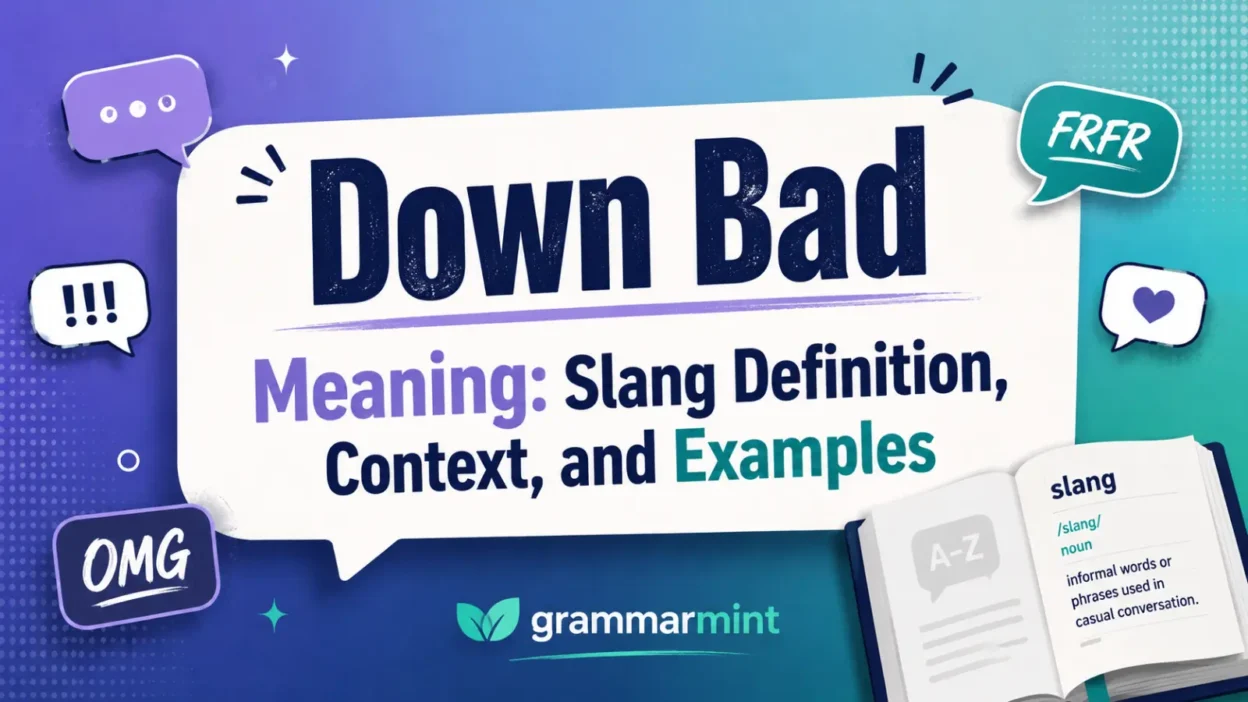
You may see down bad in texts, comments, memes, captions, or casual talk. It often appears when someone likes another person too much, wants attention badly, or acts desperate.
The phrase can also describe someone in a rough emotional state. Because the tone can be funny, teasing, or rude, context matters. This guide explains the phrase in plain English, with examples, usage notes, and common mistakes.
Quick Answer
Down bad meaning: “down bad” means someone is desperate, deeply infatuated, or in a rough emotional state. In slang, it often means a person likes someone so much that they seem embarrassed, needy, or unable to act normally.
TL;DR
• “Down bad” is informal slang.
• It often means desperate for someone.
• It can describe a rough life moment.
• It is usually playful or teasing.
• Avoid it in formal writing.
• Write it as two words.
What Down Bad Means
Down bad means being in a bad state, often emotionally. In modern slang, it usually points to strong attraction, longing, or desperation.
Someone may be “down bad” after a breakup. They may also be “down bad” for a crush. The phrase suggests that their feelings are intense and obvious.
It can mean two main things:
• Someone is struggling or feeling low.
• Someone is very attracted to another person.
Example:
“She keeps checking his profile. She is down bad.”
That means she seems too interested or too attached.
Down Bad Meaning in Slang
In slang, down bad often means desperate for romantic attention. It can also mean someone is acting foolish because they like someone too much.
The phrase is usually casual. Friends may use it as a joke when someone keeps texting a crush. It can sound funny, but it can also sound harsh.
Examples:
• “He liked every photo from 2019. He is down bad.”
• “I am down bad for her smile.”
• “She is down bad after that breakup.”
• “You bought him lunch again? You are down bad.”
The phrase often carries mild embarrassment. It suggests the person has lost some dignity.
Still, tone matters. Saying it about yourself sounds playful. Saying it about someone else can sound judgmental.
Part of Speech and Pronunciation
Down bad is an adjective phrase. It describes a person or their emotional state.
Simple pronunciation: down bad
Sound guide: daown bad
Stress both words clearly.
Use it after forms of be, such as is, am, are, was, and were.
Examples:
• “I am down bad.”
• “He is down bad for her.”
• “They were down bad after the loss.”
The usual spelling is down bad as two words. You may see downbad online, but two words are clearer.
How to Use Down Bad in a Sentence
Use down bad when the tone is casual. It fits texts, posts, jokes, and informal speech.
The most common patterns are:
• down bad for someone
• down bad over someone
• down bad after something
• so down bad
Examples:
• “He is down bad for his coworker.”
• “She was down bad over her ex.”
• “I was down bad after the breakup.”
• “You are so down bad right now.”
You can also use it for non-romantic things. However, that use is usually playful.
Example:
“I am down bad for those tacos.”
That means you really want them. It is not serious.
Small usage table:
| Context | Best Choice | Why |
|---|---|---|
| Texting a friend | down bad | Casual and funny |
| School essay | deeply infatuated | More formal |
| Work message | struggling | Safer and clearer |
| Talking about food | craving | Less confusing |
Common Contexts Where People Use Down Bad
People often use down bad in online comments. It appears in jokes about crushes, dating, breakups, and thirst traps.
It is also common in memes. The joke is usually that someone is acting too eager or too attached.
Common contexts include:
• Dating talk
• Breakup jokes
• Group chats
• TikTok comments
• Meme captions
• Sports or fandom jokes
• Casual posts about cravings
Example:
“He watched the trailer ten times. He is down bad for that movie.”
This is a joking extension. It borrows the romantic meaning for humor.
When Not to Use Down Bad
Do not use down bad in formal writing. It is too casual for essays, reports, resumes, or serious emails.
Avoid it with people you do not know well. It can sound rude if you tease someone about attraction or loneliness.
Also avoid it during serious emotional moments. If someone is truly upset, “down bad” may sound dismissive.
Better choices:
• “He is struggling.”
• “She is heartbroken.”
• “I really like him.”
• “They are in a difficult situation.”
• “He seems lonely.”
Use down bad when the mood is light. Use clearer words when the mood is serious.
Related Terms, Synonyms, and Antonyms
Down bad has close matches, but not perfect synonyms. Many similar terms carry different tones.
Close synonyms:
• desperate — stronger and less playful
• infatuated — more formal
• hung up on — stuck emotionally
• thirsty — very informal and often sexual
• obsessed — stronger and sometimes negative
• crushing hard — softer and more playful
Related slang:
• simping — doing too much for someone you like
• thirsty — openly eager for attention
• in your feelings — emotional or sentimental
• heartbroken — sad after romantic pain
Antonyms are not exact. Still, these words can work in the right context:
• unbothered
• composed
• over it
• indifferent
• emotionally steady
Example:
“He was down bad last month, but now he is over it.”
Common Mistakes and Quick Fixes
Mistake: Using it in formal writing.
Better: Use “infatuated,” “desperate,” or “struggling.”
Mistake: Spelling it as one word everywhere.
Better: Write down bad as two words.
Mistake: Using it for any sad feeling.
Better: Use it when the feeling is intense, obvious, or embarrassing.
Mistake: Calling someone down bad in a cruel way.
Better: Keep it light, or avoid it.
Mistake: Thinking it always means romance.
Better: It often does, but it can also mean a rough state.
Examples with corrections:
Incorrect: “The company is down bad in the quarterly report.”
Correct: “The company is struggling in the quarterly report.”
Incorrect: “My grandmother is down bad after surgery.”
Correct: “My grandmother is having a hard recovery.”
Incorrect: “He is downbad for her.”
Correct: “He is down bad for her.”
Mini Quiz
Choose the best answer.
- What does “He is down bad for her” usually mean?
A. He dislikes her
B. He likes her too much
C. He forgot her name - Is “down bad” formal?
A. Yes
B. No
C. Only in essays - Which sentence is safest for work?
A. “He is down bad.”
B. “He is struggling.”
C. “He is thirsty.” - Which spelling is clearer?
A. down bad
B. downbad
C. down-badly
Answer key:
- B
- B
- B
- A
FAQs
What does down bad mean?
Down bad means desperate, deeply infatuated, or in a rough state. In slang, it often describes someone who likes another person too much.
It can be funny or teasing. It can also sound rude if used carelessly.
What is an example of being down bad?
An example is texting a crush many times after no reply. Another example is liking years of old posts.
You could say, “He is down bad for her.” That means his interest is very obvious.
What does down bad mean in text?
In text, down bad usually means someone is desperate for attention or affection. It may also mean they feel low after a breakup.
The meaning depends on the message. A joke between friends feels different from an insult.
What does down bad mean on TikTok?
On TikTok, down bad often appears in comments about crushes, celebrities, edits, or thirst posts. It usually means someone is showing too much interest.
It can also appear in memes about cravings, fandoms, or bad luck.
Can down bad be used in non-romantic situations?
Yes, but it is usually joking. Someone might say, “I am down bad for coffee.”
That means they really want coffee. It borrows the romantic meaning for humor.
Is down bad rude?
It can sound rude when aimed at someone else because it suggests they look desperate or embarrassed.
Using it about yourself feels safer and more playful. Among close friends, it usually works best as a light joke.
Is down bad one word or two?
The clearer spelling is down bad as two words. You may see downbad online, but it is less standard.
Use two words in articles, captions, and clear examples.
Conclusion
Down bad meaning is simple: someone is desperate, deeply into someone, or in a rough emotional state. The phrase is casual and often joking.
Use it with the right audience. When the situation is serious, choose a clearer and kinder word.