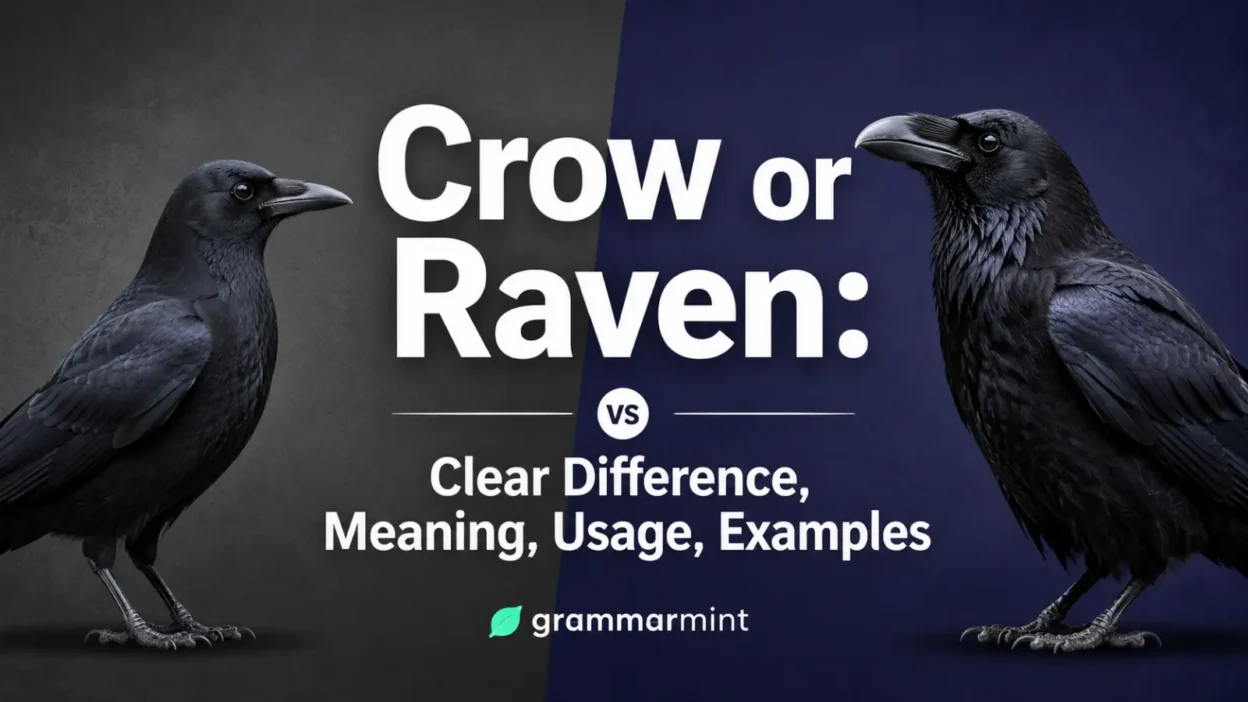
Crow or raven is a common word-choice question because both words refer to smart, black birds in the same general bird family. Both words are correct, but they do not usually mean the exact same thing.
Use crow when you mean the smaller, more common black corvid often seen in cities, suburbs, fields, and roadsides. Use raven when you mean the larger black corvid with a heavier bill, deeper voice, and wedge-shaped tail.
In casual speech, people sometimes use these names loosely. In careful writing, nature writing, school work, captions, and bird descriptions, the difference matters.
Quick Answer
Crow and raven are both correct words.
A crow is usually the smaller bird. In the United States, the word often points to the American crow, though crow can also refer more broadly to several related black birds.
A raven is usually larger, heavier-looking, and more dramatic in appearance. It often has a thicker bill, shaggy throat feathers, a deeper croaking call, and a wedge-shaped tail in flight.
So the safest simple rule is this:
Use crow for the smaller, cawing black bird often seen in groups. Use raven for the larger, croaking black bird often seen alone or in pairs.
Why People Confuse Them
People confuse crow and raven because the birds look similar at first glance. Both are usually black. Both are intelligent. Both can be loud. Both belong to the same larger bird group, so the overlap is real.
The confusion also happens because most people see the bird quickly. A black bird flies across a parking lot, sits on a fence, or calls from a tree. Without a close look at the tail, bill, size, and sound, it can be hard to know which word fits.
Another reason is casual usage. Some people use crow for almost any large black bird. Others use raven when they want a darker, more mysterious tone. Careful usage is more exact than that.
Key Differences At A Glance
Here is the useful comparison without overcomplicating it:
• Crow: usually smaller, more common around people, often seen in groups, has a sharper caw, and shows a fan-shaped or rounded tail in flight.
• Raven: usually larger, heavier-billed, often seen alone or in pairs, has a deeper croak, and shows a wedge-shaped or diamond-shaped tail in flight.
Both words are nouns when they name birds. The difference is mainly about the kind of bird being named, not grammar.
Meaning and Usage Difference
A crow is a black corvid bird. In everyday U.S. English, crow often means the familiar black bird people see in neighborhoods, fields, schoolyards, parking lots, and city streets.
Example:
The crow landed near the trash can and cawed at the others.
A raven is also a black corvid bird, but the word usually points to a larger bird. Ravens look heavier and often sound deeper. The word raven also carries a stronger literary feel because ravens appear in poems, myths, fantasy stories, and dark imagery.
Example:
A raven circled above the canyon before landing on a pine branch.
Pronunciation is simple for the bird nouns:
Crow rhymes with go.
Raven is usually pronounced RAY-vuhn.
One small note: raven can also be a rare verb pronounced more like RAV-un, meaning to devour greedily. That use is not common in modern everyday English, but it appears in dictionaries.
Tone, Context, and Formality
Crow and raven are both normal, neutral words when you are talking about birds. Neither one is more formal in a basic sentence.
Crow often feels more everyday:
A crow hopped across the sidewalk.
Raven can feel more wild, dramatic, or literary:
A raven watched from the cliff edge.
That does not mean raven is only poetic. It is also the correct ordinary word for the bird when the bird really is a raven. Still, in writing, raven may create a darker or more mysterious mood than crow.
For clear nonfiction, choose the word that matches the bird. For creative writing, choose the word that matches both the bird and the mood.
Which One Should You Use?
| Context | Best Choice | Why |
|---|---|---|
| A smaller black bird cawing in a city park | Crow | Crows are common around people and often make sharp cawing sounds. |
| A very large black bird with a deep croak | Raven | Ravens are usually larger and have lower, rougher calls. |
| A bird flying with a fan-shaped tail | Crow | Crows tend to show a rounded or fan-like tail in flight. |
| A bird flying with a wedge-shaped tail | Raven | Ravens often show a wedge or diamond tail shape. |
| A group of black birds feeding together | Crow | Crows are more often seen in groups. |
| A pair of large black birds in a wild open area | Raven | Ravens are often seen alone or in pairs. |
| A spooky poem, fantasy scene, or symbolic image | Raven | Raven often carries a stronger dark or dramatic tone. |
| You are not sure which bird it is | Large black bird | This avoids naming the bird incorrectly. |
When One Choice Sounds Wrong
Crow sounds wrong if the bird is clearly a large raven with a heavy bill, shaggy throat feathers, deep croak, and wedge-shaped tail. In that case, raven is the better word.
Raven sounds wrong if you are describing a small, social black bird cawing with a group in a typical neighborhood setting and you have no reason to think it is a raven.
The adjective use also matters. Raven hair or raven-black hair sounds natural because raven can describe glossy black color. Crow hair does not have the same standard feel.
The verb use can also cause mistakes. People usually say a crow cawed, not that a crow crowed. The verb crow is more common for a rooster’s call or for bragging.
Common Mistakes (and Quick Fixes)
Mistake: Calling every black bird a crow.
Fix: Use crow only when the bird fits, or say “black bird” if you are unsure.
Mistake: Calling every large black bird a raven.
Fix: Check size, tail, bill, call, and behavior before choosing raven.
Mistake: Saying crow and raven are interchangeable.
Fix: They are related, but they usually name different birds.
Mistake: Writing “the crow croaked” when you mean the usual sharp crow sound.
Fix: Write “the crow cawed.”
Mistake: Using raven only for scary scenes.
Fix: Use raven when the bird is a raven. The word can be dramatic, but it is also a real bird name.
Mistake: Using crow as an adjective for black hair.
Fix: Use raven, raven-black, or dark, depending on the tone.
Everyday Examples
A crow flew down from the light pole and grabbed a French fry.
We heard crows cawing before we saw them in the trees.
The raven’s deep croak echoed across the canyon.
A raven glided overhead with a wedge-shaped tail.
If you see a group of noisy black birds near a parking lot, crow is often the safer word.
If you see one huge black bird soaring over a mountain road, raven may be the better choice.
Her raven hair was pulled back in a low ponytail.
The kids watched a crow hop along the fence behind the school.
Dictionary-Style Word Details
Verb
Crow: Crow can be a verb. It often means that a rooster makes its loud morning call. It can also mean to brag or speak with too much pride.
Example: He crowed about winning the game.
For the bird called a crow, the more exact sound verb is usually caw.
Raven: Raven can be a verb, but it is rare in standard modern U.S. English. As a verb, it means to feed greedily, devour, or prey. Most readers will know raven as a bird noun, not as a verb.
Example: The old tale described wolves that ravened through the valley.
Noun
Crow: As a noun, crow means a black corvid bird. It can also appear in set phrases such as “eat crow,” where it does not mean the bird literally.
Example: A crow perched on the mailbox.
Raven: As a noun, raven means a large black corvid bird, often larger than a crow, with a heavier bill and deeper voice.
Example: A raven called from the top of the pine.
Synonyms
Crow: There is no exact everyday synonym for crow when you mean the bird. Closest plain alternatives include black bird, corvid, or large black bird, but these are broader and less exact.
Raven: There is no exact everyday synonym for raven when you mean the bird. Closest plain alternatives include large black bird, black corvid, or common raven when that species is meant.
Crow and raven should not be treated as exact synonyms in careful writing. Clear antonyms do not really fit either bird noun.
For the verb crow, useful synonyms include brag, boast, and gloat.
For the rare verb raven, useful synonyms include devour and feed greedily.
Example Sentences
Crow: A crow landed on the fence and watched the dog from a safe distance.
Crow: She did not want to crow about her promotion, but she was clearly excited.
Raven: The raven’s rough call carried across the empty trail.
Raven: His coat was a deep raven black.
Word History
Crow: Crow is an old English word connected with the bird and its harsh call. Its history is tied to sound, which makes sense because crows are easy to recognize by voice.
Raven: Raven as a bird word is also old in English. The bird noun and the rare verb raven do not work the same way in modern use. The bird word names the animal, while the verb means to devour or prey.
The safe takeaway is simple: the modern difference is not about spelling history. It is about which bird, meaning, or phrase you need today.
Phrases Containing
Crow:
As the crow flies means in a straight line from one place to another.
Eat crow means to admit you were wrong after acting confident.
Crow about something means to brag about it.
Raven:
Raven-black means glossy black.
Raven-haired means having very dark hair.
Common raven names a well-known raven species.
Ravening means greedily devouring, but it comes from the verb sense, not from ordinary bird description.
Conclusion
Crow and raven are both correct words, but they are not usually interchangeable.
Use crow for the smaller, often more social black bird that commonly caws around everyday places. Use raven for the larger black bird with a heavier bill, deeper croak, and wedge-shaped tail.