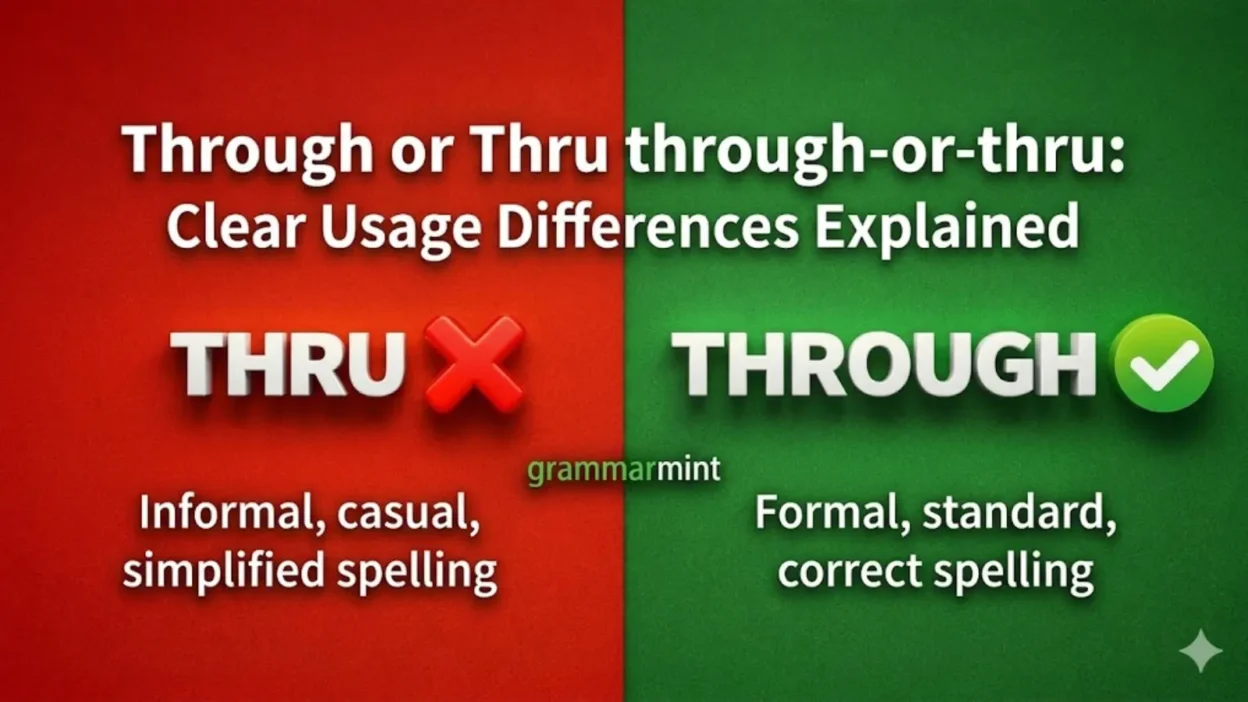
“Through” and “thru” cause confusion because they look like two different words, but they represent the same idea in English. The difference is not about meaning. It is about writing style, formality, and context.
You will see both in daily life. One appears in school writing, books, and professional communication. The other appears on signs, in texting, and in branding. That contrast is what makes people unsure which one is correct.
This guide breaks everything down in a simple way so you can confidently choose the right form every time.
Quick Answer
“Through” is the standard and correct spelling in formal and professional writing.
“Thru” is an informal, shortened form used mainly in signs, branding, and casual messages.
They mean the same thing, but they are not used in the same situations.
Why People Confuse Them
The confusion comes from how English is used in real life. You hear one word, but you see two spellings.
In speech, there is no difference. Both sound identical. So the brain assumes both spellings should be equally acceptable.
The second reason is visibility. You constantly see “drive-thru” at restaurants, banks, and coffee shops. That exposure makes “thru” feel normal, even though it is not the standard form in formal writing.
Over time, this creates uncertainty about which version is correct.
Key Differences At A Glance
| Feature | Through | Thru |
|---|---|---|
| Standard spelling | Yes | No (informal variant) |
| Formal writing | Required | Not recommended |
| Casual writing | Acceptable | Common |
| Signage/branding | Rare | Common |
| Meaning | Movement, completion, continuation | Same meaning |
Meaning and Usage Difference
Both words express the same idea: moving from one side to another, completing a process, or continuing until the end of something.
For example:
- Moving physically: walking through a tunnel
- Completing a task: working through a problem
- Time-based continuity: staying through the night
The meaning stays consistent in all cases.
The difference lies in spelling tradition. “Through” is the established standard in English writing. It follows conventional spelling rules that are used in education, publishing, and professional communication.
“Thru” is a shortened form created for speed and convenience. It removes letters but does not change meaning. Because of that, it is considered informal rather than incorrect in all cases.
Grammar-wise, “through” can function in several roles:
- Preposition: “She walked through the door.”
- Adverb: “He read straight through.”
- Adjective: “a through road”
“Thru” does not change these roles; it simply replaces the spelling in informal environments.
Tone, Context, and Formality
Tone is the most important difference between these two forms.
“Through” feels complete and professional. It is the version you expect in academic writing, business emails, books, and official documents. It signals clarity and correctness.
“Thru” feels casual and fast. It is designed for short spaces, quick communication, or visual simplicity. That is why it works well in:
- drive-thru lanes
- street signs
- app interfaces
- informal texting
- brand names
Using “thru” in a formal report can make writing feel unpolished. On the other hand, using “through” in a fast-food sign may look visually heavy or unnecessary.
The key is matching tone to situation.
Which One Should You Use?
| Context | Best Choice | Why |
|---|---|---|
| Academic writing | Through | Standard requirement |
| Professional email | Through | Maintains credibility |
| Job application | Through | Formal tone expected |
| Text message | Thru | Informal communication |
| Restaurant sign | Thru | Space-saving and common |
| Website content | Through | Clear and professional |
If you are unsure, “through” is always the safe choice.
When One Choice Sounds Wrong
Sometimes the wrong choice is not grammatically wrong—it just feels out of place.
“Thru” sounds wrong in formal writing because it breaks expectations. Readers expect complete spelling in structured documents. Seeing “thru” there can make the writing feel rushed or careless.
On the other hand, “through” can feel too formal in small or casual spaces. A sign that says “Drive Through Window” is correct but may look visually heavy compared to “Drive Thru.”
The problem is not correctness. It is context mismatch.
Common Mistakes (and Quick Fixes)
• Using “thru” in essays → Replace with “through”
• Using “thru” in resumes → Always change to “through”
• Overusing “through” in signage design → Consider “thru” for visual simplicity
• Mixing both in one document → Stick to “through” unless branding requires variation
• Assuming “thru” is newer and better → It is only informal, not a replacement
A simple rule helps:
If the situation is serious or professional, use “through.”
Everyday Examples
• We drove through the city during rush hour.
• She read the document through without stopping.
• The package went through customs yesterday.
• Grab a coffee at the drive thru on your way.
• Text me when you’re thru with work.
• He pushed through the crowd to reach the front.
• The deal went through after final approval.
These examples show how “through” dominates structured writing, while “thru” appears only in casual contexts.
Dictionary-Style Word Details
Verb
• Through: Not used as a verb, but appears in verb phrases (e.g., “go through,” “see through”).
• Thru: Not used as a verb; it only replaces spelling informally in fixed phrases.
Noun
• Through: Not used as a noun in standard English.
• Thru: Not used as a noun.
Both terms function mainly in prepositional and adverbial roles rather than standalone noun/verb forms.
Synonyms
• Through: across, via, from one side to another, throughout, by means of (closest plain alternatives depending on context)
• Thru: informal equivalent of “through” only; no separate synonym set
There is no true synonym difference between them because the meaning is identical.
Example Sentences
• Through: “We walked through the park before sunset.”
• Through: “She worked through the entire weekend.”
• Through: “The message got through eventually.”
• Thru: “Pick up food at the drive-thru.”
• Thru: “Let me know when you’re thru with class.”
Word History
• Through: Old English origin, long-established spelling used across formal English writing systems.
• Thru: Developed as an informal abbreviation used in signage and fast communication. It is not considered a replacement for formal spelling.
The historical difference is not about meaning change, but about written convenience.
Phrases Containing
• Through: through and through, go through, see it through, break through, read through, push through
• Thru: drive-thru, thruway (used in names and signage), walk-thru (informal or industry-specific usage)
FAQs — Through or Thru through-or-thru
1. What is the real difference between “through” and “thru” in everyday English?
The real difference is not meaning but writing style. “Through” is the standard, fully accepted spelling used in formal and professional English. It appears in school writing, books, emails, reports, and anything official. “Thru” is an informal shortened form used mainly in casual contexts like texting, signage, or branding (for example, “drive-thru”).
Both words mean the same thing—movement from one side to another, completion of something, or continuation until an end point. The difference is that “through” is always correct in formal writing, while “thru” is limited to informal or visual shorthand situations.
2. Is “thru” ever considered grammatically correct in English writing?
Yes, but only in limited contexts. “Thru” is not considered standard grammar in formal English, but it is widely accepted in informal communication and signage. For example, “drive-thru” is a common and recognized usage in business names and signs.
However, in academic writing, professional documents, job applications, and publications, “thru” is not appropriate. In those settings, only “through” is considered correct. So, “thru” is acceptable socially and visually, but not in formal grammar standards.
3. Why do restaurants and signs use “thru” instead of “through”?
Businesses use “thru” mainly for space, speed, and visual simplicity. Signs need to be short, easy to read quickly, and fit limited space. “Thru” removes extra letters without changing meaning, making it practical for signage like “Drive Thru” or “Car Wash Thru Lane.”
It also helps branding because shorter words are easier to recognize at a glance. Over time, this usage became common in public signs, even though it is not the standard spelling in formal writing.
4. Can I use “thru” in school essays or academic writing?
No, you should avoid using “thru” in school essays, research papers, or any academic writing. Teachers and academic style rules expect standard English spelling, and that means using “through.”
Using “thru” in an essay can make your writing look informal or careless, even if the meaning is correct. The safe rule is simple: always write “through” in academic and formal contexts unless you are directly quoting a sign or brand name.
5. Is “thru” becoming more acceptable in modern English?
“Thru” is becoming more visible, but not more formal. Its popularity comes mainly from texting, branding, and signage. People see it often in everyday life, especially in phrases like “drive-thru,” which makes it feel familiar.
However, standard English writing rules have not changed. “Through” is still the correct form for formal communication. So while “thru” is common in casual use, it is not replacing “through” in proper grammar or professional writing.
6. Why does English keep both “through” and “thru” if they mean the same thing?
English often has both formal and informal versions of the same word to match different communication needs. “Through” follows traditional spelling rules and is used where clarity and professionalism matter. “Thru” exists as a shortened version for convenience.
This pattern is common in English. Language naturally develops shortcuts for speed in informal settings, especially in texting and signage. So both forms exist because they serve different purposes, not because they mean different things.
7. Is it wrong to use “through” in casual writing like texting?
No, it is not wrong at all. Using “through” in texting, emails, or casual messages is perfectly fine. It is always correct and universally understood.
The only reason people sometimes choose “thru” in casual writing is speed or style. Some users prefer shorter words when typing quickly. But “through” is never incorrect, even in informal communication.
8. What are some common mistakes people make with “through” and “thru”?
One common mistake is using “thru” in formal writing like essays or resumes, where it looks too informal. Another mistake is assuming “thru” is the modern or updated spelling of “through,” which is not true.
Some people also mix both forms in the same document without consistency. This can make writing look unpolished. The best practice is to stick with “through” unless you are intentionally using informal style or referencing signage.
9. Can “thru” be used in professional branding or business names?
Yes, “thru” is often used in branding, product names, and business signage. Companies may choose it because it looks modern, short, and easy to read. Examples include “drive-thru” services or stylized brand names.
However, even in branding, the choice is stylistic—not grammatical. In official documents, contracts, or business communication, “through” is still the standard spelling. So branding can use “thru,” but formal writing within the same business typically does not.
10. What is the safest rule to remember when choosing between “through” and “thru”?
The safest rule is simple: always use “through” unless you are in a clearly informal or visual context. If you are writing an essay, email, report, or anything professional, “through” is always correct.
Only use “thru” when space is limited, tone is casual, or you are following established signage or branding (like “drive-thru”). If you ever feel unsure, choosing “through” will never be wrong.
Conclusion
“Through” and “thru” mean exactly the same thing, but they live in different writing worlds. “Through” is the correct and professional form used in almost all writing situations. “Thru” is a shortened, informal version used for speed, space, and casual communication.
If you remember one simple rule, it is this:
Use “through” unless you are writing something intentionally informal or designing a sign where space matters.
That one choice will keep your writing clear, natural, and appropriate in every situation.