In everyday American writing and conversation, few word pairs create as much quiet confusion as “unphased” and “unfazed.” These two terms look nearly identical at first glance and sound exactly the same when spoken. As a result, many people — including native English speakers in the United States — end up using the wrong one in emails, reports, social media posts, news articles, and even formal documents.
This confusion matters because word choice affects how professional, clear, and credible your communication sounds. Using the wrong term can make a strong statement feel uncertain or incorrect to readers. This in-depth guide cuts through the mix-up. It explains the real differences in meaning, grammar, context, and proper usage according to current American English standards. You will finish this article knowing exactly which word fits which situation and why.
The goal is simple: help you choose confidently every time you need to describe either a calm reaction or a process without stages.
Quick Answer
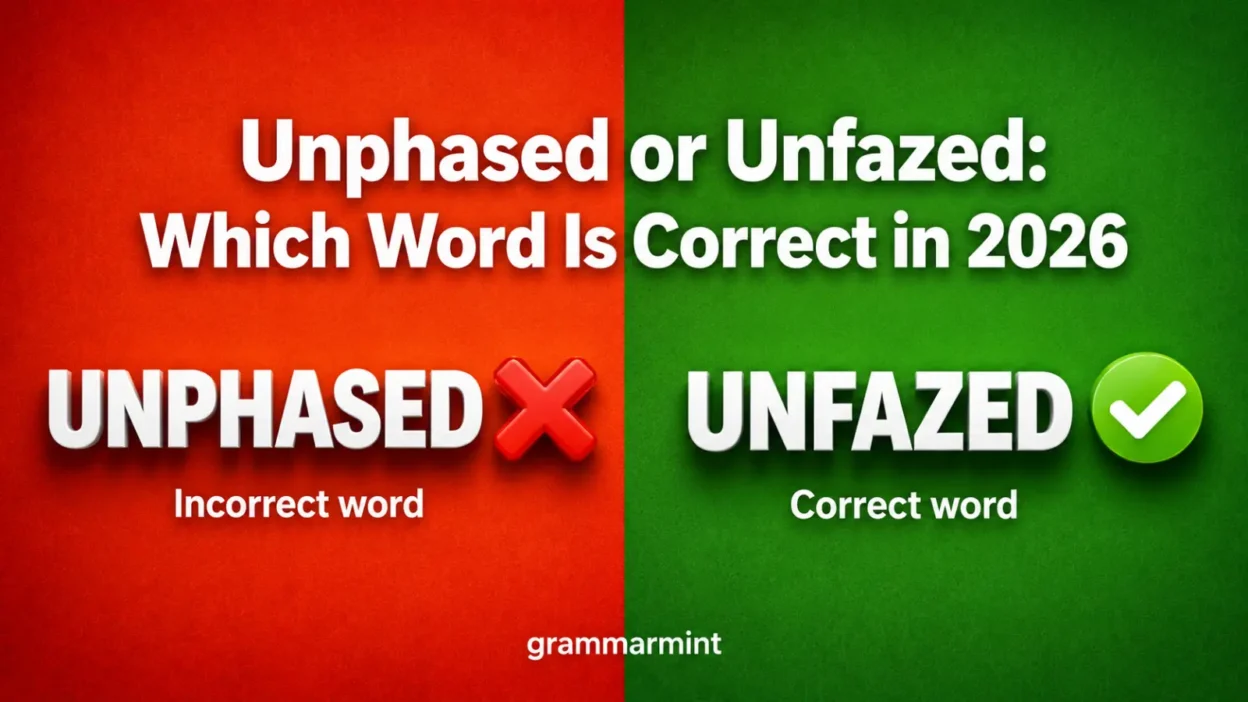
Unfazed is the correct and overwhelmingly preferred word in nearly all situations when you want to say that someone remained calm, undisturbed, or unaffected by a challenge, surprise, criticism, or difficult situation. It is a standard adjective in American English.
Unphased is a much rarer term that means something was not divided into phases or stages. It is mostly technical and appears in discussions about project management, software rollouts, or policy implementation. In the vast majority of cases where people write “unphased,” they actually mean “unfazed.”
Bottom line: Default to unfazed unless you are specifically talking about the absence of project phases. “Unphased” is frequently treated as a misspelling when used for emotional contexts.
Why People Confuse Them
The confusion starts with spelling and sound. Both words begin with “un-” and end with “-ed.” They share the exact same pronunciation: /ʌnˈfeɪzd/. When speaking quickly, there is no audible difference whatsoever.
Another major reason is familiarity. The word “phase” appears constantly in modern life — phases of the moon, project phases, phases of grief, business phases. The word “faze,” on the other hand, is far less common. Many Americans have heard “unfazed” on television or in conversation but have never seen it written clearly. Their brain automatically substitutes the more familiar “phase” spelling.
Fast typing, autocorrect suggestions, and non-native speakers learning English through reading also contribute. In schools and offices across the US, people regularly write sentences like “She was unphased by the feedback” without realizing the issue. Social media amplifies the mistake, as posts spread quickly with the incorrect spelling.
Key Differences At A Glance
| Context | Best Choice | Why It Fits Best |
|---|---|---|
| Describing a person’s reaction | Unfazed | Focuses on emotions and mental state |
| Project implementation style | Unphased | Refers to lack of staged rollout |
| News articles and social media | Unfazed | Natural and widely understood |
| Technical reports or planning | Unphased | Precise for process description |
| Job interviews or resumes | Unfazed | Sounds professional and correct |
| Everyday conversation | Unfazed | Matches spoken usage perfectly |
Additional Compact Comparison:
- Unfazed — Emotional resilience, common, positive/neutral tone
- Unphased — Structural description, uncommon, technical tone
Meaning and Usage Difference
The core difference comes down to origin and purpose.
Unfazed is an adjective that describes a state of emotional steadiness. It comes from the verb “faze,” which means to disturb, disconcert, or unsettle someone. When you say someone is unfazed, you are saying nothing managed to rattle them. It emphasizes inner calm and composure even when external conditions are chaotic.
Unphased derives from “phase,” meaning a distinct stage or period in a process. As an adjective, it indicates that something was not broken into multiple phases. It suggests a single, all-at-once approach rather than gradual implementation. This usage remains quite limited and appears mostly in specialized fields like engineering, software development, urban planning, and business strategy.
Grammatically, both function primarily as adjectives. Neither works naturally as a verb or noun in standard US English. You will almost always see them describing people (unfazed) or plans/projects (unphased).
Tone, Context, and Formality
Unfazed carries a confident, resilient tone. It works beautifully across formality levels — from casual texting (“He was totally unfazed by the cancellation”) to polished journalism (“The senator remained unfazed by intense questioning”). It feels warm and human. Readers respond positively to it because it highlights strength of character.
Unphased sounds more clinical and detached. It fits best in formal technical documents, research papers, or detailed planning meetings. In casual or general writing, it can feel stiff or even wrong. Using “unphased” in a story about a person’s reaction often makes the writing seem slightly off to experienced readers and editors.
In 2026 American workplaces, especially in tech and corporate environments, precision matters. Choosing the right word shows attention to detail.
Which One Should You Use?
Follow this practical decision guide:
Use unfazed when:
- The subject is a person (or group of people)
- You are describing their emotional response
- The sentence involves stress, criticism, failure, success, or surprise
- You want natural, flowing American English
Use unphased when:
- You are discussing a process, plan, or implementation
- You specifically mean “without distinct stages or phases”
- The context is technical or analytical
- You need to contrast gradual versus immediate action
If you feel any doubt at all, choose unfazed. It is safe, standard, and accepted in virtually every US publication and professional setting.
When One Choice Sounds Wrong
Certain combinations immediately signal a mistake to readers.
“He was unphased by the harsh criticism” sounds incorrect to most Americans because criticism does not have phases — people have emotional reactions.
“The software update was unfazed across all departments” feels strange because software does not experience emotions.
“The team delivered an unfazed product launch” creates confusion. Readers pause and wonder what emotion a product launch could possibly have.
These mismatches break the flow of reading and can damage credibility, especially in business communication or published content.
Common Mistakes (and Quick Fixes)
Mistake 1: Defaulting to “unphased” for all situations Fix: Stop and ask: “Am I talking about a person’s feelings?” If yes, switch to “unfazed.”
Mistake 2: Using “unfazed” for technical project descriptions Fix: Rephrase entirely. Instead of “The rollout was unfazed,” write “The team chose a single-phase rollout” or “The company implemented the changes unphased.”
Mistake 3: Overusing either word in the same paragraph Fix: Vary your language. Instead of repeating “unfazed,” try “unruffled,” “unbothered,” or “composed.”
Mistake 4: Assuming the words are completely interchangeable Fix: Remember the emotional vs structural divide.
Quick memory trick: “Faze” has to do with feelings (both start with F). “Phase” has to do with stages (think project roadmap).
Everyday Examples
Strong Unfazed Examples:
The young entrepreneur stayed unfazed when investors rejected her first three pitches. She simply refined her presentation and kept going.
Even as the storm caused flight cancellations across the East Coast, the experienced traveler remained unfazed and found an alternative route home.
Teachers were unfazed by the sudden policy changes announced by the school board and quickly adjusted their lesson plans.
During the intense playoff game, the veteran point guard was completely unfazed by the hostile crowd noise.
Parents of teenagers often become unfazed by dramatic mood swings after a few years of experience.
Rare but Correct Unphased Examples:
The hospital system opted for an unphased transition to the new electronic records system, updating every department simultaneously.
City planners criticized the unphased approach to infrastructure improvements, arguing that a staged implementation would reduce disruption.
The marketing team recommended an unphased campaign launch rather than testing in select markets first.
Engineers debated whether an unphased hardware upgrade carried too much risk for the manufacturing plant.
Mixed Context Example:
The manager remained unfazed by the tight deadline, even though the team used an unphased development approach that created last-minute pressure.
Dictionary-Style Word Details
Verb
- Unfazed: Does not function as a verb. It is strictly the adjectival form related to the verb “faze.”
- Unphased: Does not function as a verb. It is an adjectival form derived from “phase” but has no direct verb usage in this construction.
Noun
- Unfazed: Has no noun form in standard English.
- Unphased: Has no standard noun form. Related concepts are usually expressed as “lack of phasing” or “single-phase approach.”
Synonyms
- Unfazed: Closest plain alternatives — unruffled, undaunted, unflappable, unperturbed, unbothered, cool-headed. Antonyms: fazed, rattled, shaken, disturbed, intimidated, overwhelmed.
- Unphased: No strong direct synonyms. Closest alternatives require rephrasing — single-stage, all-at-once, non-staged, immediate implementation. No clear antonyms in common usage (though “phased” would be the logical opposite).
Example Sentences
- The surgeon stayed unfazed during the unexpected complication and successfully completed the procedure.
- Leadership chose an unphased system migration to minimize long-term disruption.
- She appeared unfazed by the negative online comments and continued posting consistently.
- An unphased budget cut across all departments created short-term operational challenges.
- No matter what challenges arose, the coach remained unfazed and focused on the next play.
Word History
Unfazed has been part of American English usage since at least the late 19th century, growing in popularity through the 20th century as “faze” became more established. Unphased is a more recent and much less documented construction. It does not appear as a main entry in most major dictionaries and is often flagged by editors as nonstandard when used outside technical contexts. Reliable sources treat unfazed as fully established while viewing unphased as marginal.
Phrases Containing
- Unfazed by: The most common structure (unfazed by criticism, unfazed by pressure, unfazed by failure).
- Remain unfazed / Stay unfazed: Frequently used expressions showing continued composure.
- Unphased approach / rollout / implementation: Technical phrases describing non-gradual processes.
- Completely unphased: Occasional technical usage meaning entirely without stages.
FAQs
1. Is “unphased” considered a correct English word?
It exists but is very uncommon and limited to technical contexts. Most style guides and dictionaries prefer alternatives or flag it when used for emotional meanings.
2. How do I remember the difference easily?
Think “faze” = feeling (emotional). “Phase” = stages (process). This simple connection helps most people choose correctly.
3. Can I use “unphased” in college essays or business reports?
Only if you are genuinely discussing project phases. Otherwise, use “unfazed” or rephrase the sentence.
4. Has the usage of these words changed in recent years?
Unfazed continues to be very stable and common. Unphased remains rare and mostly appears in specialized professional writing.
5. What are better alternatives to “unphased”?
“Single-phase,” “all-at-once,” “immediate,” or “non-staged” are often clearer and more widely understood.
6. Does pronunciation ever help tell them apart?
No. They sound identical in American English.
7. Is one word more formal than the other?
Unfazed works across all levels of formality. Unphased feels more formal but also more restricted and technical.
Conclusion
Mastering the choice between unphased and unfazed comes down to understanding one key distinction: emotions versus structure. Unfazed belongs to the world of human reactions — the calm strength we admire in others and aspire to ourselves. Unphased belongs to the world of processes and planning — a precise but limited technical term.
In 2026 American English, unfazed remains the clear winner for almost every situation you will encounter in daily life, work, and writing. Using it correctly makes your communication sharper, more natural, and more professional. When you need to discuss project stages, reach for the more precise unphased — but only when it truly fits.