In everyday American English, some word pairs create constant mix-ups because they sound identical but mean completely different things. “Cue” and “queue” rank high on that list. They are homophones—pronounced exactly the same—but using the wrong one can confuse readers or make your writing look careless.
This guide clears up the confusion once and for all with straightforward explanations, real-world US examples, and practical tips tailored for American writers, students, professionals, and content creators in 2026.
Quick Answer
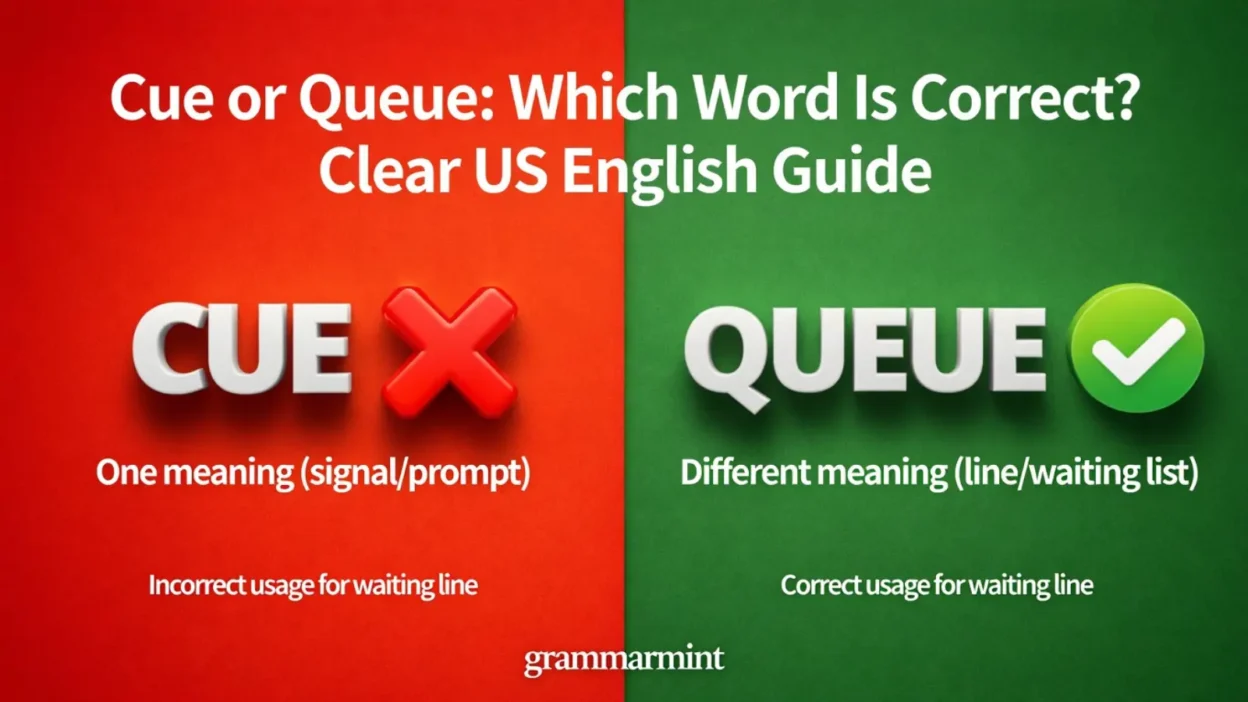
Use “cue” when you mean a signal, hint, prompt, or the stick used in pool/billiards. Use “queue” when you mean a line of people, vehicles, or items waiting in order (or the computing term for a waiting list of tasks).
They are not interchangeable.
Why People Confuse Them
Both words sound like “kyoo.” In fast typing, autocorrect fails, voice-to-text errors, and casual texting, people often swap them. Social media comments frequently show “I stood in the cue for hours” or “That was my queue to speak.” The similar spelling (both start with “qu”) adds to the mix-up, especially for non-native speakers or hurried writers.
Key Differences At A Glance
| Context | Best Choice | Why |
|---|---|---|
| Theater or performance signal | Cue | It’s a prompt for action |
| Waiting line at store/DMV | Queue | Refers to people in order |
| Pool or billiards stick | Cue | Sports equipment term |
| Computer print jobs | Queue | Technical waiting list |
| Hint or suggestion | Cue | Triggers memory or response |
Feature Comparison
- Cue: Signal/hint (noun), prompt (verb), pool stick (noun)
- Queue: Line/waiting order (noun), to line up (verb), data structure (noun)
Meaning and Usage Difference
Cue primarily functions as a noun or verb related to signals and prompts. It often appears in performing arts: an actor waits for their cue before speaking. It also means a subtle hint (“Her glance was my cue to change the subject”). In sports, the “cue stick” strikes the cue ball in pool.
Queue centers on order and waiting. In US English, people more commonly say “line” for people waiting, but “queue” appears frequently in technical contexts like “print queue,” “upload queue,” or “customer support queue.” As a verb, it means to arrange items in sequence (“Queue the next song”).
Both can act as nouns and verbs, but their core ideas stay separate: one triggers action, the other organizes waiting.
Pronunciation is identical (/kyoo/), so context alone decides meaning. No major regional US pronunciation differences exist.
Tone, Context, and Formality
“Cue” feels dynamic and theatrical—common in creative, entertainment, or conversational writing. It carries a lighter, more immediate tone.
“Queue” sounds more orderly and technical. It appears in formal business (“queue management systems”), customer service, and tech documentation. In casual American speech, “line” often replaces it for physical waiting, making “queue” slightly more formal or British-influenced in everyday talk.
Which One Should You Use?
Choose based on meaning:
- Signal, prompt, hint, or pool equipment → cue
- Waiting line, sequence, or data list → queue
In American English, prefer “line” over “queue” for physical waiting unless writing for technical or international audiences.
When One Choice Sounds Wrong
“That was my queue to leave the party” sounds off because it should be “cue” (signal to act). “I waited in the cue at the airport” feels incorrect—it needs “queue” (or better, “line” in casual US English). “Queue the lights” in theater production would confuse technicians; they expect “cue the lights.”
Common Mistakes (and Quick Fixes)
- Writing “standing in the cue” → Fix: “standing in line” or “in the queue”
- “That was my queue to speak” → Fix: “That was my cue to speak”
- Mixing in computing: “The files are in the cue” → Fix: “The files are in the queue”
- Autocorrect swapping them in texts—double-check context before sending.
- Using “que” (often Spanish for “what” or Quebec abbreviation)—avoid entirely in English unless intentional.
Everyday Examples
- Cue: The director gave the actor a cue to enter the stage. Right on cue, the lights dimmed during the concert. She took his yawn as a cue to wrap up the meeting. Grab your pool cue and let’s play a game.
- Queue: The queue for new iPhones stretched around the block (though most Americans would say “line”). Check the print queue before restarting your computer. Queue up the playlist for the road trip. Customers joined the virtual queue for the popular event.
Modern 2026 example: “The podcast producer cued the guest for the next segment while the editor managed the upload queue.”
If you’re interested in other commonly confused English words, don’t miss our guide on https://grammarmint.com/peek-or-peak/
, where we explain the differences with simple examples and easy-to-remember tips.
Dictionary-Style Word Details
Verb
- Cue: To give a signal or prompt. Example: “Cue the music after the speech.”
- Queue: To form a line or arrange in order. Example: “Queue the tasks for processing overnight.”
Noun
- Cue: A signal, hint, or pool stick.
- Queue: A waiting line or ordered list (especially in tech).
Synonyms
- Cue: Closest alternatives — signal, prompt, hint, trigger. (No exact single-word synonym in all contexts.)
- Queue: Closest alternatives — line (US preference for people), waiting list, sequence. Antonyms are context-specific: for cue, something like “silence” or “missed signal”; for queue, “chaos” or “disorder.”
Example Sentences
- The bell served as the perfect cue for dinner to begin.
- We joined the long queue at the food truck festival.
- Don’t forget to cue the next speaker during the webinar.
- The support team cleared the customer service queue quickly.
Word History Both words have distinct origins, though exact early dates vary by source. “Cue” links to ideas of signals and prompts (possibly from Latin “quando” meaning “when” in old stage directions). “Queue” comes from French for “tail,” evoking a line trailing behind. Reliable dictionaries confirm separate paths with no strong shared root in modern usage.
Phrases Containing
- Cue: Right on cue, take your cue from, cue ball, cue up (for media).
- Queue: Queue up, jump the queue (less common in US), print queue, virtual queue.
FAQs
Is “queue” used much in American English?
Yes, especially in technology, customer service, and business (“support queue,” “data queue”). For everyday waiting lines, Americans prefer “line.”
Can “cue” ever mean a line?
No. That meaning belongs exclusively to “queue” (or “line”).
What’s the difference between “cue up” and “queue up”? “
Cue up” means prepare media or a signal (cue up the video). “Queue up” means get in line or arrange tasks in sequence.
How do I remember the difference?
Think: “Cue” is short like a quick signal. “Queue” has extra letters like a longer line of people.
Is “que” ever correct in English?
Rarely—usually a misspelling. It can refer to Quebec or appear in Spanish.
In computing, is it always “queue”?
Yes. “Print queue,” “job queue,” and “message queue” are standard terms.
Does pronunciation ever change the meaning?
No—both are pronounced “kyoo.” Context decides everything.
Should I use “cue” or “queue” in formal reports?
Use the precise term based on meaning. For lines, “queue” works in technical writing; “line” suits general business reports.
If you enjoy learning the difference between commonly confused words, don’t miss our guide on to avoid another common English mix-up: fourth or forth
Conclusion
Mastering “cue” versus “queue” eliminates a common writing slip that can distract readers. Remember: cue for signals and prompts, queue for lines and ordered lists. With practice and context checks, you’ll choose correctly every time in American English.
If homophones and commonly confused words interest you, check out our guide on Where or Were to avoid another frequent English mistake: https://grammarmint.com/where-or-were/