If you’ve ever paused while typing a sentence, this guide will help you choose the right word fast. Desert or Dessert is a common mix-up because both words look close, sound close, and appear in everyday writing, menus, travel stories, schoolwork, and emails.
Still, the difference is simple. One word points to land or leaving. The other points to cake, pie, ice cream, or another sweet ending to dinner.
Quick Answer
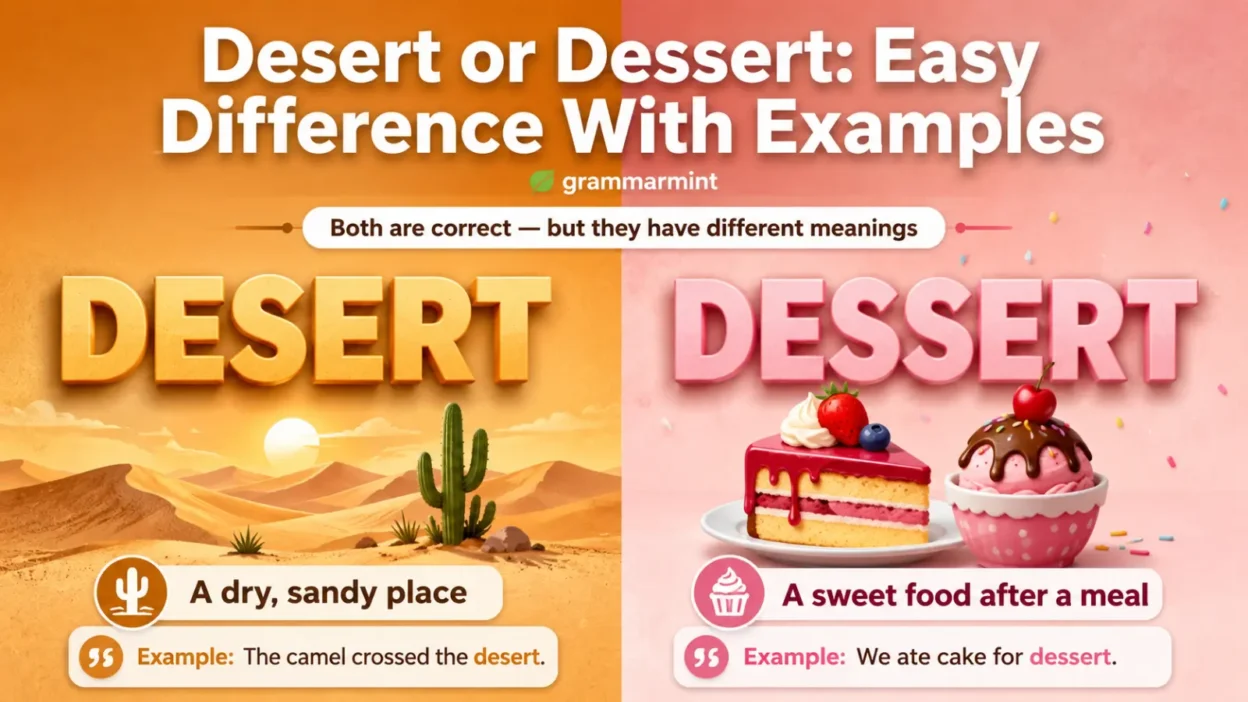
Desert or dessert depends on meaning: desert means dry land or to abandon, while dessert means sweet food after a meal. Remember this: dessert has two s’s because many people want seconds.
TL;DR
• Desert means dry land or leaving someone.
• Dessert means sweet food after dinner.
• Dessert has two s’s for seconds.
• Desert the noun sounds like DEZ-ert.
• Just deserts uses one s.
• Context usually gives the answer.
Desert Or Dessert: Quick Difference
The quickest difference is about meaning, not just letters. Desert can be land or an action, while dessert is always food.
Once you spot the topic, the spelling becomes easier. If the sentence mentions a sweet course, choose dessert.
• Use desert for sand, heat, or dry places.
• Use dessert for cake, pie, or ice cream.
• Desert can also mean to leave someone.
• Dessert never means land, travel, or abandonment.
• One word can be noun or verb.
• The other word is only a noun.
• Desert has one s in most uses.
• Dessert has two s letters together.
• Food clues usually point to dessert.
• Geography clues usually point to desert.
• Loyalty clues often point to desert.
• The sentence topic gives the answer.
Desert Meaning
As a noun, desert means dry land with little water. It often describes an arid region like the Sahara, Mojave, or Sonoran Desert.
As a verb, desert means to leave a person, place, or duty. In either case, the common spelling has one s.
• The Sahara is a famous desert.
• The Mojave Desert sits in the American Southwest.
• A desert can be hot or cold.
• Some deserts have rocks instead of sand.
• Desert plants often store water carefully.
• A desert climate gets very little rain.
• A desert road may stretch for miles.
• The word can describe empty places.
• Desert can also mean abandon someone.
• Soldiers should not desert their post.
• Friends should not desert each other.
• The one-s spelling fits the land.
Dessert Meaning
Dessert means sweet food served after a meal. In the United States, common desserts include cake, cookies, pudding, pie, brownies, and ice cream.
The spelling has two s letters. That extra letter is your best clue when the sentence is about something sweet.
• We had apple pie for dessert.
• Chocolate cake is a classic dessert.
• Ice cream works after many meals.
• Cookies can be a simple dessert.
• Pudding is soft and sweet.
• Brownies often appear at parties.
• Fruit can also be dessert.
• Dessert belongs on a menu.
• A bakery sells many desserts.
• Dessert can be rich or light.
• The word points to food only.
• Two s letters match sweet servings.
Desert Vs Dessert Pronunciation
Pronunciation adds another layer because word stress changes. The land word usually sounds like DEZ-ert, with stress at the start.
However, the verb desert sounds like dih-ZURT. Dessert also sounds like dih-ZURT, which explains the confusion.
• Desert land starts strong: DEZ-ert.
• Dessert food ends strong: dih-ZURT.
• Desert the verb also ends strong.
• Stress changes the meaning quickly.
• Listen for the sentence topic.
• Speakers may blur the sounds casually.
• Writing still needs the correct spelling.
• The noun desert names a place.
• The verb desert names an action.
• Dessert names a sweet dish.
• Context matters more than sound alone.
• Practice both sounds with short sentences.
Desert Vs Dessert Spelling
The extra s in dessert changes everything. A tiny spelling mistake can make your sentence sound funny or confusing.
Use the memory clue before you hit send. If the word means sweets, give it two s letters.
• Dessert has double s in the middle.
• Desert has a single s.
• The letters change the whole meaning.
• Typing fast causes many errors.
• Spellcheck may miss real-word swaps.
• Menus should say dessert, not desert.
• Travel writing usually needs desert.
• Loyalty sentences may need desert.
• Read the sentence out loud.
• Ask whether food is involved.
• Check the middle letters carefully.
• One letter can flip the message.
How To Remember Desert Or Dessert
The easiest trick is “dessert gets seconds.” Since dessert is sweet stuff, it gets two s letters.
Meanwhile, a desert has sand and one s. This simple picture helps students, writers, and busy texters.
• Dessert gets seconds, so use two s’s.
• Sweet stuff also starts with two s sounds.
• Desert has sand, so keep one s.
• You want more dessert, not more desert.
• Cake needs the double-s spelling.
• Camels need the single-s spelling.
• Menus point toward dessert every time.
• Maps point toward desert most times.
• Duties can be deserted, not desserted.
• Picture ice cream for two s’s.
• Picture cactus land for one s.
• The visual trick works fast.
Desert Or Dessert Examples
Good example sentences make the difference clear. When you check the context, the correct word usually becomes obvious.
Read each sentence and ask one question first. Is it about land, leaving, or sweets?
• We crossed the desert before sunset.
• She ordered dessert after the meal.
• The hikers packed water for the desert.
• Please save room for dessert tonight.
• He promised not to desert the team.
• The restaurant served a chocolate dessert.
• Desert air can feel very dry.
• This lemon dessert tastes fresh.
• Nobody should desert a loyal friend.
• The desert sky looked bright.
• Mom made pudding for dessert.
• The driver avoided the desert road.
Desert As A Verb
Desert can mean abandon or leave behind. This verb form often appears in serious sentences about duty, loyalty, family, or support.
Because it sounds like dessert, writers often spell it wrong. Yet the meaning is never about food.
• Don’t desert your friends during trouble.
• The guard refused to desert his post.
• Several workers deserted the old camp.
• Fear can make people desert plans.
• The verb often sounds formal.
• It can describe leaving a duty.
• It can describe leaving a person.
• It can describe leaving a place.
• Deserted means left empty.
• A deserted street has no people.
• A deserted house feels abandoned.
• Desserted is not the right word.
Dessert As A Noun
Dessert is a noun, so it names a thing. You’ll see it on a menu, in recipes, or in dinner plans.
It usually means a treat eaten near the end of a meal. However, dessert can be simple, fancy, homemade, or store-bought.
• Dessert appears after the main course.
• A dessert menu lists sweet choices.
• Pie is a common holiday dessert.
• Ice cream suits summer meals.
• Cheesecake feels rich and creamy.
• Cookies make an easy dessert.
• Fruit salad can be lighter.
• Restaurants may offer seasonal desserts.
• Kids often ask about dessert early.
• Adults enjoy dessert too.
• The plural form is desserts.
• Dessert never works as a verb.
Just Deserts Or Just Desserts
The correct phrase is just deserts with one s in the middle. It means a deserved result, often a fair punishment.
This fixed phrase sounds like “just desserts,” so the mistake is common. Still, the spelling stays deserts.
• Write “just deserts” for deserved outcomes.
• Do not write “just desserts” literally.
• The phrase is not about cake.
• It often means fair punishment.
• It can also mean earned consequences.
• The sound tricks many writers.
• The spelling connects to deserve.
• Use one s in deserts.
• Save desserts for sweet food.
• Context should mention fairness or justice.
• Villains often get their just deserts.
• Restaurants may joke with the phrase.
Desert Or Dessert In Sentences
Strong sentence structure helps you choose faster. In everyday writing, the surrounding words usually point toward everyday use and meaning.
Look at verbs, nouns, and nearby clues. Meal words lead one way, while land or loyalty words lead another.
• “For dessert” is a common phrase.
• “In the desert” describes location.
• “Desert the team” describes action.
• “Dessert table” describes sweet food.
• “Desert island” means uninhabited island.
• “Chocolate desert” is usually wrong.
• “Sandy dessert” is usually wrong.
• “Desert climate” describes dry weather.
• “Dessert plate” belongs after dinner.
• “Deserted town” means empty town.
• “Dessert recipe” means sweet recipe.
• Nearby words solve most choices.
Desert Or Dessert In American English
In American English, desert and dessert follow the same spelling rules used in British English. The same spelling works on both sides of the Atlantic.
Therefore, this isn’t a U.S. versus U.K. issue. It is a meaning, sound, and memory issue.
• Americans write desert for dry land.
• Americans write dessert for sweet food.
• British writers use the same spellings.
• Canadian writers use the same spellings.
• School rules do not change regionally.
• Menus still need two s’s.
• Maps still need one s.
• The phrase just deserts stays unchanged.
• Pronunciation may vary by accent.
• The spelling rule remains steady.
• U.S. examples include Mojave Desert.
• U.S. desserts include pie and brownies.
Common Mistakes With Desert Or Dessert
The most common mistake is writing desert when you mean dessert. Phones and autocorrect can make it worse, so always proofread.
Another mistake is forgetting that desert can be a verb. That makes the pair feel more confusing than it is.
• Wrong: We ate desert after dinner.
• Right: We ate dessert after dinner.
• Wrong: Camels cross the dessert.
• Right: Camels cross the desert.
• Wrong: Don’t dessert your friends.
• Right: Don’t desert your friends.
• Wrong: He got just desserts.
• Right: He got just deserts.
• Autocorrect may choose the wrong word.
• Voice typing can confuse the sounds.
• Menus need careful checking.
• Essays need one final read.
Desert Or Dessert Quiz
Use this quick quiz to test the rule. For each fill in the blank, choose desert or dessert before checking the answers.
Try not to overthink it. Ask whether the sentence means land, leaving, or sweets.
• We packed water for the _____.
• The bakery sold a lemon _____.
• Nobody should _____ a sick pet.
• The _____ was covered in red sand.
• I want brownies for _____.
• The old village looked _____.
• She studied plants from the _____.
• Dad sliced pie for _____.
• The captain refused to _____ ship.
• The restaurant changed its _____ menu.
• Answers: desert, dessert, desert, desert.
• Answers: dessert, deserted, desert, dessert, desert, dessert.
Small spelling differences can easily weaken otherwise clear writing. For help with another frequently misspelled word, learn whether <a href=”https://grammarmint.com/separate-or-seperate/“>separate or seperate</a> is the correct form.
Desert Or Dessert For Students
For students, this word pair appears in spelling work, homework, quizzes, and test prep. It is easy to learn once the meanings stay separate.
Teachers often use food and sand pictures. That works because the picture connects spelling with meaning.
• Use flashcards with one picture each.
• Write three desert sentences first.
• Then write three dessert sentences.
• Circle the s letters in both words.
• Say each sentence out loud.
• Draw sand beside desert.
• Draw cake beside dessert.
• Make a mini word chart.
• Practice the phrase just deserts.
• Check whether the word names food.
• Check whether the word names land.
• Repeat the rule before tests.
A similar spelling trap appears with <a href=”https://grammarmint.com/discrete-or-discreet/“>discrete or discreet</a>, where the position of the e’s changes the meaning from “separate” to “careful or private.”
Desert Or Dessert Cheat Sheet
This cheat sheet gives you the whole lesson fast. The quick rule is simple enough for texts, emails, essays, and clear writing.
Use desert for land or leaving. Use dessert for sweet food.
• Desert equals dry place or abandon.
• Dessert equals sweet food after meals.
• One s often means sand.
• Two s’s often mean sweets.
• Desert noun sounds like DEZ-ert.
• Dessert sounds like dih-ZURT.
• Desert verb also sounds like dih-ZURT.
• Just deserts uses one s.
• Menus usually need dessert.
• Maps usually need desert.
• Loyalty sentences often need desert.
• When unsure, check the topic.
FAQs
What Is The Difference Between Desert And Dessert?
Desert means dry land, or it can mean to abandon someone or something. Dessert means sweet food eaten after a meal.
The easiest clue is meaning. Land or leaving needs desert, while cake or ice cream needs dessert.
How Can I Easily Remember Desert Vs. Dessert?
Remember that dessert has two s’s because many people want seconds. Also, “sweet stuff” has two s sounds, just like dessert.
For desert, picture sand. Sand uses one s, and desert usually has one s.
Is Dessert Spelled With One Or Two S’s?
Dessert is spelled with two s letters. That double s is the clue for sweet food.
Desert usually has one s. Use it for dry land or the verb meaning to abandon.
Can Desert Be Used As A Verb?
Yes, desert can be a verb. It means to leave, abandon, or stop supporting someone or something.
For example, “He would never desert his team” uses desert as an action word.
What Are Some Examples Of Desserts?
Common desserts include cake, pie, cookies, brownies, pudding, and ice cream. Fruit can also be dessert after a meal.
In everyday U.S. English, dessert often appears on menus and in dinner plans.
Is “Just Deserts” Related To Dessert?
No, the correct phrase is “just deserts” with one s. It means someone gets what they deserve.
It sounds like “desserts,” which causes confusion. Still, the phrase is not about sweet food.
Since dessert usually follows the main course, review our guide to coarse or course to learn which spelling fits meals, classes, routes, and rough textures.
Conclusion
Desert or Dessert becomes easy once you connect spelling with meaning. Use desert for land or leaving, and dessert for something sweet after a meal.