
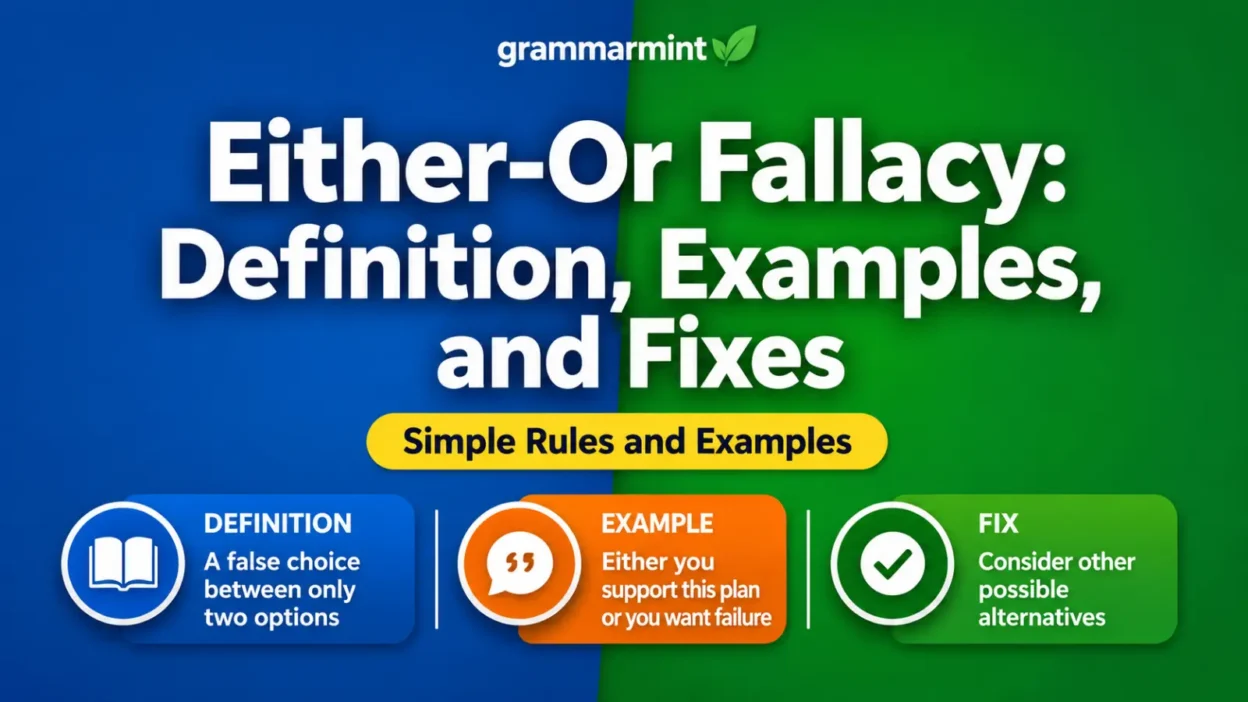
If you’ve ever felt pushed into choosing between two extreme options, the Either-Or Fallacy can help you name what’s happening. This common reasoning mistake appears in debates, ads, social media posts, classrooms, family talks, and workplace decisions. It’s tied to false dilemma, false dichotomy, black-and-white thinking, false binary, all-or-nothing reasoning, hidden alternatives, and missing middle ground. Once you spot it, you can slow the moment down and ask, “Are these really the only choices?” That simple question often opens better options, calmer talks, and smarter decisions.
Quick Answer
The Either-Or Fallacy is a reasoning error that presents only two choices when more options exist. It makes complex issues seem simpler than they are, often by hiding middle ground or better alternatives.
TL;DR
• It creates a false two-choice frame.
• It often hides better options.
• It appears in ads and debates.
• It can pressure quick decisions.
• Ask what choices are missing.
• Valid binaries are not always fallacies.
What Either-Or Fallacy Means
The Either-Or Fallacy happens when someone frames a situation as only this or that. However, the real issue often includes more choices, mixed positions, or better paths.
It works because a false choice feels clear and urgent. Yet a logical fallacy often hides hidden alternatives that matter.
• It reduces a complex issue.
• It offers only two paths.
• It ignores other real choices.
• It can sound confident.
• It often feels urgent.
• It may pressure agreement.
• It can hide compromise.
• It weakens fair debate.
• It rewards fast reactions.
• It discourages deeper thinking.
• It appears in daily talk.
• It can mislead smart people.
Either-Or Fallacy Definition
In plain English, this fallacy says you must pick one of two options, even though other options exist. Therefore, the problem is not the word “either,” but the missing choices.
A fair definition focuses on two options, oversimplification, and all-or-nothing framing. Still, some real choices truly are binary.
• It presents limited options.
• It treats them as complete.
• It leaves out middle ground.
• It may exaggerate consequences.
• It can sound persuasive.
• It often uses extremes.
• It may skip evidence.
• It narrows the discussion.
• It blocks creative answers.
• It can distort fairness.
• It affects decisions.
• It is not always intentional.
How The Either-Or Fallacy Works
This fallacy works by shrinking the frame. Instead of exploring the full situation, it pushes people toward one preferred answer.
The pattern often uses binary framing and claims options are mutually exclusive. However, missing context usually changes the whole picture.
• It starts with pressure.
• It names two choices.
• It makes one look bad.
• It makes one look obvious.
• It skips other paths.
• It rushes the listener.
• It uses emotional weight.
• It avoids deeper details.
• It may sound moral.
• It can feel unfair.
• It discourages questions.
• It steers the outcome.
Either-Or Fallacy Examples
Examples make the pattern easier to spot. In most cases, the speaker makes two choices seem final, even when another path exists.
That’s why a false dilemma can create a forced choice. A third option often changes the meaning.
• “Support this plan, or fail.”
• “Agree with me, or leave.”
• “Buy now, or miss everything.”
• “Study law, or disappoint us.”
• “Win today, or you’re weak.”
• “Pick safety, or pick freedom.”
• “Change fast, or fall behind.”
• “Love me, or choose them.”
• “Work late, or lack commitment.”
• “Eat this, or stay unhealthy.”
• “Vote yes, or hate progress.”
• “Speak up, or support harm.”
Either-Or Fallacy Examples In Real Life
In real life, this fallacy often appears during stress. So, people may use it without planning to manipulate anyone.
Still, everyday reasoning needs a gray area and practical judgment. Otherwise, normal choices can feel like traps.
• A parent frames careers narrowly.
• A boss limits work options.
• A friend demands total agreement.
• A partner turns conflict extreme.
• A coach labels caution weakness.
• A seller invents urgent loss.
• A post divides everyone harshly.
• A student fears one mistake.
• A team rejects hybrid plans.
• A family ignores compromise.
• A buyer overlooks alternatives.
• A leader frames delay as failure.
Either-Or Fallacy In Advertising
Advertising can use this fallacy to make buying feel obvious. However, strong messages become unfair when they hide reasonable alternatives.
A campaign may use scare tactics, limit consumer choice, or risk brand trust. So, careful readers look past the frame.
• “Use this, or look outdated.”
• “Switch brands, or waste money.”
• “Buy premium, or accept failure.”
• “Choose us, or choose stress.”
• “Upgrade now, or fall behind.”
• “Drink this, or lack energy.”
• “Join today, or miss success.”
• “Wear this, or look boring.”
• “Use our app, or lose time.”
• “Pick luxury, or seem ordinary.”
• “Subscribe, or stay uninformed.”
• “Act now, or regret later.”
Either-Or Fallacy In Politics
Political messages often use strong contrast because it’s memorable. Yet public issues usually involve tradeoffs, costs, timelines, and competing values.
When polarization shapes a policy debate, public opinion can harden fast. Therefore, fair reasoning needs more than slogans.
• “Back this bill, or hate safety.”
• “Support reform, or defend chaos.”
• “Choose growth, or choose decline.”
• “Trust us, or trust enemies.”
• “Vote yes, or reject families.”
• “Cut spending, or ruin taxpayers.”
• “Raise funding, or abandon schools.”
• “Act now, or invite disaster.”
• “Question policy, or oppose progress.”
• “Join our side, or surrender.”
• “Accept limits, or reject order.”
• “Pick security, or pick danger.”
Either-Or Fallacy In Relationships
In relationships, false choices can feel personal. Because emotions are involved, the pressure may seem stronger than the logic.
A statement can create emotional pressure, weaken healthy boundaries, and block a shared solution. Still, calmer wording helps.
• “Text back now, or don’t care.”
• “Agree with me, or leave.”
• “Choose friends, or choose me.”
• “Apologize fully, or it’s over.”
• “Move in, or prove nothing.”
• “Forgive instantly, or hate me.”
• “Cancel plans, or disappoint me.”
• “Take my side, or betray me.”
• “Change completely, or lose us.”
• “Share everything, or hide secrets.”
• “Say yes, or hurt me.”
• “Come tonight, or forget us.”
Either-Or Fallacy In Education
Students often meet this fallacy in essays, debates, and classroom discussions. As a result, learning to spot it improves both writing and reading.
Good critical thinking supports class discussion and stronger argument writing. It also helps students question narrow claims.
• It improves essay claims.
• It strengthens debate responses.
• It helps source evaluation.
• It reveals weak arguments.
• It encourages better evidence.
• It supports careful reading.
• It improves classroom questions.
• It helps group projects.
• It reduces rushed conclusions.
• It builds fairer opinions.
• It supports open discussion.
• It teaches flexible thinking.
False Dilemma Fallacy
The false dilemma fallacy is the closest name for this same idea. It describes a situation where the dilemma itself is unfairly limited.
A false dilemma presents limited choices while ignoring real alternatives. Therefore, the “problem” may be partly invented.
• It creates fake pressure.
• It limits the audience.
• It can sound logical.
• It often uses extremes.
• It may hide compromise.
• It can mislead decisions.
• It appears in speeches.
• It appears in marketing.
• It appears in arguments.
• It can exploit fear.
• It narrows moral choices.
• It needs careful questioning.
False Dichotomy
A dichotomy splits something into two parts. However, a false dichotomy wrongly treats that split as complete.
A false dichotomy creates a binary split where a spectrum may exist. So, the issue needs more categories.
• It divides too sharply.
• It treats groups as opposites.
• It ignores mixed cases.
• It misses partial agreement.
• It hides moderate positions.
• It reduces complex identities.
• It simplifies public issues.
• It weakens nuanced claims.
• It can frame debates unfairly.
• It often sounds tidy.
• It may feel satisfying.
• It rarely tells everything.
Black-And-White Thinking
Black-and-white thinking is the mental habit behind many false choices. It turns messy situations into total success or total failure.
With black-and-white thinking, people lose nuance and fall into extreme thinking. However, most life choices are mixed.
• “Perfect” replaces “good enough.”
• “Failure” replaces “learning step.”
• “Always” replaces “sometimes.”
• “Never” replaces “not yet.”
• “Good” replaces “partly helpful.”
• “Bad” replaces “needs work.”
• “Right” replaces “more supported.”
• “Wrong” replaces “less complete.”
• “Safe” replaces “lower risk.”
• “Dangerous” replaces “uncertain.”
• “Success” replaces “progress.”
• “Worthless” replaces “unfinished.”
False Binary
A false binary is a modern way to describe a fake two-sided frame. It often appears in online debates and culture arguments.
The false binary creates a two-sided frame and erases middle ground. As a result, people talk past each other.
• It frames groups as opposites.
• It hides blended views.
• It can fuel arguments.
• It spreads well online.
• It rewards sharp wording.
• It punishes careful nuance.
• It simplifies identity questions.
• It turns preferences moral.
• It narrows public discussion.
• It makes sides feel fixed.
• It can distort evidence.
• It blocks shared goals.
Excluded Middle Fallacy
The excluded middle problem appears when someone ignores a middle position. In daily reasoning, that middle may be compromise, balance, or partial truth.
The excluded middle matters because a middle position can support both-and thinking. Sometimes, two ideas can work together.
• You can support reform cautiously.
• You can disagree respectfully.
• You can save and spend.
• You can care and set limits.
• You can change slowly.
• You can approve part.
• You can reject extremes.
• You can ask for evidence.
• You can delay wisely.
• You can test options.
• You can combine ideas.
• You can choose balance.
How To Avoid Either-Or Fallacy
Avoiding this fallacy starts with slowing down. Then, ask whether the choice is real, complete, and fairly described.
Use better questions, search for alternative options, and aim for clearer reasoning. That simple habit improves decisions.
• Ask what else exists.
• Name the missing middle.
• Check for exaggerated stakes.
• Separate facts from pressure.
• List at least three choices.
• Look for mixed answers.
• Ask who benefits.
• Compare real consequences.
• Invite another viewpoint.
• Define the actual problem.
• Slow down urgent wording.
• Rewrite the claim fairly.
How To Respond To A False Dilemma
A calm response works better than a sharp comeback. First, show that you understand the concern, then widen the frame.
A respectful response can reframe the issue and create decision clarity. That keeps the conversation useful.
• “What other options exist?”
• “Can both be partly true?”
• “What evidence supports that split?”
• “Is there a middle path?”
• “Who says these are final?”
• “Could timing change this?”
• “What outcome matters most?”
• “Can we separate the issues?”
• “What would compromise include?”
• “Is this choice complete?”
• “What are we leaving out?”
• “How can we test it?”
FAQs
What is the either-or fallacy?
The either-or fallacy is a reasoning mistake that presents only two choices when more choices exist. It can make a complex issue feel simple, urgent, or morally loaded.
What is an example of an either-or fallacy?
A simple example is, “You either agree with this plan, or you want us to fail.” That ignores other possibilities, such as supporting a revised plan or asking for more evidence.
Is either-or fallacy the same as false dilemma?
Yes, the terms usually describe the same basic mistake. False dilemma is often the more formal name, while either-or fallacy is easier for many readers to understand.
Why is the either-or fallacy a problem?
It can push people toward rushed or unfair decisions. Also, it may hide better options, weaken debate, and make disagreement feel more extreme than it is.
Can an either-or statement ever be correct?
Yes, some choices truly have only two outcomes. For example, a light switch may be on or off, but many real-life issues are more complex.
Where is the either-or fallacy commonly used?
It appears in advertising, politics, relationships, school debates, social media, and workplace decisions. It shows up anywhere people want a choice to feel simple or urgent.
How can you avoid the either-or fallacy?
Ask whether more options exist before accepting the frame. Then, look for middle ground, mixed answers, better evidence, and clearer wording.
Conclusion
The Either-Or Fallacy is powerful because it makes a narrow choice feel final. However, better thinking begins when you pause and ask what options are missing. Next time a claim offers only two paths, look for the hidden third.
[…] without any context, there is not enough information to confidently identify the meaning. In that situation, looking at the previous messages is more reliable than assuming one fixed definition. […]