If you’re unsure which spelling belongs in a text, email, caption, or school paper, this guide clears it up fast. To Many or Too Many is a common grammar mix-up because to, too, many, countable nouns, excess, quantity, and sentence meaning all work together. Still, the rule is simple once you see it in real sentences.
Most of the time, you want “too many.” However, “to many” can be correct in a different kind of sentence. Because the words sound alike, your ear may not catch the mistake. So, use the meaning test below before you hit send.
Quick Answer
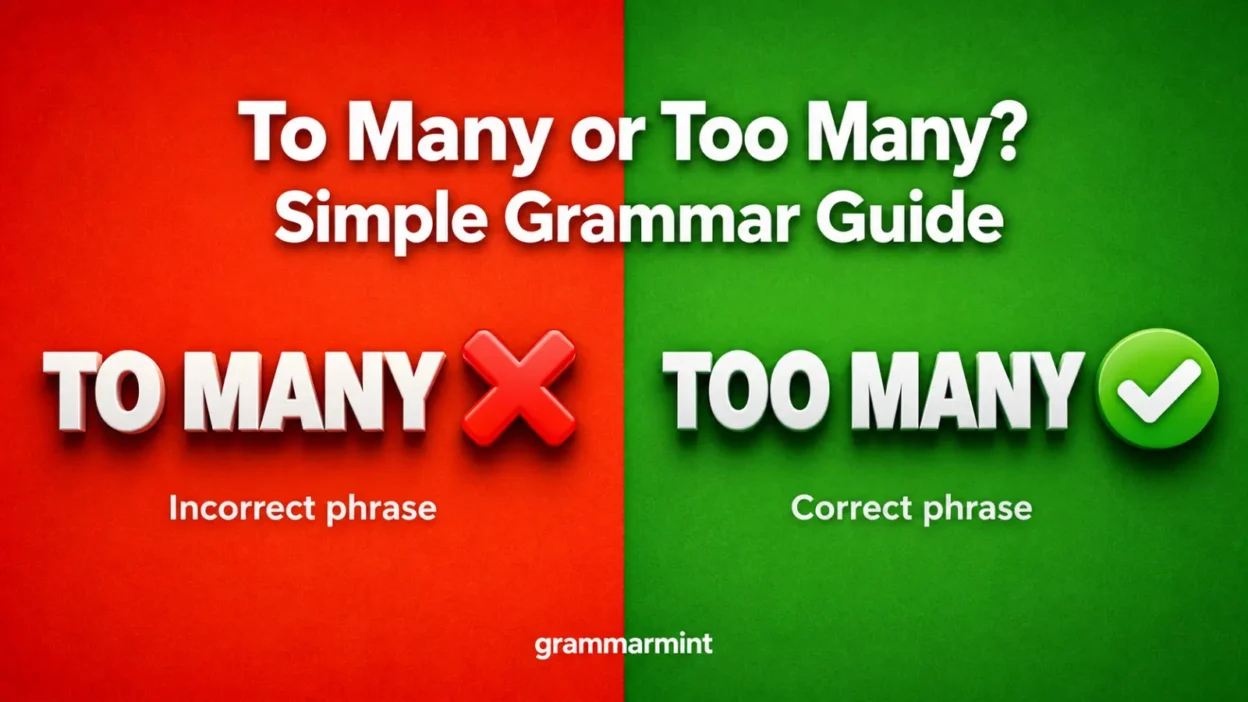
Too many is correct when you mean “more than needed” before a plural countable noun. Use “to many” only when “to” means direction or recipient, as in “sent to many people.”
TL;DR
• Use “too many” for excess.
• Use “to many” for recipients.
• Countable nouns take “too many.”
• Uncountable nouns take “too much.”
• The extra “o” signals overage.
• Context decides the right spelling.
Too Many Or To Many: The Fast Answer
The correct phrase is usually “too many.” It means an excessive number of countable nouns, like emails, mistakes, people, or choices. However, “to many” works when “to” points toward a group.
• Too many means more than needed.
• To many means toward many people.
• Use too many before plural things.
• Use to many after action verbs.
• “Too many errors” is correct.
• “Sent to many clients” is correct.
• “To many errors” is incorrect.
• “Too many clients” means excess clients.
• The extra o suggests extra amount.
• Check whether you mean over the limit.
• If yes, write “too many.”
• If no, test the verb first.
Too Many Vs To Many
The grammar difference is not about sound. It is about job. “Too” has an extra o and often means “more than enough,” while “to” is a preposition in sentences like “gave it to many friends.”
• Too many describes a large excess.
• To many shows where something goes.
• Too changes the force of many.
• To connects an action to receivers.
• Too many complaints means overload.
• Complaints to many managers means recipients.
• Too many guests sounds crowded.
• Invites to many guests sounds distributed.
• Too many is usually negative.
• To many is usually neutral.
• Too many belongs before plural nouns.
• To many often follows a verb.
Is To Many Correct?
Yes, “to many” can be correct. It works when “to” points to a recipient, shows direction, or starts a prepositional phrase. Still, it does not mean “an excessive number.”
• I spoke to many parents.
• She wrote to many customers.
• We sent updates to many users.
• The rule applies to many cases.
• This matters to many families.
• He apologized to many classmates.
• The form reached to many areas.
• To many readers, clarity matters.
• To many Americans, tone feels important.
• The gift went to many children.
• The warning spread to many towns.
• The lesson was useful to many.
When To Use Too Many
Use “too many” when the noun is plural and the number feels higher than wanted. It often carries a negative tone because it means more than enough. Therefore, it pairs naturally with a plural noun.
• Too many files slow the system.
• Too many cooks crowd the kitchen.
• Too many choices can confuse buyers.
• Too many meetings drain the team.
• Too many errors weaken the essay.
• Too many ads annoy readers.
• Too many tabs clutter your browser.
• Too many questions delayed the call.
• Too many boxes blocked the door.
• Too many tickets caused long lines.
• Too many tasks filled Monday.
• Too many messages buried the answer.
The Too Many Grammar Rule
“Too many” works like a quantifier before a plural countable noun. The usual word order is simple: too many + plural noun. Because of that, “too many mistake” is also wrong.
• Write “too many” before plural nouns.
• Add s when the noun needs it.
• Say too many mistakes, not mistake.
• Use it before people, items, or events.
• Keep too and many together.
• Don’t separate them with random words.
• Add a verb after the noun.
• “Too many students arrived” works.
• “Arrived too many students” sounds odd.
• Use “there are” for simple statements.
• “There are too many delays” works.
• The pattern stays steady in questions.
Countable And Uncountable Nouns
The key is whether you can count the thing one by one. A countable noun uses “too many,” while an uncountable noun uses another phrase. So, try the noun test before choosing.
• Count emails, so use too many.
• Count chairs, so use too many.
• Count dollars, but money is uncountable.
• Use too much money.
• Count bottles, not water.
• Use too much water.
• Count facts, not information.
• Use too much information.
• Count assignments, not homework.
• Use too much homework.
• Count grains, not rice.
• Use too much rice.
Too Much Vs Too Many
“Too much” is for uncountable things. “Too many” is for plural things you can count. In short, choose by amount versus number.
• Too much traffic sounds natural.
• Too many cars sounds natural.
• Too much noise is correct.
• Too many sounds is correct.
• Too much sugar is correct.
• Too many packets is correct.
• Too much work feels heavy.
• Too many jobs feels overloaded.
• Too much advice can overwhelm.
• Too many tips can distract.
• Too much time may be wasted.
• Too many hours may pass.
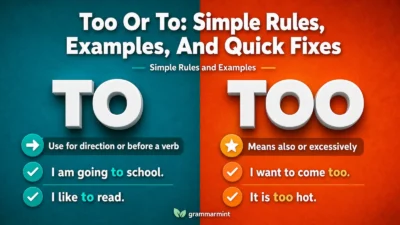
To Vs Too
“To” and “too” are homophones, so they sound alike in fast speech. However, the spelling creates a meaning change. That is why this spelling mistake slips into texts so easily.
• To can show direction.
• Too can mean also.
• Too can mean excessive.
• Two means the number 2.
• I went to school.
• I want coffee too.
• Two people arrived early.
• Too many people arrived late.
• “To many people” needs context.
• “Too many people” signals crowding.
• Sound alone will not help.
• Meaning must guide spelling.
To Many Or Too Many Examples
Examples make the rule easier. These real examples show clear sentences you can copy, compare, or use for a quick grammar check. Notice how the meaning changes with one letter.
• Correct: Too many apps are open.
• Incorrect: To many apps are open.
• Correct: I sent it to many apps.
• Better: I sent it to many users.
• Correct: Too many students missed class.
• Correct: Notes went to many students.
• Correct: Too many options slow decisions.
• Correct: We explained it to many teams.
• Correct: Too many lights stayed on.
• Correct: The memo went to many offices.
• Correct: Too many tabs caused lag.
• Correct: That matters to many voters.
Too Many Sentence Examples
The best sentence pattern is short and direct. In everyday English, “too many” usually comes before the noun. That gives your sentence natural phrasing and a clear warning.
• There are too many dishes.
• I made too many plans.
• She bought too many notebooks.
• We invited too many neighbors.
• They asked too many questions.
• He downloaded too many games.
• The store had too many returns.
• My inbox has too many alerts.
• The recipe uses too many bowls.
• This paragraph has too many commas.
• That closet holds too many jackets.
• Our schedule has too many gaps.
To Many In A Sentence
“To many” works best after verbs like give, send, speak, write, explain, or matter. Phrases like to many people, sent to many, and spoken to many are useful. Even then, read the whole sentence.
• I gave samples to many guests.
• She sent replies to many applicants.
• We spoke to many volunteers.
• They wrote letters to many officials.
• The policy applies to many workers.
• This seems fair to many parents.
• The news spread to many cities.
• He explained rules to many players.
• The offer appealed to many shoppers.
• I returned calls to many clients.
• The guide helped to many? No.
• The guide helped many readers.
Common Mistakes With Too Many
Most common errors happen when writers type fast. Also, autocorrect may miss the problem because both words exist. So, simple proofreading matters.
• Don’t write “to many problems.”
• Write “too many problems.”
• Don’t write “too many water.”
• Write “too much water.”
• Don’t write “too many information.”
• Write “too much information.”
• Don’t write “sent too many people.”
• Write “sent to many people.”
• Don’t trust sound alone.
• Read the sentence slowly.
• Replace too many with excessive.
• If excessive fits, use too.
Too Many In Emails And Work Writing
In a business email, the wrong spelling can look careless. However, professional writing improves quickly when the clear message comes first. Use the phrase that matches your point.
• Too many meetings blocked project work.
• Too many revisions delayed approval.
• Too many attachments confused the client.
• Too many recipients received the draft.
• We sent updates to many managers.
• I replied to many vendors.
• The notice went to many employees.
• Too many deadlines fell on Friday.
• Too many edits changed the tone.
• Too many reminders annoyed the group.
• This applies to many departments.
• Please forward this to many? Avoid.
Too Many People And Everyday Phrases
“Too many people” is one of the most common patterns. It appears in daily speech, texts, comments, captions, and casual writing. Still, the phrase should mean more people than wanted.
• Too many people joined the call.
• Too many people saw the draft.
• Too many people waited outside.
• Too many people shared one link.
• Too many people asked at once.
• Too many kids crowded the slide.
• Too many friends canceled plans.
• Too many neighbors parked nearby.
• Too many players missed practice.
• Too many guests brought desserts.
• Too many shoppers filled the aisle.
• Too many drivers ignored signs.
Too Many Idioms And Fixed Phrases
Some expressions are fixed by habit. The phrase too many cooks is a famous one, and its idiom meaning is about crowded control. A fixed phrase should not be rewritten casually.
• Too many cooks spoil the broth.
• It means overhelp can hurt.
• Too many hands can confuse work.
• Too many chiefs creates conflict.
• One too many means excess again.
• A few too many suggests overdoing.
• Too many irons means overcommitment.
• Don’t write “to many cooks.”
• Idioms still follow spelling rules.
• Fixed sayings need exact wording.
• Use them only when helpful.
• Plain wording is often clearer.
Practice Exercises And Quick Quiz
Now test the rule. This practice quiz uses each fill in the blank as a fast check. The answer key follows right after the questions.
• There are ___ errors here.
• I sent notes ___ students.
• She has ___ unread texts.
• This matters ___ families.
• We bought ___ oranges.
• He spoke ___ reporters.
• They asked ___ questions.
• Add answers ___ forms.
• There is ___ noise outside.
• We have ___ chairs available.
• Answers: too many, to many.
• Then: too many, to many.
• Next: too many, to many.
• Then: too many, to many.
• Last: too much, too many.
• Count the noun before choosing.
FAQs
Which is correct, “to many” or “too many”?
“Too many” is correct when you mean an excessive number. For example, write “too many mistakes,” “too many people,” or “too many emails.”
What’s the main difference between “to many” and “too many”?
“Too many” describes excess. “To many” shows that something goes toward many people, applies to many people, or matters to many people.
Is “to many” ever grammatically correct?
Yes, but only in the right sentence. For example, “I sent the update to many clients” is correct because “to” shows recipients.
When should I use “too many”?
Use “too many” before a plural noun you can count. It means the number is higher than needed, wanted, or useful.
How can I remember when to use “too many”?
Remember that “too” has an extra “o.” That extra letter can remind you of an extra amount.
What is the difference between “too much” and “too many”?
Use “too many” with countable plural nouns, like books or calls. Use “too much” with uncountable nouns, like water, traffic, or homework.
Conclusion
To Many or Too Many becomes easy when you ask one question: do you mean excess or direction? If you mean more than needed, write “too many.” If something goes toward many people, “to many” can be right.