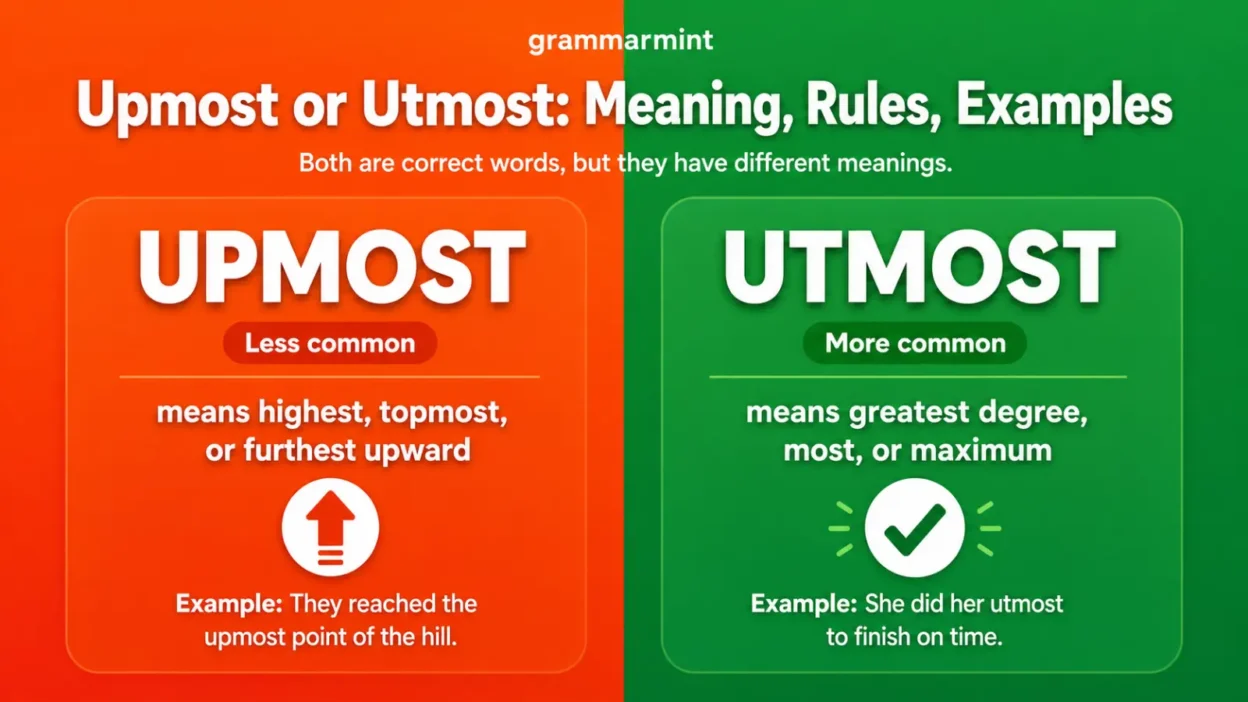
Choosing the right word can save your email, essay, caption, or work message from sounding off. If you’re stuck on upmost or utmost, the answer is usually simple: use “utmost” for respect, importance, care, effort, confidence, concern, and attention. Meanwhile, “upmost” is rare and usually points to something physically high, like a shelf, branch, or level.
This guide keeps things clear and practical. You’ll see definitions, common phrases, sentence examples, quick fixes, and easy memory rules. Therefore, by the end, you won’t need to second-guess this pair again.
Quick Answer
Upmost or utmost is usually answered with “utmost.” Use “utmost” when you mean the greatest degree, highest level, or strongest effort; use “upmost” only for something physically highest.
TL;DR
• “Utmost” means greatest degree or maximum level.
• “Upmost” means highest physical position.
• Write “utmost respect,” not “upmost respect.”
• Write “utmost importance,” not “upmost importance.”
• “Do my utmost” means try my hardest.
• When unsure, “utmost” is usually safer.
Upmost Or Utmost Meaning
These two words look almost the same. However, they do different jobs, so context matters.
Use correct word checks before you send anything. “Utmost” points to the greatest degree, while “upmost” points to the highest position.
• Use “utmost” for degree, effort, or importance.
• Use “upmost” for physical height or position.
• “Utmost” fits most modern sentences.
• “Upmost” is real but rarely needed.
• “Upmost respect” is usually a mistake.
• “Utmost respect” is the polished phrase.
• “Upmost shelf” can make literal sense.
• “Utmost shelf” would sound strange.
• Think “most” when you mean maximum.
• Think “up” when something is physically high.
• For emails, “utmost” is usually correct.
• For schoolwork, “utmost” is usually safer.
Upmost Vs Utmost
The main difference is simple. “Utmost” describes how much, while “upmost” describes where.
Because they sound similar, this grammar mistake is common. Still, they’re not interchangeable, so follow one clear usage rule: degree takes “utmost.”
• “Utmost” means greatest possible extent.
• “Upmost” means highest placed part.
• “Utmost” is common in serious writing.
• “Upmost” sounds unusual in modern English.
• Say “utmost care” for strong care.
• Say “upmost branch” for top branch.
• Don’t write “upmost concern” in emails.
• Write “utmost concern” for sincere concern.
• “Utmost” can describe effort or respect.
• “Upmost” usually describes location.
• When meaning “maximum,” choose “utmost.”
• When meaning “top,” consider “uppermost.”
Utmost Definition
“Utmost” means the highest level possible. It can describe care, effort, respect, importance, secrecy, confidence, or attention.
In plain English, it means maximum, extreme, or the greatest amount. Therefore, it works well when you want a serious, careful tone.
• “Utmost” can work as an adjective.
• It can also work as a noun.
• “Utmost care” means maximum care.
• “Utmost respect” means deepest respect.
• “Utmost importance” means highest importance.
• “Utmost effort” means strongest effort.
• “Do your utmost” means try hardest.
• It often sounds formal and careful.
• It fits business and school writing.
• It adds weight without sounding dramatic.
• It usually appears before abstract nouns.
• It can sound stiff in casual texts.
Upmost Definition
“Upmost” means highest in position. However, many readers may expect “uppermost” instead.
The word is linked to uppermost, topmost, and physical height. As a result, it usually belongs in literal descriptions, not emotional phrases.
• “Upmost” can mean highest up.
• It usually describes a physical place.
• It can point to the top part.
• It’s much rarer than “utmost.”
• Some readers may think it’s wrong.
• “Uppermost” is often clearer today.
• “Topmost” can also sound cleaner.
• Use it carefully in formal text.
• Avoid it for respect or care.
• Avoid it for effort or concern.
• It may feel old-fashioned to readers.
• Choose simpler wording when possible.
Utmost Respect Or Upmost Respect
The correct phrase is “utmost respect.” It means you hold someone in very high esteem.
This phrase shows deep respect, high regard, and a polished professional tone. Therefore, it fits notes, speeches, tributes, and workplace messages.
• Correct: “You have my utmost respect.”
• Incorrect: “You have my upmost respect.”
• Use it for sincere praise.
• Use it for professional appreciation.
• Use it for leaders or mentors.
• Use it after serious achievements.
• Use it in sympathy messages carefully.
• It can sound strong and formal.
• “Great respect” sounds more casual.
• “Real respect” sounds more relaxed.
• “Utmost respect” carries extra weight.
• Don’t overuse it in light moments.
Utmost Importance Or Upmost Importance
The correct phrase is “utmost importance.” It means something matters at the highest level.
Use it for a highest priority, a serious matter, or something of great importance. However, don’t use it for tiny everyday tasks.
• Correct: “Safety is of utmost importance.”
• Incorrect: “Safety is of upmost importance.”
• Use it for urgent issues.
• Use it for legal or policy matters.
• Use it for safety and trust.
• Use it for health or privacy.
• Use it when stakes are high.
• It can sound too heavy sometimes.
• “Very important” is more casual.
• “Critical” is shorter and stronger.
• “Essential” sounds clean and modern.
• Avoid it in playful captions.
Do My Utmost Or Upmost
The correct phrase is “do my utmost.” It means you’ll try as hard as you can.
This phrase points to best effort, the promise to try hardest, and your full ability. So, it works well in commitments and apologies.
• Correct: “I’ll do my utmost.”
• Incorrect: “I’ll do my upmost.”
• It means giving your best.
• It sounds sincere and responsible.
• It works in customer service replies.
• It works in workplace updates.
• It works in personal promises.
• “Try my best” sounds warmer.
• “Give it my all” sounds casual.
• “Do everything possible” sounds direct.
• Avoid it if action is unclear.
• Pair it with a real next step.
Utmost Care Meaning
“Utmost care” means the highest possible level of care. It’s common in service, medical, legal, and privacy contexts.
The phrase suggests careful attention, great caution, and close detail. Therefore, it tells readers that something is handled seriously.
• “We handled it with utmost care.”
• It fits sensitive personal information.
• It fits fragile items and packages.
• It fits patient or client matters.
• It fits editing and review work.
• It shows caution and responsibility.
• It can reassure nervous readers.
• “Extra care” sounds more everyday.
• “Great care” sounds clear and simple.
• “Extreme care” sounds more urgent.
• Avoid it for routine small tasks.
• Use it when care truly matters.
Utmost Effort Meaning
“Utmost effort” means the strongest effort someone can reasonably give. It focuses on commitment, not physical height.
This phrase suggests full effort, a strongest attempt, and maximum energy. However, it can sound formal, so match the setting.
• “She gave her utmost effort.”
• It praises serious commitment.
• It works in school feedback.
• It works in sports writing.
• It works in team reviews.
• It sounds stronger than “good effort.”
• It may sound formal in conversation.
• “Best effort” feels more natural.
• “All-out effort” feels energetic.
• “Full effort” feels simple.
• Don’t use “upmost effort.”
• Use action details when possible.
Upmost Shelf Meaning
“Upmost shelf” can mean the highest shelf. Still, “top shelf” or “uppermost shelf” will usually sound clearer.
This phrase deals with a top shelf, a highest branch, or another upper position. Because it’s rare, use it only when the physical meaning is obvious.
• “The box sat on the upmost shelf.”
• “Top shelf” sounds more natural.
• “Uppermost shelf” sounds more precise.
• “Highest shelf” sounds plain and clear.
• Use it for literal position only.
• Don’t use it for importance.
• Don’t use it for respect.
• Don’t use it for effort.
• Readers may pause at “upmost.”
• Editors may replace it with “uppermost.”
• It can work in descriptive prose.
• Simpler wording is usually better.
Utmost In A Sentence
The best way to learn “utmost” is through common phrases. It usually sits before an abstract noun.
These sentence examples show clear wording and natural English. As you read, notice how each sentence means “maximum” or “highest level.”
• Please treat this with utmost care.
• Your privacy is of utmost importance.
• I have the utmost respect for her.
• He gave the project his utmost attention.
• We acted with utmost caution.
• She showed utmost patience under pressure.
• They made the utmost effort to help.
• This requires utmost honesty from everyone.
• I’ll do my utmost to fix it.
• The matter deserves utmost seriousness.
• He handled complaints with utmost courtesy.
• We appreciate your utmost cooperation.
Upmost In A Sentence
“Upmost” is harder to use naturally. Often, another word will be smoother.
Because it has rare use, a literal position meaning, and an old-fashioned feel, keep it for clear physical descriptions only.
• The upmost branch caught the sunlight.
• Dust covered the upmost shelf.
• The upmost stone marked the peak.
• Birds nested in the upmost limbs.
• Snow stayed on the upmost ledge.
• The upmost window faced the hill.
• The upmost layer dried first.
• Paint reached the upmost corner.
• The upmost stair creaked loudly.
• Clouds touched the upmost ridge.
• The flag topped the upmost pole.
• Still, “uppermost” often reads better.
Synonyms For Utmost
Sometimes “utmost” is perfect. Other times, a simpler synonym will sound more natural.
Good choices include highest, greatest, and extreme. However, each word has its own tone, so choose with care.
• Use “maximum” for limits or amounts.
• Use “greatest” for degree or value.
• Use “highest” for level or rank.
• Use “extreme” for intense situations.
• Use “supreme” for formal emphasis.
• Use “complete” for full coverage.
• Use “total” for all-in meaning.
• Use “deepest” with respect or sympathy.
• Use “strongest” with effort or support.
• Use “top” for casual ranking.
• Use “best” for simple promises.
• Use “full” for effort or attention.
Utmost Vs Uppermost
“Uppermost” is usually clearer than “upmost.” It can mean highest in place or most important in someone’s mind.
Use foremost for importance, topmost for position, and “uppermost in mind” for thoughts. That separation keeps writing clean.
• “Utmost” means greatest degree.
• “Uppermost” can mean highest position.
• “Uppermost” can mean most present mentally.
• “Safety was uppermost in her mind.”
• “Safety was of utmost importance.”
• Those sentences mean different things.
• “Topmost” works for physical height.
• “Foremost” works for leading importance.
• “Utmost” works for maximum seriousness.
• “Upmost” is less common than “uppermost.”
• When unsure, rewrite the sentence.
• Clear wording beats fancy wording.
Of Utmost Importance Vs Of The Utmost Importance
Both forms can work. “Of the utmost importance” sounds a little fuller, while “of utmost importance” sounds slightly leaner.
The formal phrase often includes a definite article, but both forms carry the same meaning. Therefore, choose the version that fits your sentence rhythm.
• “This is of utmost importance.”
• “This is of the utmost importance.”
• Both mean extremely important.
• The version with “the” sounds formal.
• The shorter version sounds direct.
• Both fit business writing.
• Both fit academic writing.
• Avoid “of upmost importance.”
• Avoid “utmost important” in polished writing.
• Prefer “very important” for casual notes.
• Prefer “critical” when space is tight.
• Read the sentence aloud first.
Upmost Or Utmost In Formal Writing
In formal writing, “utmost” is usually the right choice. It sounds polished when the topic truly deserves strong emphasis.
For business writing, academic writing, and personal credibility, avoid “upmost” unless you mean physical height. Also, consider whether a simpler word would be clearer.
• Use “utmost” in professional emails.
• Use “utmost” in reports and proposals.
• Use “utmost” in apologies and responses.
• Use “utmost” in policies and notices.
• Use “utmost” in academic papers.
• Use “upmost” rarely in formal writing.
• Replace “upmost” with “uppermost” when possible.
• Check phrases before sending messages.
• Watch autocorrect and fast typing.
• Keep tone sincere, not overblown.
• Match word strength to the situation.
• When editing, search both spellings.
FAQs
What Is The Difference Between Upmost And Utmost?
“Utmost” means the greatest degree, amount, or level. “Upmost” means highest in physical position, though many readers expect “uppermost” instead.
So, write “utmost respect,” “utmost care,” and “utmost importance.” Use “upmost” only when a top physical location is truly meant.
When Should I Use Utmost?
Use “utmost” when you mean maximum seriousness, care, effort, importance, or respect. It works well in work emails, school papers, service messages, and formal notes.
Still, don’t use it everywhere. For casual writing, “best,” “full,” or “very important” may sound more natural.
Is Upmost Ever Correct?
Yes, “upmost” can be correct when it means highest in position. For example, a writer might describe an upmost branch, shelf, layer, or ledge.
However, it’s rare in current everyday writing. In many cases, “uppermost,” “topmost,” or “highest” will be clearer.
Are Upmost And Utmost Interchangeable?
No, they are not interchangeable in careful writing. “Utmost” is about degree, while “upmost” is about physical position.
That’s why “utmost effort” is right, but “upmost effort” is not. Likewise, “upmost shelf” can work, but “utmost shelf” cannot.
Can I Use Upmost In Formal Writing?
You can, but only if you mean the highest physical position. Even then, “uppermost” or “topmost” often sounds better.
For formal writing about respect, importance, care, effort, or concern, choose “utmost.” It will look cleaner and more standard.
Which Is Correct: Utmost Respect Or Upmost Respect?
“Utmost respect” is correct. It means the highest level of respect or deep admiration.
“Upmost respect” is a common mistake. Since respect is not a physical location, “upmost” does not fit.
Which Is Correct: Utmost Importance Or Upmost Importance?
“Utmost importance” is correct. It means something matters at the highest level.
“Upmost importance” is usually wrong. If you want a simpler phrase, write “very important,” “critical,” or “essential.”
Conclusion
The choice between upmost or utmost comes down to degree versus position. Use “utmost” for respect, importance, care, and effort; save “upmost” for rare physical height.