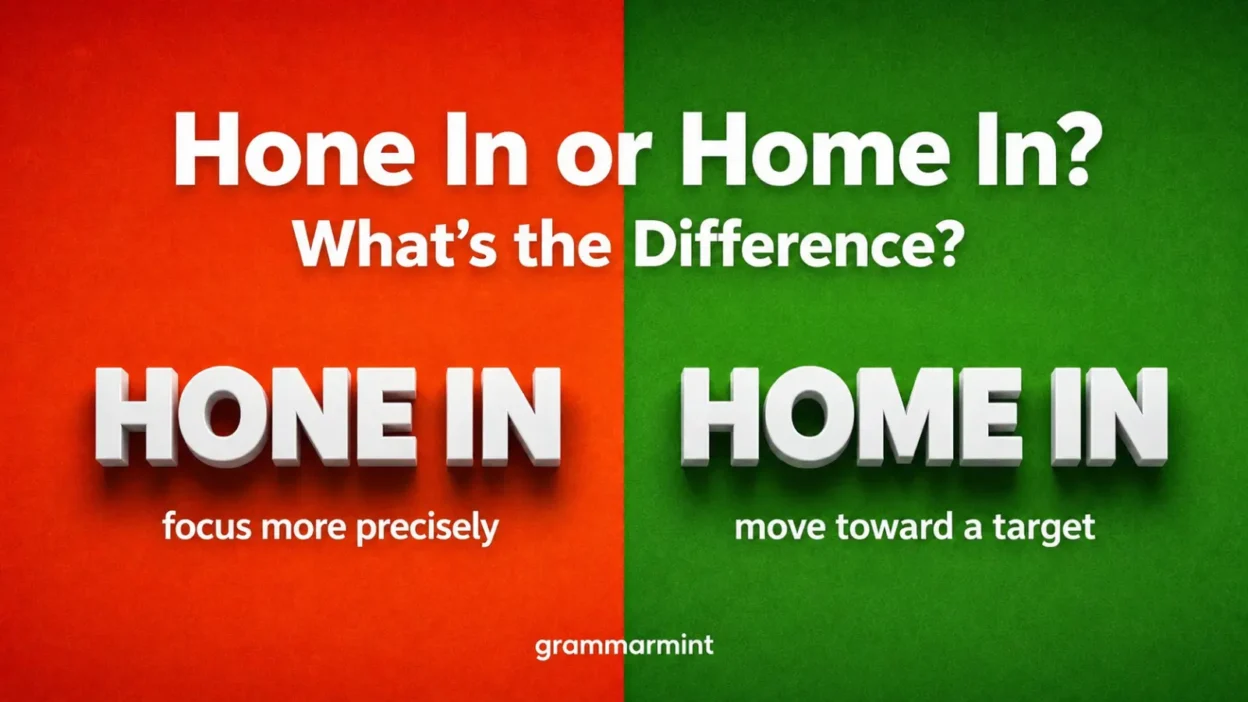
If you’ve ever paused over hone in or home in, you’re not alone. This is one of those English usage questions that trips up students, editors, office writers, and everyday speakers alike. The confusion comes from sound, habit, and overlap: home in on, hone in on, focus on, zero in on, hone your skills, and word choice all seem close at first glance. Still, careful sources largely agree on the best rule: use home in on when you mean move toward a target or focus tightly on something, and use hone when you mean sharpen or refine.
Quick Answer
For careful American writing, home in on is the safer choice when you mean “focus closely on” or “move toward a target.” Hone normally means “sharpen” or “refine,” so you hone skills, but you usually home in on a problem, clue, or goal.
TL;DR
• Home in on is the standard choice.
• Hone usually means sharpen or refine.
• Many people still say hone in.
• Formal writing should favor home in.
• You can use zero in instead.
Which One Is Standard
Most careful dictionaries and style guides still treat home in on as the standard usage and the preferred form for careful writing.
That means it is the version least likely to distract a reader, editor, teacher, or client. In other words, it is the safe pick when clarity matters.
• Write home in on for polished prose
• Use it in essays and reports
• Choose it for business communication
• Keep it in edited magazine copy
• Prefer it in school assignments
• Use it in resumes and cover letters
• Keep it in published web copy
• Pick it when readers expect precision
• Use it to avoid style objections
• Treat it as the default choice
• Save debate for casual conversation
• When unsure, choose home in
What Home In Actually Means
To home in on something is to move toward it or focus attention on it like a target. Cambridge and Merriam-Webster both support that core idea.
Sometimes the phrase is literal. More often, it is figurative. Either way, it points to narrowing attention or direction.
• Move closer to a goal
• Focus tightly on one issue
• Aim directly at the cause
• Narrow attention to one detail
• Track the strongest clue
• Fix attention on the problem
• Target the most likely answer
• Move toward the right solution
• Concentrate on what matters most
• Tune out weaker possibilities
• Close in on the main point
• Lock onto the key idea
What Hone Actually Means
By itself, hone means sharpen, refine, or improve a skill through practice. That is why writers commonly say hone skills rather than use hone with a target.
So the difference is simple once you separate the verbs. One points toward a target. The other improves the tool or ability.
• Hone a craft through practice
• Hone your writing over time
• Hone a presentation before speaking
• Hone technique with repetition
• Hone judgment through experience
• Hone instincts on real projects
• Hone timing with steady work
• Hone listening during interviews
• Hone habits that improve results
• Hone language for clarity
• Hone skills before high-pressure moments
• Hone strengths that already exist
Where Home In Came From
The phrase home in grew from the idea of a homing pigeon finding its way back, then later from vehicles or systems moving toward a guided target. Merriam-Webster and Dictionary.com both trace that development.
That history makes the phrase easier to remember. You are not sharpening your target. You are moving toward it.
• Think of pigeons returning home
• Think of a signal finding base
• Think of a missile finding target
• Picture movement, not sharpening
• Connect it to direction
• Link it with narrowing distance
• Remember it involves aiming
• Tie it to tracking
• See it as guided focus
• Use the image to recall spelling
• Let the origin do the teaching
• Home goes with destination
Why The Mix-Up Happens
People mix these forms up because they sound alike, often appear in similar contexts, and create a kind of blended usage in everyday speech. Merriam-Webster explicitly notes that the figurative sharpness of hone likely helped the newer form spread.
That explains why so many fluent speakers pause over it. The confusion is common, even among strong writers.
• The phrases sound nearly identical
• Both suggest narrowing attention
• Readers hear them more than see them
• Speech blurs the distinction
• Memory favors familiar sounds
• Hone feels logical to many
• Sharpening seems close to focusing
• People learn it by ear
• Informal speech spreads fast
• Repetition makes variants feel normal
• Mixed examples create uncertainty
• Similar meaning invites substitution
Best Choice For Formal Writing
In professional writing, academic writing, and other forms of edited prose, using home in on is still the stronger move. That is the clearest takeaway from style-oriented sources.
You do not need to win a language debate every time. You just need the choice that causes the least friction.
• Use home in in formal emails
• Keep it in research summaries
• Choose it in proposal writing
• Prefer it in news-style copy
• Use it in grant applications
• Keep it in client decks
• Pick it in policy writing
• Use it in white papers
• Keep it in application essays
• Prefer it in official statements
• Use it where editors review wording
• Let clarity outrank personal habit
When People Still Use Hone In
Even so, hone in remains common in informal speech and broader spoken English. Some dictionaries record it because real speakers use it often enough to notice.
That does not make it the best edited choice. It does explain why you hear it from smart, careful people.
• You’ll hear it in meetings
• You’ll hear it in podcasts
• It appears in casual interviews
• Friends use it without noticing
• Speakers often prefer familiar rhythm
• It sounds natural to many Americans
• Some writers use it in dialogue
• It survives because meaning stays clear
• It appears in relaxed conversations
• Many readers barely notice it
• It spreads through imitation
• Speech changes faster than style guides
Is Hone In Ever Acceptable
Some modern dictionaries include hone in as a real usage, but many usage notes still warn that it can attract criticism in careful prose. Merriam-Webster records it, yet still says home in is the better choice if you want to avoid objections.
So yes, you may encounter it. But you still do not need to choose it when writing for a wide audience.
• Accept that it exists in usage
• Expect pushback in edited writing
• Know readers may judge it
• Recognize dictionary listing is not endorsement
• Separate “seen” from “recommended”
• Use audience expectations as your guide
• Favor the less controversial form
• Keep nuance without sounding vague
• Don’t call every use ignorant
• Don’t treat it as best practice
• Use judgment, not panic
• Default to the safer option
Hone Your Skills, Not Your Target
This is the cleanest line to remember: you hone skills, improve methods, and perfect technique. You do not usually “hone in on” a clue when you want polished standard writing.
Once you lock this in, the choice becomes much easier during editing.
• Hone your speaking before interviews
• Hone your instincts through repetition
• Hone your draft after feedback
• Hone your pitch before launch
• Hone your timing during rehearsal
• Hone your craft over years
• Hone your argument with revision
• Hone your process step by step
• Hone your style with practice
• Hone your eye for detail
• Hone your technique in training
• Hone your message before sending
Everyday Examples Of Home In
In regular conversation, home in on works well for troubleshooting, studying, planning, and problem solving. The phrase often sounds natural when a person is getting closer to the real answer.
These examples keep the meaning practical and easy to feel.
• Let’s home in on the real issue
• Detectives homed in on one suspect
• We homed in on the bug
• She homed in on the weak point
• The team homed in on costs
• Doctors homed in on the cause
• He homed in on the best route
• They homed in on one pattern
• I’m homing in on a solution
• The class homed in on theme
• Reporters homed in on contradictions
• We finally homed in on facts
Common Patterns With Home In
The most common structure is home in on plus the thing you are targeting. This verb phrase is the pattern most readers expect, and it is the easiest one to copy well.
You can swap in people, problems, clues, risks, or opportunities after on.
• Home in on the answer
• Home in on the source
• Home in on customer needs
• Home in on one topic
• Home in on key evidence
• Home in on likely causes
• Home in on final edits
• Home in on urgent tasks
• Home in on overlooked details
• Home in on promising leads
• Home in on priority actions
• Home in on the truth
Common Mistakes To Avoid
Most errors happen when writers blend the two verbs or choose the familiar sound instead of the precise phrase. A fast final check usually catches the problem.
Ask a simple question: am I moving toward a target, or sharpening an ability?
• Don’t write “hone in” by reflex
• Don’t mix target with sharpening
• Don’t swap forms mid-article
• Don’t copy speech into formal prose
• Don’t treat both as equal everywhere
• Don’t force the phrase unnecessarily
• Don’t ignore audience expectations
• Don’t overthink once rule is clear
• Don’t confuse verb with phrasal verb
• Don’t edit only by sound
• Don’t miss repeated errors
• Don’t leave inconsistency in headlines
Good Alternatives When You’re Unsure
If the phrase still feels awkward, use zero in, pinpoint, or focus on instead. Merriam-Webster even suggests zero in as a clean escape hatch.
Sometimes the best fix is not to debate the phrase at all.
• Use focus on for simplicity
• Use zero in on for clarity
• Use pinpoint for precision
• Use target for directness
• Use identify for plain style
• Use narrow down for process
• Use concentrate on for neutrality
• Use single out when selecting
• Use track down in investigations
• Use work toward for progress
• Use spot for short copy
• Use locate when literal meaning fits
Quick Memory Tricks
A good memory trick should be fast, visual, and reliable. The best one comes straight from the history of the phrase.
If it involves a target, think of something finding its way home. If it involves improvement, think of a blade or skill being honed.
• Target equals home
• Skill equals hone
• Pigeon goes home, not hone
• Missiles home in on targets
• Writers hone their craft
• Home points to destination
• Hone points to sharpening
• One tracks, one improves
• One aims, one refines
• One closes distance
• One increases sharpness
• Keep the images separate
How To Edit The Phrase Fast
During proofreading or a quick copy edit, you do not need a deep grammar lesson. You need a fast test that works under pressure.
Try the swap test. Replace the phrase with “focus on” or “sharpen.” The right answer usually becomes obvious.
• If “sharpen” fits, use hone
• If “focus on” fits, use home in
• Read the sentence aloud once
• Check whether a target exists
• Look for a following “on”
• Review headlines separately
• Search the full document
• Fix all variants together
• Keep one house style
• Recheck after major rewrites
• Watch quoted speech less strictly
• Prioritize reader comfort first
Practice Lines You Can Copy
Reusable models make grammar choices easier. Once you see the pattern a few times, it becomes natural.
Here are sentence shapes you can borrow, adapt, and reuse in real writing.
• We need to home in on costs
• Let’s home in on the evidence
• The panel homed in on safety
• She homed in on one flaw
• I’m homing in on the answer
• They homed in on buyer concerns
• He wants to hone his style
• She honed her interview skills
• We honed the process last quarter
• The coach helped players hone technique
• Practice helped me hone timing
• Revision helped us hone tone
FAQs
Is it correct to say hone in or home in?
In careful writing, home in on is usually the preferred choice. Many speakers still say hone in, but it can sound less polished to readers who know the traditional distinction.
What does home in on mean?
It means to move toward a target or focus attention closely on something. The phrase can be literal or figurative, but the core idea is narrowing in with direction.
Why do people say hone in?
People often blend the phrases because hone suggests sharpening and sounds close to home. Over time, that overlap helped hone in spread in everyday speech.
Is hone in always wrong?
Not always in the sense of real-world usage, because dictionaries do record it. Still, it remains more likely to draw criticism in formal or edited writing, so home in is usually the better pick there.
Should I write hone your skills instead?
Yes. That is one of the clearest standard patterns. You hone your skills, hone your craft, or hone your technique, but you usually home in on a target, problem, or answer.
What is a good alternative to home in on?
Zero in on, focus on, and pinpoint all work well, depending on the sentence. They are especially useful if you want to avoid reader hesitation over the phrase choice.
Conclusion
If you want the cleanest choice, use home in on for targets, clues, and points of focus, and use hone for sharpening skills or improving technique. Once that distinction clicks, the hone in or home in question gets much easier to handle.