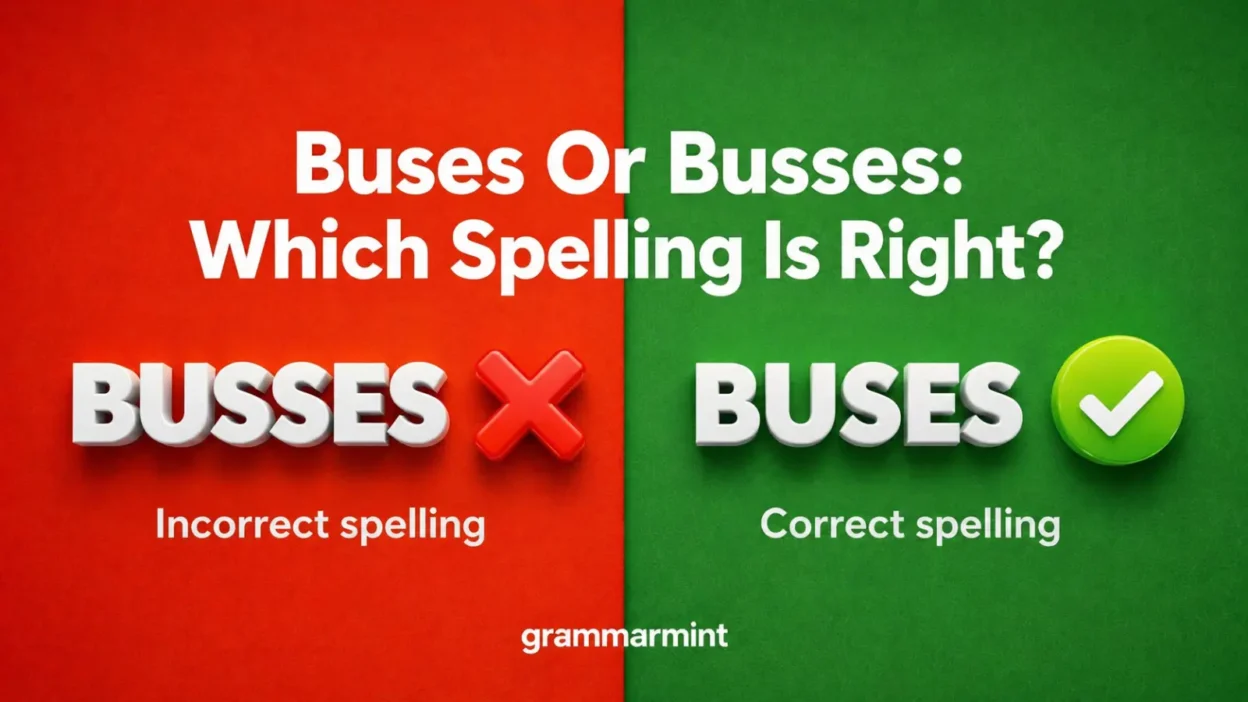
If you’ve paused over Buses or Busses while writing, you’re not alone. This is one of those English spelling questions that looks small but causes real hesitation in emails, essays, captions, and everyday grammar checks. In most cases, the right plural for the vehicle is buses. Still, confusion happens because busses exists in dictionaries, shows up in older writing, and also connects to a different word entirely.
This guide clears it up in plain American English. You’ll see the right plural, the rare exception, the verb forms, sentence examples, and easy ways to remember the difference without second-guessing yourself.
Quick Answer
Buses or busses? For almost all modern writing about vehicles, the correct choice is buses. Busses is rare and usually avoided unless you mean a form of buss, a word that means “kiss,” or you’re discussing an old or listed variant.
TL;DR
• Use buses for transport vehicles
• Treat busses as rare or separate
• In US writing, buses is safest
• Buss usually relates to kissing
• Check noun and verb meaning first
Buses Vs Busses At A Glance
Most writers want the fast answer first. Here it is: choose buses when you mean more than one bus. Meanwhile, busses looks possible, but it rarely belongs in modern everyday writing.
That simple choice prevents most mistakes. So, when the topic is transportation, school vehicles, city routes, or shuttle service, stay with the standard form.
• Correct spelling for vehicles is buses
• Plural form of bus is usually buses
• Modern usage strongly favors buses
• Busses looks old-fashioned to many readers
• Buses fits school, city, and tour contexts
• Use buses in essays and articles
• Use buses in captions and headlines
• Buses keeps your writing clear
• Busses may distract careful readers
• The safer choice is almost always buses
• Transportation writing should use buses
• Start with buses unless meaning changes
What The Plural Of Bus Really Is
English often adds -es to nouns ending in -s. That’s why the usual plural noun here becomes buses. It follows a familiar pattern, even if the spelling looks a little unusual at first.
Once you see the pattern, the word feels less strange. In short, the normal plural works the same way as many other common nouns.
• Plural noun form is buses
• Bus plural follows the usual -es pattern
• Everyday English uses buses naturally
• One bus becomes two buses
• Late bus becomes late buses
• School bus becomes school buses
• City bus becomes city buses
• Tour bus becomes tour buses
• Shuttle bus becomes shuttle buses
• Electric bus becomes electric buses
• Public bus becomes public buses
• Nearby bus stop serves several buses
The Real Difference Between Buses And Busses
The main issue is not just spelling. It’s also meaning. Buses points to transportation, while busses can pull readers toward a different word family.
That’s why the two forms feel so different in real writing. Even when some dictionaries list busses, most readers still expect buses for vehicles.
• Meaning difference matters more than looks
• Word choice changes reader understanding
• Transport context calls for buses
• Buses names passenger vehicles clearly
• Busses may suggest a different word
• Readers process buses faster
• Buses avoids mixed meanings
• Busses adds needless doubt
• The vehicle meaning stays with buses
• The uncommon form slows reading
• Clear writing prefers the familiar form
• Context decides the right spelling
When Busses Is Technically Correct
This is where the topic gets interesting. Busses is not pure nonsense. It can appear as a listed variant or as part of the word buss. Still, that does not make it the best choice for modern transport writing.
So yes, it can be technically correct in limited settings. However, most writers should still avoid it for vehicles unless they have a very specific reason.
• Variant spelling exists in some references
• Rare form does appear occasionally
• Dictionary listing does not equal best choice
• Older writing may show busses
• Historical examples can include busses
• Technical acceptance is not common preference
• Modern readers rarely expect busses
• Standard classroom advice prefers buses
• Formal US writing avoids busses
• Everyday editing still favors buses
• A listed variant can still feel wrong
• Use caution before choosing busses
What Buss Means On Its Own
A big part of the confusion comes from buss as its own word. It means “kiss.” Because of that, busses may function as a form related to kissing instead of transportation.
That separate meaning matters. Otherwise, your sentence can look awkward, old, or accidentally funny.
• Verb buss means to kiss
• Kiss meaning belongs to a separate word
• Separate word creates the confusion
• A buss is an old-fashioned kiss
• Busses can relate to repeated kisses
• Bussing can describe kissing activity
• Bussed may refer to kissed
• Most people just write kiss now
• Buss sounds literary or dated
• The transport word is not buss
• Bus and buss are not identical
• Meaning changes the correct spelling
The Basic Rule Behind The Spelling
You do not need a complicated chart to remember this word. For most nouns ending in -s, English adds -es. That’s the basic spelling rule at work with bus.
Even so, readers hesitate because the final sound makes the double-s version look tempting. The rule still holds.
• Spelling rule adds -es after final s
• Word ending guides the plural form
• Add -es gives you buses
• Glass becomes glasses, not glasss
• Bus becomes buses by pattern
• Class becomes classes by pattern
• Kiss becomes kisses by pattern
• The ending sound can mislead writers
• Visual logic is not always enough
• English keeps some odd-looking plurals
• The usual rule solves this case
• Trust the standard plural pattern
Why Buses Looks Odd But Stays Right
At first glance, buses can seem visually off. Some writers expect a double s because the sound feels similar to words like “kisses.” That reaction is normal.
Still, correct spelling is based on usage and convention, not just what feels balanced on the page. So the odd-looking form remains the right one.
• Pronunciation can trick your eyes
• Double s seems tempting here
• Standard form still stays buses
• Buses may look less symmetrical
• Visual comfort is not the rule
• Common use settles the spelling
• Familiarity makes buses easier over time
• Writers often overcorrect to busses
• The sound does not force double s
• Spelling and sound are not twins
• Correct words can look unusual
• Buses wins by convention and clarity
American English Preference
For a USA audience, the recommendation is simple. Use buses in nearly every case involving transportation. That choice matches normal American educational, editorial, and practical writing.
So, whether you’re writing blog posts, homework, newsletters, or business copy, the preferred spelling stays the same.
• American English strongly prefers buses
• Preferred spelling keeps modern tone
• Formal writing should choose buses
• Use buses in school assignments
• Use buses in local news copy
• Use buses in workplace messages
• Use buses in public notices
• Use buses in transit articles
• Use buses in social posts
• Use buses in website headings
• American readers expect buses first
• Busses feels unusual in US writing
British English Preference
This is not one of those topics where American and British English split sharply. British usage also leans to buses in normal modern writing.
That makes the decision easier. You usually do not need separate spelling rules for US and UK readers here.
• British English also favors buses
• Common usage stays close to US usage
• Modern preference remains buses
• UK readers recognize buses instantly
• Busses looks dated to many readers
• Buses works in cross-region writing
• Use buses for broad audiences
• Both regions understand buses clearly
• Regional difference is smaller than expected
• Shared modern preference helps writers
• Global English usually chooses buses
• The safest common form is buses
Which Form To Use In Formal Writing
When your writing needs to look polished, go with buses. It is the clear choice for school papers, professional copy, journalism, and edited online content.
This is one of those moments where the safest option is also the easiest. You do not gain anything by choosing the rarer form.
• Style guide logic points to buses
• Professional writing should stay predictable
• Clear choice is buses for vehicles
• Formal copy should avoid surprises
• Readers trust familiar spellings more
• Editors are likelier to accept buses
• Buses looks clean in headlines
• Buses fits reports and guides
• Use buses in polished brand writing
• Use buses in careful proofreading
• Avoid busses unless meaning truly changes
• Formal tone rewards the standard spelling
Buses In Simple Sentences
Examples make grammar stick faster. Here are easy sentences using buses the normal way. Notice how natural the word feels once it is in context.
These quick models are useful for students and non-native writers. You can copy the pattern, not the exact line.
• Example sentences help the rule stick
• Plural examples make usage easier
• Usage patterns become clear in context
• The yellow buses arrived early
• City buses stopped outside the museum
• Two buses waited by the curb
• School buses lined the parking lot
• Tour buses filled the hotel entrance
• Electric buses reduced street noise
• Several buses were running late
• The buses turned onto Main Street
• New buses serve the airport route
Busses In The Rare Cases You’ll See It
You may still run into busses in old books, dictionary entries, or discussions about the word itself. Sometimes it appears where the writer means a form of buss.
The key is not to panic when you see it. Instead, check the meaning and the date or tone of the sentence.
• Rare examples need context first
• Kiss verb may explain the spelling
• Older usage sometimes preserves busses
• The lovers exchanged playful busses
• The novel used old-fashioned busses
• A dictionary may list busses
• Historical prose may prefer busses
• Word discussions may mention busses directly
• Learners may spot busses in entries
• Not every appearance means a mistake
• Context tells you how to read it
• Modern transport writing still avoids it
Bused Or Bussed Which One Fits
Now switch from noun to verb. If bus means “transport by bus” or, in some contexts, “clear tables,” the past tense can be tricky. American writers often prefer bused, while bussed appears too, especially in other varieties.
This means the noun question and the verb question are related, but they are not identical. You should check the role of the word in the sentence.
• Past tense depends on the verb use
• Verb form changes the choice
• Regional variation can matter more here
• The students were bused downtown
• Reporters wrote that children were bused
• Staff bused tables after lunch
• Some writers also use bussed
• US copy often prefers bused
• Double-s verb forms still appear
• Verb spelling is less settled than noun
• Check whether the word is acting
• Noun and verb forms differ here
Busing Or Bussing In Real Writing
The present participle brings the same issue forward. In American writing, busing is often preferred for transporting by bus or clearing tables. Still, bussing also appears.
That’s why readers should look at both meaning and audience. Yet for a USA-focused article, busing is usually the cleaner default.
• Present participle can vary by region
• School busing is a common phrase
• Variant form bussing also appears
• Busing students changed the district plan
• The restaurant worker was busing tables
• Busing is common in US prose
• Bussing may appear in other contexts
• Choose one style and stay consistent
• Keep noun and verb separate mentally
• Learners should not mix the patterns
• Bus as a verb needs context
• Consistency matters more than novelty
Common Mistakes Writers Make
Most mistakes happen because writers rely on what looks right instead of what readers expect. The biggest problem is mixing the transport noun with the separate word buss.
A few quick checks can stop that. Look at the meaning, the role of the word, and whether you are writing for modern readers.
• Common errors start with visual guessing
• Proofreading catches this confusion quickly
• Grammar confusion often blends noun and verb
• Writing busses for vehicles is risky
• Mixing bus and buss causes errors
• Treating variant as standard creates trouble
• Forgetting audience expectations weakens clarity
• Ignoring context leads to wrong forms
• Overthinking the pronunciation causes slips
• Copying old examples can mislead writers
• Switching styles mid-article looks messy
• Failing to check part of speech hurts
Easy Memory Tricks That Stick
A simple memory trick works better than a long rule. Think: buses are for roads; busses are for kisses. Even if that second form is rare, the contrast helps you remember the modern standard.
You can also remind yourself that most readers expect the simpler, more familiar transport spelling. That makes the choice faster the next time.
• Memory trick beats last-minute guessing
• Quick reminder helps under pressure
• Easy rule keeps the spelling straight
• Buses belong on roads and routes
• Busses belongs with buss and kiss
• Vehicles use the cleaner modern form
• Transport writing should trigger buses
• Double s hints at buss
• Kiss and buss both share double s
• Bus for travel becomes buses
• When unsure, choose the common form
• Clear reader expectation favors buses
FAQs
What is the plural of bus?
The standard plural of bus is buses. While some references list busses as a variant, buses is the form most readers expect in modern writing.
Is busses ever correct?
Yes, but only in limited ways. It may appear as a rare variant or as a form of buss, which means “kiss,” but it is usually not the best choice for transport writing.
What is the difference between buses and busses?
Buses is the normal plural for the vehicle. Busses is rare and can connect to the separate word buss, so the two forms do not feel equal in modern usage.
Is it bused or bussed?
Both appear, but bused is a common American choice when bus is a verb. Bussed also exists, especially in some regional or style-based contexts.
Is it busing or bussing?
In American usage, busing is often preferred for the verb. Bussing also appears, so consistency and audience matter.
Do American and British English differ on buses or busses?
Not much for the plural noun. Both varieties usually prefer buses in modern writing about vehicles.
Conclusion
If you’re choosing between Buses or Busses, the right answer for modern transport writing is almost always buses. Keep busses for rare special cases, and your writing will stay clear, natural, and easy to trust.