Laid Off or Layed Off can trip up anyone who writes about job loss, career changes, layoffs, resume wording, interviews, past tense, and business English. If you’ve seen both versions online, you’re not alone. Still, in standard American English, the correct form is laid off, not layed off. That matters in emails, LinkedIn posts, cover letters, interview answers, and everyday workplace writing, especially when you want your wording to sound clean, natural, and professional.
Quick Answer
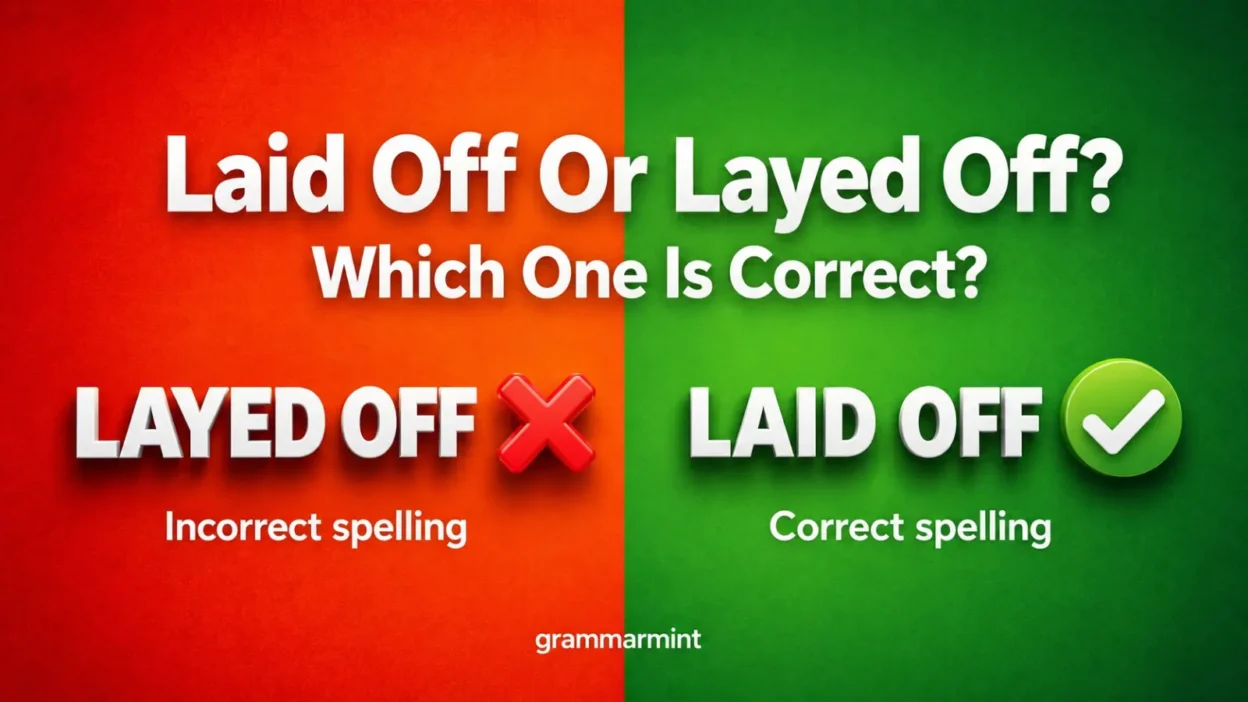
Laid Off or Layed Off: the correct form is laid off. “Laid” is the proper past tense and past participle of lay, while “layed off” is a misspelling in standard English.
TL;DR
• Use laid off, never layed off
• “Laid” is the correct past form
• “Laid off” means lost a job
• It often suggests business reasons
• “Fired” and “laid off” differ
• Use neutral wording in job searches
Laid Off Or Layed Off: The Quick Answer
This is the decision most readers want first. The safe, standard choice is simple.
• Correct spelling is “laid off”
• Correct usage follows the verb “lay”
• Standard English does not use “layed off”
• “I was laid off” is correct
• “She got laid off” sounds natural
• “They were laid off” is standard
• “He has been laid off” works
• “Layed off” looks wrong in writing
• Employers lay workers off
• Workers are later laid off
• The phrase appears in career writing
• Use it in formal and casual English
Why Laid Off Is Correct
The answer comes from the verb form. Once that clicks, the spelling gets easier.
• Past tense of “lay” is “laid”
• Past participle of “lay” is “laid”
• Irregular verb forms don’t add “-ed”
• Base form stays “lay off”
• Present form is “lays off”
• Ongoing form is “laying off”
• Finished action becomes “laid off”
• Perfect forms also use “laid”
• “Layed” breaks the normal pattern
• English keeps this verb irregular
• The phrase follows the same rule
• That’s why “laid off” is standard
What Laid Off Means At Work
The phrase is about employment, not personal failure. That meaning is important.
• Job loss happens through company action
• Downsizing is a common reason
• Workforce reduction often affects multiple employees
• A role may be cut
• A business may slow down
• Orders may fall sharply
• Funding may disappear suddenly
• A merger can remove positions
• A relocation may affect staffing
• Seasonal work can end temporarily
• Layoffs usually reflect business needs
• The term often sounds less personal
Why People Write Layed Off
The mistake is common for understandable reasons. English sound patterns can mislead writers.
• Misspelling happens because “laid” sounds unusual
• Sound-based spelling pushes writers toward “layed”
• Verb confusion makes the error easy
• Many regular verbs add “-ed”
• Writers expect “play/played” style patterns
• “Lay” looks like it should regularize
• Speech can hide the spelling
• Fast typing increases simple errors
• Learners mix lay and lie forms
• The phrase appears during stressful moments
• Job-loss writing is often emotional
• Spellcheck may not teach the rule
Lay, Laid, Lie, And Lain
This is the deeper grammar knot behind the mistake. Thankfully, the basic split is manageable.
• Lay vs lie causes most confusion
• Direct object follows “lay”
• Verb pattern changes with meaning
• “Lay” means put something down
• “Lie” means rest down yourself
• “Lay the file down” is correct
• “Lie on the couch” is correct
• Past of “lay” becomes “laid”
• Past of reclining “lie” becomes “lay”
• Past participle there becomes “lain”
• The overlap confuses many writers
• “Laid off” still comes from “lay”
Present, Past, And Perfect Forms
Seeing the timeline clearly can fix the problem fast. Use these patterns as your model.
• Base form: the company may lay off staff
• Simple past: the company laid off staff
• Past perfect: the company had laid off staff
• Present perfect uses “has laid off”
• Passive simple past uses “was laid off”
• Passive plural uses “were laid off”
• Present passive uses “is being laid off”
• Perfect passive uses “has been laid off”
• Future form uses “will lay off”
• Modal form uses “might lay off”
• Progressive form uses “is laying off”
• None of these use “layed off”
Passive Patterns With Laid Off
Most real-world examples use the passive. That’s because the worker receives the action.
• Passive voice is common here
• Was laid off fits one person
• Been laid off fits perfect forms
• “I was laid off yesterday” works
• “We were laid off in March” works
• “She has been laid off before” works
• “They’d been laid off already” works
• The company name may be omitted
• The focus stays on the worker
• This sounds natural in updates
• It suits interviews and emails
• It keeps the tone factual
Common Sentence Patterns
Clear sentence frames help you use the phrase naturally. These are the patterns readers use most.
• Example sentences build confidence fast
• Word order stays simple here
• Natural phrasing matters more than flair
• I was laid off last month
• She got laid off after restructuring
• They were laid off without warning
• He has been laid off twice
• Several workers were laid off yesterday
• Our team was laid off in January
• Many contractors were laid off first
• She explained why she was laid off
• He said the whole unit got laid off
Professional Writing Examples
Workplace writing should stay calm and direct. These examples sound polished without sounding stiff.
• Email wording should stay factual
• Formal tone helps in updates
• Clear phrasing prevents awkward wording
• I was recently laid off due to restructuring
• My position was laid off company-wide
• Several departments were laid off during cuts
• I’m navigating a recent layoff professionally
• I was laid off after budget changes
• The company laid off part of our team
• I’m now open to new roles
• The layoff was unrelated to performance
• I’m grateful for the experience gained
• I’m ready for my next opportunity
Resume And LinkedIn Wording
You usually don’t need to spotlight a layoff everywhere. Still, when you mention it, keep it neutral.
• Resume language should stay brief
• LinkedIn summary can stay positive
• Neutral wording works best
• Use “position eliminated” when accurate
• Use “company restructuring” when true
• Use “role impacted by layoffs” carefully
• Avoid emotional wording on profiles
• Don’t write “I got layed off”
• Don’t overexplain in headlines
• Keep dates and titles clean
• Focus on results and skills
• Save fuller context for interviews
• Let your work history stay central
Interview Answer Examples
Interviewers often care about clarity and composure. A short, grounded answer usually works best.
• Interview response should sound steady
• Positive framing helps you move forward
• Brief explanation is usually enough
• My role was eliminated during restructuring
• I was laid off in a broad reduction
• The layoff affected several teams
• My performance was not the issue
• I used the break to sharpen skills
• I’m focused on the next fit
• I learned a lot from that role
• The experience clarified my strengths
• I’m excited about contributing here
• I’m ready to add value quickly
Laid Off Vs Fired
These terms overlap in job loss, but they don’t usually imply the same thing. That distinction matters in writing.
• Terminated can be broader language
• Performance issues often connect to firing
• Company decision often connects to layoffs
• Fired often feels more personal
• Laid off often reflects business changes
• A firing may involve conduct concerns
• A layoff may affect many workers
• Fired is usually more direct
• Laid off is often more neutral
• Some employers prefer “terminated” formally
• Context still matters in each case
• Don’t swap the terms carelessly
Laid Off Vs Furloughed
These terms are related, but not identical. Readers often search both because they affect work status differently.
• Temporary leave often describes furloughs
• Recall is more central to furloughs
• Reduced operations may cause either event
• Furloughed workers may remain employed
• Laid-off workers usually lose active employment
• Pay may pause during furloughs
• Benefits may differ by employer
• A furlough can be short-term
• A layoff can be permanent
• Companies may later rehire laid-off staff
• The words are not interchangeable
• Use the employer’s actual term carefully
Temporary And Seasonal Layoffs
Some layoffs are not permanent. That’s why the phrase can appear in seasonal industries too.
• Temporary layoff is a real phrase
• Seasonal work often creates fluctuations
• Slow period can trigger staff cuts
• Construction can slow in winter
• Tourism can shift by season
• Retail staffing can change after holidays
• Factories may cut during weak demand
• Some workers later get recalled
• Some roles disappear for good
• Context decides the long-term meaning
• “Laid off temporarily” is natural wording
• Ask whether recall is expected
Common Mistakes To Avoid
A few easy errors show up again and again. Fixing them makes your writing cleaner right away.
• Hyphenation changes by function
• Noun form may appear as “layoff”
• Word choice should match context
• Write “laid off,” not “layed off”
• Don’t confuse layoff with laid off
• “Layoff” is often the noun
• “Laid off” is usually the verb phrase
• “Laid-off worker” can be hyphenated
• Don’t write “I am layed off”
• Don’t mix fired with laid off casually
• Don’t overcapitalize the phrase
• Don’t force slang into formal writing
Easy Ways To Remember It
A small memory trick can prevent the mistake every time. Use whichever one sticks.
• Memory tip: lay becomes laid
• Quick rule: no “-ed” here
• Pattern check beats guessing
• Think “pay/paid,” not “play/played”
• “Laid off” uses the same “laid”
• Remember: employers lay people off
• Later, those people were laid off
• If you see “was,” choose “laid”
• If you see “been,” choose “laid”
• Read it aloud after writing
• Compare it with “laid down”
• When unsure, remove “off” first
FAQs
Is it laid off or layed off?
The correct form is laid off. “Layed off” is a misspelling in standard English, and dictionaries and grammar sources consistently use laid off instead.
Is layed off ever correct?
Not in standard American English for job loss. If you’re writing about employment, interviews, résumés, emails, or everyday workplace updates, use laid off.
What does laid off mean?
It means a worker loses a job because the employer reduces staff or no longer has enough work. The term often points to business conditions rather than employee misconduct.
What is the difference between laid off and fired?
“Laid off” usually points to business reasons such as downsizing, restructuring, or reduced demand. “Fired” more often suggests a performance, conduct, or employer-initiated issue tied to the individual worker.
Can a layoff be temporary?
Yes, sometimes. Some industries use temporary or seasonal layoffs, and some workers are later recalled when business improves.
Can I say “I was laid off”?
Yes, and it’s one of the most natural forms in English. It’s a standard passive pattern and works well in conversation, emails, and job-search explanations.
Conclusion
Use laid off when you mean someone lost a job because of business conditions or staffing changes. Once you remember that laid is the correct form of lay, the Laid Off or Layed Off choice gets much easier—and your writing sounds sharper right away.