If you write for students, readers, customers, or performers in the United States, this question comes up a lot: should you use theater or theatre? The short answer is simple, but the real-world use can still feel tricky because you’ll see both spellings in articles, venue names, school programs, Broadway listings, and movie listings.
This guide explains the difference in plain American English. You’ll learn the standard rule, the proper-name exception, the arts-world nuance, and the easiest way to stay consistent in essays, headlines, site copy, and everyday writing.
Quick Answer
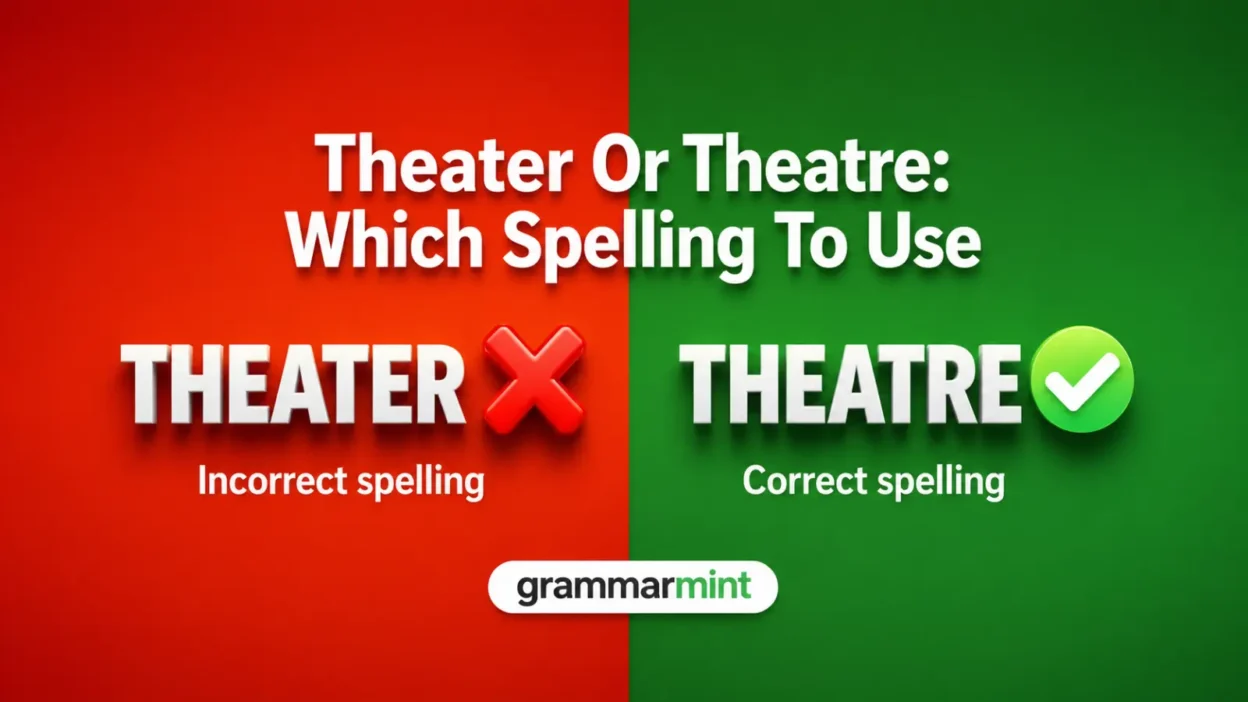
For a USA audience, theater or theatre usually comes down to region and context: theater is the standard American spelling, while theatre is the standard British spelling. In the US, keep theatre only when it is part of an official name or a deliberate style choice.
TL;DR
• Use theater for standard American writing.
• Use theatre for standard British writing.
• Keep official names exactly as written.
• Meanings usually stay the same.
• Don’t switch spellings mid-piece.
• “Movie theater” is the usual US form.
Theater Vs. Theatre At A Glance
The fast rule is easy. In American English, writers usually choose theater, while British English writers usually choose theatre.
That means the better spelling is often the one your audience already expects. Start there, and most confusion disappears.
• Theater fits most standard US writing
• Theatre fits most standard UK writing
• Both spellings point to the same word
• Audience matters more than personal preference
• Pick one form and stay with it
• US readers expect theater more often
• UK readers expect theatre more often
• Both can appear in names
• Neither spelling is automatically wrong
• Context decides the better choice
• American sites usually favor theater
• British publications usually favor theatre
What The Two Spellings Mean
In everyday use, the two spellings carry the same meaning. They can refer to the art form, a building, a performance tradition, or a performance space.
So the big difference is not meaning first. It is spelling choice first.
• Both can mean a live stage venue
• Both can mean dramatic performance generally
• Both can describe the performing arts
• Both can name a place for shows
• Both can appear in cultural writing
• Both work for stage-related discussion
• Both may describe performance history
• Both can refer to creative production
• Both can label an entertainment space
• Both show up in arts education
• Both can appear in review copy
• Both belong to standard English usage
When American Writers Should Use Theater
If your audience is in the United States, US spelling usually means choosing theater. That applies to essays, blog posts, newsletters, captions, and most everyday style choice decisions.
Also, if you’re unsure, choose the version your audience will read as normal.
• Use theater in US school essays
• Use theater in American news copy
• Use theater in most business writing
• Use theater in blog posts for Americans
• Use theater in product descriptions
• Use theater in everyday website text
• Use theater in American study guides
• Use theater in standard brand messaging
• Use theater in generic category labels
• Use theater in plain educational content
• Use theater when no official name exists
• Use theater when writing for US readers
When British Writers Should Use Theatre
For British readers, UK spelling points to theatre. The same rule often carries into other kinds of international English that lean British.
So if your publication already uses British conventions, keep that consistency throughout.
• Use theatre in British publications
• Use theatre in UK school writing
• Use theatre in British arts coverage
• Use theatre in UK cultural calendars
• Use theatre in British program notes
• Use theatre in British review writing
• Use theatre in UK learning materials
• Use theatre in British website copy
• Use theatre in Commonwealth-style usage
• Use theatre when other spellings are British
• Use theatre in UK venue guides
• Use theatre for British-facing audiences
AP Style And Other US Editorial Rules
For most American editing, AP style points writers toward theater. The bigger point, though, is that good house style stays steady from start to finish.
That matters in copy editing because a mixed page looks sloppy, even when both spellings are technically acceptable.
• AP-style writing usually uses theater
• US newsroom copy favors theater
• Brand guides often choose one spelling
• Internal consistency matters every time
• Headlines should match body spelling
• Menus should follow one house preference
• Category pages should keep one form
• Captions should not switch styles
• Meta copy should mirror page wording
• Editors should check repeated usage
• Templates should lock one spelling
• One style decision reduces confusion
Proper Names Always Come First
This is the exception many people miss. If a venue, school, or group uses proper names with theatre, keep the official title exactly that way.
You should not “fix” a department name just because your article uses theater elsewhere.
• Keep Richard Rodgers Theatre unchanged
• Keep Chicago Theatre unchanged
• Keep official venue branding intact
• Keep school department spellings exact
• Keep degree names as published
• Keep brochure titles in original form
• Keep organization names fully intact
• Keep festival names exactly written
• Keep archived titles unchanged
• Keep signage spellings as branded
• Keep trademarked wording untouched
• Keep formal listings word-for-word
Live Performance And Musical Theatre
In the arts world, live performance language sometimes leans toward musical theatre and other stage-focused wording. Still, that does not create a universal law for all uses.
In other words, dramatic arts communities may prefer theatre, but general American writing still often prefers theater.
• Musical theatre is a common set phrase
• Theatre arts programs often use theatre
• Stage communities may prefer theatre
• Playbills often preserve venue spelling
• Acting schools may lean toward theatre
• Drama teachers may teach both forms
• Live arts copy can look more formal
• Stage branding may favor theatre
• Performing arts pages often keep theatre
• Studio names may choose theatre deliberately
• Arts nonprofits sometimes prefer theatre
• General prose can still use theater
Movie Theater Or Movie Theatre
For cinema language in the US, movie theater is the version most readers expect. In many places outside North America, people may say cinema more often than film venue terms.
That’s why the movie sense usually feels easier than the stage sense.
• Movie theater is standard in America
• Theater chain names often use theater
• Cinema is common outside North America
• Movie guides usually say theater showtimes
• Ticket pages often say theater location
• Family writing often says movie theater
• Review blurbs often use theater nearby
• Film ads usually choose theater
• Entertainment pages prefer simpler wording
• Moviegoers rarely need theatre here
• Film venue copy should sound natural
• US readers spot movie theater instantly
Schools, Degrees, And Department Names
Academic wording can look mixed because degree title choices follow institutional preference. One college may say department name with theatre, while another may use different program wording.
So the safest move is simple: use the school’s official version when naming the program.
• Bachelor of Arts in Theatre appears often
• Department of Theatre is common
• Theater studies may use theater instead
• Program titles vary by campus
• Degree catalogs should stay exact
• Course lists should keep official wording
• Admissions pages should match the school
• Alumni bios should mirror transcript language
• Faculty profiles should preserve titles
• Resume entries should keep the program name
• Academic writing can explain the difference
• Official campus wording always wins
Common Set Phrases You’ll See
Some collocations become familiar through repeated use. You may see community theater, dinner theater, and home theater far more often in American everyday writing.
These phrases often feel fixed, even when other contexts stay flexible.
• Community theater is common in the US
• Dinner theater feels natural in America
• Home theater almost always uses theater
• Regional theater is widely seen
• Theater district is standard in US cities
• Theater program sounds natural in schools
• Theater company is common American wording
• Theater critic is standard US usage
• Theater season appears in listings
• Theater tickets feels everyday and clear
• Theater lobby suits venue writing
• Theater audience sounds fully natural
Headlines, Titles, And Website Copy
In publishing, headlines should match the audience first. A page title for American readers normally works best with theater unless the subject’s brand voice requires theatre.
The key is to decide once, then carry that choice across every visible element.
• Match headline spelling to audience region
• Match title tags to page wording
• Match subheads with the main choice
• Match navigation labels sitewide
• Match category names across templates
• Match image text with article spelling
• Match author bios with house style
• Match slug wording where practical
• Match newsletter subject lines too
• Match social captions for consistency
• Match landing pages to reader expectation
• Match brand voice without forcing it
Example Sentences With Theater
These examples show natural example sentence patterns in American usage. Each one uses phrasing that feels simple and natural phrasing for US readers.
Use these when you need a quick model.
• We met outside the downtown theater
• The new theater opens on Friday
• Our town restored its historic theater
• She studies theater at college
• He bought theater tickets online
• The theater seats filled quickly
• They run a youth theater program
• We reviewed the local theater season
• The theater lobby looked beautiful
• She works in community theater
• Their home theater needs better speakers
• The article covered regional theater trends
Example Sentences With Theatre
These examples show common British usage, official-name patterns, and more arts-facing formal name wording. They also help when the subject already uses stage-centered arts wording.
Again, the spelling is usually about context, not a different definition.
• The National Theatre announced new dates
• She trained in musical theatre
• Their university offers theatre history
• The theatre festival starts tomorrow
• He writes about contemporary theatre
• The theatre company toured nationally
• We loved that small fringe theatre
• Her theatre degree shaped her career
• The theatre program gained funding
• Their theatre workshop welcomed beginners
• The theatre review praised the cast
• She teaches theatre in secondary school
Common Mistakes And Myths
A lot of confusion comes from one common mistake: assuming the two forms always signal different meanings. That popular myth sounds tidy, but the real meaning difference is usually not fixed that way.
It’s better to think audience first, official names second, and nuance third.
• Don’t assume theater means movies only
• Don’t assume theatre means stage only
• Don’t switch spellings without a reason
• Don’t edit official names carelessly
• Don’t force British spelling for sophistication
• Don’t mix forms in one headline
• Don’t copy venue branding into generic prose
• Don’t treat nuance as a strict law
• Don’t ignore your style guide
• Don’t confuse branding with grammar
• Don’t overthink ordinary American usage
• Don’t turn preference into a rule
Pronunciation And Spoken Usage
For most speakers, pronunciation does not sharply separate the spellings. In spoken English, people usually say the same word with the same general word stress.
That means the debate is mostly visual, not spoken.
• Most speakers pronounce both forms similarly
• Spelling changes more than speech
• Context matters more on the page
• Conversation rarely reveals the spelling
• Readers notice the written choice first
• Voiceover scripts can use either form
• Public speakers usually say one sound
• Teachers may mention regional spelling differences
• Pronunciation guides rarely split the meanings
• Spoken usage stays broadly the same
• Accent affects sound more than spelling
• The page carries the real contrast
Where The Word Came From
The history helps explain why both forms still live side by side. The word traces back to Greek origin, passed through French influence, and later met American spelling reform linked with Webster.
So the modern split is old enough to feel normal, not accidental.
• The word traces back to Greek roots
• French helped shape the theatre form
• Older English used varied spellings too
• American reform favored simpler endings
• Webster influenced several US spellings
• Both forms have long histories
• Neither spelling is newly invented
• English preserved more than one pathway
• Usage shifted across regions over time
• Cultural taste influenced later preferences
• Print habits strengthened local norms
• Modern readers inherited both spellings
FAQs
Is it theater or theatre?
For a USA audience, theater is the safer standard choice. Use theatre when you’re writing in British English or when it appears in an official name.
What is the difference between theater and theatre?
Most of the time, there is no difference in meaning. The main difference is regional spelling, plus a few style and branding choices.
Is theatre used in America?
Yes, but not as the default spelling in standard American writing. In the US, you’ll often see theatre in proper names, school programs, and arts branding.
Why is theatre spelled theatre?
That spelling reflects an older path in English shaped by French and earlier forms. American usage later leaned more strongly toward theater.
Is it theater or theatre in AP style?
For standard American journalistic style, use theater. Still, keep theatre when it is part of an official name.
How do you spell movie theater?
In American English, movie theater is the normal spelling. Outside North America, many writers may prefer cinema instead.
Conclusion
If your readers are in the United States, theater or theatre usually has one practical answer: use theater unless an official name or clear British context calls for theatre.